
When you freeze mid competition, run this sequence: hit yourself with a strong sensory jolt like cold water or a hard clap, orient your eyes to two fixed points, wiggle your fingers or toes, shift your weight or stand up, take one short sharp inhale, then complete the smallest possible task in front of you. This works quickly for most athletes. If freeze keeps happening or traces back to a past trauma, that pattern deserves professional attention, and programs like Performance Neuro Training's Alpha Imprinting protocol exist specifically for that longer-term work.
TL;DR:
- The recommended sequence to break a freeze during competition involves sensory input, eye orientation, small movements, leg loading, and a quick breath, which requires minimal motivation.
- Coaches can support athletes by using short, external cues like "Feet, then eyes, then go" or "Give me one small thing" to trigger the reset process effectively.
- Building consistent daily routines, including wake time, movement, social contact, and pre-game micro-movements, helps establish a stable nervous system baseline to prevent freezing episodes.
- If freeze episodes persist frequently, cause memory loss, numbness, or involve thoughts of self-harm, professional clinical assessment and therapeutic intervention are necessary.
- Sport-specific nerve retraining programs, such as Alpha Imprinting, can reprogram automatic responses to stress, especially when baseline instability causes recurring freeze patterns.
Table of Contents
- What Does Freeze Response in Sports Actually Look Like?
- How Do You Get Out of a Freeze Episode During a Game?
- Building Daily Habits That Prevent Recurring Freeze
- What Can Coaches Do to Support a Frozen Athlete?
- When Should an Athlete or Coach Seek Clinical Help?
- A Sport-Specific Path for Athletes Whose Freeze Keeps Coming Back
- Ready to Address a Recurring Freeze Response?
- Sources
What Does Freeze Response in Sports Actually Look Like?
Freeze is not the same as fight or flight. Fight and flight pump you full of energy to fight or run. Freeze does the opposite: it cuts initiation and drops you into a kind of protective stillness that functional freeze experts describe as an inability to act, often triggered by acute anxiety, overwhelm, or unresolved trauma rather than a simple lack of effort.
On the field, this shows up in specific, recognizable ways:
- A slower first step off the line, or a hitch before a serve or free throw
- Limbs that feel heavy or disconnected from intent, like moving through wet sand
- Tunnel vision that narrows peripheral awareness right when you need to see teammates or defenders
- Loss of automatic mechanics, so a shot you've made a thousand times suddenly feels foreign
- A mental blank where the play call or the next step simply doesn't arrive
Not every hesitation is freeze, though. Rule out other causes before you apply freeze protocols: distractibility that looks more like ADHD, avoidance rooted in depression, or physical red flags like sudden unilateral numbness, confusion, or a possible seizure. Those need medical evaluation, not a nervous system reset. In sport specifically, freeze often presents as a tightened, braced body that has lost its normal rhythm, which is the pattern the steps below are built to interrupt.
How Do You Get Out of a Freeze Episode During a Game?
The order of these steps is not arbitrary. Freeze is a low-input state, so the fix is to add input, not to calm down further. A long, slow exhale, the classic anxiety fix, often backfires here because it lowers arousal even more when what the body needs is activation, not sedation. Sensory jolt comes first because it requires zero motivation or decision making, which is exactly what freeze takes away from you.
- Sensory jolt. Snap a towel, splash cold water on your face, bite into something sour, or have a teammate clap loudly near you.
- Orient your eyes. Pick two fixed objects, like the scoreboard and the far sideline, and look between them deliberately.
- Small peripheral movement. Wiggle your fingers, roll your ankles, tap your toes. Small and specific, not a general shake-out.
- Load your legs. Shift your weight foot to foot, stand up from a crouch, or take three steps.
- One short sharp breath. A quick inhale through the nose, not a long calming exhale.
- Finish the smallest task. Bounce the ball twice. Touch the baseline. Say one word out loud to a teammate.
Applied at the plate, that might mean stepping out of the box, tapping your cleats, resetting your grip, and taking one practice swing before stepping back in. Before a free throw, it looks like bouncing the ball a fixed number of times, finding the rim with your eyes, and exhaling once before you shoot. Before a serve, it's a ball bounce, a glance at your target, and a single controlled breath.
Coaches can help initiate this from outside, since freeze responds well to short, external cues rather than internal willpower. Two useful sideline prompts: "Feet, then eyes, then go" and "Give me one small thing." Athletes can pair those with their own quiet anchors, like "Small move first" or "Input, not outcome."
Pro Tip: If you have a teammate nearby, ask them to narrate one concrete thing out loud, like "ball's on your left," or narrate it yourself under your breath. Borrowing initiation from an outside voice often breaks a freeze faster than trying to talk yourself out of it alone.
Building Daily Habits That Prevent Recurring Freeze
Acute tools work better when your baseline nervous system state is already stable, and that stability comes from boring, repeatable daily structure rather than anything you do on game day. Athletes who freeze repeatedly under pressure usually benefit most from raising that baseline first.
A few structural habits matter more than they get credit for:
- Consistent wake time paired with morning light exposure, even five minutes on a porch
- One small daily movement habit, like a short walk or a mobility routine, done at the same time every day
- Scheduled social contact, even brief, since isolation tends to lower your baseline resilience
- Regular, predictable meals rather than skipped or erratic eating
Pre-game routines matter just as much. A quick orienting scan of the venue, a short ladder of micro-movements during warmup, and rehearsing controllable inputs like footwork or breathing under low-stakes conditions all build the same pathway you'll need mid-competition. Visualization works best here when it's tied to specific sensory details rather than vague outcomes like "winning."
In practice, build progressive exposure into your reps. Introduce a stressor, small bad calls, crowd noise, a tight scoreboard scenario, and then run the same reset sequence you'd use in a real freeze episode. Doing this between reps, not just when things go wrong, teaches your body to expect recovery as a normal part of competing. Log which resets worked and how quickly, then gradually raise the pressure once a given trigger stops producing a freeze response. A structured framework like the routine nervous system preparation approach can help formalize this progression rather than leaving it to chance.

What Can Coaches Do to Support a Frozen Athlete?
The words a coach uses in the moment either shrink the freeze or extend it. Shame slows recovery. Sensory and social cues speed it up.
Useful in-the-moment scripts include:
- "Feet on the ground, eyes on me" instead of "What's wrong with you?"
- "Give me one small thing, just touch the line" instead of demanding a full recovery instantly
- A quiet hand signal for "reset" that doesn't require a verbal explanation in front of teammates
Practice design matters over the long run too. Build in normalized micro-reset breaks during drills rather than treating any pause as a failure, and grade athletes on inputs they control, footwork, positioning, effort, rather than only outcomes like makes and misses. That shift alone reduces the shame spiral that makes freeze more likely to repeat.
Confidentiality matters here as well. If an athlete discloses that a freeze episode connects to a past trauma, that conversation stays private and gets routed toward professional support, not team-wide discussion. If freeze is frequent, intense, or clearly linked to something beyond the game itself, that's the signal to stop pushing drills and start the referral conversation instead.
When Should an Athlete or Coach Seek Clinical Help?
Most freeze episodes respond to the steps above. Some don't, and pushing harder on self-help tools at that point can do more harm than good.
Watch for these red flags:
- Losing track of time or memory of the episode itself
- Numbness on one side of the body, confusion, or any sign resembling a seizure
- Freeze that shows up several times a week or clearly impairs daily functioning, not just competition
- Any thoughts of self-harm or suicidal ideation, which always warrants immediate professional contact
When freeze is frequent, severe, or trauma-linked, professional assessment becomes the right next step rather than another self-help attempt. Effective options include CBT for reshaping the thought patterns around pressure, EMDR for processing specific traumatic memories tied to competition or injury, and somatic therapies that work directly with the body's stored stress response. Each targets a different mechanism, and clinicians often combine them depending on the athlete's history. When contacting a provider, describe the frequency, triggers, and any trauma connection plainly, and ask whether they coordinate with sport staff. That coordination, not privacy loss, tends to speed recovery.
A Sport-Specific Path for Athletes Whose Freeze Keeps Coming Back
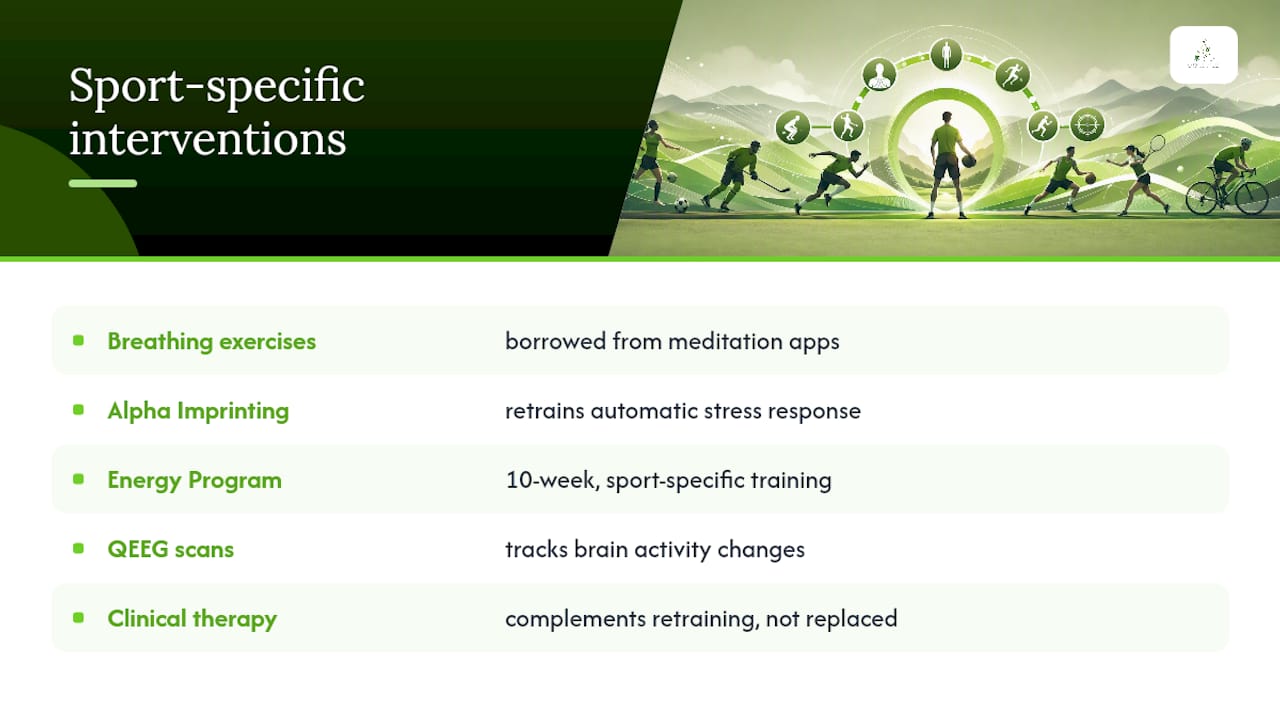
Most articles on freeze response treat it as a general anxiety problem and hand you breathing exercises borrowed from meditation apps. That's incomplete for competitive athletes. A tennis player who freezes before a second serve, and a surgeon who freezes mid-procedure are dealing with the same nervous system mechanism, but the recovery has to fit the specific demands of their environment, timing, physical position, audience, stakes. That's the gap Performance Neuro Training was built to close, under the direction of Dr. Paige Roberts.
The Alpha Imprinting protocol works by retraining the nervous system's automatic response to competitive stress, rather than relying on the athlete to consciously talk themselves through a reset every time. The 10-week Energy Optimization Program builds on that foundation with structured, sport-specific work, and it uses tools like QEEG brain scans to track what's actually happening rather than guessing. Athletes coming through the program, including Olympic medalists, report measurable shifts in how consistently they can access flow states under real pressure, not just in practice. My honest read: this kind of nervous system retraining works best as a complement to clinical therapy when trauma is present, not a replacement for it. The two aren't in competition with each other.
— Paige
Ready to Address a Recurring Freeze Response?
If the micro-protocol above helps but the freeze keeps coming back before big moments, that's usually a sign your baseline needs work, not just your in-game reset. Performance Neuro Training exists for exactly that gap between quick fixes and lasting change, giving athletes a structured, sport-specific path instead of generic anxiety advice repackaged for competition.

The Energy Optimization Workbook gives you a self-paced way to start practicing daily nervous system habits on your own schedule, while the Alpha Imprinting program is built for athletes ready for guided, one-on-one work with Dr. Paige Roberts. Sport-specific pages, including one built around tennis, show how the protocol adapts to different competitive demands. Next step: download the workbook to start now, or book an intake consult to talk through your specific pattern and whether 1:1 coaching or a team workshop fits best.
Sources
The step-by-step recovery sequence draws directly from TrueAwake's clinical breakdown of exiting a freeze state through sensory input rather than breathwork alone. Sport-specific symptoms and grounding techniques come from We Are Girls In Sport's coverage of freeze during competition. Clinical definitions, causes, and therapy options reference Banner Health's explanation of functional freeze mode.
This article is general information, not a substitute for advice from a qualified doctor. Consult a qualified healthcare professional about your own circumstances before acting on anything here.
- How to unfreeze in sport — We Are Girls In Sport
- Functional freeze mode: what it is and how to break free — Banner Health