

When a team faces sustained pressure, individual grit only goes so far. The real differentiator is the ability to build collective mental resilience as a team, meaning the shared capacity to absorb stress, adapt, and keep moving forward together. Researchers and practitioners now use the term collective resilience to describe this group-level phenomenon, which is distinct from personal coping skills and far more powerful when developed intentionally. This guide gives you the frameworks, daily habits, and leadership behaviors that actually move the needle.
Table of Contents
- Key takeaways
- How to build collective mental resilience in your team
- Embedding resilience into daily team workflows
- Leadership behaviors that sustain resilience culture
- Common obstacles when developing team resilience
- Measuring progress and sustaining momentum
- My take on what actually works
- How Robertsneurotraining supports team resilience
- FAQ
Key takeaways
| Point | Details |
|---|---|
| Psychological safety comes first | Teams cannot develop resilience without a foundation of trust and safety to speak up without fear. |
| Shared language accelerates support | Tools like the AMA's color continuum help teams recognize and respond to stress faster and with less stigma. |
| Daily habits beat one-off training | Resilience grows through recurring rituals, not a single workshop or offsite event. |
| Leaders model the culture | Honest communication and visible vulnerability from leaders set the tone for the entire team. |
| Measure and adjust continuously | Track trust and safety indicators over time and update practices as team challenges evolve. |
How to build collective mental resilience in your team
Collective resilience, the recognized term in organizational psychology, refers to a group's shared ability to prepare for, respond to, and grow from adversity. It is not the sum of each person's individual toughness. It is a system property, meaning it lives in the relationships, norms, and habits the team shares.
Before you introduce any program or practice, two conditions must be present.
Psychological safety is the non-negotiable foundation. Psychological safety is a shared belief that it is safe to be vulnerable, ask questions, and challenge the status quo without fear of negative consequences. Without it, people mask stress, avoid conflict, and disengage quietly. With it, they surface problems early, ask for help, and recover faster.
Shared purpose and identity matter just as much. Teams that see themselves as a unit with a common mission are more likely to protect each other through difficulty. That collective identity is what transforms a group of individuals into a resilient system.
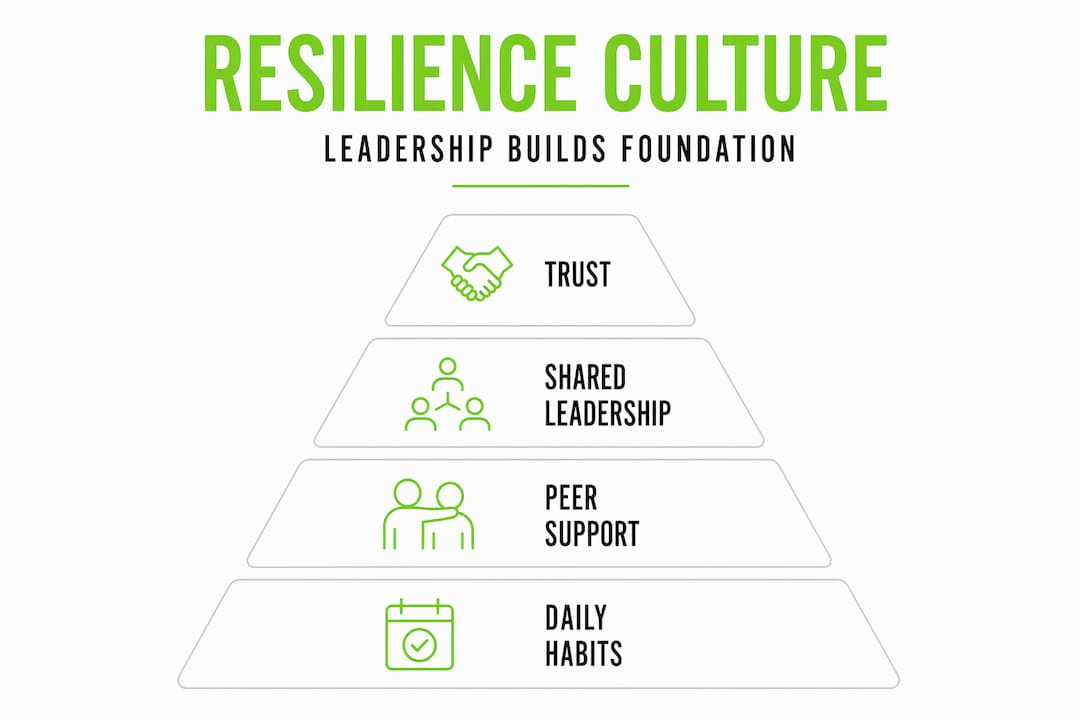
Leadership buy-in is not optional. Trust forms first with leadership, and shared leadership distributes responsibility in ways that create mutual accountability. When leaders model openness and invest in resilience practices, the rest of the team follows.
Pro Tip: Before launching any resilience initiative, run a short anonymous survey asking team members whether they feel safe raising concerns. That baseline tells you exactly how much groundwork you need to lay first.

Embedding resilience into daily team workflows
Knowing the prerequisites is one thing. Building the actual habits is where most teams stall. The strategies for team mental wellness that stick are the ones woven into existing workflows, not bolted on as extras.
Here is a practical sequence for embedding collective resilience practices:
-
Adopt a shared stress language. The AMA's Stress First Aid model uses a color continuum for stress recognition: green (thriving), yellow/orange (struggling), red (in crisis). When everyone uses the same framework, stigma drops and peer support happens faster. A team member saying "I'm sitting at orange today" is far easier than trying to explain a complex emotional state in a high-stakes moment.
-
Schedule daily pauses and orange huddles. These are short, structured check-ins where team members share their color and name one thing they need. They take five minutes and normalize the act of asking for support before things reach red.
-
Run resilience-focused debriefs after pressure events. Resilience-focused debriefing helps teams reflect on complexity and leadership adaptation under pressure. The structure is simple: What happened? What did we learn? What do we do differently? This turns stressful events into deliberate growth opportunities rather than moments the team just tries to forget.
-
Build recognition upstream. Most teams celebrate outcomes. Resilient teams also recognize the effort, the recovery, and the adaptation. Calling out how someone handled a setback is more powerful for team culture than praising the final result.
-
Use structured conversation prompts weekly. Ongoing rituals and prompts reduce isolation and overwhelm by giving people a low-stakes way to share what is hard before it compounds.
The table below shows the difference between reactive and proactive approaches to team mental wellness:
| Approach | Reactive | Proactive |
|---|---|---|
| Timing | After a crisis or breakdown | Embedded in daily and weekly routines |
| Focus | Damage control | Skill-building and early recognition |
| Ownership | HR or leadership only | Shared across the whole team |
| Outcome | Short-term relief | Sustained collective capacity |
Pro Tip: Pair your resilience rituals with an existing meeting rather than creating a new one. Attaching a two-minute check-in to a weekly standup makes adoption far more likely than scheduling a separate session.
Leadership behaviors that sustain resilience culture
Leaders are the single biggest variable in whether collective resilience takes hold or fades after the first month. The behaviors that matter most are not grand gestures. They are consistent, daily choices.
-
Honest, grounded communication. Leaders who tell the truth about difficulties, rather than projecting false confidence, create psychological safety around failure. Teams that know their leader will not spin bad news are teams that surface problems early.
-
Celebrating recovery, not just success. When a leader publicly acknowledges how the team adapted after a hard quarter or a failed launch, it signals that struggle is part of the process. This reframe is what separates teams that grow through adversity from teams that are just damaged by it.
-
Encouraging productive struggle. There is a meaningful difference between challenge that stretches a team and pressure that overwhelms it. Good leaders calibrate this deliberately, giving teams problems that are hard enough to build capacity without triggering shutdown.
-
Timely conflict resolution. Unresolved tension is one of the fastest ways to erode psychological safety. Leaders who address conflict directly and quickly, rather than hoping it resolves on its own, protect the relational fabric that resilience depends on.
-
Distributing voice and decision-making. When team members have genuine input, they are more invested in the outcomes and more committed to the norms that keep the team healthy.
"The goal is not to protect your team from difficulty. It is to build their collective confidence that difficulty is something they can move through together."
Peer support skills alone are not enough. Leaders must integrate resilience into the structural fabric of how the team operates, not treat it as a soft add-on to the real work.
Common obstacles when developing team resilience
Even well-intentioned teams run into predictable traps. Recognizing them early saves months of wasted effort.
-
Treating resilience as a one-time event. A half-day workshop creates awareness. It does not create culture. Many teams fail to build lasting resilience because they treat it as a single event rather than embedding it in consistent daily habits. The fix is simple: schedule recurring practices and protect them from being cut when things get busy.
-
Confusing psychological safety with permissiveness. Psychological safety does not mean anything goes. Safe speech must translate into clear learning outputs and follow-up actions. Without that structure, teams become comfortable but not accountable.
-
Skipping the follow-through on debriefs. Running a debrief and then taking no visible action on what the team surfaced is worse than not running one at all. It signals that speaking up has no real impact.
-
Leader overprotection. When leaders shield their teams from every difficulty, they prevent the productive struggle that builds actual capacity. Teams that are never challenged never develop the confidence to handle real adversity.
-
Cultural resistance to vulnerability. In high-performance environments, admitting struggle can feel like weakness. This is especially true in sports, military, and competitive corporate cultures. The antidote is leader modeling. When the person at the top says "I'm sitting at orange today," the permission structure for the whole team shifts.
Pro Tip: If your team resists vulnerability-based practices, start smaller. A simple "one word to describe your week" check-in is far less threatening than a full emotional disclosure and builds the same habit over time.
Measuring progress and sustaining momentum
You cannot manage what you do not measure. Tracking how to enhance team resilience over time requires looking at leading indicators, not just outcomes.
| Indicator | What to track | How often |
|---|---|---|
| Psychological safety | Anonymous survey scores on speaking up and risk-taking | Quarterly |
| Debrief participation | Percentage of team attending and contributing | Monthly |
| Peer support frequency | Number of check-ins and orange huddles held | Weekly |
| Conflict resolution speed | Time from surfaced tension to resolution | Per incident |
Scheduled debriefs after stressful events are one of the most reliable ways to turn difficult moments into growth opportunities. When these become a ritual rather than an exception, teams build a track record of adaptation that reinforces their collective identity as a resilient group.
Adjust your practices based on what the data tells you. If psychological safety scores are flat after three months, the issue is likely leadership behavior, not the program design. If debrief participation is low, the format may be too long or too formal for your team's culture.
The end goal is to make resilience a core team value, something the team sees as part of who they are, not something they do when things get hard.
My take on what actually works
I have worked with athletes and high-performance teams long enough to know that the biggest mistake people make is treating resilience as a mental toughness problem. It is not. It is a systems problem.
Individual mental strength matters. But I have seen plenty of individually tough people on teams that crumble under pressure because there was no shared language, no trust infrastructure, and no leader willing to model vulnerability. The nervous system does not operate in isolation, and neither does performance under stress.
What I have found actually works is the compounding effect of small, consistent habits. A two-minute check-in three times a week does more for collective capacity than a quarterly resilience retreat. The retreat feels significant. The check-in is significant, because it rewires how the team relates to stress over time.
The other thing I want to push back on is the idea that resilience means bouncing back to where you were. The teams I respect most do not bounce back. They bounce forward. They use difficulty as data and come out of hard seasons with better systems, stronger trust, and a clearer sense of what they are capable of together.
Leader vulnerability paired with clear accountability is the combination that makes this real. Vulnerability without accountability becomes venting. Accountability without vulnerability becomes performance. You need both, and the leader has to model both first.
— Paige
How Robertsneurotraining supports team resilience
At Robertsneurotraining, the work goes deeper than standard mental performance coaching. Dr. Paige Roberts uses a neuroscience-based approach to train the nervous system directly, targeting the stress responses and mental blocks that prevent teams and athletes from performing at their best under pressure. The Alpha Imprinting method works at the level where stress patterns are actually stored, making it possible to clear performance anxiety and trauma responses that conventional training never touches. If your team is ready to move beyond surface-level resilience practices and address the neurological roots of stress and performance, explore the programs at Robertsneurotraining to find the right fit for your group's needs.
FAQ
What is collective resilience in a team context?
Collective resilience is a group's shared ability to absorb stress, adapt to adversity, and grow stronger together. It differs from individual resilience because it lives in the team's relationships, norms, and shared practices rather than in any one person.
How does psychological safety relate to team resilience?
Psychological safety is the foundation that makes collective resilience possible. Without it, team members mask stress and avoid asking for help, which prevents the early intervention that resilience depends on.
What is the AMA Stress First Aid model?
The AMA Stress First Aid model is a peer support framework using a color continuum (green, yellow/orange, red) to help teams recognize and respond to stress in real time, reducing stigma and enabling earlier support.
How often should teams practice resilience rituals?
Daily or weekly practices are far more effective than monthly or quarterly events. Short check-ins, recurring debriefs, and structured conversation prompts build the neural and relational pathways that sustain collective capacity over time.
What is the biggest mistake teams make when building resilience?
Most teams treat resilience as a one-time training event rather than an ongoing cultural practice. Sustainable resilience requires consistent daily habits, leader modeling, and structured follow-through after every debrief or stress event.