

Nervous system training for coaches is the practice of applying neuroscience-informed techniques to help athletes manage stress, regulate emotional states, and build performance resilience. The autonomic nervous system, specifically the balance between its sympathetic and parasympathetic branches, determines whether an athlete freezes under pressure or performs at their peak. Methods like HRV biofeedback, coherent breathing, and Polyvagal Theory-informed coaching give coaches direct tools to shift that balance. Robertsneurotraining, led by Dr. Paige Roberts, has built an entire performance model around this principle, using approaches like Alpha Imprinting to clear mental blocks and restore flow states in athletes from recreational competitors to Olympic medalists.
What nervous system concepts should coaches understand?
Effective nervous system training starts with understanding the physiological architecture you are working with. The autonomic nervous system operates through two primary branches: the sympathetic system, which drives the fight-or-flight stress response, and the parasympathetic system, which governs rest, recovery, and social engagement. Most performance anxiety is a sympathetic overdrive problem. Coaches who understand this stop treating anxiety as a mindset issue and start treating it as a physiological state that requires a physiological solution.
Polyvagal Theory, developed by Dr. Stephen Porges, adds a third layer to this picture. Performance anxiety reflects the nervous system losing access to ventral vagal pathways that enable safety and connection. When an athlete feels threatened, whether by a rival, a crowd, or a past injury memory, the nervous system drops out of its social engagement mode before the athlete consciously registers the shift. Coaches who recognize this understand why logical pep talks often fail: regulation precedes cognition.

The "window of tolerance" is the third concept every coach needs. It describes a functional arousal zone between hyperarousal (panic, rage, overwhelm) and hypoarousal (shutdown, dissociation, numbness) where emotions and cognition work together effectively. Vagal toning and pendulation techniques, which oscillate the nervous system between activation and calm, expand this window over time. Athletes with wider windows of tolerance handle high-pressure moments without losing access to their trained skills.
Key nervous system concepts coaches should know:
- Sympathetic/parasympathetic balance: The ratio between activation and recovery determines performance readiness, not just physical fitness.
- Polyvagal Theory: Safety cues in the coaching environment directly regulate athlete nervous system states.
- Window of tolerance: Athletes perform best when arousal stays within this zone. Training expands it.
- HRV (Heart Rate Variability): A measurable marker of autonomic flexibility. Higher HRV at rest signals better regulation capacity.
- Co-regulation: The coach's own nervous system state influences the athlete's state through relational cues, tone of voice, and body language.
Which nervous system training methods are most effective?
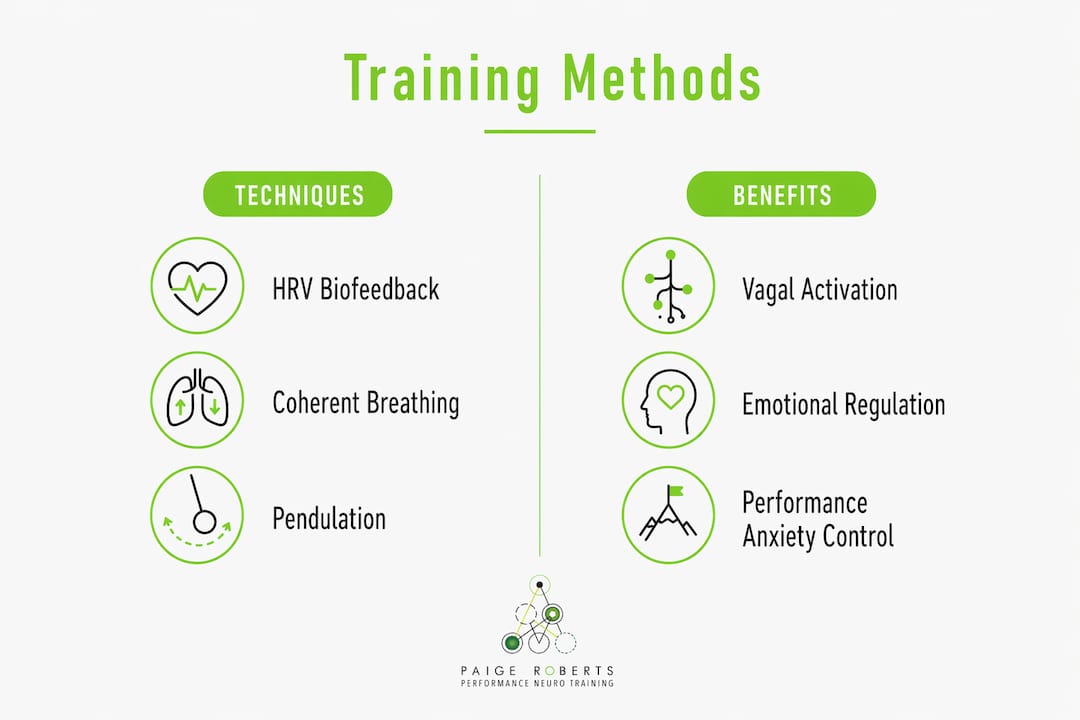
The evidence base for nervous system regulation strategies in sports is growing fast. Four methods stand out for coaches looking to apply neuroscience training methods with athletes.
HRV biofeedback
HRV biofeedback is the best-documented behavioral intervention for increasing vagal activation and emotional regulation. Training begins with resonance frequency breathing, typically between 4.5 and 7.5 breaths per minute, which maximizes HRV oscillations. This rate varies slightly by individual, so coaches working with athletes on this method should identify each athlete's personal resonance frequency through a short assessment protocol. Devices like the Inner Balance sensor by HeartMath or the Elite HRV app make this accessible outside clinical settings.
Coherent breathing
Coherent breathing, which involves breathing at a steady rate of approximately five breaths per minute, produces measurable physiological changes. A 2026 randomized study of 22 athletes found the coherent breathing group showed higher RMSSD (a parasympathetic marker), more stable cortisol, lower inflammatory markers, longer total sleep duration, and reduced sleep latency compared to controls. These are not marginal improvements. For coaches managing athlete recovery across a competitive season, coherent breathing is one of the most cost-effective tools available.
Pendulation and vagal toning
Pendulation is the practice of intentionally moving the nervous system between states of activation and calm. A coach might guide an athlete through a brief visualization of a stressful scenario, then use a grounding breath sequence to return to baseline. Repeated cycles of this expand the athlete's window of tolerance. Vagal toning exercises, including humming, cold water face immersion, and extended exhale breathing, directly stimulate the vagus nerve and shift the system toward parasympathetic dominance.
Neuroscience-informed coaching models
Models like the SCARF® framework from the NeuroLeadership Institute and the CREATE Model™ address the threat-and-safety dynamics that govern athlete behavior. Brain-based coaching certifications teach coaches to use emotion labeling and cognitive reappraisal to shift stuck mental states. These approaches work at the intersection of nervous system regulation and behavioral insight, making them particularly useful for coaches dealing with athletes who have performance blocks tied to past experiences.
| Method | Primary mechanism | Best use case |
|---|---|---|
| HRV biofeedback | Vagal activation via resonance breathing | Pre-competition regulation, recovery tracking |
| Coherent breathing | Parasympathetic upregulation, cortisol stabilization | Recovery, sleep, sustained season performance |
| Pendulation | Window of tolerance expansion | Trauma-informed work, performance anxiety |
| SCARF® / CREATE Model™ | Threat-safety reframing, memory reconsolidation | Mental blocks, behavioral change |
Pro Tip: Measure HRV at the same time each morning, before any training stimulus, to get a reliable baseline. A single low reading means little. A downward trend over five days signals that the athlete's nervous system is under-recovered and needs regulation work before adding load.
How can coaches integrate nervous system training into practice?
Knowing the science is one thing. Applying it during a real training session with a real athlete under real pressure is another. Here is a practical sequence coaches can follow.
-
Regulate yourself first. The coach's regulated presence is often more impactful than any technique. Before a session, spend two minutes on resonance frequency breathing. Your tone of voice, facial expression, and body language transmit nervous system signals to your athlete before you say a single word.
-
Time regulation exercises strategically. Paced breathing before feedback enhances athlete learning by ensuring regulatory state readiness. Run a two-minute coherent breathing sequence before any technical debrief or behavioral feedback conversation. Athletes in a regulated state absorb information more effectively.
-
Build co-regulation into session design. Create moments of relational safety: brief check-ins, eye contact, a calm and steady tone during high-pressure drills. These cues activate the ventral vagal system and keep athletes within their window of tolerance.
-
Use HRV as a session-entry check. A quick one-minute HRV reading before training tells you whether the athlete's nervous system is ready for high-intensity work or needs a regulation primer first. This removes guesswork from training load decisions.
-
Avoid cognitive overload during skill execution. A 2025 golf research study found that resonance breathing impaired motor accuracy when athletes focused on breath control during skill tasks. Nervous system regulation exercises belong before and after skill work, not during it. Splitting cognitive resources between breath control and motor execution degrades both.
Pro Tip: Design a two-minute "state check" ritual at the start of every session. Ask the athlete to rate their energy and tension on a simple 1-to-10 scale, then run a short breathing exercise if either score is outside the optimal range. This builds nervous system awareness in the athlete over time.
What are the best nervous system training resources for coaches?
Coaches serious about deepening their nervous system awareness have several strong educational pathways available.
- NeuroLeadership Institute's Brain-Based Coaching Certification: An ICF-accredited program covering eight modules on brain function, the SCARF® model, emotion regulation, and sustainable habit formation. Designed for coaches who want a rigorous neuroscience foundation with direct coaching application.
- Balanceology's Neuroscience-Informed Coach CPD Programme: A 12-module self-paced course covering stress, burnout, memory reconsolidation, and subconscious belief change. Particularly useful for coaches working with athletes managing trauma or chronic performance anxiety.
- HeartMath Institute resources: Practical training in HRV biofeedback and coherent breathing protocols, with tools designed for field use by coaches and trainers.
- Polyvagal-informed coaching workshops: Several continuing education providers now offer workshops grounded in Dr. Porges' Polyvagal Theory, focusing on creating safety in coaching relationships and reading nervous system cues in athletes.
- Robertsneurotraining: Dr. Paige Roberts' program applies Alpha Imprinting and neuroscience-based methods specifically to sports performance, making it one of the few resources built explicitly for athletes recovering from injury or trauma-related performance blocks.
When evaluating any program, prioritize courses that distinguish between state regulation (changing autonomic balance) and behavioral insight (cognitive understanding). These are distinct processes that require different tools. Programs that conflate them tend to produce coaches who know a lot of theory but struggle to apply it when an athlete is dysregulated in front of them. Also check whether the program addresses evidence-based assessment of nervous system markers like HRV and RSA, which track the autonomic flexibility that regulation training aims to improve.
Key takeaways
Nervous system training for coaches works because physiological regulation precedes cognition, and coaches who address the autonomic state first create the conditions where technique, feedback, and mental skills actually land.
| Point | Details |
|---|---|
| Regulation precedes cognition | Athletes cannot absorb coaching or execute skills when their nervous system is dysregulated. |
| HRV biofeedback is measurable | Resonance frequency breathing at 4.5 to 7.5 breaths per minute produces trackable autonomic improvements. |
| Coherent breathing improves recovery | A 2026 study showed it stabilizes cortisol, reduces inflammation, and improves sleep in competitive athletes. |
| Coach self-regulation matters most | The coach's own regulated presence co-regulates the athlete before any technique is applied. |
| Avoid breath work during skill tasks | Cognitive dual-task interference means regulation exercises belong before and after skill execution, not during it. |
What I've learned that most coaching programs don't teach
Most coaches come to nervous system training looking for techniques. They want the breathing protocol, the HRV number, the pre-competition ritual. What they discover, if they stay with it long enough, is that the techniques are secondary. The primary variable is the coach's own nervous system.
I have worked with athletes at every level, from youth competitors to Olympic medalists, and the pattern is consistent. When I am regulated, calm, and genuinely present, athletes settle. Not because I said the right thing. Because the nervous system is a social organ and it reads the room before the brain does. The neuroscience of co-regulation confirms this: relational safety is the foundation, and technique is the structure you build on top of it.
The other thing most programs miss is the distinction between state shift and behavioral insight. You can teach an athlete to breathe at resonance frequency and watch their HRV climb. That is a state shift. It creates physiological readiness. But it does not automatically update the subconscious belief that they will fail under pressure, or clear the nervous system imprint from a past injury. That requires a different layer of work, which is exactly where methods like Alpha Imprinting become relevant. Coaches who understand both layers, the physiological and the imprinted, are the ones who get lasting results.
The uncomfortable truth is that nervous system training requires the coach to do their own regulation work first. You cannot guide an athlete to a state you have not accessed yourself.
— Paige
Take your coaching practice deeper with Robertsneurotraining

Robertsneurotraining offers coaches and sports professionals a neuroscience-based framework for addressing the nervous system patterns that block athlete performance. Dr. Paige Roberts' program goes beyond standard breathing protocols to target the imprinted stress responses and trauma patterns that standard coaching methods cannot reach. Whether you work with athletes managing performance anxiety, recovering from injury, or hitting unexplained performance ceilings, the tools at Robertsneurotraining are built specifically for that challenge. Explore the program to see how nervous system regulation and Alpha Imprinting can become the foundation of your coaching practice.
FAQ
What is nervous system training for coaches?
Nervous system training for coaches is the application of neuroscience-informed techniques, such as HRV biofeedback, coherent breathing, and Polyvagal Theory-based methods, to help athletes regulate autonomic states, reduce performance anxiety, and build resilience. It addresses the physiological root of mental blocks rather than treating them as purely psychological issues.
How does HRV biofeedback work in sports coaching?
HRV biofeedback trains athletes to breathe at their resonance frequency, typically 4.5 to 7.5 breaths per minute, which maximizes heart rate variability oscillations and increases vagal activation. Coaches use HRV readings as a daily readiness marker to determine whether an athlete's nervous system is prepared for high-intensity training or needs regulation work first.
Can coherent breathing actually improve athletic performance?
Coherent breathing directly improves recovery conditions rather than in-competition output. A 2026 randomized study found it raised parasympathetic activity, stabilized cortisol, lowered inflammation, and improved sleep quality in competitive athletes, all of which support sustained performance across a season.
What is the biggest mistake coaches make with nervous system training?
The most common mistake is applying breathing or regulation exercises during skill execution. Research shows that focusing cognitive resources on breath control during complex motor tasks degrades accuracy. Nervous system regulation work belongs before and after skill practice, not embedded within it.
Where can coaches find credible nervous system training certification programs?
Strong options include the NeuroLeadership Institute's Brain-Based Coaching Certification, Balanceology's Neuroscience-Informed Coach CPD Programme, and Robertsneurotraining's performance-focused program led by Dr. Paige Roberts. Prioritize programs that cover both autonomic regulation and behavioral change, and that use measurable markers like HRV to track progress.