
Most athletes assume sports psychology is purely about mindset and motivation. That assumption leaves a lot of performance on the table. What is neuroscience sports psychology? It's the intersection of brain science and psychological performance training, and it's reshaping how serious athletes prepare, recover, and compete. This field, more formally called performance neuroscience within sports psychology, targets the actual neural and physiological systems that drive focus, motor control, anxiety, and resilience. Understanding how it works gives you a real edge over training approaches that only scratch the surface.
Table of Contents
- Key takeaways
- What is neuroscience sports psychology, really?
- Brain mechanisms that drive athletic performance
- Neuroscience-informed interventions athletes actually use
- Practical applications in competitive settings
- Neuroscience-informed vs. traditional sports psychology
- My take on where this field is actually heading
- Train your nervous system with Robertsneurotraining
- FAQ
Key takeaways
| Point | Details |
|---|---|
| It's an interdisciplinary field | Neuroscience sports psychology blends brain science with psychological skills training to target performance at the nervous system level. |
| Nervous system state drives performance | Your ability to stay in flow under pressure depends on emotion regulation circuits, not just mental toughness or willpower. |
| Interventions are multi-modal | Effective programs combine neurofeedback, biofeedback, and psychological skills training rather than relying on any single technique. |
| Evidence is promising but still developing | Neurofeedback and related tools show real benefits for state regulation, though direct performance gains need more large-scale research. |
| Integration beats isolation | Neuroscience methods work best alongside traditional sports psychology, not as a replacement for it. |
What is neuroscience sports psychology, really?
The phrase "neuroscience sports psychology" gets used loosely, so it's worth being precise. Sports psychology explained as a discipline focuses on the mental processes that affect athletic performance, including motivation, confidence, focus, and the cognitive and behavioral skills athletes use to perform under pressure. Neuroscience, on the other hand, investigates the brain and nervous system mechanisms that actually produce those mental states.
Performance neuroscience, the recognized term for this overlap, investigates brain mechanisms underlying cognitive, physical, and emotional performance domains. When you combine both fields, you get a framework that doesn't just teach you to think differently. It targets the underlying neural architecture that makes thinking, moving, and competing possible.
Here's what that intersection actually covers:
- Cognitive performance: Attention, decision-making, working memory, and the neural circuits that support them under stress
- Motor performance: How the brain encodes and refines movement patterns through practice and competition
- Emotional regulation: The brain systems that govern anxiety, threat response, and resilience in high-stakes environments
- Physiological state: Heart rate variability, cortisol response, and nervous system arousal as measurable performance inputs
This is not a single standardized discipline with one agreed-upon protocol. Understanding hinges on identifying which psychological skills and nervous system mechanisms a given program actually targets. That distinction matters when you're evaluating any program or coach claiming to use "neuroscience."
Brain mechanisms that drive athletic performance
Athletic performance isn't just physical conditioning. It runs on neural hardware, and that hardware can be trained.
Motor control sits at the center of this. Neural mechanisms for motor control and coordination govern how your brain sends signals to muscles, adjusts in real time, and refines movement through repetition. Every skill you've drilled into automaticity, a free throw, a penalty kick, a gymnastics routine, lives in procedural memory networks that the brain builds through deliberate practice. The cleaner those networks run, the more consistent your execution becomes under pressure.
Emotion regulation is equally critical. When you're facing a high-stakes moment, your brain's threat-detection systems can flood your body with stress hormones, tighten your muscles, and narrow your attention in ways that actively hurt performance. The prefrontal cortex, which handles executive function and decision-making, is particularly vulnerable to being overridden by stress circuitry. Athletes who train their nervous systems to regulate these states don't just feel calmer. They perform more consistently because their brain is literally operating in a more functional state.

Pro Tip: Track your resting heart rate variability (HRV) each morning before training. A consistently low HRV signals that your nervous system is under-recovered, which means your emotional regulation capacity is compromised before you even step on the field.
A few core brain processes matter most for competitive athletes:
- Procedural memory consolidation: Sleep and spaced repetition are not optional. They're when the brain cements motor patterns at the neural level.
- Arousal regulation: Your optimal performance zone is a specific physiological state. Training to recognize and shift into that state is a trainable skill.
- Attentional control: The ability to direct focus and filter distractions is governed by prefrontal and parietal networks that respond to both training and stress.
- Stress resilience circuits: Brain adaptation processes that maintain performance under stress can be strengthened through targeted nervous system training.
Neuroscience-informed interventions athletes actually use
The applied side of performance neuroscience has produced several tools that coaches and sports psychologists now use with athletes at every level. None of them are magic. All of them work best as part of a multi-component training plan.
Neurofeedback trains athletes to regulate their own brainwave activity in real time using EEG feedback. A 2026 systematic review of neurofeedback in football found improvements in working memory, visuospatial memory, and decision-making, with some technical skill gains as well. The honest caveat: limited randomized trials and significant variation in protocols mean you should treat these results as promising rather than definitive. Neurofeedback primarily targets neurophysiological alpha and SMR bands, and transfer to on-field performance can be difficult to isolate.
Heart rate variability (HRV) biofeedback teaches athletes to consciously regulate their autonomic nervous system by controlling breathing patterns. HRV biofeedback and EEG neurofeedback have both shown measurable effects on psychological states relevant to performance, including anxiety reduction and improved attentional focus.
Here's a direct comparison of the most widely used neuroscience-informed tools:
| Technique | Primary target | Evidence strength | Best used for |
|---|---|---|---|
| HRV biofeedback | Autonomic state regulation | Moderate to strong | Pre-competition anxiety, recovery |
| EEG neurofeedback | Brainwave self-regulation | Promising, preliminary | Focus, decision-making, flow states |
| Self-talk protocols | Cognitive reframing | Strong | Confidence, focus under pressure |
| tDCS (brain stimulation) | Motor cortex excitability | Early stage | Motor learning acceleration |
| Psychophysiological monitoring | State awareness | Moderate | Real-time readiness tracking |
Pro Tip: Don't invest in neurofeedback as a standalone fix. Psychophysiological approaches work best when integrated with psychological skills training, self-talk, and behavioral coaching as part of a full readiness plan.
Practical applications in competitive settings
The real test of any performance method is what happens when the pressure is on. Here's where neuroscience-informed sports psychology separates itself from generic mental skills coaching.
Anxiety management gets reframed entirely. Instead of telling athletes to "stay calm" or "think positively," performance neuroscience treats anxiety as a state regulation problem involving stress physiology and emotion circuits. The goal isn't to eliminate anxiety. It's to shift the nervous system into a state where anxiety becomes fuel rather than interference.
Professional sports organizations are catching on fast. Real Salt Lake, for example, employs combined mental health and performance psychology roles specifically to address the full spectrum of athlete readiness, treating mental health and performance as inseparable systems rather than separate departments.
The coach-athlete relationship is also getting a neuroscience-informed upgrade. Compassionate coaching styles activate brain networks linked to motivation and stress modulation more effectively than compliance-based approaches. Neuroimaging research shows that positive emotional engagement literally changes which brain networks are active during training and competition.
For athletes looking to apply these concepts directly, the most practical starting points are:
- State-shifting protocols before competition: Controlled breathing, specific warm-up sequences, and mental rehearsal that target nervous system arousal rather than just confidence
- Post-competition nervous system recovery: Active downregulation practices after high-intensity competition to prevent chronic stress accumulation
- Attention training in practice: Deliberately practicing under distraction conditions to train attentional control networks
- Physiological self-monitoring: Using HRV or simple breathing awareness to gauge nervous system readiness before training loads
Neuroscience-informed vs. traditional sports psychology
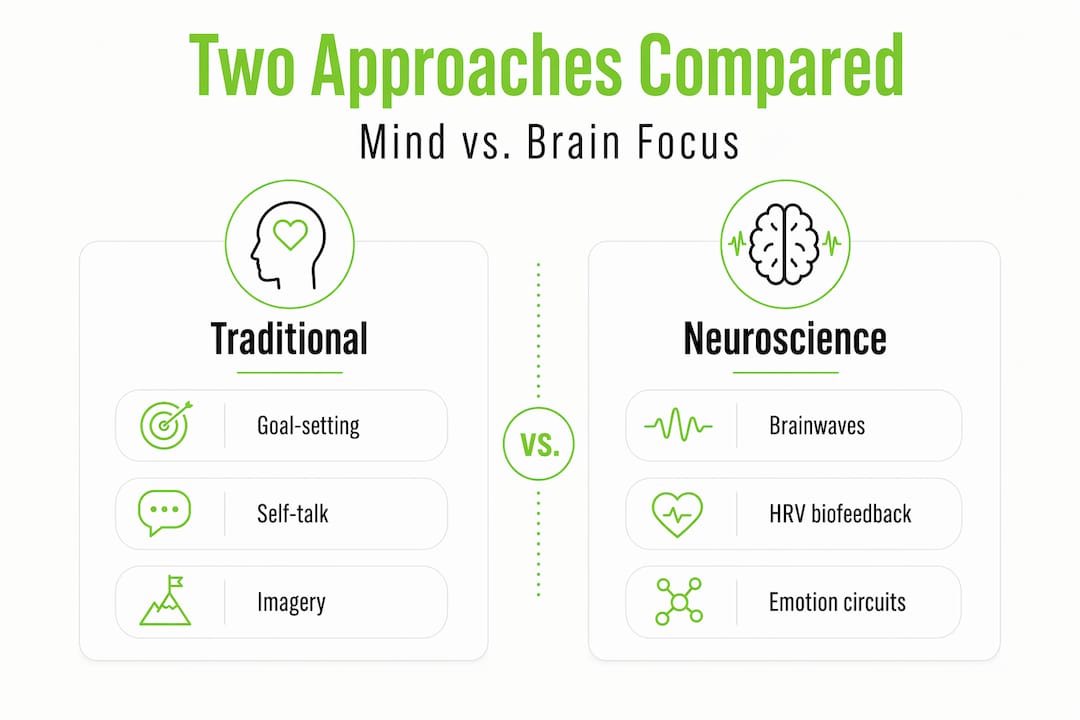
Traditional sports psychology has a strong foundation. Goal-setting, self-talk, imagery, and concentration training all have decades of research behind them and genuine performance benefits. The question isn't whether those tools work. It's whether they're enough on their own.
| Dimension | Traditional sports psychology | Neuroscience-informed approach |
|---|---|---|
| Primary focus | Mindset, motivation, cognitive skills | Brain state, physiological regulation, neural adaptation |
| Measurement tools | Self-report, behavioral observation | HRV, EEG, cortisol, psychophysiological data |
| Anxiety treatment | Cognitive reframing, relaxation techniques | State regulation, nervous system training |
| Performance model | Psychological readiness | Physiological and psychological readiness combined |
| Evidence base | Decades of strong research | Growing, with some areas still preliminary |
The most effective programs don't choose between these approaches. Applied teams combine mental health support with performance psychology because athlete mental health and resilience form foundational pillars of performance success. The neuroscience layer adds physiological precision to what traditional sports psychology already does well.
Where neuroscience still needs to catch up: many studies use small samples, inconsistent protocols, and outcome measures that don't map cleanly to competitive performance. Performance neuroscience findings should be interpreted as probabilistic and mechanism-seeking until larger, standardized studies confirm them. That's not a reason to avoid these tools. It's a reason to apply them thoughtfully.
My take on where this field is actually heading
I've worked with athletes across a wide range of competitive levels, and the pattern I keep seeing is the same. Athletes who get results aren't the ones chasing the newest brain technology. They're the ones who understand that their nervous system is the foundation of everything else they're trying to build.
What I find genuinely exciting about performance neuroscience is that it finally gives us a language for what athletes have always known intuitively. That panic before a big game isn't a mindset problem. It's a nervous system state. That mental block after an injury isn't weakness. It's a learned threat response encoded in the brain. When you treat it at that level, you get real, lasting change.
My caution is this: the field attracts a lot of hype. I've seen athletes spend significant money on gadgets and protocols that weren't matched to their actual problem. A neurofeedback device won't fix a trauma response from a career-threatening injury. A breathing app won't clear a performance block that's been wired in for years. The tools matter less than the framework behind them.
What I believe works is addressing the nervous system directly, systematically, and in a way that's built around the specific athlete in front of you. Not a generic protocol. A targeted intervention that maps to what's actually happening in their brain and body under pressure. That's what produces the kind of results I've seen with Olympic-level athletes, and it's what separates genuine performance neuroscience from the noise.
— Paige
Train your nervous system with Robertsneurotraining
If this article has clarified what neuroscience sports psychology actually involves, the next question is what to do with that understanding. Robertsneurotraining, led by Dr. Paige Roberts, is built specifically for athletes who want to move beyond generic mental skills coaching and address performance at the nervous system level.
The program uses Alpha Imprinting, a targeted method for reprogramming nervous system responses that block performance, whether those blocks stem from injury, past trauma, or chronic performance anxiety. Athletes from Olympic medalists to major league professionals have used this approach to clear mental blocks, reduce panic responses, and reach peak performance states in competition. If you're ready to train the system that runs everything else, this is where to start.
FAQ
What is neuroscience sports psychology in simple terms?
It's the combination of brain science and sports psychology to improve athletic performance by targeting the neural and physiological systems behind focus, motor control, anxiety, and resilience. The recognized field term is performance neuroscience within sports psychology.
How does neuroscience affect sports performance?
Neuroscience reveals that performance depends on brain state, nervous system arousal, and emotion regulation circuits, not just physical conditioning or mindset. Training these systems directly improves consistency, decision-making, and the ability to perform under pressure.
What are the main benefits of neuroscience coaching in sports?
The core benefits include improved state regulation before and during competition, faster recovery from performance anxiety, stronger attentional control, and more consistent access to flow states. These gains compound when neuroscience tools are integrated with traditional psychological skills training.
Is neurofeedback proven to improve athletic performance?
Research shows neurofeedback can improve working memory, decision-making, and anxiety regulation in athletes, but direct competitive performance gains are still considered preliminary. It works best as one component of a broader mental training program rather than a standalone solution.
How is neuroscience sports psychology different from traditional sports psychology?
Traditional sports psychology focuses on mindset, motivation, and cognitive skills. The neuroscience-informed approach adds physiological measurement and nervous system regulation, treating anxiety and performance blocks as brain-state problems with measurable, trainable solutions.