

Career trauma is defined as any event or sustained pattern of workplace stress that ruptures an individual's professional self-concept and, by extension, their broader sense of who they are. Most people understand burnout as a productivity problem. The reality is far more destabilizing. When your career is threatened or destroyed, your identity goes with it. Research from the Annual Review of Organizational Psychology confirms that career transitions cause a rupture in professional self-definitions, and Monster's 2026 State of Workplace Mental Health Report shows that 71% of workers remain in toxic jobs partly because leaving feels like losing themselves. Robertsneurotraining works with high performers who know this feeling firsthand.
Why career trauma impacts identity at the psychological level
Identity dissolution is the clinical term for what most people describe as "not knowing who I am anymore" after a career crisis. It is not a metaphor. When your professional role collapses, the neural and psychological structures that organize your self-concept lose their anchor. For high performers especially, the self and the role become so fused that identity reconstruction is nonlinear and deeply disorienting.
The psychological process moves through what researchers call a liminal state. You are no longer who you were professionally, but you have not yet become someone new. This vacuum produces confusion, grief, and a specific kind of exhaustion that sleep does not fix. Career trauma symptoms include emotional exhaustion, identity confusion, and physical fatigue unrelieved by rest. These symptoms often appear before a person consciously recognizes they are grieving their professional self.
Grief is the right word here. Researchers use two frameworks to describe it: loss orientation, where you process what was taken from you, and restoration orientation, where you begin building forward. Most people get stuck in loss orientation because the culture around work does not validate career grief as real grief. Therapy helps, but career grief requires integration, not just processing. You cannot simply talk your way into a new identity.
- Identity fusion: High performers who define themselves entirely through their work face the sharpest psychological drop when that work disappears.
- Liminal paralysis: The in-between state after career loss produces decision fatigue and social withdrawal that compounds the original trauma.
- Somatic signals: Physical symptoms like chronic fatigue and sleep disruption are the nervous system's response to identity threat, not just stress.
- Narrative collapse: When your professional story ends abruptly, the internal narrative that gives your life coherence breaks down with it.
Pro Tip: Start narrative work early. Journaling about what your role meant to you, not just what you did in it, accelerates the meaning-making process that identity reconstruction requires.
What structural and workplace factors cause career trauma?
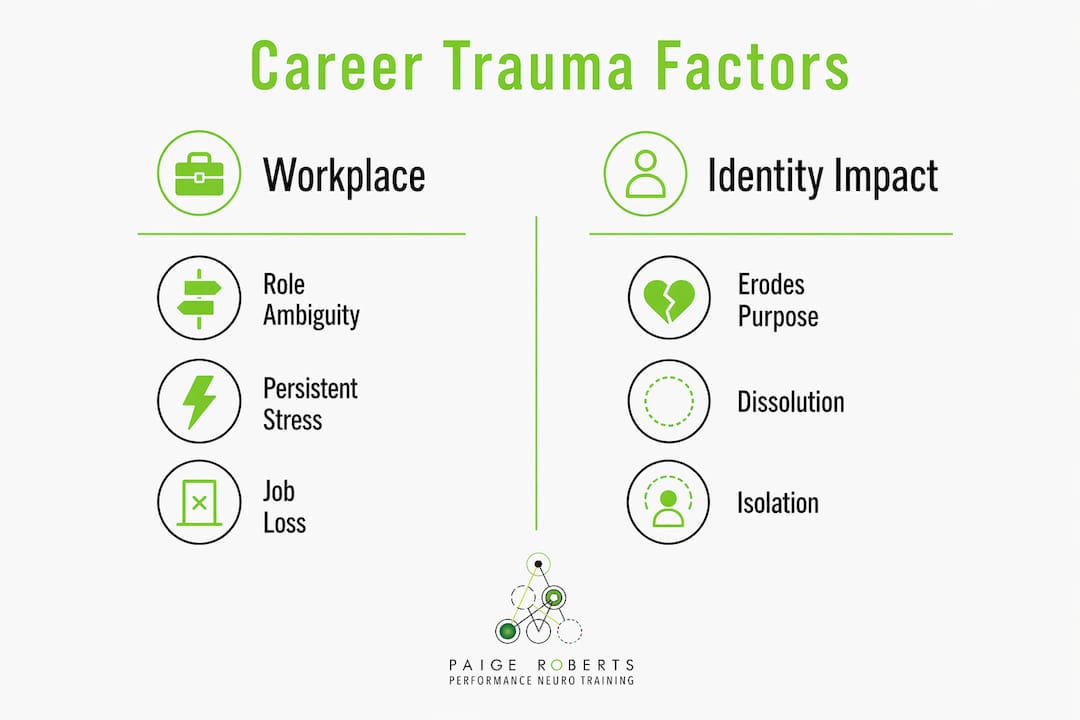
Role ambiguity is the most underestimated driver of career-related identity damage. Auburn University's 2026 findings show that unclear professional expectations cause a 69.7% drop in work engagement and an 80.7% decline in task performance. That is not a productivity statistic. It is evidence that when people cannot define their professional purpose, they begin to lose their sense of professional self.
Toxic workplace cultures accelerate this process. Nearly 46% of employees report burnout from work-related stress, and 37% fear repercussions if they disclose mental health struggles. That fear forces people to perform wellness they do not feel, which deepens the disconnect between their public professional identity and their private psychological state. The gap between who you pretend to be at work and who you actually are becomes its own source of identity erosion.
"Role ambiguity is more corrosive than high workload because it causes fundamental identity and purpose crises that make toxic jobs feel safer than leaving." — Research synthesis from Monster's 2026 Workplace Mental Health Report
The distinction between episodic trauma and Persistent Traumatic Stress Exposure matters here. A single firing or public failure is episodic. Years of micromanagement, gaslighting, or chronic under-recognition constitute cumulative occupational trauma, which researchers now classify under the PTSE framework. PTSE calls for systemic organizational accountability, not just individual coping strategies. The individual is not broken. The structure they worked inside was.
| Stressor type | Identity impact | Common response |
|---|---|---|
| Role ambiguity | Erodes professional purpose and self-worth | Overwork to compensate for unclear expectations |
| Toxic culture | Normalizes emotional suppression and self-betrayal | Staying in harmful roles to avoid identity loss |
| Episodic trauma (firing, demotion) | Acute rupture in professional self-concept | Grief, withdrawal, reactive job searching |
| PTSE (cumulative exposure) | Gradual erosion of identity across months or years | Numbness, dissociation, difficulty imagining alternatives |
How does trauma impact identity differently across populations?
High performers experience the most acute identity disruption because their professional role is not just what they do. It is who they are. A study of over 500 high-performer coaching clients found that identity reconstruction is nonlinear and that the higher the performer, the more complete the identity fusion with their role. When that role disappears, the psychological loss is closer to bereavement than disappointment.

Involuntary career change compounds this. Being laid off, demoted, or pushed out removes agency from the transition. Agency is central to identity. When you choose to leave a role, you carry your narrative forward. When the choice is made for you, the narrative breaks. Frontline workers and those in high-pressure industries face a different version of this through cumulative trauma. Their identity erosion is slower but often more complete because it happens without a single identifiable event to grieve.
| Population | Primary identity threat | Recovery challenge |
|---|---|---|
| High performers | Role-self fusion; acute rupture | Rebuilding identity beyond achievement |
| Involuntary career changers | Loss of agency and narrative control | Reclaiming authorship of professional story |
| Frontline or high-pressure workers | Cumulative PTSE; gradual erosion | Recognizing trauma without a single trigger event |
| Athletes in career transition | Performance identity collapse | Separating self-worth from athletic output |
Social network loss is a factor that rarely gets named directly. Your professional community validates your identity daily. When a career collapses, that community often disappears with it. The isolation that follows is not just loneliness. It is the loss of the social mirror that reflected your professional self back to you. Coaching focused on identity, rather than just career planning, produces significantly better outcomes during these transitions because it addresses the social and psychological dimensions together.
How does narrative reconstruction rebuild identity after career trauma?
Narrative reconstruction is the process of building a coherent self-story that connects who you were professionally to who you are becoming. It is the central mechanism of recovery from career-related identity loss. Trauma, by definition, changes identity permanently. Recovery does not mean returning to your previous self. It means creating new self-descriptions that integrate the disruption into a stronger, more grounded identity.
The distinction between identity loss and identity gain matters practically. Identity loss is reactive. It is what happens to you. Identity gain is active construction. Identity gain after disruption reframes recovery not as restoration but as expansion. You are not rebuilding what was destroyed. You are building something more resilient in its place. This reframe alone changes the emotional trajectory of recovery.
Practical approaches that support this process include:
- Reflective journaling: Write about what your previous role meant to your sense of self, not just your daily tasks. This separates identity from function.
- Structured coaching: Work with a coach who addresses identity, not just career strategy. The whole-life coaching approach produces better job satisfaction and professional success post-trauma.
- Social witnessing: Share your career story with trusted people who can reflect it back without judgment. Narrative integration requires an audience.
- Physical recovery practices: The nervous system holds trauma. Somatic work, breathwork, and energy-focused training support the psychological reconstruction process.
Pro Tip: Create margin before making major career decisions after trauma. The liminal state distorts judgment. Give yourself structured time to reconstruct your narrative before committing to a new professional identity.
Key takeaways
Career trauma impacts identity because the professional self is not separate from the whole self. It is one of its primary organizing structures.
| Point | Details |
|---|---|
| Identity fusion drives severity | High performers fuse self with role, making career trauma psychologically equivalent to bereavement. |
| Role ambiguity is a primary cause | A 69.7% drop in engagement from unclear expectations shows ambiguity erodes identity before acute trauma occurs. |
| PTSE differs from episodic trauma | Cumulative workplace stress causes gradual identity erosion that lacks a single identifiable trigger to grieve. |
| Narrative reconstruction is the core of recovery | Building a coherent self-story that integrates disruption produces stronger identity than attempting to restore the previous self. |
| Identity gain reframes the process | Recovery is active construction of a more resilient self, not a return to who you were before the trauma. |
What I've learned from working at the intersection of trauma and identity
What strikes me most, after years of working with high performers navigating career disruption, is how rarely anyone names what is actually happening. People come in describing exhaustion, confusion, and a strange sense of grief they feel embarrassed to claim. They say things like, "It's just a job." But it was never just a job. It was the structure around which they organized their entire sense of worth, purpose, and belonging.
The stigma around career grief is real and damaging. We have cultural permission to grieve relationships and losses of life. We have almost none to grieve a career. So people suppress it, perform recovery they have not actually done, and wonder why they feel hollow in their next role. The identity wound does not heal because it was never acknowledged.
What I have found is that the most important first step is simply naming the experience accurately. You are not weak. You are not failing to adapt. You are experiencing a genuine rupture in your professional self-concept, and that rupture has physical, emotional, and neurological dimensions. Recognizing that changes everything. It moves you from self-blame into the kind of honest reconstruction that actually leads somewhere worth going.
The nonlinear nature of this process is also something I want to normalize. Recovery does not move in a straight line. Some days you will feel clear and forward-moving. Others will pull you back into grief. Both are part of integration. The goal is not to eliminate the hard days. It is to build enough internal structure that the hard days do not define you.
— Paige
Rebuild your identity with support that understands the nervous system
If you recognize yourself in this article, the next step is not another career plan. It is addressing the nervous system patterns that career trauma leaves behind.

Robertsneurotraining offers neuroscience-based programs designed specifically for high performers rebuilding after professional disruption. Using the Alpha Imprinting method, the program targets the nervous system directly, clearing the anxiety, mental blocks, and trauma responses that prevent you from performing and living at full capacity. This is not generic wellness coaching. It is evidence-based energy optimization built for people who need to perform at the highest level again. If you are ready to move from identity loss to identity gain, Robertsneurotraining is where that work begins.
FAQ
What is career trauma and why does it affect identity?
Career trauma is any event or sustained workplace pattern that ruptures your professional self-concept. It affects identity because for most people, especially high performers, professional role and personal identity are deeply fused.
How long does identity recovery from career trauma take?
Recovery is nonlinear and varies by individual, trauma severity, and available support. Research shows that narrative reconstruction and social support are the most reliable accelerators of the process.
Why do high performers experience career trauma more intensely?
High performers fuse their sense of self with their professional role more completely than others. When that role is disrupted, the psychological loss is closer to bereavement than a typical career setback.
What is the difference between burnout and career trauma?
Burnout is a state of chronic depletion tied to workload and stress. Career trauma is a rupture in identity that occurs when a professional role is lost, threatened, or fundamentally changed. Burnout can trigger career trauma, but they are distinct experiences requiring different recovery approaches.
Can the nervous system be retrained after career trauma?
Yes. The nervous system holds the physical imprint of traumatic stress, including career-related trauma. Neuroscience-based approaches like those used at Robertsneurotraining target these patterns directly, enabling recovery that goes beyond cognitive reframing alone.