
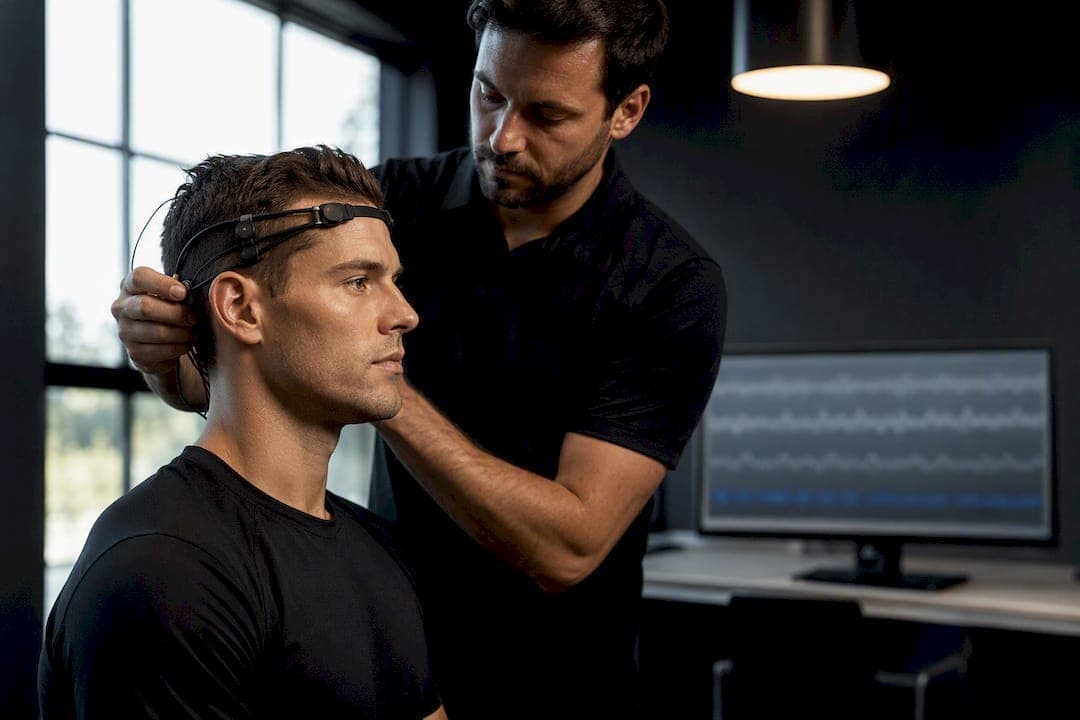
Alpha brainwave activity is trainable, and the evidence is strongest for three routes: clinician-guided neurofeedback, audiovisual brainwave entrainment, and consistent meditation or eyes-closed practice. Each produces measurable EEG changes, but the effects vary by person, and gains from a single session are modest compared to what builds over weeks. If you want durable results, personalization around your own alpha frequency matters more than the method you pick.
TL;DR:
- Neurofeedback and audiovisual brainwave entrainment show the strongest evidence for increasing alpha activity, but individual personalization, especially targeting your specific alpha frequency, enhances results.
- A single 20-minute audiovisual entrainment session can produce immediate alpha amplitude increases, especially for individuals with lower baseline alpha levels.
- Repeated neurofeedback sessions over weeks are necessary for durable cognitive improvements, with baseline alpha levels predicting how much a person will respond to training.
- Clinical programs using individual EEG assessments can optimize protocols by focusing on relevant scalp regions and personalized frequencies, unlike generic, one-size-fits-all approaches.
- Alpha training should be integrated with sleep, stress management, and therapeutic support for best performance and mental health outcomes.
Table of Contents
- What Alpha Brainwaves Are (Frequency, Role, and EEG Markers)
- Evidence-Backed Techniques to Increase Alpha, Ranked and Explained
- How Neurofeedback and Entrainment Work, and How to Choose Between Devices and Clinician-Led Programs
- How to Build a Practical Alpha Brainwave Training Protocol
- Safety, Limitations, and What to Actually Expect
- How a Clinician-Run Program Applies Alpha Training
- Integrating Alpha Training Into a Performance Plan
- How Robertsneurotraining Turns This Research Into a Program
- Sources
- FAQ
What Alpha Brainwaves Are (Frequency, Role, and EEG Markers)
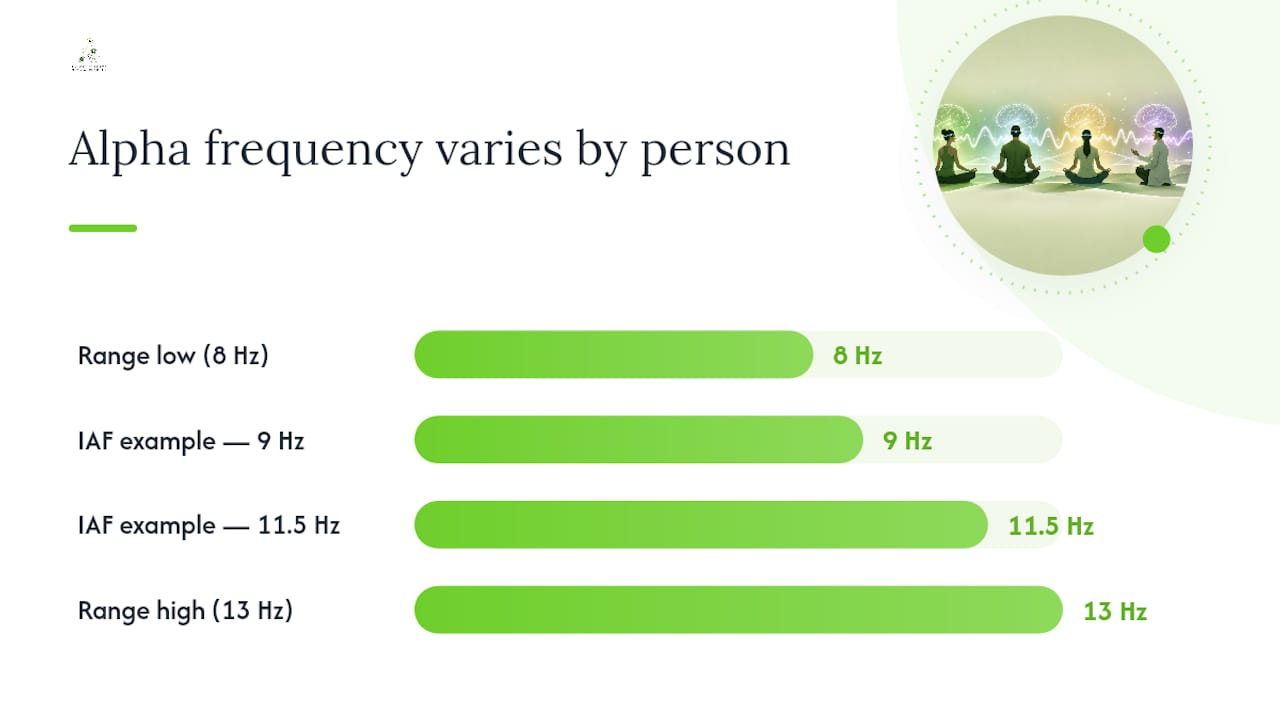
Alpha waves sit in the 8 to 13 Hz range on an EEG readout, though the exact peak differs from person to person. That personal peak is called your Individual Alpha Frequency, or IAF, and it is not a trivial detail. Two people can both be "in alpha" while one peaks at 9 Hz and the other at 11.5 Hz, and training programs that ignore this difference tend to underperform.
Functionally, alpha activity tracks a state researcher describe as relaxed alertness. It is not sleepiness and it is not intense focus. It sits somewhere in between: calm, but responsive. Alpha also appears to help the brain filter out irrelevant sensory input, a process sometimes called inhibitory gating. When alpha power rises in certain cortical regions, it seems to dampen processing in areas the brain has decided it does not need right now, which frees up resources for the task that matters.
Alpha activity also intersects with the default mode network, the set of brain regions active during mind-wandering, self-reflection, and rest. Research using combined EEG and fMRI has found that alpha power fluctuations can tighten their coupling with this network under certain stimulation conditions, hinting at a mechanistic link between alpha regulation and the brain's resting-state connectivity.
On a raw EEG readout, a few markers show up consistently:
- Amplitude and power rise in the alpha band during eyes-closed rest, most noticeably.
- The effect is strongest over the occipital region, at the back of the skull.
- Alpha typically drops when the eyes open or attention shifts to a demanding visual task.
- Baseline alpha level before training often predicts how much a person will respond to that training.
That last point turns out to matter a great deal for anyone starting a program: people with lower baseline alpha tend to show larger gains, which means results are rarely uniform across a group.
Evidence-Backed Techniques to Increase Alpha, Ranked and Explained
Not all alpha training methods carry the same weight of evidence. Some have randomized, sham-controlled trials behind them. Others are supported by smaller studies or by mechanism plausibility rather than large controlled data. Here is how the field currently stacks up, roughly ordered by strength of evidence and speed of effect.
-
Neurofeedback (clinician-guided or device-based). This is the most rigorously tested route. Randomized studies show that alpha neurofeedback training can raise alpha amplitude and improve both working memory and episodic memory in responders, using closed-loop protocols where the person watches or hears real-time feedback tied to their own EEG signal. Short-term neurofeedback has also been shown to shift Individual Alpha Frequency upward, with that shift correlating with better performance on cognitive tasks like mental rotation and n-back testing. Sessions typically run for a moderate duration; meaningful shifts in IAF have appeared after concentrated short-term protocols, while memory benefits tend to build over one to several weeks of repeated training.
-
Audiovisual brainwave entrainment (aBWE). This uses rhythmic light and sound pulses, often through a headset, to synchronize brain activity to a target frequency. The evidence here is notable for its speed: a single 20-minute aBWE session produced statistically significant increases in alpha amplitude and power across multiple brain regions in healthy adults, with the largest jumps seen in people who started with lower baseline alpha. This is the fastest-acting method on this list, and it requires no training or skill from the user, just the headset and 20 minutes.
-
Alpha-frequency transcranial alternating current stimulation (tACS). This applies a weak electrical current at an alpha frequency through scalp electrodes. Studies combining EEG and fMRI report that occipitoparietal α-tACS can modulate alpha oscillations and tighten the coupling between alpha power and default mode network activity. It is mechanistically interesting and shows real EEG effects, but it is the least accessible method here, generally requiring supervised, clinical, or research settings.
-
Meditation and eyes-closed rest. The simplest, cheapest, and most reliable method on this list, supported by evidence of remarkable effects from mindfulness and fitness on holistic health. Closing your eyes and sitting quietly reliably raises occipital alpha within minutes, and mindfulness practice appears to help the brain regulate itself rather than acting as an external fix imposed on it, a framing that researchers studying brain rhythm regulation consider more accurate than talk of a quick cure. There is no equipment cost and no learning curve, which makes it a sensible starting point before layering on anything more technical.
-
Supportive practices: paced breathing, nature exposure, exercise, sauna. These carry weaker direct evidence for alpha specifically, but they support the same relaxed-alertness state and cost little to add. Think of them as scaffolding around a primary method, not a replacement for it.
Statistic to know: in one controlled aBWE study, a single session lasting about twenty minutes was enough to produce a statistically significant alpha increase, with the effect most pronounced in participants who started with lower baseline alpha power. If your alpha is already high at rest, expect a smaller bump from any single session.
Who benefits most from each? People chasing a quick pre-performance state shift tend to gravitate toward aBWE or eyes-closed rest, since both act within minutes. People targeting durable cognitive gains, like memory or attention improvements that outlast the session, are better served by repeated neurofeedback over weeks. Athletes managing competition anxiety often need both: a fast method for the moment before performance and a slower one built into weekly training.
How Neurofeedback and Entrainment Work, and How to Choose Between Devices and Clinician-Led Programs
Three distinct mechanisms are doing the work across these methods, and confusing them leads to mismatched expectations.
Neurofeedback operates on operant conditioning. The system measures your EEG in real time, and when your brain produces more alpha activity, you get a reward signal, usually a tone that changes pitch or a visual cue that brightens. Your brain, without conscious effort, learns to produce more of the rewarded state to get more of the pleasant feedback. This is a skill you build, not a state pushed onto you from outside.
Audiovisual entrainment works differently. It presents rhythmic external stimulation, flickering light or pulsing tones, at a target frequency, and the brain's electrical activity tends to synchronize toward that external rhythm. No learning is required; the effect is closer to a tuning fork setting a nearby object vibrating at the same pitch.
tACS applies a weak alternating electrical current directly, nudging neural oscillations toward the stimulation frequency at a more direct, physical level.
Personalization changes outcomes across all three. Targeting a generic "alpha band" instead of a person's actual IAF is a bit like tuning a radio to 99 FM when the station you want is at 101.3. You will catch some signal, but you will miss the strongest reception. Research on IAF trainability backs this up directly, and separate work on personalization and topographic targeting confirms that one-size-fits-all frequency treatments underperform compared to individually calibrated protocols.
Where you target the scalp matters too. Occipital training, at the back of the head, tends to influence visual processing and relaxed alertness most directly. Frontal targeting shifts toward attention and emotional regulation effects. A protocol built for calm won't necessarily be the right one for sharpening focus, even if both are labeled "alpha training."
That leaves the practical question: device or clinician?
- Consumer wearables and portable EEG headsets have become genuinely useful. Research on portable alpha-band neurofeedback devices shows measurable neural modulation and supports their feasibility for accessible, at-home training.
- Multi-channel clinical QEEG systems give a fuller picture of brain activity across many scalp sites simultaneously, which supports more precise topographic targeting and professional interpretation of what the data actually means.
- Portable systems are convenient and lower-cost but require careful calibration to match clinician-grade accuracy, and interpretation without a trained eye can miss important nuance.
- Clinician-guided programs cost more and require scheduling, but they add professional interpretation, IAF-specific calibration, and protocol adjustment when someone isn't responding.
Pro Tip: If you're using a home device and see no change in your subjective state or sleep after two to three weeks of consistent sessions, that is a signal to get a proper qEEG baseline rather than simply logging more hours on the same protocol.
Clinician-guided training is generally the better route when performance anxiety, trauma responses, or a diagnosed clinical condition are part of the picture, since tailored protocols and professional oversight matter more when the stakes involve mental health rather than general relaxation.
How to Build a Practical Alpha Brainwave Training Protocol
Start with a baseline, not a program. An eyes-closed resting EEG, even a basic five-minute recording, tells you where your alpha activity sits before you change anything. If you have access to a clinician, a full qEEG map adds topographic detail a simple headset reading can't capture, and it is worth requesting one if you plan to invest in a multi-week program.
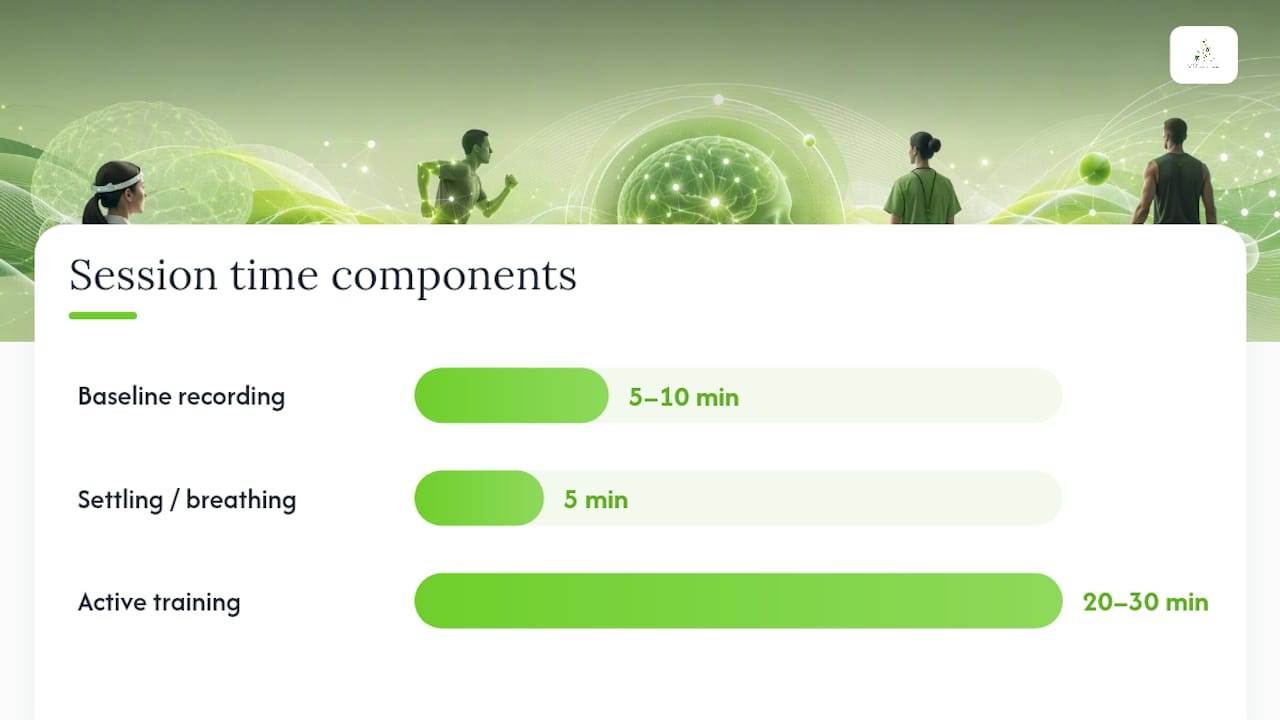
- Assess your baseline. Record five to ten minutes of eyes-closed resting EEG, or book a qEEG if you're pursuing clinician-guided training.
- Set your target. If you know your IAF, use it. Without one, a practical rule is to train toward the upper end of your own resting alpha range rather than an arbitrary population average.
- Structure the session. A reasonable template: five minutes of settling in and eyes-closed breathing, then 20 to 30 minutes of active training (neurofeedback or aBWE), followed by a short cooldown and a brief note on how you feel.
- Set your cadence. Three to five sessions a week is a common active-training frequency in the studies showing measurable gains; once you see consistent change, two sessions a week is often enough to maintain it.
- Track outcomes beyond the EEG. Pair the raw alpha numbers with something you actually care about: a simple n-back or Corsi block test for working memory, plus a sleep or stress questionnaire logged weekly.
- Escalate if needed. If two to three weeks of consistent training produce no shift in either the EEG numbers or your subjective state, that is the point to consult a clinician rather than extend the same protocol indefinitely.
Statistic to know: in one short-term IAF neurofeedback protocol, concentrated sessions shifted resting IAF by roughly 0.2 Hz in healthy young adults, with that shift tracking real gains on mental rotation tasks. That is a small number on paper, but it is the kind of change that shows up in how a trained brain performs, not just how it looks on a printout.
Some clinicians pair alpha training with a concurrent cognitive task, like a working memory drill done immediately after a training block, on the theory that pre-training alpha empowerment can amplify what the brain consolidates afterward. If you're building a protocol from scratch, that pairing is worth testing on yourself before assuming a passive session alone will get you where you want to go.
Safety, Limitations, and What to Actually Expect
The research picture here is genuinely encouraging, but it is not uniform. Studies report real gains in memory and alpha amplitude, and yet heterogeneity across methods and outcomes is common enough that reviewers routinely call for larger samples and more personalized protocols before drawing firm conclusions.
A few practical points worth holding onto:
- Not everyone responds equally. People with lower baseline alpha tend to show larger gains than people who start with high alpha at rest, which is one reason a protocol that worked for a training partner may do less for you.
- tACS can cause mild scalp tingling or discomfort at the electrode site, and it is not appropriate for anyone with a neurological implant or a seizure history without direct clinical guidance.
- Entrainment effects from a single aBWE session are often immediate but temporary, while neurofeedback benefits generally build over repeated sessions across days or weeks rather than appearing all at once.
- Raising alpha activity is not a universal fix. The realistic, supported claims are around memory, relaxed-alertness, and stress regulation, not a blanket promise of better performance in every domain of life.
Clinicians also routinely track "responders" versus "nonresponders" early in a program and adjust the protocol, rather than running a fixed plan for weeks on someone it clearly isn't working for. That kind of course correction is one real advantage of guided training over a set-and-forget home device.
How a Clinician-Run Program Applies Alpha Training
A clinician-run pathway typically starts with intake and a qEEG baseline, then builds an IAF-informed protocol around what that scan shows. From there, training blocks target the frequencies and scalp regions most relevant to the person's goals, with outcomes tracked through both EEG changes and real performance metrics, not EEG numbers alone.
The clinician-guided Alpha Imprinting approach structures work this way for athletes and high performers, using qEEG data to guide protocol design rather than a generic frequency target. Candidates are often competitive athletes and performance-driven professionals working through telehealth sessions, 1:1 programs, or structured workbooks, as part of a broader recovery plan.
Integrating Alpha Training Into a Performance Plan
Alpha training works best as one piece of a larger plan, not a standalone fix. It belongs alongside sleep quality, skill repetition, and, when trauma or anxiety are in the picture, real therapeutic support. Start with an assessment, not a guess, and expect gradual change rather than a single dramatic session.
— Paige
How Robertsneurotraining Turns This Research Into a Program
Robertsneurotraining is the clinician-guided alternative to trial-and-error home entrainment: instead of guessing at a frequency, your program starts with a qEEG baseline and builds an Alpha Imprinting protocol around your actual Individual Alpha Frequency, not a generic setting.
For athletes managing performance anxiety or working back from injury, that distinction shows up in whether a protocol adjusts to you or leaves you running the same session for weeks with no signal it's working. Roberts Neurotraining's intake and assessment process walks through exactly how the qEEG baseline informs your training blocks, and the Energy Optimization Workbook is a practical starting point if you want a structured, self-directed foundation before committing to a full program. Readers who want to dig into the underlying science further can also visit the research and clinical collaboration page. If you're ready to move past self-guided experimentation, book a consultation to get your baseline assessed and a protocol built around it.
Sources
- Impact of Audiovisual Brainwave Entrainment on Alpha Wave Activity: A Real-Time EEG Assessment
- Exploring the neural mechanisms of alpha-band EEG neurofeedback using portable devices - IOPscience
FAQ
How Do You Train Alpha Brain Waves?
The most consistent methods are eyes-closed rest or meditation for immediate effects, audiovisual entrainment for fast measurable EEG shifts, and neurofeedback for gains that build over repeated sessions with personalized IAF targeting.
Do Alpha Wave Methods Actually Work?
Randomized, sham-controlled studies show real increases in alpha amplitude and improved memory in many participants, though response size varies by baseline alpha and individual physiology, so results are not identical for everyone.
What Kind of Sound Can Reset Your Brain?
Rhythmic audiovisual entrainment, delivered through light pulses paired with tones at a target frequency, is the sound-and-light method with EEG evidence for producing rapid, measurable shifts in alpha amplitude and power within a single 20-minute session.
Are Alpha and Theta Waves Linked to ADHD?
Some research associates atypical alpha and theta activity patterns with attention regulation differences, including in ADHD, but the relationship is complex and individual EEG profiles vary too widely for a simple alpha-theta ratio to serve as a standalone diagnostic marker.