

Athletes who train in the alpha brain state tend to perform better than those who rely on physical preparation alone. Alpha waves, neural oscillations occurring within a specific frequency range, create a condition of calm alertness that neuroscientists now recognize as the neurological signature of flow. When your brain shifts into this frequency range, several things happen at once:
- Concentration sharpens without the tension that beta-wave dominance brings
- Anxiety drops, because alpha activity suppresses the internal chatter that derails precision under pressure
- Motor execution improves, as the brain stops wasting resources on task-irrelevant processing
- Emotional regulation stabilizes, keeping performance consistent across rounds, sets, or quarters
- Recovery between efforts accelerates, since the nervous system resets faster from a calm baseline
EEG alpha activity measured in elite athletes shows bursts of high-power alpha waves in the left hemisphere just before optimal execution in precision sports such as archery and basketball free throws. That pattern is not accidental. It is the brain organizing itself for peak output. Neurofeedback training and methods like Alpha Imprinting, developed by Robertsneurotraining, are now giving athletes a direct path to that state on demand.
What does the science say about alpha waves and peak performance?
The link between alpha brain waves and elite athletic execution is one of the more consistent findings in sports neuroscience. EEG alpha power reliably increases before precision tasks, and that increase predicts better outcomes, not just correlates with them.

Here is the mechanism worth understanding. Alpha waves function as an inhibitory signal, quieting cortical regions that are not needed for the task at hand. A golfer lining up a putt does not need the brain areas associated with self-doubt or crowd awareness firing at full volume. Alpha suppresses them. What remains is clean, task-focused processing.
| Brain Wave State | Frequency | Athletic Context | Effect on Performance |
|---|---|---|---|
| Alpha | Within a specific frequency range | Pre-shot routine, flow state | Calm focus, reduced distraction, optimal motor control |
| Beta | — | Overthinking, anxiety, high arousal | Increased tension, disrupted motor patterns |
| Theta | 4 Hz | Deep relaxation, drowsiness | Too little arousal for competition demands |
Beta dominance is the state most athletes know too well. It shows up as overthinking a serve, second-guessing a play call, or freezing at the free-throw line. Theta sits at the other extreme, too relaxed to compete. Alpha sits between them, and that is precisely why it matters.
Research on elite gymnasts found that eyes-open alpha power training produced measurable improvements in sleep quality, mental functioning, and physical condition, even in athletes already performing at the highest level. Such gains are meaningful in practice.
How neurofeedback and biofeedback training build your alpha state
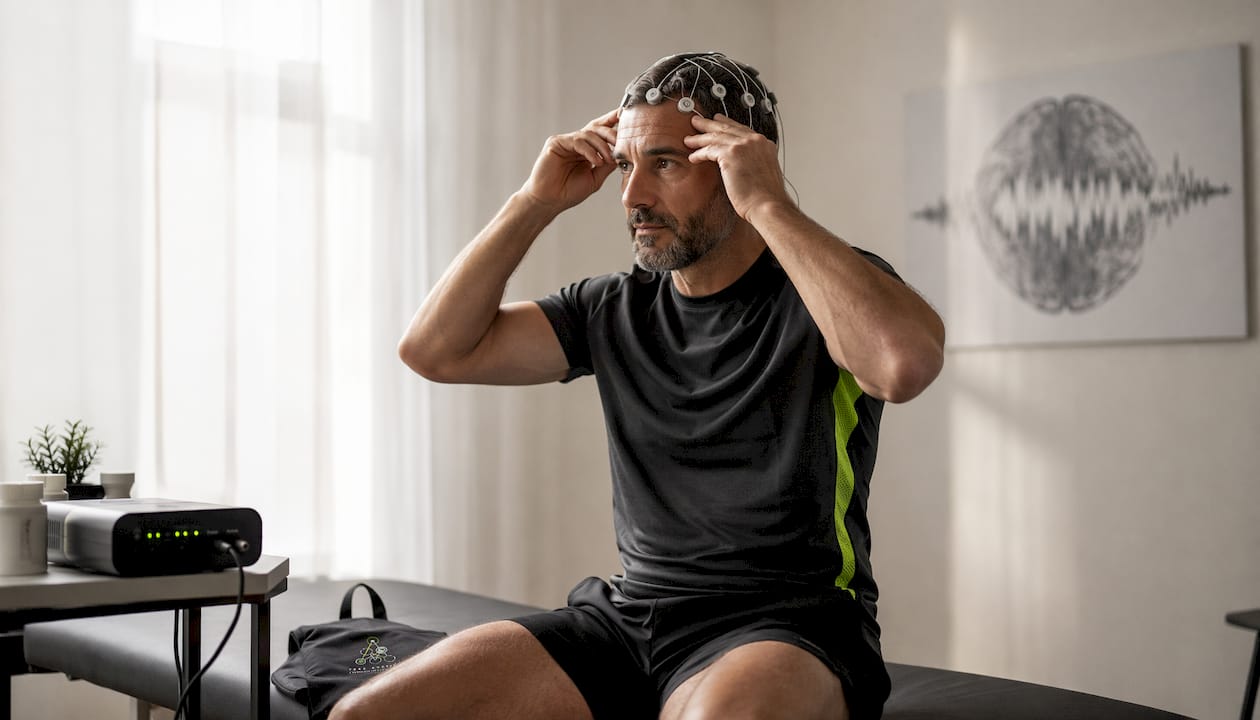
Neurofeedback is the most direct tool athletes have for training alpha wave production. The protocol is straightforward: sensors read your EEG activity in real time, and the system rewards you when alpha power rises. Over repeated sessions, your brain learns to reach that state more reliably, and eventually, more automatically.
Alpha neurofeedback training has shown increases in alpha power at multiple EEG locations following combined coaching and biofeedback sessions in professional soccer players and elite track and field athletes. The outcomes extend beyond brain activity: emotional stability, concentration, and stress reduction all improved alongside the EEG data.
Heart rate variability (HRV) biofeedback works as a strong complement. When HRV improves, it reflects better autonomic balance, meaning your nervous system shifts more easily between activation and recovery. Combined EEG alpha and HRV training shows positive trends in both physiological and subjective performance metrics over time.
Here is a practical sequence for integrating alpha training into your preparation:
- Establish a baseline EEG reading before beginning any neurofeedback protocol, so progress is measurable.
- Complete neurofeedback sessions two to three times per week during the off-season or early training blocks, targeting alpha power elevation.
- Add HRV biofeedback on recovery days to reinforce autonomic regulation.
- Practice pre-performance routines that anchor the alpha state, such as controlled breathing, a specific warm-up sequence, or a cue word.
- Simulate competition conditions during training to test whether the alpha state holds under pressure.
- Track reaction time and emotional regulation as objective markers of progress alongside subjective feel.
One challenge athletes face is that the alpha state can collapse under acute stress. The moment a referee makes a bad call or a competitor gets in your head, beta waves surge. That is why training the state in low-stakes environments first, then progressively exposing it to stressors, is the only way to make it competition-proof.
Pro Tip: Cue words and pre-performance routines act as behavioral anchors that condition your nervous system to enter the alpha state automatically. Pick one word or physical gesture that you pair consistently with your best training moments, then use it before every competition.
Hydration also plays a role that most athletes overlook. The brain is 75% water, and even mild dehydration impairs the electrical stability needed for sustained alpha coherence. Arriving at a neurofeedback session or a competition dehydrated means you are already working against your own nervous system.
How Alpha Imprinting takes neurofeedback further
Standard neurofeedback trains the brain to produce more alpha waves. Alpha Imprinting, the proprietary method developed by Dr. Paige Roberts at Robertsneurotraining, goes a step further by targeting the nervous system patterns that block alpha access in the first place.
Mental blocks, performance anxiety, and trauma responses from past injuries do not just affect confidence. They create persistent nervous system dysregulation that keeps athletes locked in beta-dominant states even when they consciously want to relax. Alpha Imprinting works by reprogramming those patterns at the nervous system level, clearing the interference so that flow becomes the default rather than the exception.
The method has been applied across a wide range of sports, including football, equestrian, and combat sports, each of which places distinct demands on mental regulation. A combat sport athlete needs alpha access in the middle of physical contact and crowd noise. An equestrian rider needs it while managing an animal that responds directly to their nervous system state. The applications are different, but the underlying mechanism is the same: a nervous system that defaults to calm alertness performs better than one that defaults to threat response.
Athletes who have worked with Robertsneurotraining, including Olympic medalists, report improvements in focus, anxiety management, and the ability to enter flow states consistently. The neuroscience behind mental training supports what those athletes experience: when the nervous system stops fighting itself, physical output improves without any change to the physical training load.
Sport-specific applications worth noting:
- Precision sports (archery, golf, marksmanship): alpha state directly reduces the micro-tension that throws off accuracy
- Team sports (football, lacrosse, basketball): alpha supports faster decision-making and emotional recovery after mistakes
- Endurance sports (cycling, swimming): sustained alpha coherence reduces perceived effort and supports pacing discipline
- Combat sports: alpha access under physical stress is the difference between reactive and composed performance
The athletic mindset factors that support peak performance, including composure, focus, and emotional control, map almost exactly onto what alpha state training produces neurologically. That alignment is not coincidental. The mental qualities coaches have always valued turn out to have a measurable brain-state signature.
One practical note: Alpha Imprinting is not a replacement for physical training. It works best when the athlete already has technical competence and is being held back by mental interference rather than skill gaps. The nervous system work removes the ceiling; the physical work still builds the floor.
For athletes ready to apply these methods, Robertsneurotraining's nervous system preparation routines offer a structured starting point for integrating alpha state training into existing practice schedules.
Ready to train your nervous system for peak performance?
Robertsneurotraining's Alpha Imprinting program gives athletes a direct path to the alpha state, not as a relaxation technique, but as a competitive tool. If mental blocks, anxiety, or inconsistent performance are limiting what your body already knows how to do, the Alpha Imprinting program addresses the root cause at the nervous system level. The Energy Optimization Workbook is a practical starting point for athletes who want to understand and apply these methods before committing to a full program.
Key Takeaways
Alpha state training produces measurable improvements in focus, anxiety control, and motor precision, making it one of the most evidence-backed mental performance tools available to athletes in 2026.
| Point | Details |
|---|---|
| Alpha waves and flow | EEG alpha power precedes peak execution in precision sports, marking the neurological state of flow. |
| Inhibitory function | Alpha waves suppress task-irrelevant brain areas, reducing self-criticism and internal distraction during performance. |
| Neurofeedback outcomes | Combined EEG alpha and HRV biofeedback training improves emotional stability, concentration, and stress resilience in elite athletes. |
| Alpha Imprinting | Robertsneurotraining's Alpha Imprinting method reprograms nervous system patterns that block alpha access, enabling consistent flow states. |
| Hydration and alpha coherence | The brain is 75% water; mild dehydration disrupts the electrical stability required for sustained alpha wave production. |