

Mental training improves physical output by changing how the brain regulates effort, focus, and stress during competition. The mechanism is not motivational. It is neurological. Structured approaches like Brain Endurance Training (BET), Mindfulness-Acceptance-Commitment (MAC), and Psychological Skills Intervention (PSI) each target the central nervous system in ways that directly affect endurance, decision-making, and anxiety management. The impact of mindset on performance is measurable, and the research behind it is no longer preliminary. Athletes who train their nervous system alongside their body consistently outperform those who rely on physical conditioning alone.
Why mental training improves physical output: the brain's role
The brain controls how hard physical effort feels. That single fact explains why mental training benefits extend far beyond motivation or confidence. When the brain perceives exertion as too high, it reduces motor output before the muscles actually fail. Mental training teaches the brain to recalibrate that threshold.
Neuroscience-based training shows that most mental training gains come from central nervous system changes, not peripheral physiology. Studies report no significant changes in markers like VO2 max or blood lactate after mental training programs. What does change is perceived exertion and executive control, the two brain-level regulators that determine how long and how hard an athlete can sustain output.

Mental fatigue impairs inhibitory control and raises perceived exertion. That combination limits performance before the body reaches its physical ceiling. Training the brain to manage that state is not a soft skill. It is a performance variable with direct physical consequences.
How does brain endurance training boost endurance performance?
Brain Endurance Training combines cognitively demanding tasks with physical exercise. The goal is to train the brain to maintain executive function under fatigue, which delays the point at which perceived effort becomes limiting.
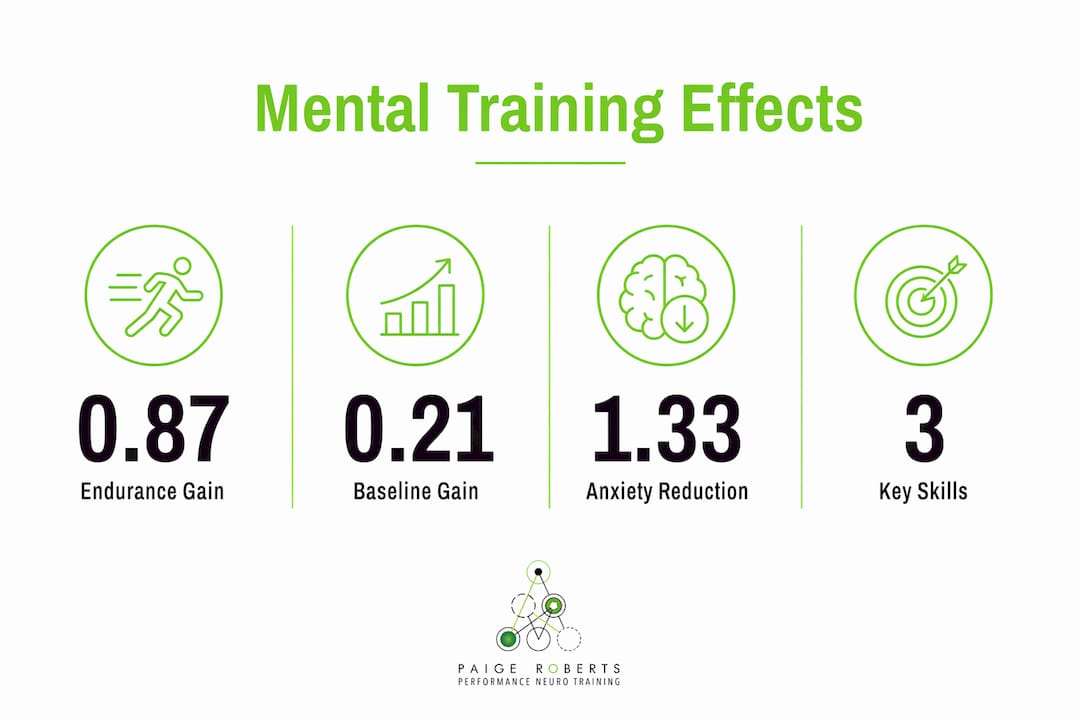
A 2026 meta-analysis found that BET improves endurance outcomes with a standardized mean difference of 0.87 under fatigued conditions, compared to 0.21 at baseline. That gap is the key finding. BET's advantage shows up most when athletes are already mentally tired, which is exactly when competition demands peak output.
The practical implication is significant. Athletes who train only in fresh, rested states are not preparing their brains for the cognitive load of late-game or late-race conditions. BET recreates that strain deliberately. The brain adapts by improving its ability to sustain effort regulation when it matters most.
Pro Tip: Add a cognitively demanding task, such as a working memory exercise or a rapid decision-making drill, during the final 20 minutes of a hard training session. This recreates competition-level mental fatigue and forces the brain to adapt under real strain.
BET performance effects: fatigued vs. baseline conditions
| Condition | Effect Size (SMD) | What it means |
|---|---|---|
| Baseline (rested) | 0.21 | Modest endurance gain with no prior cognitive load |
| Under mental fatigue | 0.87 | Large endurance gain when brain is already taxed |
| Mental fatigue resistance | 9.22 (MD) | Strong reduction in cognitive decline during exertion |
How do psychological skills interventions improve decision-making under pressure?
PSI programs build the mental skills that translate directly into better physical execution. The techniques include attentional focus training, imagery, goal setting, and emotional regulation. Each one targets a different layer of cognitive performance under competitive pressure.
A 2026 randomized controlled study with U-19 footballers showed that the PSI group gained significantly in both mental toughness and decision-making accuracy compared to the control group. Physical conditioning was equal between groups. The performance gap came entirely from cognitive and psychological gains.
The reason this matters physically is direct. Better decision-making means more accurate, timely actions on the field. A defender who processes information faster makes a better tackle. A point guard who manages emotional pressure reads the play more clearly. PSI strengthens the mental skills that govern those moments.
Key PSI techniques and their physical performance links:
- Attentional focus training reduces distraction during high-pressure moments, keeping motor execution on task
- Imagery and mental rehearsal build neural pathways for physical movements before the body performs them
- Goal setting structures effort allocation, preventing energy waste on low-priority actions
- Emotional regulation reduces the cortisol-driven muscle tension that slows reaction time
- Self-talk protocols interrupt negative cognitive loops that impair coordination and timing
Subconscious belief reprogramming works alongside PSI by clearing the deeper mental blocks that surface under competitive stress. When both layers are addressed, the gains in tactical execution become consistent rather than situational.
Which anxiety reduction method works best for athletes?
The answer depends on the type of anxiety. Somatic anxiety, the physical tension and racing heart before competition, responds best to MAC. Cognitive anxiety, the mental worry and negative self-talk, responds best to relaxation-based techniques. Matching the method to the anxiety type is the critical variable.
A 2026 Bayesian meta-analysis reported that MAC reduces competitive anxiety with a standardized mean difference of 1.33. That is a large effect. MAC works by teaching athletes to accept internal sensations rather than fight them. Acceptance removes the attentional interference that anxiety creates.
Relaxation techniques, including progressive muscle relaxation and controlled breathing, target the cognitive worry component more directly. They reduce the mental noise that disrupts focus and decision-making. Neither approach is universally superior. The athlete's anxiety profile determines which tool fits.
Anxiety intervention comparison
| Anxiety type | Best-fit intervention | Primary mechanism |
|---|---|---|
| Somatic (physical tension) | Mindfulness-Acceptance-Commitment (MAC) | Acceptance of internal states, reduced avoidance |
| Cognitive (mental worry) | Relaxation techniques | Reduced mental noise, attentional clarity |
| Mixed anxiety profile | Combined MAC and relaxation | Addresses both physical and cognitive channels |
A 7-week MAC program with 14 elite shooters produced improved shooting accuracy under competitive stress alongside measurable neural attentional efficiency gains. The physical improvement was real. The mechanism was entirely mental. Athletes who understand this stop trying to eliminate anxiety and start learning to perform through it.
What neuroscience explains about effort regulation and mental fatigue
The brain does not just observe physical effort. It regulates it. The prefrontal cortex governs executive control, including the ability to sustain attention, suppress distractions, and maintain motor output when fatigue signals arrive. Mental training directly targets this system.
Mental fatigue degrades inhibitory control and raises perceived exertion, which limits endurance performance before muscles reach failure. This is why two athletes with identical VO2 max scores can produce very different race results. The one with better central fatigue regulation sustains output longer.
"Mental training effects are most evident during mental fatigue. Training must recreate competition-like cognitive strain for maximal benefit." This principle separates athletes who gain from mental training and those who plateau.
Effective mental training also improves moment-to-moment attentional stability during dynamic pressure situations. Many routine mental strategies, like pre-game visualization alone, fail to build this real-time regulation capacity. The brain needs to practice managing attention while under actual cognitive load, not just in calm preparation settings.
Pro Tip: Track your mental fatigue before training sessions using a simple 1-10 perceived effort scale at rest. If you start a session already at 6 or above, that session is a prime opportunity to practice BET-style cognitive loading. The adaptation happens in that state.
The importance of mental focus in sports is not about concentration as a personality trait. It is about training the prefrontal cortex to maintain executive function when the body is under physical and cognitive stress simultaneously. That is a trainable capacity, and it has direct, measurable effects on physical output.
Key Takeaways
Mental training improves physical output by changing how the brain regulates effort, executive control, and anxiety, not by altering muscle physiology.
| Point | Details |
|---|---|
| BET targets mental fatigue | Brain Endurance Training shows its largest gains under fatigued conditions, with an effect size of 0.87 vs. 0.21 at baseline. |
| PSI builds decision-making speed | Psychological Skills Intervention improves mental toughness and tactical accuracy, translating directly into better physical execution. |
| Match anxiety method to type | MAC works best for somatic anxiety; relaxation techniques target cognitive anxiety more effectively. |
| Central regulation drives output | Mental training changes perceived exertion and executive control, not VO2 max or lactate levels. |
| Train under cognitive load | Recreating competition-level mental fatigue in training is the condition that produces the strongest adaptation. |
What I have learned from training athletes at the nervous system level
The most common mistake I see is athletes treating mental training as pre-competition prep. They visualize the night before. They do a breathing exercise in the locker room. Then they wonder why it does not hold up in the third quarter when the game is on the line.
Real mental training happens under load. The nervous system adapts the same way muscles do: through stress, recovery, and progressive challenge. If you only practice mental skills when you are calm and rested, you are training a version of yourself that does not exist during competition.
The second misconception I encounter constantly is that anxiety management means anxiety elimination. MAC does not suppress anxiety. It teaches the nervous system to stop treating anxiety as a threat. That shift from avoidance to acceptance is what frees up attentional resources for actual performance. Athletes who learn this stop fighting themselves mid-competition.
At Robertsneurotraining, I work with athletes who have hit physical ceilings they cannot explain. Their conditioning is strong. Their technique is sound. The block is neurological. Alpha Imprinting and QEEG-guided training get to the root of those blocks in ways that standard sport psychology does not reach. The results speak through the athletes themselves, including Olympic-level performers who found their way back to flow after injury and trauma.
— Paige
How Robertsneurotraining supports mental and physical performance
Athletes who want to apply these principles with structure and precision have a clear starting point with Robertsneurotraining.
The Energy Optimization Workbook gives athletes a practical framework for managing mental and physical energy across training cycles. For athletes dealing with performance blocks rooted in past injury or trauma, Alpha Imprinting directly reprograms the nervous system patterns that hold performance back. QEEG Brain Scans identify specific neurological barriers before they become competition-day problems. These tools work together as a system, not as isolated techniques, and they are built for athletes who are serious about closing the gap between physical capacity and actual performance.
FAQ
What is brain endurance training?
Brain Endurance Training (BET) combines cognitively demanding tasks with physical exercise to train the brain to sustain executive function under fatigue. Research shows it produces significantly larger endurance gains when performed under mental fatigue conditions.
Can mental training replace physical conditioning?
Mental training does not replace physical conditioning. It enhances physical output by improving how the brain regulates effort and manages fatigue, producing gains that physical training alone cannot achieve.
How does mindfulness reduce competitive anxiety?
Mindfulness-Acceptance-Commitment (MAC) reduces competitive anxiety by teaching athletes to accept internal sensations rather than avoid them. A 2026 Bayesian meta-analysis reported MAC achieved an anxiety reduction effect size of 1.33, particularly for somatic anxiety.
What mental skills have the biggest impact on sports performance?
Attentional focus, emotional regulation, and decision-making speed have the most direct links to physical performance outcomes. PSI programs targeting these skills show measurable gains in mental toughness and tactical execution under competitive pressure.
Why does mental fatigue limit physical performance?
Mental fatigue raises perceived exertion and impairs inhibitory control in the prefrontal cortex. This causes the brain to reduce motor output before muscles actually reach their physical limit, making central fatigue regulation a critical performance variable.