
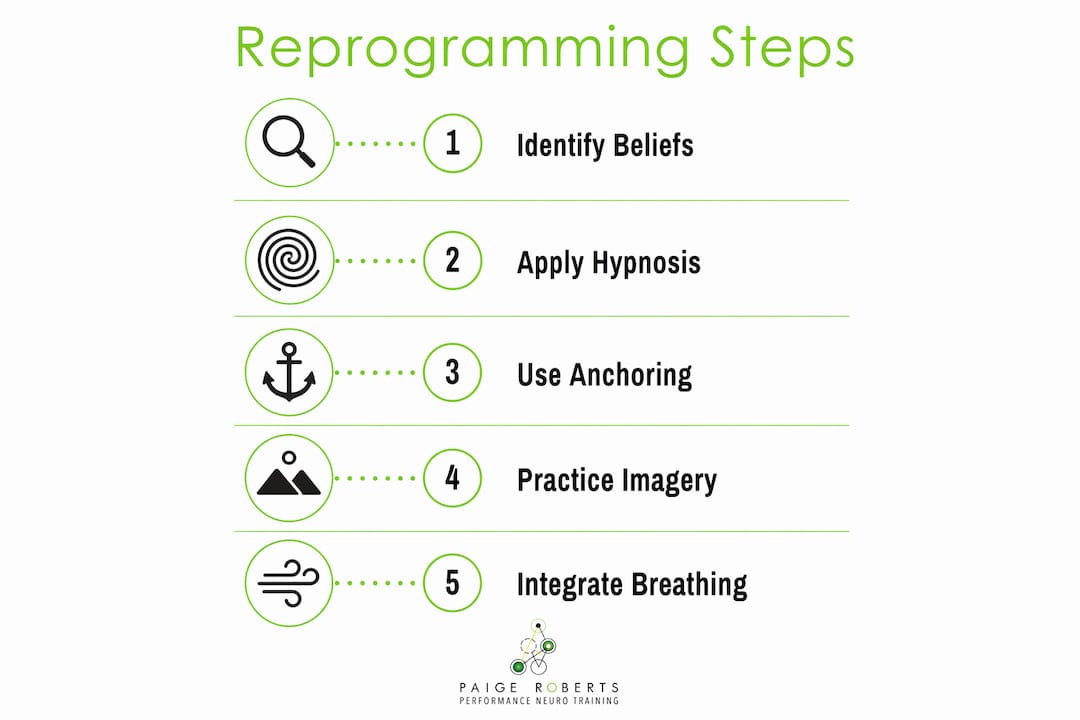
Reprogramming subconscious athletic beliefs means deliberately restructuring the automatic mental narratives and neural response patterns that govern how you perform under pressure. These beliefs form through years of training, competition outcomes, injury, and criticism. They operate below conscious awareness, which is exactly why positive thinking alone rarely moves the needle. The most effective methods for athletic belief transformation combine hypnosis, mental imagery, cognitive reframing, and anchored routines. Each targets a different layer of the nervous system, and 2026 research from institutions including the University of Montreal and Frontiers in Psychology confirms these approaches produce measurable physiological and cognitive changes.
What tools do you need to reprogram subconscious athletic beliefs?
Mental readiness is the first prerequisite. You cannot reprogram what you refuse to examine. Athletes who approach this work with curiosity rather than resistance move faster and retain gains longer. That openness is not a personality trait. It is a trainable stance, and it is the foundation every technique below depends on.
The core tools for subconscious sports conditioning fall into four categories:
- Hypnosis: Induces a receptive mental state that lowers defensive filtering and allows new belief scripts to be installed at the automatic level. A single hypnosis session improved executive function and heart rate variability in stressed participants, demonstrating real physiological impact.
- Mental imagery: Uses structured visualization to rehearse skill execution and success states, reinforcing neural pathways associated with confident, automatic performance.
- Cognitive reframing: Converts threat appraisals into challenge appraisals, changing the internal story that runs during high-stakes moments.
- Anchoring techniques: Pairs a physical gesture, mantra, or ritual with a desired mental state so that state can be retrieved automatically during competition.
Professional guidance accelerates all four. A sports psychologist or mental performance coach provides the structured protocol, monitors adherence, and adjusts intensity as you progress. Without that structure, most athletes practice only in calm conditions, which is insufficient for durable change.
| Tool | Prerequisite | Function |
|---|---|---|
| Hypnosis | Willingness to enter receptive state | Installs new belief scripts below conscious filtering |
| Mental imagery | Imagery ability and quiet practice space | Reinforces neural pathways for skill and confidence |
| Cognitive reframing | Awareness of current self-talk patterns | Converts threat appraisals into challenge responses |
| Anchoring | Completed hypnosis or imagery session | Triggers optimal mental state automatically in competition |
| Professional coaching | Access to qualified practitioner | Provides structure, evaluation, and protocol adjustment |
Pro Tip: Before your first session, write down three recurring negative beliefs you notice during competition. Specificity here is everything. "I freeze on penalty kicks" is far more useful than "I get nervous."
How to apply hypnosis and anchoring to shift deep-seated beliefs
Hypnosis works by reducing the brain's critical filtering, allowing new performance scripts to bypass the skepticism that blocks conscious affirmations. The 2026 study on stressed medical students found that hypnosis improved executive performance and parasympathetic recovery, meaning the nervous system actually shifted toward regulation rather than just feeling calmer. For athletes, this translates to faster recovery between high-pressure moments and more reliable access to trained skills.
Here is a step-by-step framework for a personalized hypnosis session focused on athletic belief transformation:
- Set a specific target belief. Choose one limiting belief per session. "I perform poorly after mistakes" is specific enough to work with.
- Enter a relaxed, receptive state. Use slow diaphragmatic breathing for three to five minutes. The goal is reduced cortical arousal, not sleep.
- Construct a sensory-rich success scenario. Imagine a competition moment where you execute perfectly. Include sound, physical sensation, crowd noise, and emotional tone. Elite athlete Jakub Dobeš uses sensory-rich hypnosis scenarios linked to specific mantras to create automatic confidence retrieval during matches.
- Install the anchor. At the peak of the success scenario, press two fingers together or repeat a short phrase. This pairs the physical cue with the optimal state.
- Repeat the anchor three times within the session to strengthen the association.
- Test the anchor in low-stakes practice before using it in competition.
Research on posthypnotic anchoring found that anchors increased grip strength in participants, with effects lasting at least one week. That is not a placebo effect on mood. That is a measurable physical output change driven by a mental cue.
Common pitfalls include rushing the relaxation phase, using vague scenarios, and abandoning anchors after one or two uses. Anchors require repetition to become automatic. Athletes who rely on automatic state triggers rather than willpower-based relaxation report far more consistent pre-competition readiness.
Pro Tip: Record your hypnosis sessions as audio. Listening back before sleep accelerates the consolidation of new belief scripts because the brain is already in a low-filtering state.
How does mental imagery reshape automatic neural pathways?
Mental imagery is the deliberate rehearsal of performance in the mind with enough vividness and structure to activate the same neural circuits used in physical execution. The PETTLEP model, developed by sport psychologists Jeff Holmes and Dave Collins, specifies that imagery must match the Physical, Environmental, Task, Timing, Learning, Emotion, and Perspective dimensions of the actual performance to produce transfer.
A 2026 systematic review of 16 studies on imagery in gymnasts found performance benefits, but with mixed evidence quality. The key moderators were imagery dose, athlete expertise, and session structure. Casual visualization produced weak results. Structured, script-based or PETTLEP-informed protocols produced meaningful gains. This distinction matters for coaches designing mental conditioning programs.
Effective imagery implementation follows these principles:
- Use first-person perspective for skill execution imagery to maximize neural overlap with physical performance.
- Match the real-time pace of the skill. Slowing down or speeding up reduces transfer.
- Include emotional content. Confidence, focus, and controlled arousal must be part of the image, not just technical execution.
- Progress from controlled to pressured scenarios. Start with a quiet gym, then add a crowd, a scoreboard, and a rival.
- Monitor imagery ability. Athletes with lower vividness scores benefit from guided scripts before independent practice.
Imagery reprogramming requires structure and adherence monitoring, not just inspirational visualization. Treat it as a training protocol with sets, reps, and progression, not a motivational habit.
| Imagery Type | Best Use Case | Transfer Strength |
|---|---|---|
| Cognitive-specific (CS) | Skill acquisition and technical refinement | High for technique |
| Motivational-general (MG) | Confidence and arousal regulation | High for mental state |
| PETTLEP-informed | Competition preparation and belief shifts | Highest overall |
Pro Tip: Progress your imagery under cognitive load. After mastering a scenario in silence, add a secondary task like counting backward from 100. This mirrors real competition demands and makes the reprogrammed response more durable.
How cognitive reframing and controlled breathing support belief change
Cognitive reframing is the practice of consciously replacing a threat appraisal with a challenge appraisal. When an athlete thinks "I can't handle this pressure," the nervous system responds with cortisol and sympathetic activation. Reframing that thought to "This pressure means this moment matters, and I've trained for it" produces a measurably different physiological response. The shift is not denial. It is a more accurate reading of the situation.
Practical reframing statements for athletes include:
- "Nerves mean my body is ready to perform."
- "A mistake is data, not a verdict."
- "I've been in harder situations and executed."
- "My preparation is already done. My job now is to trust it."
These statements work best when rehearsed in low-stakes settings until they become automatic responses. The 2026 ACT and hypnosis study found that a 7-week integrated program reduced negative experiential avoidance and improved processing speed under stress in 309 adolescent athletes. The mechanism was increased psychological flexibility, which is exactly what reframing builds.
Controlled breathing is the physiological partner to reframing. Box breathing (four counts in, four counts hold, four counts out, four counts hold) activates the parasympathetic nervous system within 90 seconds. Resonance breathing at approximately six breaths per minute maximizes heart rate variability, the same marker that improved in the hypnosis study. For mentally preparing for competition, a two-minute breathing sequence before warm-up sets the autonomic baseline for the entire performance.
The sequence that works in practice:
- Notice the limiting thought or physical tension signal.
- Apply two to three cycles of box breathing to lower arousal.
- Insert the reframing statement while the nervous system is receptive.
- Fire the anchor (gesture or mantra) to lock in the new state.
This four-step sequence integrates all the tools into a single pre-performance routine that athletes can execute in under three minutes.
How to practice these techniques under realistic pressure
Mental rehearsal practiced only in calm conditions produces calm-condition results. Cognitive load impairs subliminal processing in athletes, meaning the automatic scripts you build in quiet practice may not survive the attentional demands of real competition. This is the most commonly overlooked variable in mental conditioning programs.
The solution is progressive stress inoculation. You build the belief script in calm conditions, then systematically add cognitive and environmental demands until the response is automatic regardless of context.
| Training Context | Cognitive Demand | Expected Outcome |
|---|---|---|
| Quiet imagery session | Low | Belief script installation |
| Imagery with secondary task | Moderate | Script durability under distraction |
| Physical drill with anchor use | Moderate to high | Anchor reliability in movement |
| Simulated competition with pressure cues | High | Automatic state retrieval under stress |
| Full competition | Maximum | Transfer of reprogrammed beliefs |
Mental rehearsal under realistic cognitive load is the mechanism that converts a mental skill into an automatic competitive asset. Without this progression, athletes often report that their mental training "works in practice but not in games." That gap is a load problem, not a belief problem.
Common mistakes include skipping the dual-task phase, using anchors only in training, and never rehearsing the specific high-stakes scenarios that trigger the original limiting belief. For guidance on building psychological safety in team settings that support this kind of progressive mental training, the team environment matters as much as individual practice.
Pro Tip: Layer mental conditioning directly into physical and tactical drills. Fire your anchor before every repetition of a skill you associate with failure. This builds the association between the cue and successful execution in the exact context where you need it.
Key takeaways
Reprogramming subconscious athletic beliefs requires combining hypnosis, imagery, reframing, and anchoring with progressive cognitive load to produce durable, competition-ready mental shifts.
| Point | Details |
|---|---|
| Hypnosis produces real physiology | A single session improves executive function and heart rate variability, not just mood. |
| Anchors must be trained under load | Posthypnotic cues only transfer to competition when rehearsed under realistic cognitive demands. |
| Imagery needs structure and dose | PETTLEP-informed protocols outperform casual visualization for neural pathway change. |
| Reframing requires physiological support | Controlled breathing primes the nervous system to accept new belief scripts. |
| Integration beats isolation | A 7-week combined ACT, hypnosis, and imagery program outperformed single-method approaches in adolescent athletes. |
What I've learned from working at the intersection of neuroscience and athletic belief
Most athletes arrive expecting a mindset pep talk. What they actually need is a nervous system intervention. The beliefs that limit performance are not ideas. They are encoded physiological patterns, and they respond to physiological methods far more reliably than to conscious intention.
What I have observed consistently is that hypnosis anchors are the most underused tool in mental performance work. Athletes invest heavily in visualization and self-talk, but without an anchor, those practices stay in the conscious layer. The anchor is what drives the new belief into automatic territory, which is the only territory that matters when you are three seconds from a game-deciding moment.
Cognitive load is the variable that exposes every gap in a mental conditioning program. I have worked with athletes who had beautiful imagery practices that collapsed entirely under match pressure. The fix was never more visualization. It was always adding load to the practice context. The neuroscience behind sports psychology confirms this: automaticity requires practice under the conditions where automaticity is needed.
The athletes who make the most durable shifts are the ones who treat mental conditioning as a structured protocol with the same discipline they apply to physical training. Patience matters here. Meaningful subconscious reprogramming takes weeks, not sessions. But the athletes who stay consistent stop white-knuckling their way through pressure. They start performing from a place of trained automatic confidence, and that difference is visible to everyone in the arena.
— Paige
How Robertsneurotraining supports your mental performance work
Robertsneurotraining, led by Dr. Paige Roberts, applies a neuroscience-based framework to exactly the challenges described in this article. The program targets the nervous system directly through Alpha Imprinting, a method designed to clear trauma responses, mental blocks, and performance anxiety at the automatic level rather than the conscious one.

Athletes from Olympic medalists to professional league competitors have used Robertsneurotraining's protocols to move from anxiety-driven performance to flow states. The program integrates hypnosis, personalized anchoring, and neurofeedback into a structured progression that mirrors the load-based approach outlined here. If you are ready to move beyond surface-level mindset work, explore the full program at Robertsneurotraining and start building the automatic mental architecture that competition demands.
FAQ
What does it mean to reprogram subconscious athletic beliefs?
Reprogramming subconscious athletic beliefs means using structured techniques like hypnosis, imagery, and anchoring to replace automatic limiting mental patterns with performance-supporting ones. These methods target the nervous system directly, not just conscious thought.
How long does it take to see results from mental conditioning?
A single personalized hypnosis session produced measurable improvements in executive function and stress regulation, but durable belief shifts typically require consistent practice over several weeks. A 7-week combined program showed significant gains in attention and psychological flexibility in adolescent athletes.
Why do mental techniques fail under competition pressure?
Cognitive load reduces subliminal processing in athletes, meaning mental scripts built in calm conditions may not activate automatically under match stress. Training anchors and imagery under progressively demanding conditions is the fix.
What is a posthypnotic anchor and how does it work?
A posthypnotic anchor is a physical cue, such as a gesture or mantra, paired with a desired mental state during hypnosis. Research found that anchors increased grip strength with effects lasting at least one week, demonstrating that the cue can reliably trigger the trained state outside the hypnosis session.
Can coaches use these techniques without a sports psychologist?
Coaches can introduce reframing language, breathing protocols, and structured imagery into training. For hypnosis and personalized anchoring protocols, working with a qualified mental performance professional produces faster and more reliable results.