
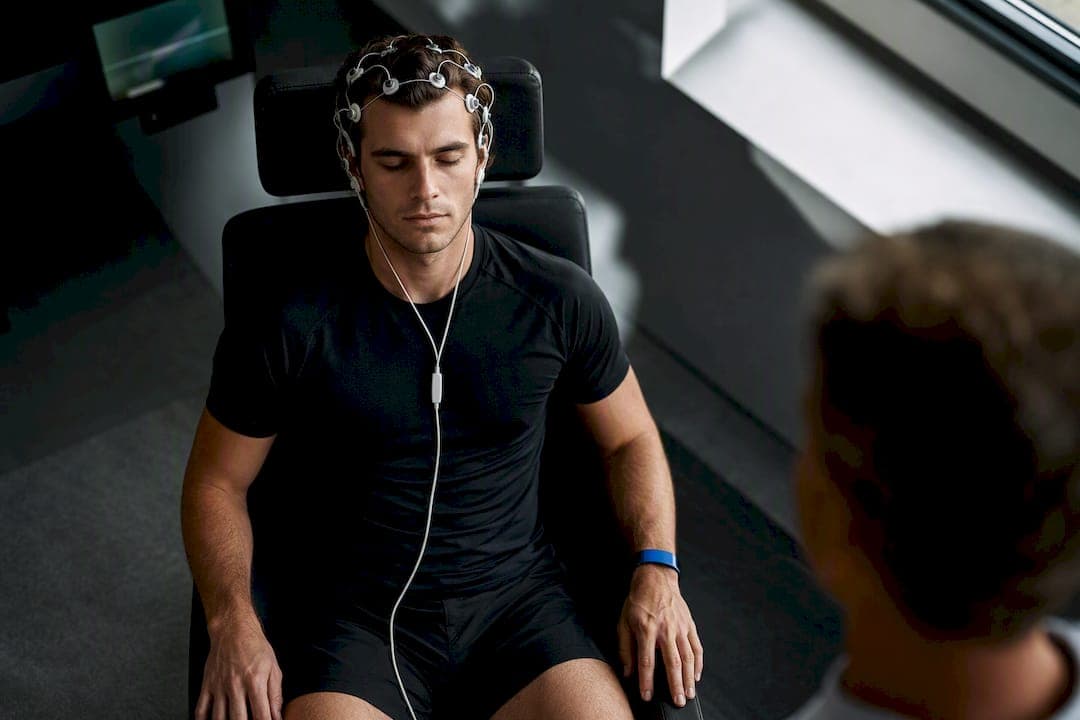
Neurofeedback helps athletes improve attention, reaction time, and anxiety regulation, but the evidence is still experimental, not definitive. Athletes in precision sports and those wrestling with performance anxiety tend to see the clearest gains. The next sections walk through the systematic reviews behind that verdict and what a real training program looks like.
TL;DR:
- Neurofeedback shows promise for reducing cortisol, improving reaction time, and enhancing motor coordination, especially in precision sports or stress-related issues.
- Study heterogeneity and limited sham-controlled trials mean the evidence remains promising but not fully conclusive for widespread claims.
- Effectiveness depends heavily on targeting specific problems like anxiety or focus, with technical performance gains being less consistently supported.
- Protocols typically span four to twelve weeks, with baseline assessment and behavioral tracking essential for measuring true progress.
- Individual response varies based on initial regulation levels, motivation, and profile, emphasizing the need for personalized evaluation and cautious expectations.
Table of Contents
- What Does Neurofeedback for Athletes Actually Involve?
- Systematic Reviews and RCT Evidence: How Strong Is the Research?
- How Does Neurofeedback Help Athletes Across Different Performance Domains?
- What EEG Protocols and Session Schedules Do Studies Use?
- Combining Neurofeedback With HRV Training and On-Field Practice
- What Are the Biggest Limitations in Neurofeedback Research?
- How Performance Neuro Training Applies This Research
- Do All Athletes Respond to Neurofeedback the Same Way?
- Is Neurofeedback Safe for Athletes to Try?
- How Do You Choose a Qualified Sports Neurofeedback Practitioner?
- How Do You Maintain Gains After Neurofeedback Training Ends?
- What Do Real-World Examples of Neurofeedback in Sports Look Like?
- When Should Athletes Try Neurofeedback, and How Should They Judge It?
- Ready to Try Alpha Imprinting? Here's How It Works
- Sources
What Does Neurofeedback for Athletes Actually Involve?
Neurofeedback trains an athlete's brain to self-regulate by showing them their own electrical activity in real time. An EEG cap picks up brainwave patterns, software translates them into a sound or visual cue, and the athlete learns, through repetition, to shift those patterns toward a target state. That is the whole mechanism. There is no injection, no supplement, no device doing anything to the brain. The brain is doing the work; the equipment just shows it a mirror.
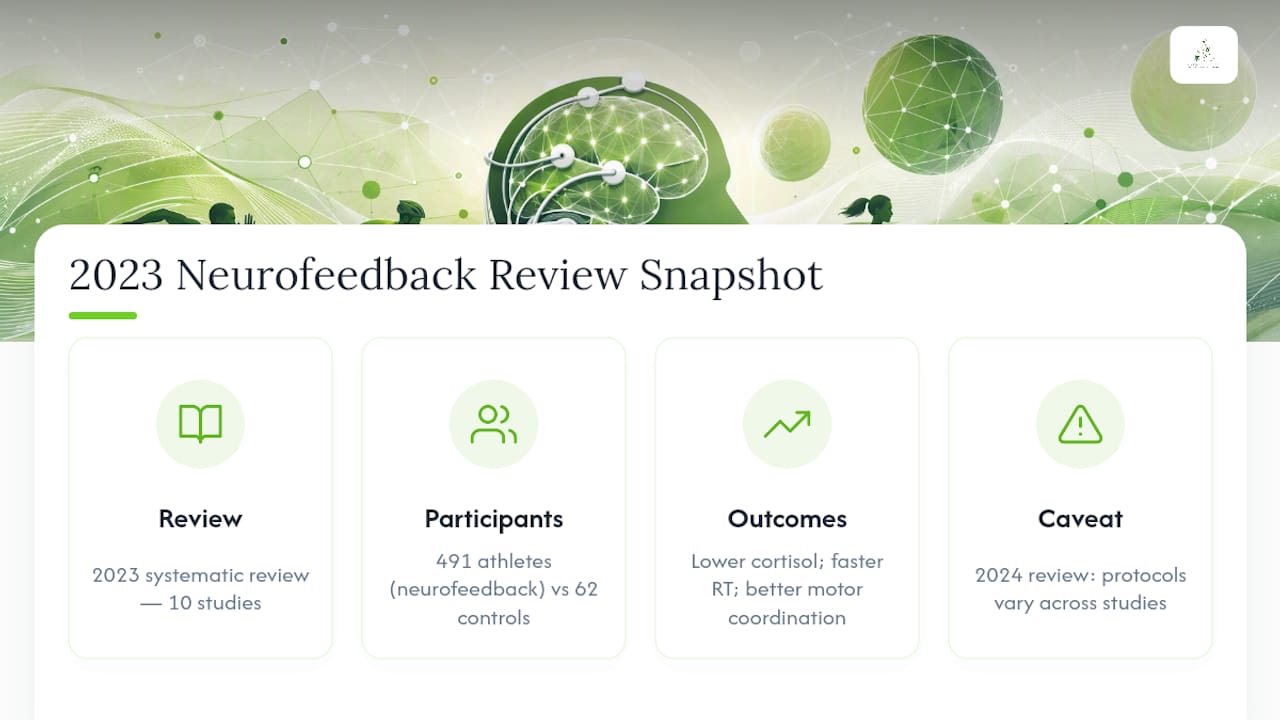
The research base has grown enough in the past few years to move this out of the "interesting but unproven" bin and into "promising with real caveats." A 2023 systematic review pooling 10 studies with 491 athletes in neurofeedback groups against 62 controls found consistent signals: lower cortisol, quicker reaction times, and better motor coordination across sports including judo, volleyball, and soccer. A 2024 Frontiers review reached a similar conclusion but added an important asterisk: the protocols across studies vary so much that comparing them directly is tricky.
Here is where the standard industry term matters. What most people casually call "brain training" is actually EEG neurofeedback, a specific biofeedback technique distinct from consumer gamified apps or generic brain training devices athletes might buy online. Neurofeedback uses live EEG data and clinical protocols; a phone app measuring reaction time on a puzzle is not the same category, even if it gets marketed with similar language. That distinction is worth holding onto as you read claims online, because the research below applies to clinical or practitioner-delivered neurofeedback, not to gamified apps.
Athletes most likely to benefit are those with a specific, targetable problem: a golfer whose putting falls apart under pressure, a shooter who can't quiet mental noise before the trigger pull, a returning athlete whose nervous system still fires a threat response during contact drills after an injury. Neurofeedback sports performance research so far says less about across-the-board performance boosts and more about correcting specific regulation problems.
Systematic Reviews and RCT Evidence: How Strong Is the Research?
The strongest data point comes from that 2023 systematic review, which is also the most frequently cited paper in this space. Ten studies, 491 neurofeedback participants, 62 controls, spanning research published between 2012 and 2022. The pooled findings showed decreased cortisol, faster reaction times, and improved motor coordination across multiple sports. That is a meaningful sample for a niche research area, but it is still a fraction of the size you'd want before calling any single protocol "standard of care."
A 2025 meta-analysis of real-time EEG neurofeedback in elite athletes reported a large pooled effect for cognitive and psychological outcomes, with a standardized mean difference around 1.26. That is a big number in effect-size terms, on par with some well-established performance interventions. But the same analysis reported heterogeneity (I2) near 94%, which means the studies barely resemble each other in design, dosage, or population. A large effect size sitting on top of that much inconsistency is a genuine finding, but not a settled one.
-
491 athletes studied across neurofeedback groups in the 2023 review, versus 62 controls, spanning judo, volleyball, soccer, and other sports.
-
A large pooled effect size for cognitive and psychological outcomes in the 2025 elite-athlete meta-analysis, though with very high heterogeneity among studies.
-
133 football players across seven studies in a 2026 review of football-specific outcomes, showing cognitive gains but limited technical transfer.
-
Roughly 29% of studies in a recent scoping review used active sham controls, and only about 6% used inert sham controls, per the EEG-based scoping review.
The pattern to notice: effect sizes look strong when studies find something, but the studies rarely agree on how neurofeedback should be delivered in the first place. That gap between "it works" and "we know exactly how" is the honest state of the field in 2026.
The football-specific data adds useful texture. A 2026 systematic review tracked 133 players across seven studies and found neurofeedback, usually targeting alpha or SMR bands, associated with cognitive improvements like working memory and decision-making speed. What it did not find was strong evidence for technical performance gains, things like shooting accuracy on the pitch. That is an important nuance: cognitive gains in a lab task do not automatically show up as better shots on goal.
Sham-controlled trials remain the weak link. Most neurofeedback studies compare a treatment group to a waitlist or an untreated control, not to a sham neurofeedback condition where participants think they're getting real feedback but aren't. Without that comparison, some portion of any measured improvement could come from attention, novelty, or simply believing the training works. Reviewers keep flagging this. It's the single biggest reason "neurofeedback works" claims deserve a qualifier rather than a period at the end of the sentence.
How Does Neurofeedback Help Athletes Across Different Performance Domains?
Break the research down by what athletes actually care about, and a clearer picture emerges than the "improves everything" framing you'll see on marketing pages.
Attention and concentration. Sustained-attention tasks and continuous performance tests show the most consistent improvement across studies. Athletes training SMR or beta bands report better ability to hold focus during repetitive or monotonous stretches of competition, the kind of dead time in a tennis match between points or a baseball at bat that separates sharp athletes from distracted ones.
Reaction time and decision-making. The 2023 systematic review specifically flagged faster reaction times as one of its clearest pooled outcomes. Working memory and task-switching speed, both proxies for in-game decision-making, also showed gains in the football-focused 2026 review, even though on-field technical transfer lagged behind.
Motor precision. This is where the theory gets interesting. SMR training in particular is tied to a concept called psychomotor efficiency, the idea that quieting certain sensorimotor brain rhythms reduces the "noise" that interferes with fine motor control. Small randomized trials have shown SMR training improving golf putting accuracy, which lines up with the broader theory that precision sports (golf, shooting, archery, putting greens) are where neurofeedback's mechanism has the clearest logical fit.
Stress, anxiety, sleep, and physiology. Cortisol reduction was one of the headline findings in the 2023 review. Lower cortisol after training suggests the nervous system is genuinely down-regulating its stress response, not just that athletes feel calmer subjectively. That matters for athletes whose performance anxiety shows up as physical symptoms: shaky hands, shallow breathing, racing heart before a big moment.
Novice versus elite athletes. The literature leans toward larger relative effects in athletes who start with more room to improve, meaning those with clear pre-existing regulation issues (documented anxiety, inconsistent focus, post-injury hesitation) tend to show bigger measured shifts than already highly regulated elite performers. That does not mean elite athletes see nothing. The 2025 meta-analysis specifically studied elite populations and still found a large pooled effect. It means the size of the gain often tracks how much dysregulation was there to begin with.
Pro Tip: If you're deciding whether neurofeedback is worth trying, ask yourself which domain is actually your bottleneck. An athlete whose technical skill is fine but whose mind goes blank under pressure is a very different case than an athlete who is technically inconsistent. Neurofeedback targets the former far more directly than the latter.
What EEG Protocols and Session Schedules Do Studies Use?
Most published protocols target one of four frequency bands, each tied to a specific intended effect:
- SMR (sensorimotor rhythm, roughly 12 to 15 Hz): the most common target in sports research, associated with calm, focused motor readiness. Used heavily in precision-sport studies like putting and shooting.
- Alpha (roughly 8 to 12 Hz): linked to relaxed alertness and reduced anxiety; frequently paired with SMR in combined protocols.
- Theta (roughly 4 to 8 Hz): tied to frontal midline theta activity associated with sustained attention and cognitive control during demanding tasks.
- Beta (roughly 13 to 30 Hz): targeted when the goal is sharper alertness or faster processing speed, though excessive beta training risks overstimulation in athletes already prone to anxiety.
Session structure in the research is not standardized, but a rough pattern shows up across studies: programs commonly run four to twelve weeks, with sessions delivered multiple times per week rather than as one-off treatments. Nobody in the credible literature is promising results from a single session, and any provider who does is worth being skeptical of.
Assessment typically starts with a QEEG baseline, a quantitative EEG map that shows an athlete's resting brainwave patterns before training begins. That baseline gives practitioners something to measure against later. From there, most programs track a mix of behavioral tasks (attention tests, reaction-time measures) alongside the raw EEG data, because brainwave shifts alone do not prove anything transfers to actual performance. The better studies pair the EEG data with sport-relevant behavioral outcomes; the weaker ones report only EEG change and call it a win.
Operationalizing "did this work" is the hard part. A practitioner watching band power shift during a session is seeing learning happen in real time. Whether that learning holds up three weeks later under competition pressure is a separate question, and one the current evidence answers unevenly.
Combining Neurofeedback With HRV Training and On-Field Practice
Neurofeedback rarely works best in isolation. Programs pairing it with heart rate variability (HRV) biofeedback show promise for improving stress-recovery capacity, since HRV training targets the autonomic nervous system's ability to shift out of fight-or-flight, a complementary target to neurofeedback's more cortical focus. The catch: these combined-protocol studies are small, and because the interventions are stacked together, it's hard to know how much of the benefit comes from neurofeedback specifically versus the HRV work. Athletes exploring stress inoculation training built around HRV will find it fits naturally alongside neurofeedback rather than competing with it.
Timing matters more than most programs acknowledge. Neurofeedback sessions scheduled right before technical practice, rather than as a standalone clinic visit disconnected from training, give the brain a chance to apply the regulation skill while the body is actually doing sport-specific movement.
A basic coach checklist:
- Run a baseline assessment (QEEG plus a relevant behavioral task) before starting any protocol.
- Schedule neurofeedback sessions close to skill practice, not on isolated days with no sport context.
- Progress gradually into higher-pressure simulated conditions as training advances.
- Track a behavioral metric, not just subjective reports of "feeling calmer."
Pro Tip: The single most common mistake is treating neurofeedback like a spa treatment, done in a quiet clinic room disconnected from the sport itself. Learning to regulate alpha waves in silence does not automatically transfer to regulating them in a stadium. Push toward ecologically valid, noisy, pressure-filled practice as soon as the basic skill is established.
What Are the Biggest Limitations in Neurofeedback Research?
Every honest conversation about this field has to include its weak points, because the marketing around neurofeedback often outruns what the studies support.
Sample sizes remain small by clinical-research standards. Ten studies and 491 participants sounds substantial until you compare it to the thousands of participants behind an established sports-medicine intervention. Protocols also vary wildly. One study's "SMR training" is not identical to another's, which makes pooling results across studies statistically messy, exactly the heterogeneity problem showing up as that 94% I2 figure in the elite-athlete meta-analysis.
Sham controls are the biggest structural gap. A scoping review of 48 studies found only about 29% used an active sham condition and just 6% used an inert sham, meaning most of the field cannot fully rule out placebo or expectancy effects. Athletes are famously responsive to belief and ritual; if you believe a treatment will calm you down, sometimes it does, regardless of the mechanism.
What the field needs next is straightforward: standardized EEG target protocols so studies can actually be compared, larger sham-controlled RCTs, and more attention to ecological validity, meaning testing whether lab gains hold up in real competition, not just on a screen in a clinic.
Red flags worth watching for when evaluating a provider:
- Promises of results after one or two sessions.
- No baseline QEEG or objective measurement of any kind.
- Vague claims of "rewiring the brain" with no explanation of which frequency band or protocol is being trained.
- No plan to progress training into actual sport-specific stress conditions.
How Performance Neuro Training Applies This Research
A neurofeedback protocol can be built around the core idea that the nervous system holds onto stress and trauma responses that show up as performance anxiety, mental blocks, or hesitation after injury, and targeted training can help reprogram that response. Such approaches may be developed specifically for athletes navigating those obstacles, rather than adapting a generic clinical protocol after the fact.
Some neurofeedback programs start with objective baseline measurement through QEEG brain scans, use that data to guide the training plan, and track progress against measurable markers rather than relying purely on how an athlete says they feel. This baseline-then-track approach helps distinguish credible neurofeedback programs from vague "brain training" claims.
A few practical notes on fit:
- Athletes recovering from injury who've developed a fear response tied to specific movements are a strong match for this kind of nervous-system-focused work.
- Precision-sport athletes (golf, tennis, shooting, equestrian disciplines) often see the clearest connection between the training's mechanism and their competitive demands.
- Athletes managing performance anxiety that shows up physically, tight chest, shaky hands, racing thoughts before competition, fit the same profile the cortisol-reduction research points toward.
Testimonials from athletes describe measurable performance shifts after working through neurofeedback programs, though as with any provider's track record, individual results vary and specific credentials and case documentation should be reviewed directly with the provider.
Do All Athletes Respond to Neurofeedback the Same Way?
No, and the research is fairly clear on this point even if it doesn't fully explain why. Some athletes show rapid, measurable shifts in brainwave patterns within a handful of sessions. Others need considerably longer to demonstrate the same self-regulation skill, and a smaller subset show minimal EEG change at all despite consistent training.
Baseline dysregulation appears to be one driver. Athletes who start with clear anxiety symptoms, documented sleep disruption, or a strong post-injury stress response tend to have more room to move, and the literature reflects that: bigger baseline problems often correlate with bigger measured gains. An elite athlete who is already well-regulated may see a smaller shift simply because there's less to correct, not because the training failed.
Individual EEG profiles also differ. Two athletes targeting the same SMR band can have meaningfully different starting brainwave patterns, which is exactly why a QEEG baseline matters before training begins rather than applying a one-size protocol to everyone. Motivation and engagement during sessions likely play a role too, since neurofeedback is an active learning process, not a passive treatment; an athlete who tunes out during sessions gets less out of them than one actively working to shift their internal state.
Age, prior meditation or mindfulness experience, and general trainability of attention may all factor in, though the research hasn't isolated these variables cleanly enough to make firm predictions. The honest takeaway: expect variability, track your own data, and don't assume a friend's four-week timeline will match yours.
Is Neurofeedback Safe for Athletes to Try?
Neurofeedback carries a favorable safety profile compared to most performance interventions, largely because it's not invasive and doesn't involve medication. The EEG sensors read electrical activity; they don't send current into the brain in standard neurofeedback (that's a different technique called neurostimulation). Still, "generally safe" doesn't mean "no considerations."
Some athletes report mild, temporary side effects during early sessions: headache, fatigue, or a brief feeling of mental fog after concentrated training, similar to how a hard cognitive workout can leave you tired. These effects tend to fade as sessions progress and typically resolve within a day.
A more athlete-specific consideration involves overtraining certain frequency bands. Excessive beta training aimed at boosting alertness can, in some cases, increase anxiety or disrupt sleep if pushed too aggressively, which is part of why a qualified practitioner adjusts protocols based on an athlete's baseline rather than applying the same target to everyone. Athletes with a history of seizures or certain neurological conditions should disclose that history before starting, since baseline brain activity assessment is part of responsible protocol design.
Timing around competition also deserves thought. Introducing a brand-new protocol immediately before a major event, when an athlete has no track record with how their brain responds, adds an unnecessary variable. Most practitioners recommend establishing a baseline and a few sessions of familiarity well before it matters most, not during a taper week. As with any performance intervention touching the nervous system, working with a qualified provider who monitors response session to session is the safest path.
How Do You Choose a Qualified Sports Neurofeedback Practitioner?
Not every neurofeedback provider understands athletic performance, and not every sports psychologist understands EEG protocols. The overlap you want is specific, and it's worth screening for directly.
Ask whether the practitioner uses a QEEG baseline before designing any protocol. If the answer is no, or if they're proposing a generic template regardless of your brain data, that's a meaningful gap in rigor. Ask what frequency bands they target and why, tied to your specific issue (anxiety, focus, post-injury response) rather than a one-size answer for everyone who walks in.
Ask how they measure progress. A credible practitioner tracks something concrete, a behavioral task, a reaction-time measure, a documented change in reported symptoms, alongside the raw EEG shifts. "You'll just feel better" is not a measurement plan.
Ask about sport-specific experience. Someone who has worked with equestrian athletes managing pre-competition nerves understands a very different pressure profile than someone who's only worked with combat-sport athletes on impact-related trauma. Sport context shapes how training gets applied.
Finally, ask how they handle the transition from clinic-based sessions to real competitive pressure. A practitioner with no plan for that transfer is stopping at the easiest part of the work. For a deeper look at how these programs typically apply neuroscience principles across sports, see this overview of neuroscience-based training.
How Do You Maintain Gains After Neurofeedback Training Ends?
Neurofeedback teaches a skill, not a permanent installation, and skills fade without use. Most practitioners recommend periodic "booster" sessions, spaced weeks or months apart, once initial training concludes, rather than assuming the nervous system's new regulation pattern is locked in forever.
Between formal sessions, athletes can reinforce the underlying skill through consistent practice that echoes what the training targeted. If your protocol focused on calm, sustained attention, structured breathing work or brief daily focus drills done under mild simulated pressure help keep that neural pathway active. This is where mindfulness for athletic performance fits naturally alongside neurofeedback rather than as a separate, unrelated practice.
Tracking matters here too. Athletes who keep a simple log, noting focus quality, anxiety levels before competition, or sleep consistency, give themselves (and any practitioner they check back in with) real data on whether the gains are holding or slipping. Competitive seasons with heavy travel, injury setbacks, or major life stress are the moments most likely to erode progress, and they're also the moments worth scheduling a check-in session rather than waiting for performance to visibly decline first.
The realistic expectation: think of maintenance the way you'd think of physical conditioning. Nobody trains hard for eight weeks, stops entirely, and expects the fitness to stay. The nervous system works on a similar principle.
What Do Real-World Examples of Neurofeedback in Sports Look Like?
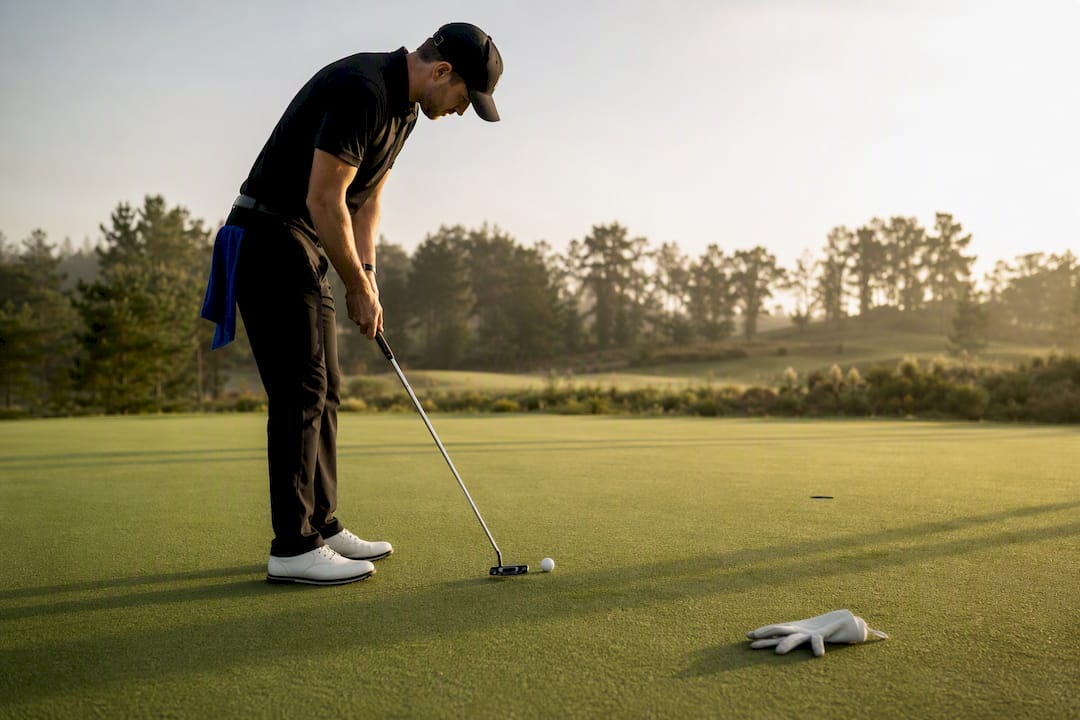
The clearest documented cases in the literature come from precision and combat sports, where the connection between calm focus and outcome is direct and measurable. Golfers in small randomized trials training SMR bands showed improved putting accuracy, a result that lines up cleanly with the psychomotor efficiency theory: quieter sensorimotor noise, steadier stroke.
The football research offers a different kind of example. Across the seven studies covering 133 players, cognitive testing showed real gains in working memory and decision-making speed, the kind of split-second read that separates a player who sees the pass developing from one who reacts a beat late. What didn't show up as clearly was technical performance, shooting accuracy stayed largely unchanged, a useful reminder that cognitive improvement and skill execution are not the same thing.
Judo, volleyball, and soccer athletes in the pooled 2023 review showed reductions in cortisol alongside faster reaction times, suggesting the stress-regulation piece generalizes across very different sport demands, from grappling under time pressure to reading a fast-moving ball.
Beyond the published research, practitioner-reported cases (including athletes working through programs like Alpha Imprinting) describe similar patterns: performance anxiety easing enough to compete without the physical anxiety symptoms that used to derail focus, and post-injury athletes regaining confidence in movements that previously triggered a hesitation response. These accounts are consistent with the mechanism the research describes, though they carry the same caveat as any single provider's case reporting: they illustrate what's possible, not a guaranteed outcome for every athlete.
When Should Athletes Try Neurofeedback, and How Should They Judge It?
Neurofeedback deserves a place in serious performance planning, but it should be approached the way any athlete approaches an experimental training method: with clear expectations and a plan for measuring whether it's actually working, not blind faith that it will.
Prioritize it first if you have a specific, nameable problem. Chronic pre-competition anxiety, a post-injury hesitation you can point to, a mental blank spot that shows up under pressure and nowhere else. Those are the profiles where the research signal is strongest. If your issue is purely technical, a swing flaw, a footwork problem, neurofeedback is not the right first tool. Fix the mechanics first.
Measure value the same way a good coach measures any intervention: pick one or two concrete markers before you start (a reaction-time test, a self-rated anxiety score before competition, sleep quality) and track them across the training period. If nothing moves after a reasonable stretch of consistent sessions, that's real information, not a reason to feel discouraged, but a reason to reassess with your practitioner rather than continuing indefinitely on faith.
The field is still writing its own rulebook. Treat any provider's confidence as a starting point for questions, not a substitute for your own data.
— Paige
Ready to Try Alpha Imprinting? Here's How It Works
Robertsneurotraining's Alpha Imprinting protocol targets the specific problems this article keeps circling back to: performance anxiety that shows up physically before competition, post-injury hesitation that lingers after the body has healed, and the energy drain that comes from carrying unresolved stress into every training session. It's built for athletes who've already tried working harder and need their nervous system, not just their technique, to catch up.
The process starts with an assessment, using QEEG brain scans to map where your nervous system is actually holding tension, rather than guessing based on symptoms alone. From there, the 10-week Energy Optimization Program or 1:1 sessions build a training plan around that data, with progress tracked against measurable markers instead of vague check-ins. Whether you're managing pre-competition nerves in an individual sport or working through a post-injury mental block, the structure adapts to your specific case rather than applying one template to everyone.
If you recognize your own competitive struggles in what's described here, the next step is straightforward: visit the Alpha Imprinting program page to see how the assessment works and get started.
Sources
- The Use of Neurofeedback in Sports Training: Systematic Review (PMC)
- Evaluating EEG neurofeedback in sport psychology: a systematic review (Frontiers)
- Effects of real-time EEG neurofeedback training on cognitive, mental, and motor performance in elite athletes: systematic review and meta-analysis
- Neurofeedback in Football: A Systematic Review of Cognitive, Technical, Physical and Psychological Outcomes (MDPI / PubMed entry)