
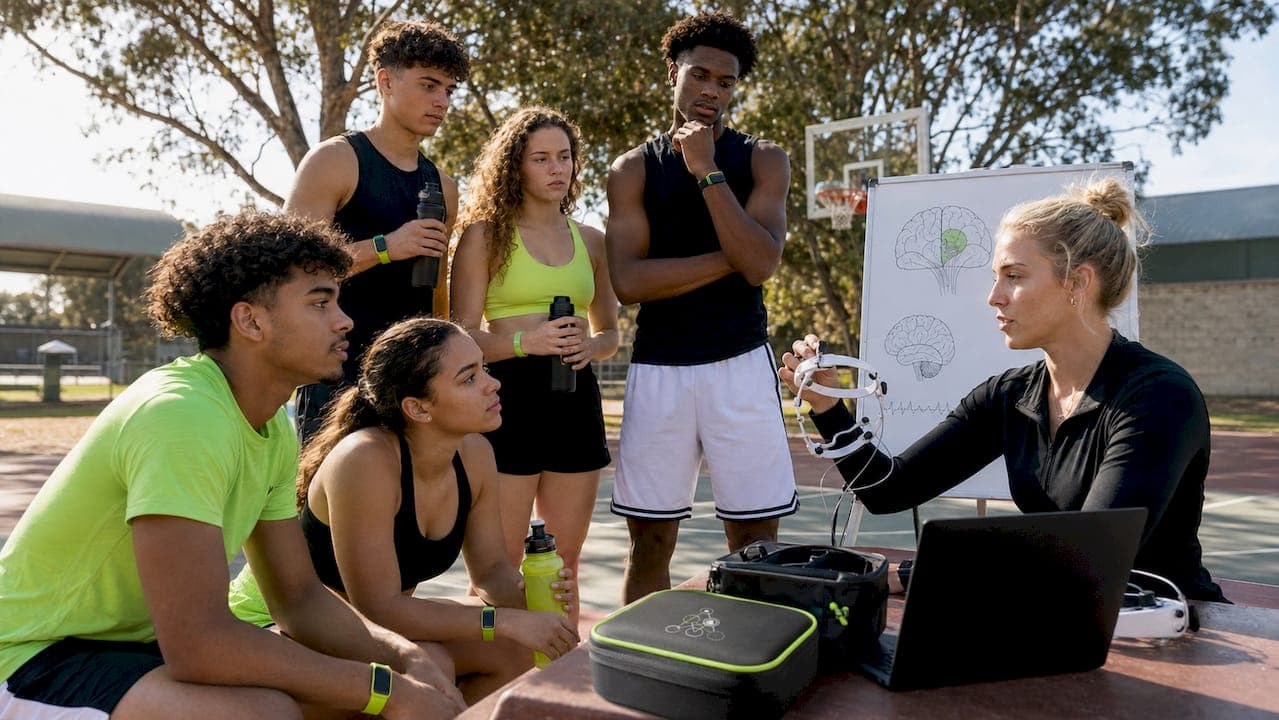
Team performance neuroscience is defined as the study of how brain and nervous system processes synchronize among team members to drive collective effectiveness, resilience, and peak output under pressure. A January 2025 study in Social Cognitive and Affective Neuroscience tracked 890 participants and found that higher prefrontal cortex synchronization directly predicts better team outcomes. That finding reframes how coaches and athletes should think about preparation. The real competitive edge is not just individual skill. It lives in the neural alignment between teammates, and it is measurable.
What is team performance neuroscience and why does it matter for sports?
Team performance neuroscience is the applied study of interbrain synchrony, nervous system co-regulation, and bidirectional neural communication as they shape how groups compete and recover together. The field draws on cognitive neuroscience, relational neuroscience, and sports psychology to explain what actually happens in the brain when a team clicks or falls apart. For athletes and coaches, this is not abstract science. It is a map of the mechanisms behind trust, communication, and collective resilience.
The brain regions most central to this field include the dorsolateral prefrontal cortex, which governs decision-making and working memory, and the orbitofrontal cortex, which processes social reward and group identity. June 2025 hyperscanning research confirmed that group identification links to neural synchrony in the orbitofrontal cortex, while individual performance anchors in the dorsolateral prefrontal cortex. These two systems work together. When they align across teammates, the team performs at a higher level.

The standard industry term for this field is applied performance neuroscience, and team performance neuroscience is its collective dimension. Both terms appear throughout sports science literature, and coaches benefit from knowing both. Robertsneurotraining uses this science as the foundation for its training methods, including nervous system reprogramming for athletes dealing with mental blocks, performance anxiety, and trauma responses.
How does neural synchrony shape team dynamics in sports?
Neural synchrony is an active, measurable process, not a metaphor for good chemistry. The Korn Ferry Institute and Wharton Neuroscience Initiative describe synchrony as the scientific basis for what coaches have long called team chemistry. It creates alignment of neural activity, behaviors, and emotions across individuals. That alignment speeds up learning and sharpens communication in real time.
Researchers measure interbrain synchrony using hyperscanning technologies, including functional near-infrared spectroscopy (fNIRS) and EEG. These tools record brain activity from multiple people simultaneously during cooperative tasks. The data shows that when teammates synchronize, their neural patterns mirror each other across regions tied to attention, movement planning, and social cognition.
Key findings from hyperscanning research show that neural synchrony produces specific, measurable benefits for sports teams:
- Faster learning: Synchronized teams acquire new plays and strategies more quickly because shared neural states reduce the cognitive load of interpretation.
- Improved communication: Aligned brain activity predicts cleaner, faster information exchange between players without verbal instruction.
- Higher trust: Neural alignment correlates with increased willingness to take risks and rely on teammates in high-pressure moments.
- Better collaboration: Shared intentionality and aligned mental representations emerge naturally when synchrony is present, reducing friction during complex plays.
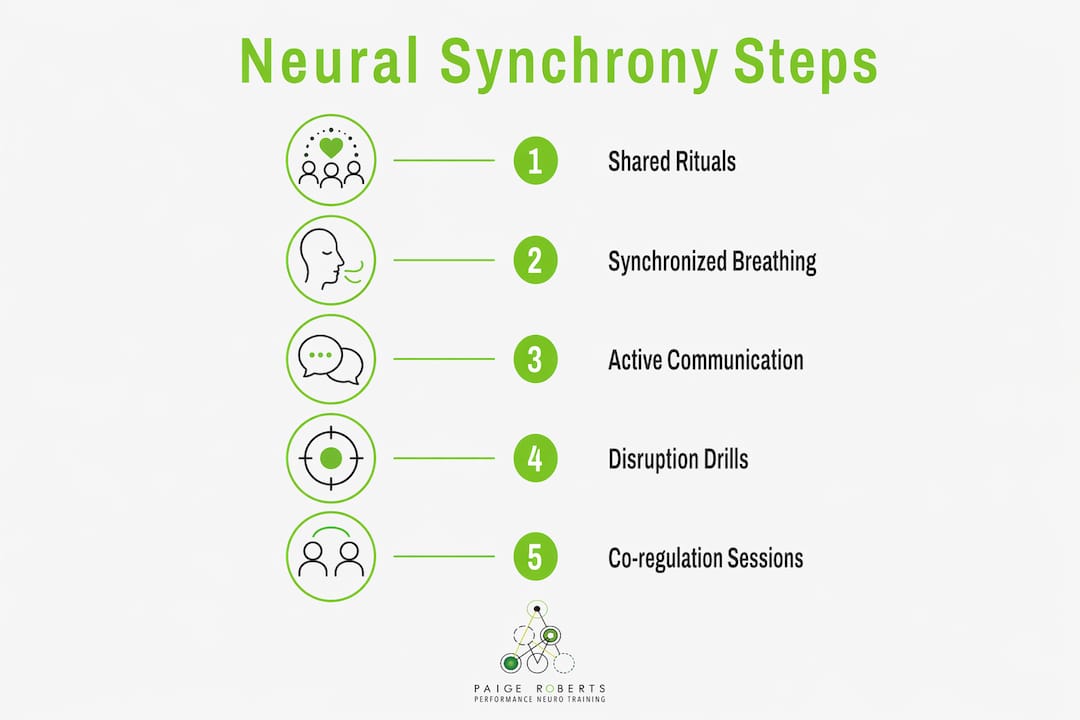
Pro Tip: Build pre-game rituals that the entire team performs together. Shared rhythmic activity, such as synchronized breathing or coordinated warm-up sequences, primes interbrain synchrony before competition begins.
Synchrony is not passive. Coaches can actively cultivate it through structured team routines, and neuroscience-based training methods now give athletes practical tools to build this alignment systematically.
How does nervous system co-regulation build collective resilience?
Relational neuroscience establishes that the brain and body do not regulate themselves in isolation. They co-regulate through social connection. When teammates share physical space and emotional attunement, their autonomic nervous systems influence each other. This process is the biological foundation of psychological safety in sports teams.
Heart rate variability (HRV) is one of the clearest biomarkers of this process. Peak performance depends on optimizing both the central nervous system and the autonomic nervous system, with HRV reflecting the body's capacity for focus and emotional regulation under stress. A team whose members show synchronized HRV patterns is a team whose nervous systems are working together. That coordination translates directly to composure under pressure.
Chronic interpersonal stress breaks this down. When conflict or distrust persists within a team, prefrontal cortex function degrades. Decision-making slows. Problem-solving becomes reactive rather than proactive. The neural cost of a toxic team environment is not metaphorical. It is measurable in brain function.
Practical steps for building relational capacity in a team include:
- Presence over performance: Create space in practice for athletes to check in with each other without an agenda tied to results.
- Curiosity-driven conversations: Coaches who ask open questions rather than issuing directives activate the social brain networks that support co-regulation.
- Safe conflict resolution: Teams that address tension directly and quickly prevent the chronic stress that degrades prefrontal function.
- Shared recovery practices: Breathwork, cold exposure, and mindfulness done as a group reinforce autonomic co-regulation across the team.
Investing in relational capacity and nervous system co-regulation across a team is more effective for performance under pressure than individual intelligence or resilience apps alone. — 2024 neuroscience framework
Pro Tip: Schedule one weekly team session focused entirely on relational connection, with no performance metrics attached. The psychological safety this builds pays dividends in crunch moments.
How does neuroscience explain leadership emergence in sports teams?
Leadership in sports teams is a measurable neural phenomenon. A July 2025 study using fNIRS hyperscanning and Granger causality analysis found that information flow between leaders and followers is bidirectional and spatially distinct across brain regions. Leadership does not flow in one direction. It is a dynamic, reciprocal exchange between the brain of the person leading and the brains of those following.
The brain regions involved are specific. The middle temporal gyrus, associated with social cognition and language processing, and the sensorimotor cortex, tied to action coordination, both show distinct activation patterns in leaders versus followers during cooperative tasks. This spatial hierarchy means that effective leadership communication is not just about what a coach says. It is about how the brain of the listener processes and responds at a neural level.
The sequential stages of leadership-related neural signaling in team settings follow a clear pattern:
- Signal initiation: The leader's prefrontal cortex generates a decision or directive, activating planning and social prediction networks.
- Transmission: Neural signals travel through language and social cognition regions, including the middle temporal gyrus, shaping how the message is encoded.
- Reception: Follower brains process the signal through their own sensorimotor and prefrontal networks, generating a response state.
- Feedback loop: Follower neural activity feeds back to the leader's brain, adjusting subsequent signals in real time.
- Synchrony consolidation: Repeated successful exchanges build a shared neural pattern that makes future coordination faster and more automatic.
This model has direct implications for sports coaching. A coach who reads the room and adjusts communication style is not just being intuitive. That coach is participating in a live neural feedback loop with the team. Training coaches to recognize and respond to these signals is one of the most direct applications of team dynamics neuroscience in practice.
How do teams maintain neural synchrony under pressure and disruption?
Neural flexibility is defined as a team's capacity to re-establish synchrony after disruptions. A 2026 study in Behavioral and Brain Functions found that neural flexibility matters more for long-term resilience and performance than maintaining constant synchrony. That distinction is critical. No team stays perfectly synchronized through an entire competition. The teams that win are the ones that recover alignment fastest.
Disruptions that break synchrony include substitutions, referee decisions, injuries, and momentum shifts. Each of these events introduces a neural reset moment. Teams without flexibility stall. Teams with trained neural adaptability re-synchronize quickly and return to effective collective function.
| Synchrony state | What it looks like on the field | Performance outcome |
|---|---|---|
| High and stable | Fluid passing, anticipatory movement, shared reads | Peak collective output |
| Disrupted | Miscommunication, hesitation, individual play | Reduced effectiveness |
| Recovered quickly | Rapid re-alignment after a setback or substitution | Resilient performance |
| Chronically low | Persistent conflict, poor coordination, low trust | Consistent underperformance |
Coaches can train neural flexibility directly. Deliberate disruption drills, where teams practice re-establishing communication and coordination after a simulated breakdown, build the neural pathways that support fast recovery. Team cohesion through neuroscience is not a fixed state. It is a practiced skill.
Pro Tip: Introduce controlled disruption scenarios in practice, such as sudden rule changes or unexpected lineup shifts, and debrief on how quickly the team re-synchronized. Tracking recovery speed builds awareness of the team's neural flexibility.
Key takeaways
Team performance neuroscience shows that collective resilience depends on interbrain synchrony, nervous system co-regulation, and neural flexibility, not individual talent alone.
| Point | Details |
|---|---|
| Interbrain synchrony drives outcomes | Higher prefrontal cortex synchronization directly predicts better team performance in competitive settings. |
| Co-regulation builds pressure resilience | Autonomic nervous system alignment across teammates supports composure and decision-making under stress. |
| Leadership is a neural feedback loop | Effective coaching involves bidirectional brain-level exchanges, not one-way instruction. |
| Neural flexibility beats constant synchrony | Teams that recover alignment quickly after disruptions outperform those that try to maintain perfect synchrony. |
| Relational capacity is trainable | Structured team practices that build psychological safety and shared nervous system states improve collective output. |
My experience applying neuroscience to team performance
Most coaches I work with come in focused on individual athletes. They want to fix the one player who freezes under pressure or the one who loses focus after a mistake. That is a reasonable starting point. But the research keeps pointing to the same conclusion: the space between athletes matters as much as what is happening inside any single brain.
What surprised me most when I started integrating relational neuroscience into my work was how quickly teams shifted when we addressed co-regulation rather than individual performance metrics. A team that learns to breathe together, to read each other's nervous system states, and to recover synchrony after conflict starts performing differently within weeks. The change is not subtle.
The common misconception I push back on hardest is the idea that resilience is a solo skill. Coaches invest in individual mental toughness programs and wonder why the team still falls apart in the fourth quarter. The answer is almost always relational. The nervous systems in that locker room are not co-regulating. They are competing with each other even when the game is supposed to bring them together.
Methods like Alpha Imprinting, which Robertsneurotraining uses to reprogram the nervous system at a deep neural level, work for individual athletes. But the next frontier is applying those principles to the relational field of the team. When you train the nervous system of each athlete and then create conditions for those nervous systems to align, you get something that no amount of individual training produces on its own. You get a team that performs as a single, adaptive organism.
— Paige
Robertsneurotraining's approach to team neural performance
Robertsneurotraining works with athletes and coaches who want to move beyond conventional mental skills training and address performance at the level of the nervous system.
The program's Alpha Imprinting method reprograms the nervous system to clear mental blocks, reduce performance anxiety, and create the neural conditions for flow states during competition. For teams, this means each athlete arrives at the collective environment with a more regulated, responsive nervous system, which directly supports interbrain synchrony. Robertsneurotraining also offers QEEG brain scans that provide a personalized map of each athlete's neural patterns, giving coaches and athletes precise data to guide training decisions. Athletes at every level, from high school competitors to Olympic medalists, have used these methods to recover performance and build lasting resilience. Visit Robertsneurotraining's services to see the full range of programs available for athletes and teams.
FAQ
What is team performance neuroscience?
Team performance neuroscience is the study of how brain and nervous system processes, including interbrain synchrony and autonomic co-regulation, interact among team members to produce collective effectiveness and resilience in competitive settings.
How does interbrain synchrony affect sports teams?
Interbrain synchrony aligns neural activity, behaviors, and emotions across teammates, producing faster learning, cleaner communication, and higher trust. Research tracking 890 participants confirmed that prefrontal cortex synchronization directly predicts better team outcomes.
Can coaches train neural synchrony in their teams?
Yes. Shared pre-game rituals, synchronized breathwork, deliberate disruption drills, and relational check-ins all build the neural alignment that supports team synchrony. Neural flexibility, the ability to recover synchrony after disruption, is a trainable skill.
What role does the autonomic nervous system play in team performance?
The autonomic nervous system governs the body's stress and recovery responses. When teammates co-regulate their autonomic states through shared practices, heart rate variability improves and the prefrontal cortex maintains the function needed for clear decision-making under pressure.
How does Robertsneurotraining support team neuroscience goals?
Robertsneurotraining uses Alpha Imprinting and QEEG brain scans to train each athlete's nervous system for regulation, flow, and resilience. A regulated individual nervous system is the building block for the collective neural alignment that drives team performance.