

Team cohesion is defined neurologically as the synchronized alignment of brain states, emotional regulation, and shared situational awareness that enables groups to perform beyond individual capacity. Team leaders and sports coaches who understand how to enhance team cohesion through neuroscience gain a measurable edge: research from Google's Project Aristotle identifies psychological safety as the single strongest predictor of team effectiveness, outranking rank, tenure, or technical expertise. The underlying mechanisms include neural synchrony, social brain activation, and autonomic co-regulation. These are not abstract concepts. They are trainable, measurable, and directly applicable to how you run a practice, lead a meeting, or respond under pressure.
How neuroscience explains team cohesion
The psychology of team cohesion has a clear neurobiological foundation, and it starts with psychological safety. When team members feel safe to speak, fail, and challenge ideas, the amygdala down-regulates its threat response. This allows the prefrontal cortex to take over, the region responsible for complex reasoning, empathy, and collaborative problem-solving. Psychological safety acts as the neurobiological infrastructure for high-performing teams. Without it, the brain stays in a defensive state, and cohesion collapses under pressure.
Neural synchrony is the second pillar. The Korn Ferry Institute's research shows that inter-brain synchrony predicts collective performance by aligning brain waves, emotions, and physical states across team members. This synchrony is causal, not just correlational. Teams that achieve it make better decisions, build trust faster, and sustain cooperation under stress. For a sports coach, this explains why some lineups click immediately while others with equal talent never gel.
The Social Brain network, which includes regions like the medial prefrontal cortex and the temporoparietal junction, supports empathy, perspective-taking, and communication. Shared decision-making enables brains to synchronize more effectively and produce integrative, high-quality outcomes. Teams that distribute responsibility activate this network more broadly, which means more of the team's collective intelligence gets used.
The most underappreciated insight in neuroscience in teamwork is the leader's role as a nervous system regulator. A leader's emotional regulation creates the emotional tone of the entire team environment. Your nervous system is contagious. If you walk into a locker room dysregulated, anxious, or emotionally flat, your team's nervous systems mirror that state within minutes. This is not metaphor. It is neurobiology.

Pro Tip: Before any high-stakes team interaction, take two minutes to regulate your own nervous system through slow diaphragmatic breathing. Your team's collective state will follow yours.
Team cohesion and performance also share a reciprocal relationship built through shared goals, mutual support, and neurocognitive synchrony. Cohesion drives performance, and strong performance reinforces cohesion. Coaches who understand this loop stop treating team chemistry as a soft variable and start treating it as a performance metric.
Neuroscience-based techniques to build team unity
Applying neuroscience strategies for teams does not require a lab. The most effective methods are behavioral, repeatable, and grounded in how the brain actually works.
-
Build psychological safety deliberately. Start every team meeting or practice with a brief check-in where each person speaks without interruption. This simple ritual signals to the amygdala that the environment is safe. Over time, it lowers the team's collective threat response and opens the door to honest communication. Explore psychological safety in sports for sport-specific protocols that reinforce this practice.
-
Use shared rhythmic activities to cultivate neural synchrony. Low-tech behaviors like synchronized movement, call-and-response drills, and group breathing exercises align neural activity across team members. In sports, warm-up routines done in unison serve this function. In corporate teams, structured group activities like outdoor team-building programs can produce the same neurological effect.
-
Practice structured active listening. Eye contact sustained during conversation is one of the most direct ways to promote interpersonal neural synchrony. Train your team to listen without preparing their response. Assign a "listener role" in debrief sessions where one person reflects back what they heard before responding. This builds the neural pathways for empathy and perspective-taking.
-
Distribute leadership intentionally. Rotating decision-making authority across team members activates the Social Brain network more broadly. When athletes or team members own a piece of the strategy, their brains engage at a deeper level. Distributed leadership is not about removing authority. It is about expanding the number of brains fully invested in the outcome.
-
Use personality and emotional resilience assessments. Tools like the Logos Personality Evaluation help leaders understand their own relational style and how it shapes team culture and cohesion. Self-awareness at this level allows you to make deliberate choices about how you communicate under pressure, rather than defaulting to reactive patterns that erode trust.
Pro Tip: Pair the Logos assessment with a nervous system training program to translate self-awareness into actual behavioral change under competitive pressure.
What tools measure team cohesion and neural synchrony?
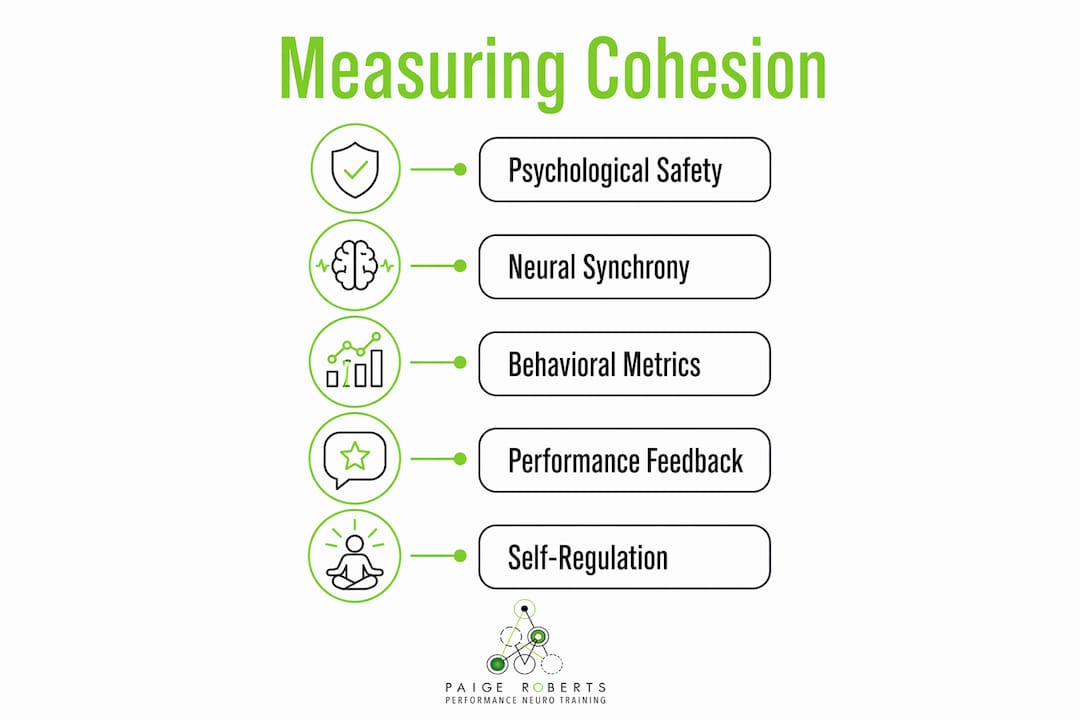
Measuring progress is what separates a neuroscience-informed approach from guesswork. The table below compares the primary assessment methods available to team leaders and coaches.
| Method | What it measures | Best for |
|---|---|---|
| Psychological safety surveys | Perceived safety, openness, and trust within the team | Baseline and ongoing team climate assessment |
| Behavioral observation | Communication patterns, turn-taking, and conflict response | In-session coaching and real-time feedback |
| Self-report resilience assessments | Emotional regulation, stress response, and relational style | Individual leader and athlete development |
| fNIRS hyperscanning | Inter-brain synchrony during collaborative tasks | Research settings and elite performance labs |
| Situational awareness scales | Shared understanding of team goals and environment | Pre-competition and tactical preparation |
Functional near-infrared spectroscopy (fNIRS) is the most direct tool for measuring neural synchrony. Behavioral metrics and fNIRS hyperscanning provide objective measures of team coordination following training interventions. Lower prefrontal inter-brain synchrony can actually accompany improved teamwork quality in fast-paced tasks, which means raw synchrony scores require careful interpretation.
For most coaches and team leaders, psychological safety surveys and structured behavioral observation deliver the most practical return. They require no equipment, produce actionable data, and can be run after every practice or meeting. The key is consistency. A single survey tells you nothing. A monthly trend tells you everything about whether your interventions are working.
Understanding how psychological safety drives performance gives you the interpretive framework to act on what your data reveals.
Common pitfalls when applying neuroscience to team cohesion
The most common mistake coaches and leaders make is treating neural synchrony as a goal rather than a signal. Higher inter-brain synchrony does not always correlate with better performance. In high-tempo tasks, excess neural coupling creates redundant processing that actually slows decision-making. The goal is optimal synchrony, not maximum synchrony. This is the synchrony paradox, and ignoring it leads to over-engineered team rituals that drain energy rather than build it.
A second pitfall is neglecting the leader's own nervous system. Many coaches invest heavily in team-building activities while remaining personally dysregulated. Because your nervous system sets the emotional tone of the room, no amount of team ritual compensates for a leader who is chronically stressed, emotionally unavailable, or reactive under pressure. Leader self-regulation is not a soft skill. It is the primary lever for group dynamics.
Three additional pitfalls worth naming directly:
- Skipping psychological safety for complex tasks. Teams under pressure often skip the relational groundwork and jump straight to execution. This is neurologically counterproductive. Without psychological safety, the prefrontal cortex stays partially offline, and the team's collective problem-solving capacity drops.
- Maintaining rigid hierarchy in collaborative settings. Strict top-down structures suppress Social Brain activation. When only one person makes decisions, only one brain is fully engaged. The rest of the team operates in a reduced cognitive state.
- Applying surface-level techniques without deep attunement. Running a breathing exercise once before a game is not nervous system training. Sustainable cohesion requires consistent, repeated practice that rewires the team's collective neural patterns over time.
Key takeaways
Enhancing team cohesion through neuroscience requires psychological safety, leader self-regulation, and intentional neural synchrony practices applied consistently over time.
| Point | Details |
|---|---|
| Psychological safety is neurological | It down-regulates the amygdala and activates prefrontal collaboration circuits in every team member. |
| Leader regulation sets team tone | Your nervous system is contagious; regulate yourself first before expecting team cohesion to follow. |
| Neural synchrony is trainable | Simple behaviors like eye contact, rhythmic movement, and structured listening build measurable inter-brain alignment. |
| Synchrony paradox requires balance | Optimal, not maximal, neural coupling produces the best outcomes, especially in fast-paced competitive environments. |
| Measure cohesion consistently | Psychological safety surveys and behavioral observation provide the most practical, repeatable data for coaches and leaders. |
What I've learned about leading with your nervous system first
Most leadership frameworks treat team cohesion as a product of strategy, communication training, or personality fit. After working with athletes and coaches through a neuroscience lens, I see it differently. The single most powerful variable in any team's cohesion is the regulated state of its leader. Not the plays. Not the personality assessments. The nervous system of the person at the front of the room.
I have watched technically gifted coaches lose their teams not because of bad strategy but because their own anxiety became the team's ambient emotional state. Conversely, I have seen leaders with modest tactical knowledge build extraordinary cohesion simply because they were grounded, present, and consistent. Their teams felt safe. And when teams feel safe, the neuroscience takes care of the rest.
What I recommend to every coach and team leader I work with: start with yourself. Use tools like the Logos assessment to understand your relational patterns. Build a daily nervous system regulation practice. Then layer in the team-level techniques. The sequence matters. You cannot regulate a team you have not first regulated yourself.
The data-driven approaches, fNIRS, safety surveys, behavioral observation, are genuinely useful. But they are most valuable when the leader interpreting the data is self-aware enough to act on what they reveal. Neuroscience gives you the map. Your regulated nervous system is the vehicle.
— Paige
How Robertsneurotraining supports coaches and team leaders
Robertsneurotraining, led by Dr. Paige Roberts, applies neuroscience-based methods to help sports coaches and team leaders build the nervous system foundation that group cohesion requires. The program uses Alpha Imprinting to clear mental blocks, reduce performance anxiety, and train the nervous system to sustain focus and emotional regulation under competitive pressure. Olympic Medalists and professional athletes have documented significant performance improvements through this approach. If you are ready to move beyond generic team-building and apply proven neurotraining methods that work at the neurological level, Robertsneurotraining offers a direct path to measurable results for you and your team.
FAQ
What is team cohesion in neuroscience terms?
Team cohesion is the synchronized alignment of brain states, emotional regulation, and shared situational awareness across team members. It is supported by neural synchrony, Social Brain activation, and psychological safety, all of which are measurable and trainable.
How does psychological safety improve group dynamics?
Psychological safety down-regulates the amygdala's threat response, allowing the prefrontal cortex to support collaboration, creativity, and problem-solving. Google's Project Aristotle identified it as the strongest predictor of team effectiveness across all team types.
Can neural synchrony be built without technology?
Yes. Simple behaviors like sustained eye contact, synchronized movement, and structured active listening intentionally cultivate inter-brain alignment without any equipment. Consistent repetition of these practices produces measurable changes in team coordination over time.
What is the synchrony paradox in team performance?
The synchrony paradox refers to the finding that higher neural coupling does not always produce better outcomes. In high-tempo tasks, excess synchrony creates redundant processing that slows decision-making. Optimal, not maximal, synchrony is the target for high-performing teams.
How can coaches measure team cohesion progress?
Psychological safety surveys, behavioral observation, and self-report resilience assessments provide practical, repeatable data for most coaching contexts. For elite or research settings, fNIRS hyperscanning offers objective measurement of inter-brain synchrony during collaborative tasks.