

Psychological safety is defined as the shared belief among team members that it is safe to take interpersonal risks without fear of punishment or humiliation. Research by Harvard Business School professor Amy C. Edmondson proves this belief is the single most reliable predictor of team learning and performance in high-stakes environments. Teams that operate without it default to silence, self-protection, and missed signals. Teams that build it gain a structural advantage: members speak up, report problems early, and adapt faster than competitors. The role of psychological safety in team performance is not a soft skill conversation. It is an operational imperative.
How psychological safety drives team cooperation and performance
The clearest empirical evidence for psychological safety's impact on team performance comes from a cross-national study of 84 financial-sector teams across Brazil and Germany. Researchers used PLS-SEM modeling to measure how psychological safety translated into cooperation and dynamic capabilities. The results were unambiguous. Psychological safety positively associated with team cooperation in both countries, with cooperation coefficients of β=0.365 in Brazil and β=0.568 in Germany. This means that in German teams, psychological safety had a stronger direct pull on cooperative behavior, and performance gains were statistically significant only in the German sample (β=0.271, p<0.001).
Cooperation is the behavioral bridge. Psychological safety alone does not produce results. It enables team members to share information, challenge assumptions, and coordinate without fear. That cooperation then activates what researchers call dynamic capabilities: the team's ability to sense change, reconfigure resources, and adapt. In high-stakes environments, whether a surgical unit or a trading floor, that adaptability is the difference between a team that catches a problem and one that misses it entirely.

The cultural gap in the data is worth examining. Brazilian teams showed weaker performance effects despite similar cooperation gains. This suggests that structural factors, including workflow design, leadership clarity, and accountability systems, moderate how much psychological safety translates into measurable output. Safety creates the conditions. Structure converts those conditions into results.
| Factor | Brazil (β) | Germany (β) | Implication |
|---|---|---|---|
| Psychological safety → Cooperation | 0.365 | 0.568 | Stronger in Germany; culture and structure matter |
| Psychological safety → Dynamic capabilities | 0.345 | 0.209 | Brazil shows higher direct capability effect |
| Cooperation → Performance | Not significant | 0.271 (p<0.001) | Performance gains require structural reinforcement |
Pro Tip: If your team shows high inclusion but low output velocity, the problem is not safety. It is the absence of structured learning loops that convert open communication into corrected processes.
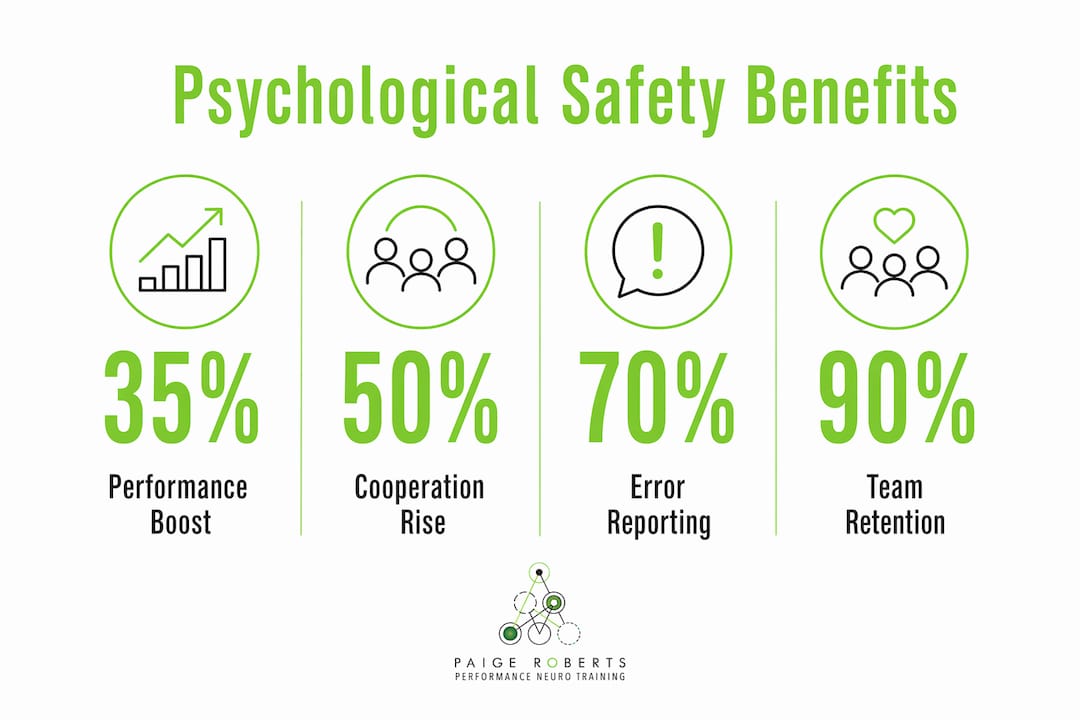
What does psychological safety do for error reporting in healthcare?
Healthcare is the sector where the stakes of silence are most visible. A multilevel structural equation modeling study of 1,500 employees at a Japanese university hospital found that psychological safety strongly reduced incident counts, with a standardized estimate of negative 0.67 at the department level. That is one of the strongest single-variable effects reported in recent organizational research. It also positively associated with work engagement and patient safety culture simultaneously.
A separate cross-sectional study of 225 clinical nurses in Korea found that psychological safety predicted near-miss reporting intention with β=0.18 (p<0.05), while safety-specific transformational leadership did not reach significance once psychological safety was controlled. This finding reframes the leadership conversation. The leader's style matters less than whether team members actually feel safe speaking up. Style without safety is theater.
Quantitative analysis across healthcare settings shows that psychological safety and learning climate together explain 50.7% of the variance in incident reporting behavior. That figure is striking. More than half of whether a healthcare professional reports a problem comes down to two cultural variables, not individual personality or training level.
Three mechanisms explain this pattern:
- Reduced fear of blame: When team members trust that reporting a mistake will not end their career, they report earlier and more accurately.
- Normalized learning conversations: Psychologically safe teams treat errors as data, not failures, which makes post-incident reviews productive rather than defensive.
- Increased work engagement: Psychological safety correlates with higher engagement, and engaged professionals are more attentive to safety signals in the first place.
"Psychological safety catalyzes work engagement and safety culture, and reduces incident counts, serving as a mechanism for surfacing early issues rather than a mere employee-satisfaction metric." — BMC Health Services Research, 2026
The practical implication for leaders outside healthcare is direct. If your team is not surfacing problems early, the issue is almost certainly not that problems do not exist. It is that people do not feel safe enough to name them.
How does psychological safety compare across sectors and cultures?
The healthcare and financial sector data point in the same direction but through different mechanisms. In healthcare, psychological safety primarily reduces harm by increasing transparency. In financial services, it primarily increases performance by enabling cooperation and adaptive decision-making. Both effects are real. Neither is automatic.
Cultural context shapes the magnitude of the effect. The Brazil-Germany comparison shows that teams operating in higher-uncertainty-avoidance cultures, where rules and structure are more valued, may convert psychological safety into performance gains more efficiently. German teams showed statistically significant performance effects; Brazilian teams did not, despite similar safety levels. This does not mean psychological safety matters less in Brazil. It means the pathway from safety to performance requires additional structural support in lower-uncertainty-avoidance contexts.
The paradox of increased error reporting deserves direct attention. When a leader introduces psychological safety practices and incident reports go up, the instinct is to panic. That reaction is wrong. Increased reporting reflects improved learning capacity, not worsening performance. Problems were always there. Now they are visible, which means they can be fixed.
Pro Tip: Track the ratio of reported near-misses to confirmed incidents over time. A rising ratio signals that your team is catching problems earlier, which is exactly what psychological safety is designed to produce.
Psychological safety in sports teams follows the same pattern. Athletes who feel safe to report fatigue, pain, or performance anxiety to coaches surface problems before they become injuries or competition failures. The sector changes. The mechanism does not.
How to build psychological safety in high-stakes teams
Leaders who want to build psychological safety quickly need to understand one thing: psychological safety builds from trust in the leader's behavior first. Team members watch how a leader responds to the first mistake, the first dissenting opinion, and the first uncomfortable question. Those early responses set the cultural norm for everything that follows.
Here is a practical sequence for leaders in high-stakes environments:
- Reward useful dissent publicly. When a team member challenges a decision and turns out to be right, name it in front of the group. This signals that speaking up has upside, not just risk.
- Handle mistakes with curiosity, not judgment. Ask "What did we learn?" before asking "Who is responsible?" This reframes errors as team data rather than individual failures.
- Implement non-punitive reporting systems. Create a formal channel for near-miss and error reporting that is decoupled from performance reviews. Anonymity helps in early stages.
- Follow through visibly on what gets reported. Structured learning workflows with consistent leader follow-through are the fastest way to convert psychological safety from a cultural aspiration into a performance driver. If people report problems and nothing changes, reporting stops.
- Model vulnerability deliberately. Leaders who share their own uncertainties and past mistakes give team members explicit permission to do the same. This is not weakness. It is the fastest trust-building signal available.
Building collective mental resilience in teams requires the same consistency. Resilience is not a trait people either have or lack. It is a behavioral pattern that leaders either reinforce or undermine through their daily responses to pressure.
The distinction between inclusive leadership and transformational leadership matters here. Transformational leaders inspire through vision and charisma. Inclusive leaders create the conditions for every team member to contribute. Research on psychological safety in interdisciplinary teams shows that inclusive behaviors, specifically listening, inviting input, and responding without defensiveness, predict psychological safety more reliably than inspirational communication. You can be a compelling speaker and still have a team that is afraid to tell you the truth.
Key takeaways
Psychological safety is the operational foundation of high-performing teams, and leaders who build it through consistent, trust-based behaviors see measurable gains in cooperation, error reduction, and adaptive performance.
| Point | Details |
|---|---|
| Safety enables cooperation | Psychological safety drives team cooperation, which then activates dynamic capabilities and performance gains. |
| Error reporting is a positive signal | Rising incident reports in psychologically safe teams reflect improved transparency, not declining performance. |
| Culture alone is insufficient | Safety must be paired with structured learning workflows to convert open communication into performance velocity. |
| Leadership behavior sets the norm | How a leader responds to the first mistake determines the team's cultural baseline for speaking up. |
| Context shapes the effect | Cultural and structural factors moderate how strongly psychological safety translates into measurable output. |
Why most leaders underestimate what psychological safety actually costs to ignore
I have worked with athletes and high-performance teams long enough to recognize a pattern that most leadership frameworks miss entirely. Leaders consistently overestimate how much their team tells them and underestimate how much silence costs. They assume that if something were seriously wrong, someone would say so. That assumption is the most expensive one in high-stakes performance.
What I see repeatedly is that teams with high technical skill and low psychological safety perform at a fraction of their actual capacity. The talent is there. The communication is not. And because the failures are invisible, leaders attribute underperformance to effort, focus, or individual capability rather than the environment they created.
The shift I advocate for is moving from culture as aspiration to culture by design. Psychological safety does not emerge because a leader is well-intentioned. It emerges because specific behaviors are modeled, repeated, and reinforced until they become the team's default operating mode. That requires deliberate investment, not just good values.
The measurable case is clear. A negative 0.67 correlation between psychological safety and incident counts in a hospital setting is not a soft finding. It is a hard operational number. Leaders who treat psychological safety as a morale initiative are leaving performance on the table. Leaders who treat it as a system design problem start winning.
— Paige
Take your team's performance to the next level with Robertsneurotraining
Psychological safety creates the conditions for peak performance. Robertsneurotraining gives your team the neurological tools to operate within those conditions at full capacity.
Dr. Paige Roberts leads a neuroscience-based program that trains the nervous system to clear mental blocks, reduce performance anxiety, and build the mental resilience that high-stakes teams require. Using the Alpha Imprinting method, Robertsneurotraining has produced measurable performance improvements for athletes from Olympic medalists to major league professionals. If you lead a team where pressure is constant and margins are thin, explore neurotraining for teams and see what optimized nervous system performance looks like in practice.
FAQ
What is psychological safety in teams?
Psychological safety is the shared belief that team members can take interpersonal risks, including speaking up, reporting errors, and challenging decisions, without fear of punishment or humiliation. Amy C. Edmondson's research at Harvard Business School established this definition and linked it directly to team learning and performance.
How does psychological safety affect team performance?
Psychological safety improves team performance by enabling cooperation, increasing error reporting, and activating dynamic capabilities that help teams adapt to change. A cross-national study of financial-sector teams found performance gains were significant in teams where psychological safety drove cooperation (β=0.271, p<0.001).
What is psychological safety in sports teams?
In sports teams, psychological safety allows athletes to report pain, fatigue, and performance anxiety to coaches without fear of losing their position or being judged as weak. This early reporting prevents injuries and performance failures that would otherwise go unaddressed until they become critical.
Why does error reporting increase when psychological safety improves?
Increased error reporting signals improved learning capacity, not worsening performance. Problems existed before. Psychological safety makes them visible, which is the first step toward fixing them.
How can leaders build psychological safety quickly?
Leaders build psychological safety fastest by training their own response behaviors: rewarding candid feedback, handling mistakes with curiosity rather than blame, and following through visibly on what gets reported. Consistent leader responses to early mistakes set the cultural norm that either opens or closes team communication.