

The highest-evidence path to restoring athletic performance after injury starts with a clinician-led neuroassessment, followed by Brain Endurance Training (BET) and state-regulation neurofeedback. These aren't brain hacks. They're the methods with the strongest peer-reviewed backing for improving endurance, reaction time, and mental fatigue resistance in athletes. Noninvasive brain stimulation (NIBS/tDCS) gets a lot of attention, but the evidence is inconsistent enough that it stays in the experimental column for now.
What to start this week:
- Request a clinician-led neuroassessment that includes HRV, EEG, and cognitive baseline testing
- Ask your provider about concurrent BET protocols timed with physical rehab sessions
- Treat NIBS/tDCS as experimental until protocols are better standardized
Pro Tip: Don't wait until you're fully cleared for sport to start neurotraining. Cognitive and autonomic work can begin during early rehab phases, often before full physical load is appropriate.
Table of Contents
- What is neuroassessment and why does it change rehab?
- Which neuroscience interventions actually have evidence behind them?
- Neural optimization: what elite brain function actually looks like
- How to build a personalized neurotraining program after injury
- How long does it take and what does it cost?
- Safety, red flags, and when to stop
- How Performance Neuro Training applies these principles
- Key Takeaways
- Why neuroassessment-led training produces better outcomes
- Performance Neuro Training: a clinician-led path back to your sport
- Useful sources
What is neuroassessment and why does it change rehab?
Neuroassessment is a standardized battery that combines self-report scales, computerized cognitive tests, autonomic measures, and neurofunctional markers into a single data-driven profile. The result isn't a vague "mental readiness" score. It's a map of where your nervous system is actually underperforming.
For injured athletes, this matters because many persistent deficits after injury are neurocognitive, not muscular. Attention lapses, slowed inhibitory control, and autonomic dysregulation can quietly block return-to-performance long after tissue has healed. Standard physical testing misses all of it.
Core metrics to request from your provider:
- HRV baseline and LF/HF ratio — autonomic regulation and stress-recovery balance
- EEG frequency bands — alpha and SMR activity linked to attentional readiness
- ERP components (N2/P3) — markers of inhibitory control and decision-making speed
- Psychomotor vigilance and reaction-time baselines — direct measures of cognitive fatigue
These metrics do two things: they tell you which intervention to prioritize (BET vs. neurofeedback vs. both), and they give you objective markers to track progress over weeks. Without them, you're adjusting a program based on feel rather than data.
Which neuroscience interventions actually have evidence behind them?
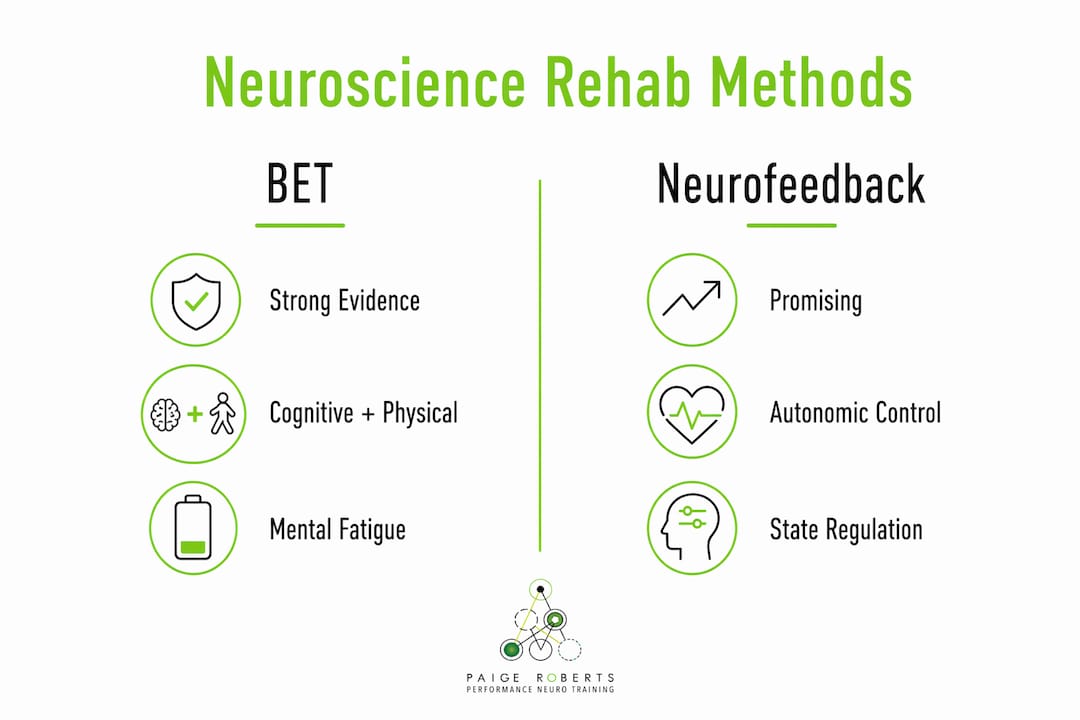
The short answer: BET is the strongest, neurofeedback is promising for state regulation, and NIBS remains experimental.
Brain Endurance Training
BET pairs intense cognitive tasks with physical exertion to train resistance to mental fatigue. A 2026 systematic review covering 13 controlled trials found BET protocols of 4–12 weeks consistently improved endurance-related outcomes, with adaptations appearing to be central (prefrontal and cingulate) rather than peripheral. VO2max and lactate thresholds barely moved. The brain adapted; the lungs didn't need to. Controlled trials also report improvements in reaction time and intermittent endurance in professional football players after multi-week BET programs. One seminal study from Marcora et al., cited in a narrative review, reported a large increase in time to exhaustion following a concurrent BET protocol.

Neurofeedback
Neurofeedback trains real-time autonomic and arousal control. For athletes dealing with trauma-related panic or performance anxiety, this is where it earns its place. Systematic reviews in football report cognitive gains and improved stress-recovery metrics, though protocols and outcomes are heterogeneous. The primary value is state regulation: accessing flow, reducing panic responses, and stabilizing autonomic markers under pressure. Pairing neurofeedback with HRV biofeedback strengthens that effect.
NIBS/tDCS
Promising in theory, inconsistent in practice. Recent reviews caution that tDCS effects can be paradoxical or non-linear when protocols lack precision. Neural responses to stimulation are not linear; more intensity is not always better. Treat it as experimental and never self-administer.
| Method | Evidence strength | Primary outcome | Typical protocol | Monitoring tools |
|---|---|---|---|---|
| BET | Strong (13 RCTs, systematic review) | Endurance, reaction time, mental fatigue resistance | 4–12 weeks, 2x/week concurrent | Cognitive tests, PVT, HRV |
| Neurofeedback | Preliminary, promising | State regulation, attention, autonomic control | 8–12 weeks, 1–2x/week | EEG, HRV |
| NIBS/tDCS | Experimental, inconsistent | Motor learning, strength (lab settings) | Variable, protocol-sensitive | EEG, TMS markers |
Neural optimization: what elite brain function actually looks like
The old model said elite athletes use their brains more efficiently by using less of them. That framing is outdated. Contemporary neuroimaging research reframes elite performance as neural optimization: the strategic, adaptive allocation of neural resources across executive networks, particularly the prefrontal cortex and anterior cingulate, under conditions of uncertainty.
This distinction changes how you train. The goal isn't to quiet the brain. It's to train flexible, precise engagement of executive control under sport-like conditions. After injury or trauma, that flexibility is often disrupted. Autonomic dysregulation and fear-based responses pull the nervous system into rigid, reactive patterns that block the adaptive allocation elite performance requires.
Practical implications: train decision-making under fatigue, simulate competitive uncertainty during rehab, and prioritize restoring flexible cognitive control before adding sport-specific complexity.
Pro Tip: Simulate competitive uncertainty safely during rehab by adding simple dual-task challenges (e.g., responding to auditory cues while performing low-load movement drills). This trains adaptive neural allocation without overloading injured tissue.
How to build a personalized neurotraining program after injury
The four-phase framework: assess, plan, train, monitor.
- Baseline neuroassessment — collect HRV, EEG, reaction time, and cognitive baselines before any intervention. This is your starting point and your comparison benchmark.
- Prioritize objectives — identify the specific deficit (mental fatigue, autonomic dysregulation, attentional lapses) and match the intervention to it.
- Integrated training protocol — combine BET timed with physical rehab sessions, add neurofeedback for state regulation as needed, and layer in sport-specific cognitive drills progressively.
- Ongoing monitoring — retest objective markers every 2–3 weeks and adjust load based on data, not perception.
BET is most effective when performed during or immediately after physical training. The dual-stressor environment is the actual stimulus. Cognitive tasks done in isolation produce weaker transfer. Coordinate timing with your physical therapist or physician to avoid overloading injured tissue while applying cognitive stressors.
| Weeks | Sessions/week | Cognitive task type | Physical load | Monitoring metrics |
|---|---|---|---|---|
| — | 1–2 | Baseline testing only | Low (rehab-guided) | HRV, RT, PVT, EEG |
| 2–6 | 2–3 | Simple sustained attention (concurrent BET) | Moderate | RT, PVT lapses, HRV |
| 6–12 | 3 | Complex decision-making, dual-task drills | Sport-specific | EEG alpha/SMR, HRV, cognitive tests |
How long does it take and what does it cost?
Expect measurable changes in mental fatigue resistance and reaction-time metrics within 4–12 weeks, depending on protocol intensity and injury severity. Trauma-related autonomic retraining typically takes longer. The metrics that move first are reaction time, psychomotor vigilance task (PVT) lapses, and HRV indices. EEG markers tend to shift later, reflecting deeper neural adaptation.
Key milestone: The 113% time-to-exhaustion gain reported in Marcora et al.'s seminal BET study came from a multi-week concurrent protocol — not a single session, not a supplement. Adaptation takes time and consistency.
Clinician-led programs in the United States vary in cost. Neuroassessment sessions typically run higher than standard psychological intake appointments given the technology involved (EEG, HRV equipment, cognitive testing platforms). Per-session neurofeedback costs vary by provider and location; remote programs generally cost less than in-person. Insurance coverage for neurofeedback and cognitive performance training is limited and inconsistent. Ask your provider about sliding-scale options, and prioritize clinician oversight for the first 6–8 weeks before considering any self-directed work.
Safety, red flags, and when to stop
Most behavioral and neurofeedback protocols are low-risk under clinician supervision. Anything involving brain stimulation (NIBS/tDCS) requires medical oversight. Full stop.
Stop training and seek immediate clinical referral if you experience: worsening pain, new neurological symptoms, uncontrolled PTSD panic responses, signs of cardiac instability (abnormal HRV patterns), or any acute post-concussive signs. Seizure history is a contraindication for NIBS without neurologist clearance.
Session safety checklist:
- Confirm no acute concussion symptoms before each session
- Monitor HRV before and after to flag autonomic overload
- Keep cognitive task intensity matched to current physical load
- Never self-administer NIBS or experimental stimulation devices
When to consult a specialist:
- Sports medicine physician: before starting any protocol post-injury
- Neurologist: if concussion history, seizure risk, or new neurological symptoms are present
- Clinical psychologist: for trauma-related PTSD responses that exceed standard performance anxiety
Follow clinician protocols and device manufacturer safety guidance. Self-administering experimental stimulation without oversight is not a shortcut; it's a risk with no upside.
How Performance Neuro Training applies these principles
Robertsneurotraining, led by Dr. Paige Roberts, builds programs around exactly this framework: clinician-led neuroassessment first, then an individualized protocol combining BET, neurofeedback, and nervous-system conditioning integrated with the athlete's existing rehab plan.
Program core components:
- Baseline neuroassessment using HRV, EEG, and cognitive behavioral metrics
- Individualized BET protocol timed with physical training
- Neurofeedback and Alpha Imprinting for state regulation and trauma-related performance blocks
- Ongoing objective monitoring with data-driven adjustments
- PhD-level clinical oversight from Dr. Paige Roberts throughout
Olympic medalists and professional athletes across major leagues have worked with the program. The outcomes reported center on clearing mental blocks, reducing panic responses during competition, and accessing flow states more consistently. These aren't soft outcomes. They're the result of neurological patterns being retrained through structured, monitored protocols.
When evaluating any provider, look for: clinical credentials (PhD, licensed clinician), objective monitoring tools (not just self-report), peer-reviewed methods, and a clear assessment-first process.
Pro Tip: Ask any prospective provider what objective metrics they track and how often they retest. A program without measurable benchmarks is a program without accountability.
Key Takeaways
Neuroscience-based athletic performance training after injury works best when it starts with a clinician-led neuroassessment and follows a structured BET plus state-regulation protocol monitored with objective metrics.
| Point | Details |
|---|---|
| Start with neuroassessment | Collect HRV, EEG, and reaction-time baselines before any intervention to identify the actual deficit. |
| BET is the strongest method | A 2026 systematic review of 13 trials confirms 4–12 week BET protocols improve endurance and mental fatigue resistance. |
| Time BET with physical training | Concurrent or post-session BET produces stronger adaptation than cognitive tasks done in isolation. |
| Neurofeedback targets state regulation | Use it for trauma-related panic, autonomic dysregulation, and flow access — not as a substitute for BET. |
| Robertsneurotraining offers clinician-led programs | Dr. Paige Roberts integrates neuroassessment, BET, and Alpha Imprinting with objective monitoring for injured athletes. |
Why neuroassessment-led training produces better outcomes
The athletes I work with who recover fastest aren't the ones who push hardest through physical rehab. They're the ones who address what the injury actually disrupted: the nervous system's capacity to regulate, adapt, and perform under pressure. A torn ligament heals. The fear response it triggers, the attentional narrowing under competition stress, the autonomic dysregulation that follows trauma — those don't resolve on their own.
Generic mental skills work helps at the margins. What actually changes outcomes is starting with objective data: knowing whether an athlete's deficit is attentional, autonomic, or trauma-driven, and targeting that specific system with the right protocol. That's what neuroassessment makes possible. And that's why measurable progress requires objective monitoring, not just self-reported confidence.
Performance Neuro Training: a clinician-led path back to your sport
Athletes recovering from injury need more than motivation. They need a program built on what their nervous system actually shows, not what they think they feel.
Robertsneurotraining offers a clinician-led process that begins with a full neuroassessment — HRV, EEG, cognitive baselines — and builds from there into a tailored protocol combining BET, neurofeedback, and Alpha Imprinting. Every program is overseen by Dr. Paige Roberts, with objective metrics tracked throughout so you can see what's changing and why. Athletes from Olympic competition to professional leagues have used this process to clear performance blocks and return to sport with measurable gains in mental resilience and energy output.
The next step is straightforward: review the clinical process and request an assessment. That first data point is where the real program begins.
Useful sources
| Source | What it contributes |
|---|---|
| Neuroassessment in Sports (PMC) | Foundational framework for integrating HRV, EEG, and cognitive metrics into athlete profiling |
| BET Systematic Review | 13-trial review confirming BET effects on endurance and mental fatigue; timing and dose guidance |
| BET in Professional Football, IJSPP | Controlled trial showing BET improves reaction time and intermittent endurance in professional players |
| BET Narrative Review (PMC) | Covers seminal Marcora et al. study; 113% time-to-exhaustion gain from concurrent BET protocol |
| Neural Optimization | Reframes elite performance as adaptive neural resource allocation, not reduced cortical activity |
| NIBS/tDCS Physiology Review | Cautions on inconsistent tDCS effects; non-linear dose-response and protocol sensitivity |
| NIBS Narrative Review (PMC) | Broader critical review of NIBS in athletic contexts; safety, ethics, and heterogeneity concerns |
| Neurofeedback in Football, MDPI | Systematic review of neurofeedback outcomes in sport; cognitive and autonomic gains, protocol variability |
| Neural Efficiency Systematic Review | review of neural efficiency in athletes; context for the neural optimization discussion |
This article is general educational information, not medical or clinical advice. Confirm protocols with a qualified clinician or sports medicine physician before beginning any neurotraining program.