

Neurological patterns are the brain's internal blueprints that determine how the body moves, heals, and adapts after injury. The role of neurological patterns in injury recovery is not secondary to physical tissue repair. It is the primary driver of whether an athlete returns to full function or plateaus at partial capacity. The brain begins synaptic remodeling within four hours of acute injury, which means the window for shaping recovery opens almost immediately. Understanding this process, and actively working within it, separates athletes who fully recover from those who don't.
What are the neurological mechanisms behind injury recovery?
Neuroplasticity is the brain's ability to reorganize itself by forming new neural connections. In the context of injury, this is not a passive process. The brain actively rewires in response to movement, effort, and sensory input. The quality of that rewiring depends entirely on what signals the nervous system receives during recovery.
Recovery does not restore the brain's pre-injury circuits. Instead, it creates entirely new neural network configurations that route around damaged areas. Research confirms that recovery builds novel network states using an individual's existing motor reserve, which is the brain's latent capacity to recruit alternative pathways. Athletes with higher motor reserve, built through years of varied training, tend to recover faster because they have more neural pathways available to recruit.
The mechanisms that drive this process include:
- Synaptic remodeling: The brain begins restructuring connections almost immediately post-injury, making the first hours and days critical for intervention.
- Network-level plasticity: Recovery is a whole-brain event. Regions far from the injury site adapt and compensate, which is why neurological patterns rehabilitation must address the full system, not just the injured area.
- Motor reserve activation: Athletes who engage in high-effort, varied movement during recovery activate dormant neural pathways that support functional return.
- Maladaptive pattern formation: When recovery is passive or poorly guided, the brain can lock into inefficient neural states. These maladaptive compensatory patterns entrench themselves quickly and actively resist correction later.
The last point is the one most athletes miss. Recovery failure is rarely caused by irreversible damage. It is caused by the brain settling into a suboptimal pattern and defending it. Guarding, bracing, and limping are not just physical habits. They are neurological programs that the brain reinforces with every repetition.
Why does timing and intensity of rehabilitation matter?
The neuroscience of injury recovery is clear on one point: timing is not just helpful. It is biological. Neuroplastic responsiveness peaks during the first 4–6 weeks post-injury, creating a window where the brain is most receptive to guided change. Missing that window does not make recovery impossible. It makes it significantly harder.
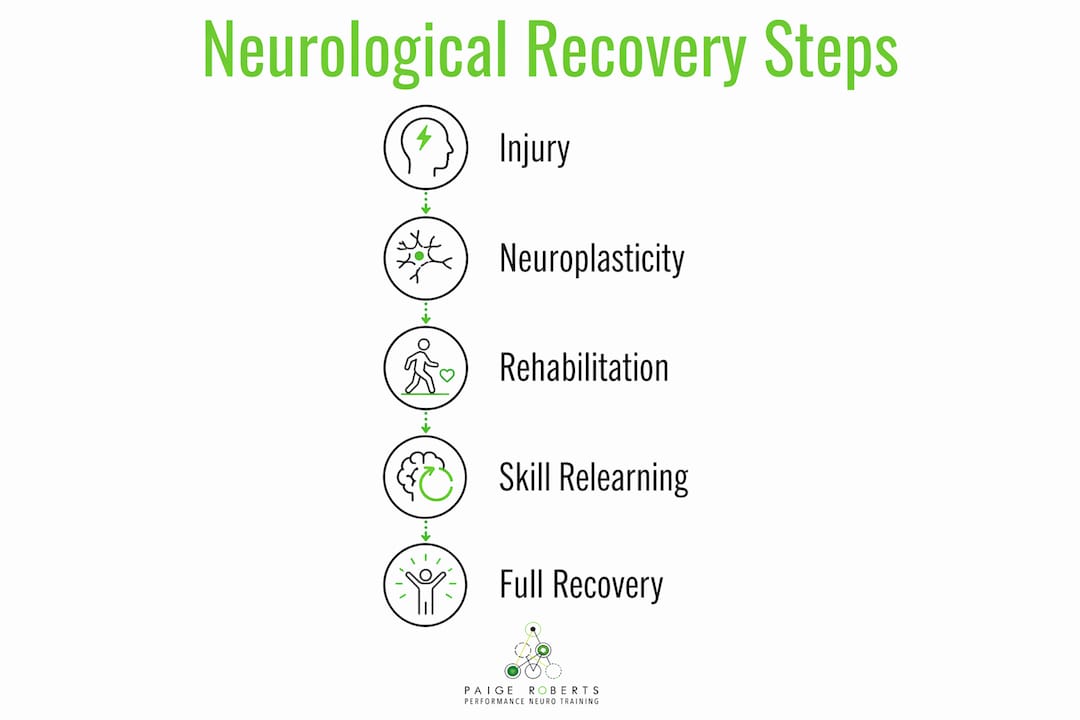
Athletes who begin guided movement within two days of a soft tissue injury return to sport about 20 days sooner than those who delay rehab to nine days. That is not a marginal difference. It represents weeks of competitive time and months of neurological drift in the wrong direction.
Intensity matters just as much as timing. The common mistake is equating long sessions with effective rehab. Neuroscience frames intensity differently:
- Repetition density: The number of meaningful movement repetitions per session drives neuroplastic adaptation far more than total session time.
- Metabolic load: Rehab that challenges the body's energy systems signals the brain to prioritize neural reorganization in the targeted area.
- Athlete effort and engagement: Passive treatments alone risk reinforcing maladaptive neurological signaling. Active, focused effort is what triggers the brain to build new pathways.
- Biological dose, not clock time: Research defines rehab intensity as a biological dose composed of repetition, metabolic demand, and engagement. A 20-minute high-effort session outperforms a 90-minute passive one.
Pro Tip: Think of each rehab session as a sprint, not a marathon. The brain responds to effort and challenge, not to time spent lying on a table.
The risk of low-intensity or delayed rehab is not just slower healing. It is the active reinforcement of the very patterns that block full recovery. Every day spent in passive rest after the acute phase is a day the brain spends cementing a suboptimal neural state.
How do neurological patterns influence movement and skill relearning?
Motor function recovery is not about rebuilding muscle strength alone. It is about retraining the neural programs that control how muscles fire, sequence, and coordinate. The role of brain patterns in movement is to act as the operating system beneath every physical action.

When an athlete guards a knee after an ACL injury, the brain is not being cautious. It is running a protective program that made sense in the acute phase but becomes a liability in the recovery phase. That program reduces range of motion, alters gait mechanics, and recruits the wrong muscle groups. Over time, it becomes the new normal.
The distinction between adaptive and maladaptive neurological compensation is critical:
- Adaptive compensation recruits alternative neural pathways that maintain functional movement quality while the primary pathway heals.
- Maladaptive compensation recruits inefficient patterns that provide short-term pain relief but limit fine motor control and full functional return.
| Pattern type | Short-term effect | Long-term consequence |
|---|---|---|
| Adaptive neural compensation | Maintains movement quality | Supports full functional recovery |
| Maladaptive guarding/bracing | Reduces pain temporarily | Limits motor control restoration |
| Passive avoidance | Decreases acute discomfort | Entrenches inefficient neural dynamics |
Retraining movement after injury requires targeted neuromotor control work. Repetition density matters here too. The brain needs hundreds of correct movement repetitions to overwrite a maladaptive pattern. Technologies like neuromodulation and virtual reality are now used specifically to perturb maladaptive neural states and shift the brain toward adaptive configurations. These tools work because they force the nervous system out of its default pattern and into a state where new learning can occur.
The psychological dimension of this process is real and measurable. Anxiety, fear of reinjury, and trauma responses all generate neurological signals that reinforce protective patterns. Addressing the mental side of recovery is not optional. It is part of the neurological reprogramming process.
What practical strategies can athletes use to accelerate neurological recovery?
The impact of neurological patterns on recovery becomes an advantage once athletes know how to work with them. These strategies are grounded in current neuroscience and apply across injury types and athletic levels.
Pro Tip: Start moving as early as your clinical team clears you. Even gentle, guided movement in the first 48 hours sends the brain a signal that recovery is active, not passive.
- Initiate guided movement early. The first days post-injury are neurologically critical. Controlled loading within pain-free ranges stimulates neural pathways without triggering pain-avoidance patterns that slow recovery.
- Prioritize session quality over session length. High-density, effortful practice drives neuroplasticity. Aim for focused, challenging repetitions rather than extended low-effort sessions.
- Actively interrupt compensatory habits. If you notice yourself guarding, bracing, or favoring one side, treat it as a neurological cue that needs correction, not a physical limitation to work around.
- Integrate visualization and mental rehearsal. Mental rehearsal of correct movement patterns activates the same neural circuits as physical practice. Athletes who combine physical and mental training show stronger motor function recovery outcomes.
- Track your patterns, not just your pain. Pain is a lagging indicator. Neurological recovery is better measured by movement quality, coordination, and the absence of compensatory habits. Adjust your program based on these markers.
The psychological and neurological aspects of sports injury recovery are deeply connected. Fear, anxiety, and avoidance behaviors are neurological events, not character flaws. Treating them as part of the rehab process, rather than separate from it, produces faster and more complete recovery.
Key Takeaways
Neurological patterns drive injury recovery by shaping how the brain rewires itself, and athletes who actively engage this process during the critical early weeks recover faster and more completely.
| Point | Details |
|---|---|
| Early intervention is neurological | Synaptic remodeling begins within four hours of injury, making the first days critical for shaping recovery. |
| Intensity beats duration | High-density, effortful sessions drive neuroplasticity more than long, passive ones. |
| Maladaptive patterns are the real barrier | Guarding and bracing entrench inefficient neural states that actively resist full recovery. |
| Mental training is neurological training | Visualization and anxiety management directly influence the neural circuits controlling movement. |
| The critical window is 4–6 weeks | Neuroplastic responsiveness peaks early post-injury. Missing this window makes recovery harder, not impossible. |
Neuroplasticity is the edge most athletes never use
Working with athletes at various levels has shown me one consistent pattern: the athletes who recover fastest are not the ones with the least severe injuries. They are the ones who treat recovery as an active neurological process from day one.
The conventional approach to injury recovery focuses almost entirely on tissue healing. Rest, ice, compression, and elevation have their place. But they do nothing to shape the neurological patterns that will determine whether an athlete moves well or just moves. The brain is making decisions about how to reorganize itself from the moment of injury. If no one is guiding that process, the brain defaults to whatever pattern reduces pain fastest, which is almost never the pattern that restores full performance.
What I have seen with athletes who engage neurological training during recovery is a different trajectory entirely. They do not just return to their pre-injury baseline. Many exceed it. The reason is that the neuroplastic process, when guided correctly, does not just repair. It builds. The brain forms new connections, recruits more efficient pathways, and develops a more resilient neural architecture than existed before the injury.
The hardest part of this work is convincing athletes that their anxiety, their fear of reinjury, and their protective movement habits are neurological events that need direct intervention. These are not mental weaknesses. They are the brain doing exactly what it was designed to do. The goal is to give it better instructions.
— Paige
How Robertsneurotraining supports neurological recovery for athletes
Robertsneurotraining, led by Dr. Paige Roberts, applies neuroscience directly to the recovery and performance challenges athletes face after injury. The program uses Alpha Imprinting, a method designed to reprogram the nervous system at the pattern level, clearing the mental blocks, anxiety responses, and trauma-driven compensations that standard rehab leaves untouched.

Athletes across professional and amateur levels have used Robertsneurotraining to move beyond the plateau that follows conventional rehab. The Energy Optimization Workbook gives athletes a structured starting point for understanding and shifting their neurological patterns. For a deeper look at the full process, the personalized coaching approach at Robertsneurotraining translates the neuroscience from this article into a program built around your specific recovery needs.
FAQ
What are neurological patterns in injury recovery?
Neurological patterns are the brain's learned programs for controlling movement and managing pain. After injury, these patterns either support recovery or entrench compensatory habits that limit full functional return.
How does neuroplasticity affect healing after a sports injury?
Neuroplasticity allows the brain to form new neural connections that route around damaged areas. Athletes who engage in high-effort, guided movement during the critical 4–6 week post-injury window show the strongest neuroplastic gains.
Why do maladaptive movement patterns develop after injury?
The brain defaults to patterns that reduce pain quickly, even when those patterns are neurologically inefficient. Guarding and bracing feel protective but entrench inefficient neural dynamics that block full motor function recovery.
Does mental training actually change neurological recovery outcomes?
Mental rehearsal activates the same neural circuits as physical movement. Combining visualization with physical practice accelerates neuroplasticity in recovery and reduces the anxiety-driven patterns that slow return to sport.
How soon after injury should rehabilitation begin?
Athletes who begin guided movement within two days of a soft tissue injury return to sport significantly sooner than those who delay. The first hours and days post-injury are when the brain is most responsive to guided neurological change.