
Stop calling it a slump. Pick one small, winnable task and finish it in the next hour. Then run a quick reset: ten minutes of movement, a few minutes of outdoor light, and a single micro-goal for tomorrow's practice. That breaks the freeze. The rest of this guide covers how to diagnose what's actually driving the decline, what to do over the next three days, and when self-help isn't enough and a program like Roberts Neurotraining becomes worth considering.
TL;DR:
- A physical or mental slump requires identifying the root cause, such as low energy, cognitive issues, skill drift, or motivation, to choose the appropriate intervention.
- Addressing physical factors like sleep, nutrition, and training load must occur alongside mental skills, as neglecting them hampers recovery efforts.
- Immediate recovery strategies involve completing small mastery tasks, engaging in moderate movement, outdoor light exposure, setting micro-goals, and planning simple if-then routines.
- Psychological techniques like process goals, cue-based self-talk, imagery, attention control, and switching internal voices to third person enhance slump recovery.
- Persistent slumps after several weeks may indicate underlying nervous system patterns that require neurotraining approaches such as trauma reprocessing or energy optimization programs.
Table of Contents
- What kind of slump recovery in sports do you actually need?
- Why do athletes fall into slumps in the first place?
- What should you do in the first 72 hours?
- Which mental skills speed up recovery from a slump?
- How do sleep, food, and training load affect slump recovery?
- How do you rebuild skill and confidence after a slump?
- When should you get professional help for a slump?
- Why nervous-system conditioning matters for stubborn slumps
- Roberts Neurotraining: specialist support when self-help plateaus
- Sources
What kind of slump recovery in sports do you actually need?
Not every slump has the same engine, and treating a fuel problem like a confidence problem wastes weeks. Before you fix anything, figure out which category you're in.
- Low-energy slump: heavy legs, poor sleep, dragging through warmups, irritability by evening
- Cognitive slump: rumination between reps, second-guessing routine decisions, tightness that only shows up under pressure
- Skill-drift slump: mechanics have quietly shifted, timing feels a half-beat off, coaches notice before you do
- Motivation slump: practice avoidance, dread before sessions, going through the motions without caring about outcomes
A low-energy slump usually clears with recovery basics. A cognitive slump needs mental skills work. Skill drift needs structured repetition, not more willpower. One distinction matters here: if the flatness comes with a total loss of pleasure in things outside sport, sleep disruption lasting weeks, or thoughts of not wanting to continue at all, that's outside the scope of performance coaching. That calls for a licensed clinician, not a practice plan.
Why do athletes fall into slumps in the first place?
Slumps rarely have one cause. A systematic review of competitive athletes found performance decline typically stems from a mix of anxiety, perfectionism, and what researchers call learned helplessness, where repeated setbacks convince an athlete that effort no longer changes outcomes.
Physical drivers compound the problem. Overtraining, disrupted sleep, and under fueling are documented contributors to sustained performance decline, and reduced movement volume also lowers BDNF, a protein tied to mood regulation and motor learning. In team sports, social dynamics pile on: a cohesion breakdown or shaky leadership can drag an entire roster into a collective slide, not just one player.
- Psychological: anxiety, perfectionism, learned helplessness
- Physical: overtraining, poor sleep, low fueling, reduced BDNF from inactivity
- Social: team cohesion problems, leadership gaps
Applied research on team-sport slumps treats these as interacting factors, which is why a single fix (just sleep more, just think positive) so often falls flat on its own.
What should you do in the first 72 hours?
This window is about interrupting the spiral before it hardens into a story you tell yourself. Do these in order:
- Complete one under-15-minute mastery task. Pick something you can finish today with a clear, visible result. Small forward progress reliably restores engagement, a pattern researchers call the progress principle.
- Move for 10 to 30 minutes. A brisk walk, a light lift, or an easy spin session is enough. Moderate exercise raises BDNF quickly enough to shift mood within the same day.
- Get outside within an hour of waking. Morning light anchors your circadian rhythm, which stabilizes both sleep and next-day energy.
- Set one micro-goal for tomorrow's session. Something binary and checkable, like "ten clean first touches" rather than "play better."
- Write an if-then plan. "If I start rushing my routine, then I stop and reset my breathing for three breaths." This removes the decision-making friction that stalls athletes mid-slump.
Pro Tip: Write your mastery task down before bed the night before. Deciding what counts as a "win" while you're calm keeps you from negotiating it down when you're anxious the next morning.
Which mental skills speed up recovery from a slump?
Process goals beat outcome goals during a slump, full stop. "Hit 80% of my serves in the box" is something you control. "Win the match" is not, and chasing it while you're already shaky just adds pressure.
- Micro-goal templates: break each session into three checkable targets tied to execution, not results
- Instructional self-talk: short, cue-based phrases ("elbow up," "eyes on target") instead of evaluative ones ("don't miss this")
- Cognitive-Strategic Reframing (CSR): a structured method that helps athletes detach emotionally from short-term outcomes and evaluate choices by their long-run odds of success, not the last result
- Imagery routines: rehearse the process, not the scoreboard, right before competition
- Attention-control drills: a fixed reset cue (a breath count, a word, a physical tap) to interrupt rumination mid-performance
One underused tool: switch your internal voice to third person during a rough patch. Talking to yourself as "you" or by name, rather than "I," is shown to reduce rumination and emotional reactivity, which makes it easier to catch a spiral before it takes over a whole session.
Pro Tip: Keep a two-line pre-performance checklist on your water bottle or wrist tape. Under pressure, athletes forget routines they'd never forget on a calm day.
For a deeper breakdown of attention-control drills specifically, see this recovery guide for athletes.
How do sleep, food, and training load affect slump recovery?
Mental skills only go so far if the physical foundation is broken. Fix these basics alongside the psychological work, not after it.
- Keep a fixed wake time, even on rest days. Circadian consistency does more for sleep quality than an earlier bedtime alone.
- Get natural light exposure within the first hour of waking to anchor your internal clock.
- Eat enough to support two full-quality sessions a day. Undereating shows up first as sloppy technique late in practice.
- Hydrate before you're thirsty. Mild dehydration blunts reaction time before it registers as fatigue.
- Deload volume by roughly a third for a week if fatigue, irritability, and flat performance are stacking up together. Overtraining is a documented driver of exactly the decline you're trying to reverse.
- See a physician or physical therapist if pain, not just fatigue, is limiting your movement. A slump caused by an untreated injury won't respond to mental skills work.
Nutrition partners like Pure Blue cover fueling strategy in more depth if food quality is part of your picture.
How do you rebuild skill and confidence after a slump?
Confidence comes back through repeatable success, not a single good performance. Structure practice so wins stack instead of relying on one big moment to fix everything.
- Chunk skills into micro-blocks. Ten to fifteen minutes on one specific element, with a clear pass/fail marker, beats an hour of unfocused reps.
- Track a measurable metric every session. First-touch success rate, free-throw percentage, split times. What gets measured gets noticed when it improves.
- Add variability once the basics are stable. Vary conditions (fatigue, pressure, opponent) gradually so skills transfer to competition without cratering confidence.
- Schedule early low-stakes competitive reps. A scrimmage or a low-pressure meet before the big one builds psychological momentum that a scoreboard win alone can't.
The neuroscience-based training guide covers drill sequencing in more detail for athletes rebuilding after a longer layoff.
When should you get professional help for a slump?
Self-help works for most slumps within a few weeks. It's time to bring in a professional when any of these show up:
- Persistent loss of interest or pleasure in life outside sport, not just competition
- Any thoughts of self-harm or not wanting to continue, which need immediate clinical attention
- Concussion symptoms that haven't resolved on the expected timeline
- An injury or pain pattern that isn't improving despite rest
- A slump that started after an injury and hasn't shifted after 6 to 8 weeks of the steps above
When you do reach out to a sport psychologist or performance specialist, ask specifically what measures they use to track progress and what timeline they expect. Psychological readiness tools like the ACL-RSI are proven predictors of successful return to sport across multiple prospective cohort studies, and a good specialist should be able to name something comparable for your situation, not just offer general encouragement. You can see how an assessment-first process works on the Roberts Neurotraining process page.
Why nervous-system conditioning matters for stubborn slumps
Most slump advice treats the mind as something you can talk yourself out of. That undersells how much of a slump lives in the nervous system itself, not just in conscious thoughts.
Dr. Paige Roberts built Performance Neuro Training around that gap: athletes carrying past injury or stress often have a nervous system stuck in a defensive pattern that mental skills training alone doesn't touch. Alpha Imprinting is designed to work at that level, aiming to clear the anxiety and trauma-based inhibition that keeps talented athletes locked out of flow. It's not a replacement for the process and micro-goal work above. It's what you reach for when those steps stall out despite consistent effort.
— Paige
Roberts Neurotraining: specialist support when self-help plateaus
If you've run the resets, tightened sleep and fueling, and rebuilt your practice structure and the slump still won't budge, that's usually a sign the block is happening below conscious thought, not in your effort or your technique. That's the specific gap specialized neurotraining programs are designed to address, using telehealth coaching, trauma reprocessing protocols, and structured energy optimization programs instead of generic mental-toughness talk.
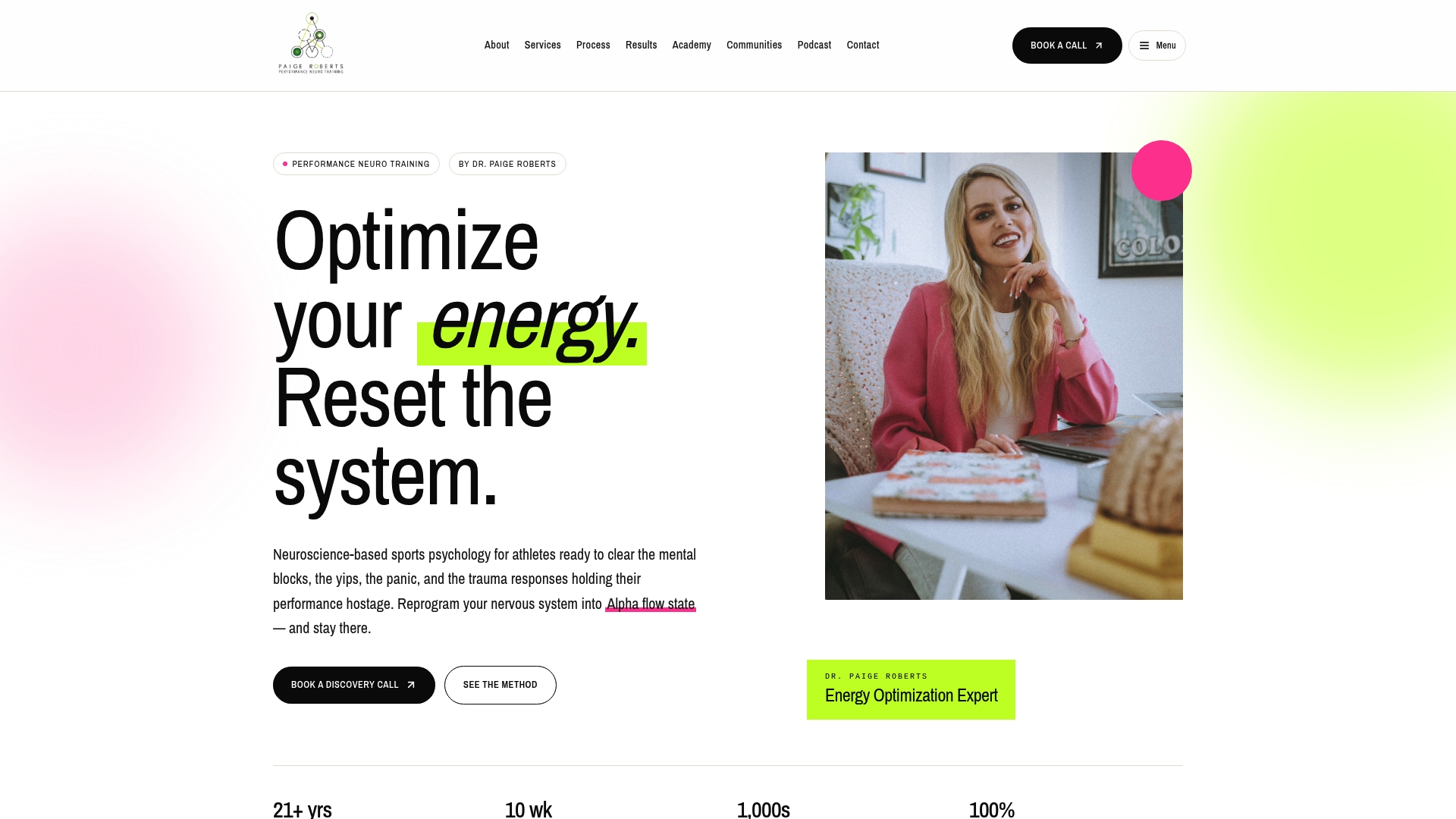
The Energy Optimization Workbook is a reasonable starting point if you want a self-guided introduction before committing to coaching. Athletes coming back from injury or a longer stall typically start with an assessment and a telehealth consult, mapped out in detail on the process page, where you can see exactly what a first session covers and book a time to start.
Sources
- From Slump to Comeback: Psychological Determinants of Performance Decline, Burnout, and Recovery in Competitive Athletes—A Systematic Review
- Physiological contributors to performance decline and overtraining
- Self-distancing and reduced rumination: mechanisms and applications
- Understanding and managing performance slumps in team sports: a theoretical and applied perspective