

Retraining your attention after injury is not a soft skill add-on. It is the mechanism that determines whether your nervous system lets you move freely again or keeps you locked in a pain-monitoring loop. The role of attention control in sports recovery comes down to one shift: expanding your attentional window back toward external cues so your body can return to automatic, fluid movement. Here is what to do first:
- Run a quick self-assessment: note when your focus collapses during practice (pain spikes, crowd noise, self-doubt).
- Pick one reset cue, a short phrase or breath pattern, and practice it daily for two weeks.
- Contact a nervous-system specialist. Performance Neuro Training, led by Dr. Paige Roberts, uses Alpha Imprinting to reprogram the nervous system patterns that keep attention stuck on threat.
Table of Contents
- Why attention control matters after injury or trauma
- How the four dimensions of attention map to your sport
- How attention-control training restores performance step by step
- Practical drills to start today
- How to measure progress and what timeline to expect
- Integrating attention training with rehab and when to get specialist help
- What the evidence says and where Alpha Imprinting fits
- Key Takeaways
- Why attention training is the part of recovery most athletes skip
- Performance Neuro Training: nervous-system-focused support for injured athletes
Why attention control matters after injury or trauma
Attentional control, the formal term from Attentional Control Theory-Sport (ACT-S), refers to the executive functions that direct where your focus goes, what it filters out, and how fast it shifts. These functions, inhibition, shifting, and updating, govern everything from reading a defensive formation to landing a clean jump. Athletic training reorganizes how the brain allocates attention rather than simply expanding raw capacity.
Injury breaks that organization. When you are hurt, the nervous system floods the body with sympathetic activation, the fight-or-flight state. Your attention narrows inward, scanning for pain, threat, and worst-case outcomes. That internal hyper-focus is protective in the short term. Left untrained, it becomes a performance ceiling: attention narrowing driven by anxiety that block the external-focus states that allow automatic, efficient movement.
Understanding polyvagal nervous-system responses explains why this matters practically: a dysregulated nervous system does not just feel bad, it structurally limits the attentional bandwidth available for sport.
How the four dimensions of attention map to your sport
The Nideffer/Sagal framework, widely used in APA Division 47 sport psychology practice, organizes attention along two axes: width (broad vs. narrow) and direction (internal vs. external). Every sport situation calls for a different quadrant.
| Quadrant | Description | Sport example |
|---|---|---|
| Broad-external | Scanning the environment for multiple cues | Soccer midfielder reading the field before a pass |
| Narrow-external | Locking onto one specific external target | Tennis player tracking ball contact point |
| Broad-internal | Analyzing strategy and game plans | Quarterback reviewing defensive schemes at the line |
| Narrow-internal | Monitoring body mechanics or arousal | Gymnast cueing a specific takeoff position |
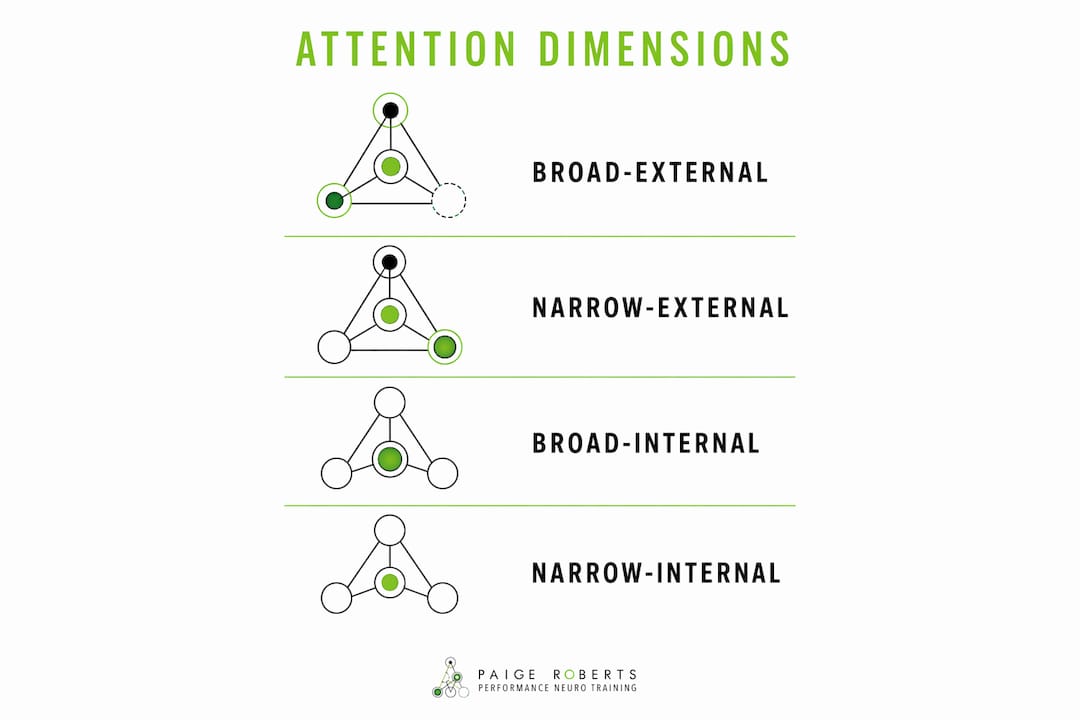
After injury, athletes get stuck in narrow-internal mode, monitoring pain, bracing against re-injury, running catastrophic self-talk. The goal of attention-regulation training is not to force focus to stay fixed. It is to build attentional flexibility, the ability to shift rapidly between quadrants as the situation demands. Research consistently shows that external-focus cues produce better movement efficiency and neuromuscular economy than internal ones, particularly during skill re-automation after injury.
How attention-control training restores performance step by step
This four-step protocol gives you a structure to follow with your PT, coach, or mental performance specialist.
-
Assess. Keep a symptom and focus log for one week. Record when attention collapses, what triggered it (pain, crowd noise, internal self-talk), and how long recovery takes. Map your sport's specific attentional demands: which quadrant does each key skill require?
-
Map. Match each trigger to a quadrant. A basketball player flinching on drives after a knee injury is stuck in narrow-internal. A pitcher losing command after a shoulder strain may be over-monitoring mechanics (also narrow-internal). Identifying the mismatch is half the fix.
-
Train. Build a progression: isolated drills first (low load, controlled environment), then contextual drills (sport-relevant movement with attention cues), then pressured drills (simulated competition stress). Develop bespoke concentration cues, short, repeatable phrases or tactile anchors tied to your specific triggers. Generic cues transfer less than athlete-specific ones. Example reset cues: "Ball. Breath. Go." (external redirect) or a single slow exhale before a movement initiation.
-
Integrate. Embed attention cues directly into physical rehab drills. If your PT has you doing single-leg balance work, add a visual target on the wall and a verbal cue to redirect focus there when pain-monitoring kicks in. Combining mental and physical training accelerates the return of motor automaticity.
Practical drills to start today
These drills are short, safe, and designed to rebuild attentional flexibility without overloading healing tissue.
Focused breathing with external anchor (3 minutes daily). Inhale for four counts, exhale for six. Fix your gaze on a specific point in the room. Each time your attention drifts to pain or worry, redirect it to the point without judgment. This trains the reset habit.
Target-effect practice (5 minutes). During any rehab movement, define the outcome in external terms: "hit the target," "push the floor away," "reach the cone." Avoid internal cues like "squeeze the quad." External focus strategies reduce EMG activity and improve movement economy across motor tasks.
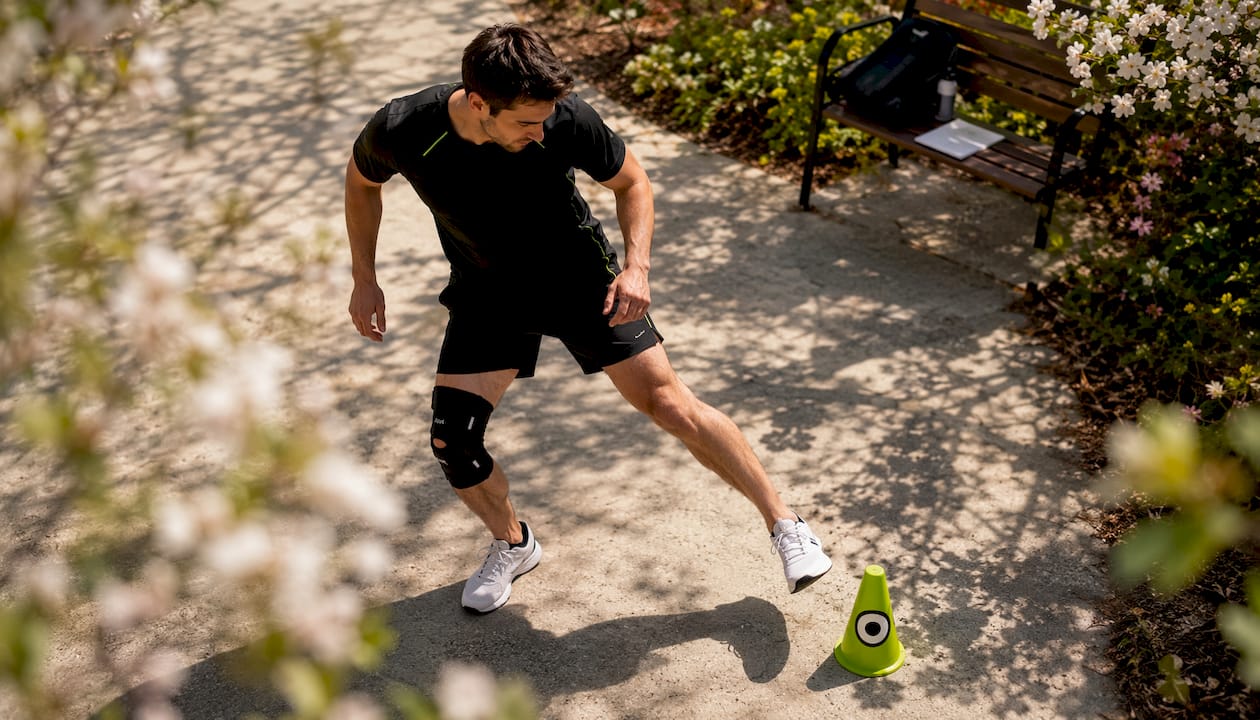
Distraction-switching drill (4 minutes). While performing a low-load sport-specific movement (ball handling, light footwork), have a partner call out random numbers or colors. Respond verbally while maintaining movement quality. This trains the shifting function directly.
Dual-task balance (3–5 minutes). Stand on one leg (or use a balance board at appropriate rehab stage). Simultaneously count backward from 100 by threes. Scale cognitive load up or down based on stability. Stop immediately if pain increases or movement quality degrades.
Safety rule: reduce cognitive load before reducing physical load. If movement quality drops under any cognitive demand, that is a signal the nervous system is not ready for that combination yet.
Pro Tip: Keep drills to 3–6 minutes each and fold them into your existing warm-up or rehab routine. Daily short practice beats weekly long sessions for building attentional habits.
How to measure progress and what timeline to expect
Progress is real, but it is not linear. Here is what to watch for:
- Weeks 1–4 (early wins): Reduced catastrophic self-talk during practice, ability to use a reset cue within 5–10 seconds of an attentional lapse, and more practice reps completed without focus collapse.
- Weeks 4–12 (transfer milestones): Improved drill performance under simulated distraction, restored movement automaticity in rehab tasks, and faster decision speed in low-stakes scrimmages.
- 12+ weeks (performance return): Sustained attention under competitive pressure, reduced fear-of-reinjury interference, and coach-rated improvement in decision quality.
Measurement tools to use: a daily focus log (rate attentional quality 1–10 after each session), simple reaction drills with a partner, and coach-rated transfer checklists. If lab tools are available, the Sustained Attention to Response Task (SART) captures moment-to-moment attention fluctuations and links them to functional brain network states, giving clinicians a precise baseline.
Integrating attention training with rehab and when to get specialist help
Attention training works best inside a collaborative structure: athlete, physical therapist, coach, and nervous-system specialist communicating regularly. PTs can embed attention cues into motor tasks from day one of rehab. Coaches can use distraction drills during low-intensity practice phases. The mental performance specialist manages the psychological layer.
When attention training is embedded in physical rehabilitation rather than treated as a separate add-on, the transfer to sport performance is faster and more durable.
Red flags that warrant specialist evaluation: persistent pain that worsens under even low cognitive load, autonomic dysregulation (heart rate spikes, dissociation, freeze responses during practice), and attentional narrowing that does not respond to practiced reset cues after four weeks. These patterns often signal trauma-related nervous-system dysregulation, not just a focus problem. Mental performance coaching at the specialist level addresses the nervous-system root, not just the symptom.
What the evidence says and where Alpha Imprinting fits
Athletes show superior sustained attention on lab tasks compared to non-athletes, and teaching athletes to monitor their attentional spotlight and practice reset strategies is a high-impact intervention for restoring automatic motor control. The external-focus literature (Wulf and Lewthwaite lineage) consistently shows that outcome-focused cues reduce muscular co-contraction and improve movement efficiency.
Alpha Imprinting, the method used in Performance Neuro Training, works at the nervous-system level: it targets the subconscious patterns that keep attention locked on threat and pain after injury or trauma. It complements physical rehab by addressing why the nervous system resists returning to automatic, confident movement even after tissue has healed.
Athletes who have used Performance Neuro Training report performance improvements after working through the nervous-system patterns that standard rehab does not reach.
Research limits are real: most attention-training studies use lab tasks, and transfer to live competition is harder to measure. That is exactly why individualized, sport-specific cue libraries and nervous-system methods matter more than generic protocols.
Key Takeaways
Attention control is a trainable executive skill that determines whether your nervous system lets you compete freely or keeps you stuck in a pain-monitoring loop after injury.
| Point | Details |
|---|---|
| Attentional narrowing after injury | Injury triggers sympathetic activation that locks focus inward, blocking the external-focus states needed for automatic movement. |
| Four-quadrant framework | Map your sport's demands to broad/narrow and internal/external quadrants; flexible shifting between them is the goal. |
| Reset cues are the core tool | A short, practiced phrase or breath pattern redirects attention within seconds and is more effective than willpower alone. |
| Progress timeline | Early wins appear in weeks 1–4; transfer to sport performance typically builds across weeks 4–12 and beyond. |
| Robertsneurotraining | Performance Neuro Training uses Alpha Imprinting to address the nervous-system root of attentional narrowing in injured and trauma-affected athletes. |
Why attention training is the part of recovery most athletes skip
Most athletes I work with arrive having done everything right physically: the surgery, the PT, the strength work. What they have not addressed is the nervous system's learned threat response, the pattern that keeps attention narrowed even after the tissue has healed. That is not a character flaw. It is physiology. The nervous system learned to protect you, and it is very good at its job.
What changes the outcome is treating attention as a trainable skill, not a personality trait. Athletes who build a personal cue library, who practice redirecting focus daily, and who address the nervous-system layer underneath the mental block, those athletes do not just return to their previous level. They often surpass it, because they now have explicit control over something that used to run on autopilot.
Performance Neuro Training: nervous-system-focused support for injured athletes
Physical rehab rebuilds the body. Performance Neuro Training rebuilds the nervous system's relationship with performance. For athletes whose attention stays locked on fear, pain, or past trauma long after tissue has healed, the Alpha Imprinting program offers a structured, neuroscience-based path back to flow.

The program includes sport-specific Alpha Imprinting sessions and the Energy Optimization Workbook, a low-friction starting point for athletes who want to begin nervous-system work immediately on their own schedule. Olympic medalists and professional athletes across major leagues have used these methods to clear the mental blocks that standard training does not touch. If you are ready to address the nervous-system layer of your recovery, consider visiting Robertsneurotraining to learn more about available resources.