

Mental performance optimization techniques athletes use are structured psychological skills that directly improve focus, confidence, and stress regulation under competitive pressure. In sport science, this practice is formally called Psychological Skills Training, or PST. PST covers goal setting, visualization, self-talk regulation, mindfulness, and breathing exercises. An 8-week structured PST program produces significant improvements in mental toughness and decision-making in competitive athletes. The mental side of sport is not a soft add-on. It is a trainable system, and the athletes who treat it that way gain a measurable edge.
1. What are the most effective mental performance optimization techniques athletes use?
The highest-impact PST methods share one trait: they are practiced daily, not just before big competitions. Mental techniques must be embedded systematically into physical training and competition preparation to work under pressure. Treating them as occasional tools produces occasional results.
The core mental training strategies athletes rely on include:
- Goal setting: Directs attention and effort toward specific, measurable outcomes.
- Visualization and imagery: Mentally rehearses skills and competition scenarios before they happen.
- Self-talk management: Replaces automatic negative thoughts with deliberate, performance-supporting language.
- Mindfulness and breathing: Reduces anxiety, sharpens attention, and speeds recovery between efforts.
- Psychological Re-centering: Interrupts mental spirals by anchoring attention to specific physical sensations.
Each of these skills builds on the others. A sprinter who visualizes a clean start also needs self-talk to stay calm in the blocks. A soccer player who sets sharp goals still needs mindfulness to refocus after a missed shot.
2. How to use visualization and imagery for a competitive edge
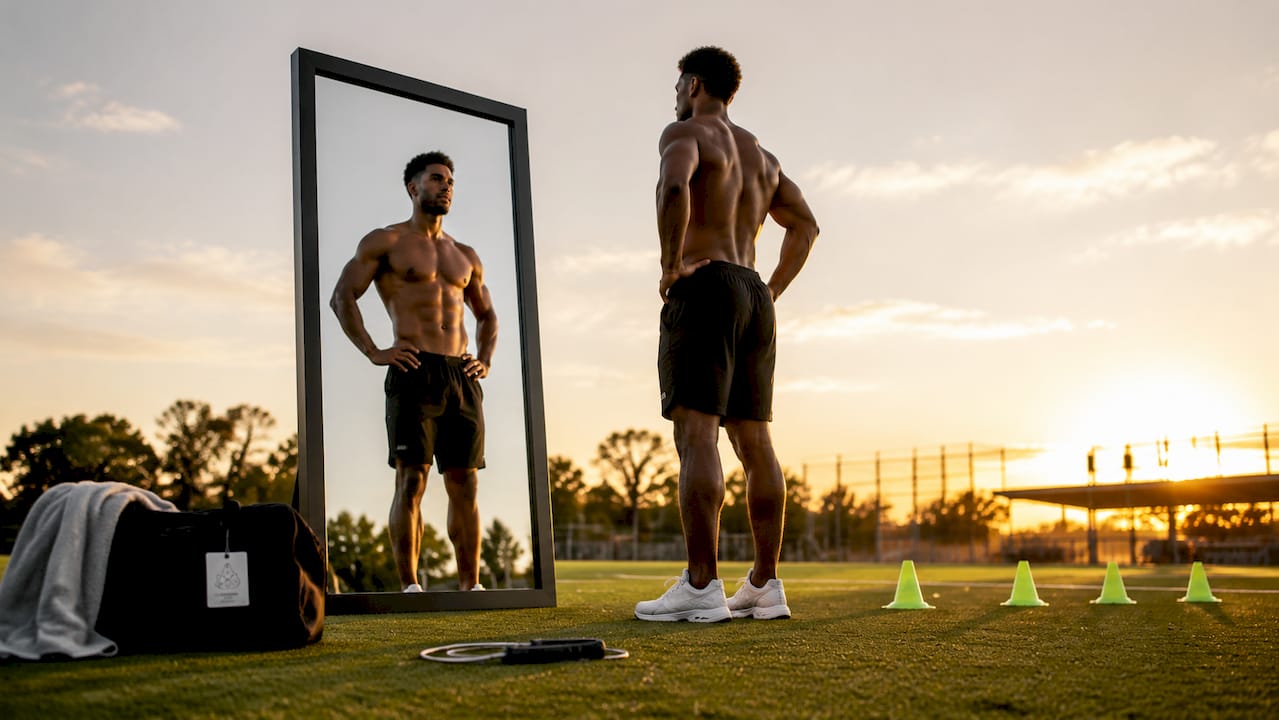
Imagery is the deliberate mental rehearsal of a skill, scenario, or emotional state using all available senses. It is not daydreaming. Effective imagery is structured, specific, and practiced with the same discipline as a physical drill. Research confirms that brief imagery sessions of 3–5 minutes before sleep build performance capacity over time.
Sport-specific visualization exercises include:
- A swimmer mentally executing each stroke phase, turn, and finish at race pace.
- A basketball player visualizing free throws from the feel of the ball to the sound of the net.
- A tennis player rehearsing returning a fast serve, including the recovery step after contact.
- An athlete imagining a moment of adversity, such as a bad call or early deficit, and then seeing themselves refocus and execute.
That last point matters more than most athletes realize. Imagery that only rehearses perfect outcomes leaves you unprepared when things go wrong. Building adversity into your mental rehearsal trains the nervous system to stay composed when competition gets messy.
Pro Tip: Practice imagery in the same physical position you use during competition. A cyclist who visualizes in a road-bike tuck activates more sport-specific neural patterns than one who rehearses lying flat on a couch.
3. Using goal setting to sharpen focus and motivation
Goal setting is the performance GPS of psychological skills training. Without clear targets, effort scatters. With them, training sessions and competition decisions align toward a single direction. The most effective goals for athletes combine long-term vision with short-term checkpoints.
- Set performance goals, not just outcome goals. "Improve my 400m split by 0.3 seconds" is more useful than "win the race." You control your performance. You do not fully control the outcome.
- Use SMART criteria. Goals should be Specific, Measurable, Achievable, Relevant, and Time-bound. Vague goals produce vague effort.
- Align goals with training cycles. Periodizing mental skills training alongside physical training develops the mindset required to use physical capacity effectively under stress.
- Review and adjust weekly. Goals set in preseason may need recalibration after injury, a strong performance, or a shift in competition schedule. Rigid goals become obstacles. Flexible goals stay useful.
- Write them down and place them where you train. Visibility keeps goals active in working memory. A goal you cannot see is a goal you forget.
The connection between goal setting and mental performance coaching is direct. Coaches who structure goal-setting conversations into regular check-ins report faster athlete development than those who leave goal work to chance.
4. Managing self-talk and internal dialogue for confidence
Self-talk is the internal commentary running through your mind during training and competition. It is not neutral. Research on PST programs shows that structured self-talk training significantly reduces anxiety and improves confidence and refocusing skills in athletes over eight weeks.
Self-talk falls into three categories:
- Motivational self-talk: Boosts energy and confidence. "I've trained for this." "Stay strong."
- Instructional self-talk: Directs attention to technique. "Drive the knee." "Soft hands."
- Negative self-talk: Undermines performance. "I always choke here." "My legs are gone."
The goal is not to silence the mind. The goal is to replace automatic negative patterns with deliberate, useful ones. The technique is simple: notice the negative thought, name it ("there's the doubt spiral"), and replace it with a pre-prepared cue word or phrase. Athletes who practice this replacement routine in training find it activates automatically under competition pressure.
Pro Tip: Build a personal cue word list during practice. Three to five short phrases that reset your focus work better than long affirmations. Test them in low-stakes training before relying on them in competition.
Pre-competition self-talk routines also regulate physiological state. Calm, instructional self-talk lowers heart rate variability and reduces cortisol response before a start. That is not a metaphor. It is a measurable nervous system effect. Connecting self-talk practice to nervous system preparation before events gives athletes a concrete pre-performance protocol.
5. Incorporating mindfulness and breathing for stress management
Mindfulness for sports performance is the practice of directing attention to the present moment without judgment. It is not meditation for relaxation. For athletes, it is a cognitive control tool that reduces anxiety and keeps attention on the task rather than the outcome.
| Technique | How it works | Best use case |
|---|---|---|
| Box breathing | Inhale 4 counts, hold 4, exhale 4, hold 4 | Pre-competition anxiety, timeout resets |
| Focused attention | Fix attention on one sensory input (breath, feet, ball) | Refocusing after errors |
| Cognitive reappraisal | Reframe a stressor as a challenge, not a threat | High-pressure moments, injury return |
| Psychological Re-centering | Anchor attention to a specific sensation to interrupt mental spirals | Mid-competition focus loss |
Brief mindfulness sessions in training strengthen cognitive reappraisal, which mediates performance improvements by managing anxiety and recovery. Cognitive reappraisal means changing how you interpret a stressor, not suppressing it. An athlete who reframes pre-race nerves as "my body is ready" performs better than one who fights the feeling.
Psychological Re-centering interrupts mental proliferation by anchoring attention to specific sensations and restoring focus. Mental proliferation is the chain of worry thoughts that compounds after one mistake. Re-centering breaks that chain before it costs you the next play.
Industry experts recommend daily mindfulness habits of 5–10 minutes of focused attention each morning as a sustainable baseline for building mental resilience in athletes. That is a small time investment for a skill that pays off in the highest-pressure moments of competition. Athletes who want to deepen this work can also explore how yoga supports cognitive control as a complementary practice.
Key takeaways
Mental performance optimization techniques work best when practiced daily, periodized alongside physical training, and built into pre-competition routines rather than used only in crisis moments.
| Point | Details |
|---|---|
| PST produces measurable gains | An 8-week structured program improves mental toughness and decision-making in competitive athletes. |
| Consistency beats variety | Practicing one mental skill daily for three months builds more capacity than rotating several skills briefly. |
| Imagery needs adversity | Include difficult scenarios in visualization practice to prepare the nervous system for real competition stress. |
| Self-talk is physiological | Deliberate self-talk routines lower anxiety and cortisol response before competition, not just mood. |
| Mindfulness is a focus tool | Cognitive reappraisal and Re-centering techniques restore attention during competition, not just in training. |
Why I think most athletes underuse their biggest performance asset
Athletes spend years perfecting physical technique and almost no time building psychological skills with the same rigor. I see this pattern constantly. An athlete will log 20 hours a week of physical training and maybe 10 minutes of mental work, usually only when something goes wrong.
The research is clear: consistent daily practice of a single mental skill for three months develops more capacity than short rotations of multiple skills. That mirrors how physical training works. You do not build strength by trying every lift once. You build it by repeating the same movement under progressive load. Mental skills follow the same logic.
The other mistake I see is treating mental training as separate from physical training. Integrating psychological interventions into physical preparation is what makes them stick under pressure. A breathing technique you only practice on a meditation app will not activate automatically in the final seconds of a tied game. One you practice at the end of every hard training set will.
My honest recommendation: pick one skill, practice it every day for 90 days, and track what changes. You will be surprised how much your physical performance shifts when your nervous system stops working against you.
— Paige
How Robertsneurotraining supports your mental performance
Robertsneurotraining, led by Dr. Paige Roberts, works directly with competitive athletes to address the nervous system patterns that block performance. The program goes beyond standard PST by targeting the root causes of performance anxiety, mental blocks, and trauma responses that standard coaching does not reach.

The signature Alpha Imprinting method reprograms the nervous system at the level where panic, freeze responses, and mental blocks originate. Athletes also have access to QEEG brain scans that map cognitive strengths and identify the specific patterns limiting performance. Olympic medalists have used this process to achieve measurable performance gains. If you are ready to train the part of your game that physical practice cannot reach, Robertsneurotraining offers a structured path forward.
FAQ
What is psychological skills training for athletes?
Psychological Skills Training, or PST, is a structured program that develops mental abilities like focus, confidence, self-talk control, and stress regulation. An 8-week PST program produces significant improvements in mental toughness and decision-making in competitive athletes.
How often should athletes practice mental skills?
Experts recommend 5–10 minutes of daily mindfulness or focused attention, a morning self-talk review, and 3–5 minutes of pre-sleep imagery as a sustainable baseline for building mental performance capacity.
Does visualization actually improve athletic performance?
Yes. Imagery activates sport-specific neural patterns and prepares the nervous system for competition scenarios, including adversity. Including difficult situations in visualization practice strengthens the mental response when those situations occur in real competition.
What is the fastest way to reduce pre-competition anxiety?
Box breathing, which follows a four-count inhale, hold, exhale, and hold cycle, is one of the most effective and immediate tools for lowering anxiety before competition. Pairing it with a pre-prepared self-talk cue word produces faster results than either technique alone.
How is Robertsneurotraining different from standard sports psychology?
Robertsneurotraining targets the nervous system directly using Alpha Imprinting and QEEG brain mapping, addressing trauma responses and mental blocks that standard talk-based coaching does not reach. This approach is designed for athletes dealing with performance anxiety rooted in injury, past stressors, or deep-seated mental patterns.