

Yes, feeling angry, snappish, or unusually irritable after a concussion is common, and for most people it fades within a couple of weeks. A minority keep struggling longer and need extra support. Right now: prioritize sleep, cut down on noise and screens, pace your activities, and call your clinician if the anger feels severe, is getting worse, or comes with thoughts of harming yourself or others.
TL;DR:
- Most post-concussion anger peaks within the first two weeks and typically subsides as headaches and brain fog improve, though some may experience longer-term symptoms.
- Triggering factors include sensory overload, cognitive fatigue, poor sleep, and physical pain, with warning signs such as racing heartbeat and clenched fists indicating escalation.
- Autonomic dysregulation caused by disrupted nervous system balance makes the brain more reactive and less able to regulate emotions, worsening irritability.
- Managing sleep, pacing cognitive effort, and practicing breathing techniques can significantly reduce irritability without needing immediate medical intervention.
- Persistent anger beyond three months warrants professional assessment, with treatment options including anger self-management protocols, behavioral therapy, medication, and nervous system training.
Table of Contents
- Anger After Concussion: What It Actually Looks Like
- Why Concussion Can Cause Anger and Irritability
- How Long Does Post-Concussion Anger Usually Last?
- What Triggers the Anger, and How to Track It
- When to Get Clinical Help and What Treatment Looks Like
- Self-Management Strategies That Actually Reduce Anger
- How Caregivers Can Help Without Making It Worse
- Where Nervous System Training Fits Alongside Medical Care
- Resources Worth Bringing to Your Next Appointment
- Get Support: Practical Recovery Tools For Athletes and Everyone Else
- Sources
Anger After Concussion: What It Actually Looks Like
Post-concussive anger rarely looks like the slow burn of everyday frustration. It shows up fast, often disproportionate to whatever triggered it, and it can feel foreign even to the person experiencing it. One minute you're fine, the next you're snapping at your partner because the dishwasher is loud, or shouting at a kid brother over a video game glitch that would have rolled off you a month earlier.
Recognizable patterns include:
- A short fuse that ignites over minor annoyances (traffic, background noise, a slow Wi Fi connection)
- Sudden shouting or harsh words followed almost immediately by guilt or confusion about the outburst
- Withdrawing abruptly from conversations or social settings instead of blowing up outwardly
- Snapping at the people closest to you, especially caregivers or family members trying to help
- Crying or laughing that feels out of proportion to the trigger
According to the fact sheet on irritability and anger from the Model Systems Knowledge Translation Center, anger after traumatic brain injury tends to be sudden and unpredictable, frequently set off by cognitive fatigue, memory lapses, or sensory overload rather than any single obvious provocation. That unpredictability is itself a diagnostic clue: pre-existing anger problems usually have a pattern you can trace, while injury-related anger often seems to come out of nowhere.
The emotional symptom rarely travels alone. Watch for a cluster that shows up alongside the irritability:
- Fatigue that hits harder than it should for the level of activity
- Trouble concentrating or holding a train of thought
- Sensitivity to light or noise that wasn't there before the injury
- Headaches, especially ones that intensify with screen time or crowded rooms
- Sleep that's either harder to get or doesn't feel restorative
If several of these appeared at the same time as the mood change, and that timing lines up with the head injury, you're likely looking at a post-concussive symptom rather than an unrelated mental health issue. The distinction matters for how you and your clinician approach treatment.
So how do you tell injury-related anger from a mood problem that existed before the hit? Three questions help. First, when did it start? If the irritability began within days of the concussion and you had no history of anger issues before, injury is the more likely driver. Second, is this a change from your baseline, or is it a familiar pattern intensified? A lifelong quick temper that got slightly worse points toward an existing condition being aggravated, not a new one being created. Third, does the anger travel with other concussion symptoms like headache, light sensitivity, or brain fog, or does it show up on its own? Isolated anger with no accompanying physical symptoms is less likely to be purely concussion driven, though concussions and mood disorders can and do overlap, which is exactly why a clinician's evaluation beats guessing.
Why Concussion Can Cause Anger and Irritability
The short answer is that a concussion disrupts the exact systems your brain uses to notice you're getting upset and put the brakes on before it turns into an outburst. This isn't a character flaw showing itself. It's biology and circumstance colliding.
Autonomic dysregulation is the technical name for what's happening under the hood. A concussion can throw off the balance between your sympathetic nervous system, the one that ramps you up, and your parasympathetic system, the one that calms you down. When that balance tips toward overdrive, your body sits closer to a fight or flight state than usual, so it takes less to push you into a reaction. At the same time, the prefrontal cortex, which normally acts like a brake pedal on impulsive emotional responses, is working with less fuel than usual after a head injury. The result is a nervous system that's both more reactive and less able to self-regulate, a combination that shows up as a shorter fuse.
Several everyday factors pile on top of that biological shift and make it worse:
- Sleep disruption, which degrades emotional regulation even in people who never had a head injury
- Physical pain, particularly headaches, which lowers frustration tolerance on its own
- Sensory overload from lights, crowds, or noise that the injured brain can no longer filter efficiently
- Cognitive fatigue from trying to concentrate, read, or multitask when your working memory is running at reduced capacity
None of these operate in isolation. A bad night of sleep makes light sensitivity worse, which makes concentrating at work harder, which produces the exact kind of cognitive fatigue that makes irritability spike by mid-afternoon. It's a loop, not a single cause.
There's also a psychological layer that gets underplayed in most concussion advice. Losing the ability to think clearly, work efficiently, or perform athletically, even temporarily, triggers something close to grief. Researchers studying the neuropsychiatric side of concussion describe this as a form of loss aversion, where patients react to a temporary dip in ability the way they'd react to losing something permanently. That grief response often surfaces as anger before it surfaces as sadness, especially in people used to being high performers.
Anger after a concussion is a commonly reported symptom, affecting many individuals recovering from the injury. A collegiate athlete study found that every participant reported some degree of anxiety within the first ten days after a sport-related concussion, with frustration and irritability as recurring themes, and most saw noticeable improvement by the second or third week.
The clinical literature is careful to stress that this is a multi-determined symptom. In other words, don't assume every flash of temper means permanent brain damage. The same research on concussion's neuropsychiatric effects cautions against attributing mood changes directly to structural injury, since sleep, stress, pain, and the psychological toll of the injury itself all contribute independently. That's a relief, honestly. It means the anger is treatable through multiple angles, not a fixed feature of a damaged brain.
How Long Does Post-Concussion Anger Usually Last?
For most people, the irritability that follows a concussion peaks in the first week or two and fades on roughly the same timeline as headaches and brain fog. The CDC notes that emotional symptoms can actually surface a week or two after the initial injury, not always immediately, and generally start improving from there, though the pace varies by person.
A commonly cited window has acute symptoms settling within 7 to 10 days, matching what the collegiate athlete study found: anxiety and frustration were highest in the first ten days and dropped off noticeably by day 11 to 20. That's not a guarantee for every case, but it's a reasonable expectation to hold onto during the roughest stretch.
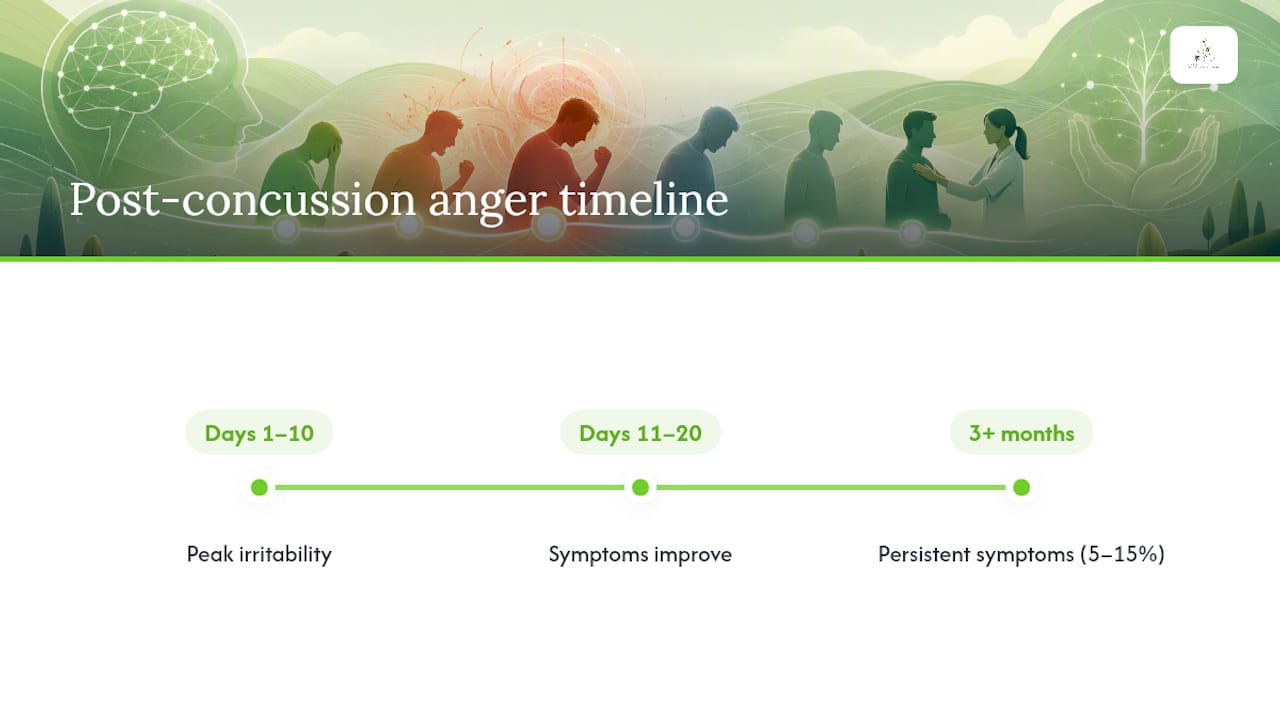
A smaller share of people don't follow that curve. When symptoms including irritability, headaches, concentration problems, and mood changes persist beyond three months, clinicians classify it as post-concussion syndrome. Research on concussion's longer-term effects estimates that 5 to 15% of patients experience mood or cognitive symptoms that outlast the typical recovery window. The Cleveland Clinic notes that in some cases, these persistent symptoms can stretch on for a year or longer, though treatment at that stage shifts from waiting it out to actively managing symptoms and restoring day to day function.
Certain factors raise the odds of landing in that slower recovery group:
A history of anxiety, depression, or other mental health conditions before the injury tends to predict a longer emotional recovery, likely because the concussion is layering new dysregulation on top of an already sensitive system. Multiple prior concussions have a cumulative effect, with each additional injury making full emotional recovery somewhat less predictable. Poor sleep quality during the recovery period itself, separate from any pre-injury history, consistently shows up as a driver of prolonged irritability. And ongoing life stressors, whether that's a demanding job, a competitive season, or family conflict, give the dysregulated nervous system less room to settle.
None of these risk factors guarantee a rough recovery. They're context, not a verdict. Someone with two of these factors can still bounce back in three weeks, and someone with none of them can still land in the persistent group. That's part of why tracking your own symptoms matters more than comparing yourself to a general timeline.
What Triggers the Anger, and How to Track It
Before you can manage post-concussion anger, you need to know what sets it off. Most triggers fall into a short, predictable list, and the MSKTC fact sheet points to cognitive fatigue and sensory overload as two of the most common culprits behind sudden, seemingly unprovoked flare-ups.
Watch for these recurring triggers:
- Sensory overload — bright lights, loud environments, crowded rooms, or multiple people talking at once
- Criticism or correction — even mild, well-intentioned feedback can land harder than it used to
- Cognitive overload — trying to multitask, read for long stretches, or follow fast conversation
- Poor sleep — a single bad night noticeably lowers your tolerance the next day
- Physical pain — headaches especially, but also neck pain or light-triggered eye strain
Your body usually gives you a warning before the outburst hits. Learning to catch those signals is the difference between managing an episode and getting blindsided by one:
- A racing heartbeat or a sudden feeling of heat in your face or chest
- Jaw clenching, shoulder tension, or clenched fists you didn't consciously decide to make
- Thoughts that speed up or start looping on the same irritation
- An urge to leave the room, raise your voice, or slam something down
A simple tracking log turns vague frustration into useful data, both for you and for whoever is treating you. Log the time of the episode, what triggered it, an intensity rating from 1 to 10, how many hours you slept the night before, whether you took any medication that day, and a one line note on context. A week of that log, even a rough one scribbled in your phone's notes app, gives a clinician far more to work with than "I've been irritable lately." Patterns tend to jump out fast: maybe every spike happens after four hours of screen time, or every bad day follows less than six hours of sleep.
When to Get Clinical Help and What Treatment Looks Like
Most post-concussion anger doesn't need a specialist. Some of it does, and knowing the difference matters more than any breathing exercise.
Treat these as emergencies, not wait and see situations:
- Thoughts of suicide or self-harm, at any intensity
- Actual violence toward another person, or a strong urge you're struggling to control
- Sudden neurological changes such as slurred speech, one-sided weakness, vision loss, or a severe worsening headache
Any of those warrants an emergency room visit or a call to emergency services immediately, not a scheduled appointment next week.
For everything short of that, timing guides where you go. If irritability shows up in the first week or two alongside other classic concussion symptoms, your primary care provider or a concussion clinic is the right first stop. Children's Hospital Colorado recommends behavioral health evaluation specifically when emotional symptoms last longer than two weeks or start interfering with school, work, or relationships. That two week mark is a useful personal checkpoint: if you're past it and things aren't easing up, it's time to loop in a specialist rather than keep waiting.
Pro Tip: Bring your symptom log to that first appointment. A clinician working from "I've been on edge" has to guess. A clinician working from a week of logged triggers, sleep hours, and intensity ratings can actually build a targeted plan.
Once you're in front of a specialist, expect a few things. A structured assessment first, looking at your full symptom picture rather than anger in isolation, since irritability rarely travels alone. From there, many clinicians turn to anger self-management protocols, a category of treatment built on cognitive behavioral techniques adapted specifically for brain injury recovery. Research on anger self-management in chronic traumatic brain injury supports structured, psychoeducational approaches as a legitimate way to reduce persistent anger, even in cases where the injury happened long ago. Medication comes into play when anger sits alongside significant anxiety, depression, or sleep disruption that isn't responding to behavioral approaches alone. And for more complicated or prolonged cases, multidisciplinary rehab teams, combining neurology, physical therapy, and behavioral health, tend to produce better outcomes than any single specialist working alone.
Self-Management Strategies That Actually Reduce Anger
You don't have to wait for an appointment to start calming your nervous system down. These techniques target the same autonomic dysregulation driving the irritability, and they're the kind of thing clinicians hand patients as homework anyway.
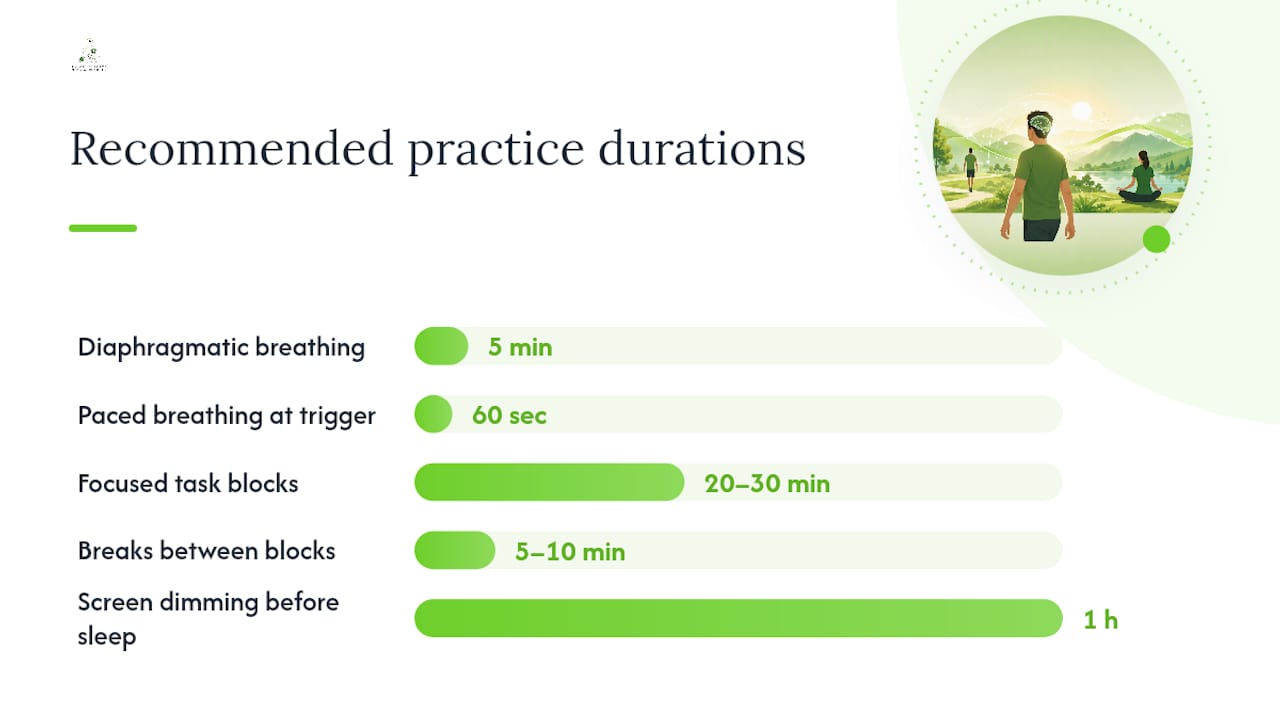
- Practice diaphragmatic breathing twice a day, even when you feel fine. Sit or lie down, place a hand on your belly, and breathe in slowly through your nose for four counts, feeling your belly rise more than your chest. Hold for two counts, then exhale through your mouth for six counts. Repeat for five minutes. Doing this proactively, not just mid-meltdown, trains your baseline nervous system state down over days and weeks.
- Use paced breathing the moment you notice a trigger. The early warning signs, jaw clenching, racing heart, heat in your face, are your cue. Stop, breathe out longer than you breathe in for 60 seconds, and give your body a chance to downshift before words come out.
- Pace your cognitive tasks in short blocks with real breaks. Work in 20 to 30 minute stretches of reading, screens, or focused conversation, then take a five to ten minute break in a quiet, dim space. Pushing through fatigue is what tips cognitive overload into an outburst.
- Protect your sleep window like it's part of treatment, not a luxury. Keep a consistent bedtime, dim screens an hour before sleep, and avoid caffeine after early afternoon. Since poor sleep is one of the clearest drivers of next day irritability, this single habit does more heavy lifting than most people expect.
- Build a sensory management plan for high risk environments. If crowded stores or loud family dinners reliably trigger you, bring earplugs or noise dampening headphones, wear sunglasses indoors if lights bother you, and give yourself permission to step outside for two minutes without explanation.
- Keep the same mood and trigger log described earlier, but review it weekly. Look for the pattern instead of just recording the data. If every bad evening follows a day with less than six hours of sleep, that's your priority fix, not the breathing exercises.
- Write yourself a short cool off script before you need it. Something as simple as, "I'm going to step outside for five minutes and come back," said out loud the moment you feel the heat rising, gives your prefrontal cortex a task to execute instead of leaving it to catch up after the words are already out.
None of these require special equipment, though a basic guided breathing app or a simple sleep tracker can make the habit easier to stick with. The point isn't to eliminate every flash of frustration. It's to shrink the gap between noticing the trigger and choosing your response, which is exactly the gap a concussion widens.
Pro Tip: If you're an athlete easing back into training, treat sensory and cognitive pacing the same way you'd treat a return to play protocol. A guide on managing sensory overload during concussion recovery breaks down how to structure that gradual reintroduction without triggering setbacks.
Cognitive fatigue deserves special attention because it's the trigger people underestimate most. Concentration problems, slower processing speed, and memory lapses aren't just annoying on their own. They're a direct pipeline to irritability, since every failed attempt to focus or remember something adds frustration to an already depleted tank. A closer look at how mental performance issues surface after concussion makes the connection clearer: managing the cognitive symptoms often does more to calm the mood than any anger specific technique on its own.
How Caregivers Can Help Without Making It Worse
If you're supporting someone through post-concussion anger, your instincts might actually work against you. Arguing back, demanding they "calm down," or taking the outburst personally tends to escalate things fast, since a dysregulated nervous system responds to pressure with more pressure.
What tends to help:
- Validate before you problem-solve. A simple "I can see you're really frustrated right now" does more than any logical counterargument in the heat of the moment.
- Step back instead of stepping in. Giving physical space, even just leaving the room for a few minutes, lets the nervous system come down without an audience.
- Wait for the calm window to talk it through. Trying to reason with someone mid outburst rarely lands. Revisit the incident once things have settled.
- Keep routines steady. Predictable meals, sleep times, and quiet periods reduce the number of triggers your loved one has to navigate in a day.
What tends to backfire:
- Arguing about whether the reaction was "fair" or proportionate
- Bringing up past outbursts during a current one
- Taking the anger personally, since it's frequently about overload, not about you
- Pushing through a planned activity when clear warning signs (tension, snapping, withdrawal) have already shown up
Have a simple safety plan in place before you need it. Agree in advance on a signal or phrase either person can use to pause a tense situation, know where the nearest urgent care or emergency room is, and don't hesitate to call emergency services if anger turns physical or someone mentions wanting to hurt themselves or someone else. That's not overreacting. That's the same red flag list any clinician would tell you to take seriously.
Beyond the moment to moment de escalation, caregivers carry a lot of the logistical weight of recovery. Driving to appointments, keeping track of the symptom log, and speaking up when a clinician needs the full picture rather than just what the patient remembers to mention, all of that matters more than people expect. A somatic coping strategies guide offers additional grounding techniques caregivers can practice alongside the person recovering, which tends to make the support feel collaborative instead of one sided.
Where Nervous System Training Fits Alongside Medical Care
Standard concussion care treats the visible symptoms: headaches, cognitive fog, sleep disruption. What it addresses less directly is the underlying autonomic state, the fight or flight loop that keeps a recovering brain locked in a reactive posture long after the initial injury.
That's the gap nervous system training is built to address. A specialized nervous system training protocol called Alpha Imprinting is used by some practitioners to help retrain the autonomic nervous system away from chronic overdrive states that keep irritability, hypervigilance, and performance anxiety cycling. The approach uses tools including QEEG brain mapping and light based sessions to identify and target the specific dysregulation patterns showing up in a given athlete's nervous system.
A few things worth understanding about where this fits:
- It's designed as a complement to medical and psychological care, not a substitute for the evaluation and treatment your physician or therapist provides.
- Candidates tend to be athletes and performers whose emotional dysregulation, anxiety, or performance blocks persist after standard concussion protocols have addressed the acute injury.
- Coordination with your treating clinician matters. Nervous system training works best layered on top of your existing care plan, not run in isolation from it.
- The goal isn't to bypass anger management skills or therapy. It's to work at the physiological layer underneath those skills, so the regulation techniques you're already learning have an easier nervous system to work with.
Anyone considering this route, whether recovering from a sport related concussion or working through the anxiety that follows one, should treat it as one part of a broader recovery team that includes their physician and, where appropriate, a behavioral health provider. The concussion recovery program at Robertsneurotraining outlines how that coordination typically works in practice.
Resources Worth Bringing to Your Next Appointment
A handful of sources back nearly everything covered here, and they're worth having on hand, either printed or saved as a PDF on your phone, for your next appointment.
- The CDC's guidance on concussion signs and symptoms is a solid baseline for what's typical and what warrants concern.
- The MSKTC fact sheet on irritability and anger after TBI breaks down triggers and coping strategies in plain language.
- The Cleveland Clinic's overview of post-concussion syndrome explains what persistent symptoms look like and how treatment shifts over time.
- The peer reviewed review of neuropsychiatric aspects of concussion covers the mechanisms behind mood changes in more clinical depth.
- The research on anger self-management in chronic TBI supports the behavioral treatment approaches referenced throughout this piece.
Bringing even one of these to an appointment gives your provider a shared starting point, which tends to make the conversation more specific and less like starting from zero.
Get Support: Practical Recovery Tools For Athletes and Everyone Else
The research is consistent on one point: anger after concussion is common, it's biologically explainable, and it's treatable through more than one channel at once. Where I think conventional advice falls short is in treating the emotional symptoms as something to simply wait out. Waiting works for a lot of people. It doesn't work for everyone, and the two week and three month markers exist precisely because a meaningful share of patients need more than patience.
What gets underrated is pacing, not breathing exercises. Everyone reaches for the breath work first because it's the most visible tool, but the cognitive overload and sleep disruption sitting upstream of most outbursts get far less attention than they deserve. Fix the pacing and the sleep, and the anger often follows.
If you're an athlete, prioritize getting your nervous system evaluated alongside your standard concussion care, not after it fails to resolve on its own. That's where an adjunctive approach like Alpha Imprinting tends to add the most value: working on the autonomic layer while your medical team handles the rest. For sport specific programs, athletes recovering from concussion in tennis, baseball, and lacrosse can find protocols built around the physical and cognitive demands of their sport specifically. For a broader look at tracking recovery metrics over time, a tennis performance tracking workflow offers a useful model even outside that one sport.
— Paige
Sources
- Neuropsychiatric aspects of concussion: acute and chronic sequelae - PMC
- Understanding and Coping With Irritability, Anger, and Aggression After TBI — MSKTC
- Signs and symptoms of concussion — CDC
- Anger Self-Management in Chronic Traumatic Brain Injury — PMC
- Post-concussion syndrome: What It Is, Symptoms & Treatment — Cleveland Clinic