

Most common team mental performance breakdowns share a root in the nervous system, not in talent or effort. Emotional contagion spreads anxiety and anger through a roster faster than any coach can intervene. Failures in shared mental models leave athletes guessing about roles when split-second coordination matters most. Psychological safety collapses under pressure, silencing the honest communication teams need to self-correct. And underneath all of it, system-level dysfunction — misaligned goals, leadership gaps, eroded trust — creates the conditions where individual athletes and whole squads spiral. For athletes recovering from injury or trauma, these dynamics hit harder, because a nervous system already primed for threat reads every team stressor as confirmation that something is wrong.
Key breakdowns to understand:
- Emotional and behavioral contagion spreading anxiety, anger, and freezing behaviors
- Shared mental model failures causing coordination collapse
- System-level causes including leadership gaps and goal misalignment
- Psychological safety erosion under competitive stress
- Cognitive biases amplifying poor decisions during high-pressure moments
- Burnout and fatigue degrading mental sharpness and motivation
- Communication breakdowns accelerating team collapse cycles
Neuroscience-based recovery methods, including Performance Neuro Training and Alpha Imprinting developed by Dr. Paige Roberts, directly address the nervous system patterns driving these breakdowns.
Table of Contents
- 1. How emotional contagion derails your whole team at once
- 2. Why shared mental models are the backbone of team resilience
- 3. System-level causes that coaches often misdiagnose
- 4. Psychological safety breaks down faster than most coaches realize
- 5. Neuroscience-based mental performance training for recovery and resilience
- Robertsneurotraining addresses what recovery programs miss
- Key Takeaways
1. How emotional contagion derails your whole team at once
Emotional contagion is the rapid, largely unconscious transfer of anxiety, anger, and frustration from one athlete to another. A player doesn't need to have been involved in the triggering moment to absorb the emotional fallout. Research on collective sport team collapse published in Frontiers in Psychology documents how these transferred emotions produce cautious, hesitant play, outright freezing on the court or field, and a breakdown of the team's strategic system. Communication drops. Blame rises. The collapse feeds itself.
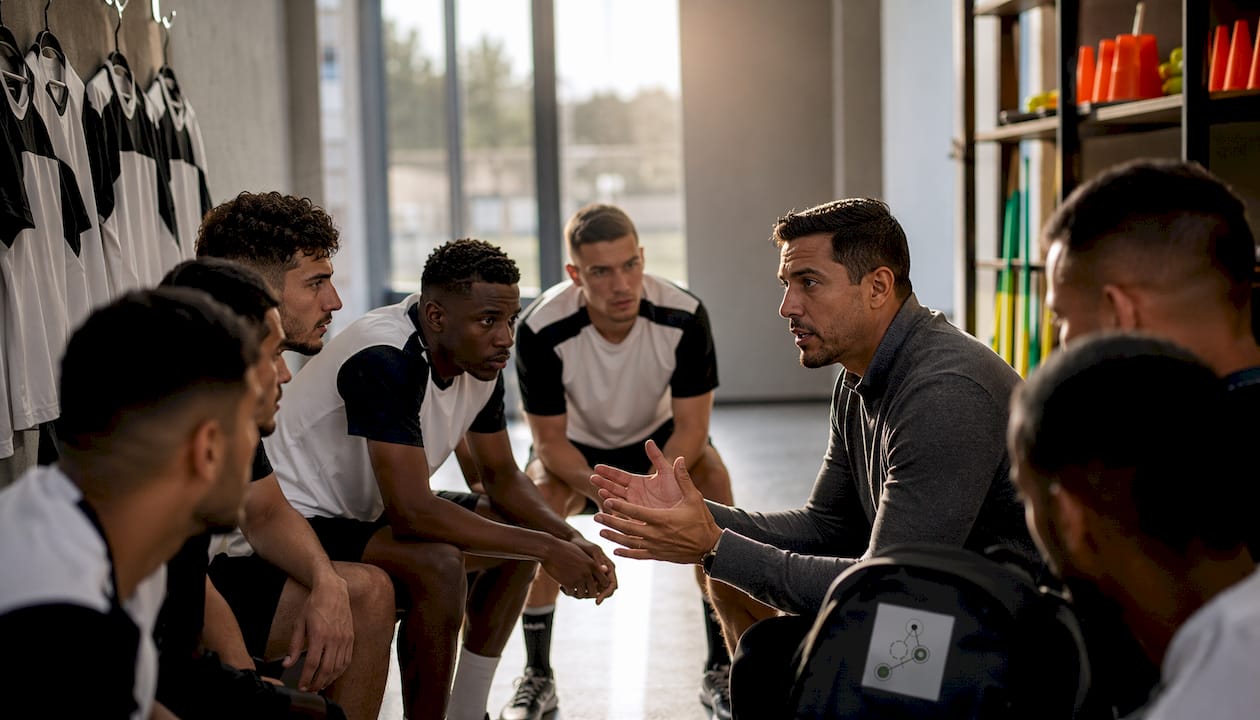
What makes this particularly dangerous for athletes recovering from injury is that their nervous systems are already sensitized. A trauma-primed athlete picks up a teammate's panic signal faster and holds it longer.
| Contagion Stage | What Happens | Behavioral Outcome |
|---|---|---|
| Critical event triggers | Mistake, referee call, injury | Anxiety spike in one or two players |
| Emotional transfer | Mood spreads without direct involvement | Team-wide tension, loss of focus |
| Cognitive shift | Goal-oriented thinking becomes prevention-oriented | Defensive, cautious play |
| Behavioral collapse | Communication drops, blame increases | Strategic system breaks down |
| Vicious cycle | Failures accumulate and reinforce each other | Full team performance collapse |
Pro Tip: When you feel the emotional temperature rising in a huddle, a brief box breathing reset (steady cycles of inhaling, holding, exhaling, and holding) lasting about a minute activates the parasympathetic nervous system and interrupts the contagion loop before it spreads further. Neuroperformance coaching builds this as an automatic response.
2. Why shared mental models are the backbone of team resilience
A shared mental model is a team's collective understanding of who does what, when, and why. When those models are accurate and current, athletes adapt without needing constant verbal instruction. When they're absent or outdated, teams struggle to coordinate under pressure and fall back on slow, overt communication at exactly the moment speed matters most.
Research from Frontiers in Psychology confirms that cohesion, shared mental models, and adaptability are the emergent states that buffer teams against stress. Without them, a single unexpected event can derail a team that looked solid in practice.
For athletes returning from injury, the problem is compounded. Time away from the team creates gaps in their mental model of current roles, plays, and dynamics. They return physically ready but cognitively out of sync.
Best practices for building and maintaining shared mental models:
- Run scenario-based simulations that mirror high-pressure game situations
- Debrief after every practice with explicit role-clarity conversations
- Use coach-led mental model reviews to surface assumption gaps before competition
- Reintegrate recovering athletes with structured role walkthroughs, not just physical drills
- Encourage athletes to verbalize their situational read during training to expose misalignments early
3. System-level causes that coaches often misdiagnose
Most team performance issues aren't talent problems. Underperformance stems primarily from structural ambiguities, goal misalignment, and managerial gaps. When those root causes go unaddressed, the default response is to blame individuals, which accelerates trust erosion and makes the underlying problem worse.
Chronic failure depletes dopamine, and when athletes stop expecting success, they stop trying. That's learned helplessness, and it's a neurological state, not a character flaw. Effective leadership that establishes clear goals, consistent accountability, and a culture of trust is the primary lever for reversing it.
Diagnostic signals and system-level remedies:
- Signal: Repeated mistakes by multiple athletes. Remedy: Audit the system before the individual.
- Signal: Declining effort despite high talent. Remedy: Check goal clarity and relevance.
- Signal: Blame cycles between teammates. Remedy: Manager coaching on accountability culture.
- Signal: High turnover or disengagement. Remedy: Structural redesign and resource assessment.
- Signal: Inconsistent performance across contexts. Remedy: Goal recalibration and role realignment.
4. Psychological safety breaks down faster than most coaches realize
Psychological safety is fragile. Under competitive stress, athletes who would normally speak up about confusion, pain, or doubt go quiet. They read honesty as risk. The team looks cohesive on the surface while critical information stays buried.
Neuroscience explains why: emotional flooding, operating below conscious awareness, shuts down the prefrontal cortex's capacity for rational communication. Athletes aren't choosing silence. Their nervous systems are choosing it for them. This is especially acute in athletes who carry trauma, where the threat-detection system is already running hot.
Strategies to maintain and rebuild psychological safety in trauma-affected teams:
- Normalize post-competition debriefs where errors are discussed without judgment
- Create explicit "no-blame" language norms in team meetings
- Use psychological safety best practices that reward vulnerability over performance posturing
- Have coaches model uncertainty openly ("I'm not sure that call was right")
- Separate performance feedback from identity feedback in all athlete conversations
Pro Tip: Build a weekly "honest minute" ritual where each athlete names one thing they're uncertain about. It sounds small, but it trains the nervous system to associate honesty with safety rather than threat, which is the exact rewiring trauma-affected athletes need.
5. Neuroscience-based mental performance training for recovery and resilience
Performance Neuro Training, developed by Dr. Paige Roberts at Robertsneurotraining, addresses team mental performance breakdowns at the source: the nervous system. Rather than teaching athletes to manage anxiety cognitively, the approach retrains the autonomic nervous system responses that generate anxiety cascades, performance freeze, and mental blocks in the first place.
The proprietary Alpha Imprinting method works by reprogramming the nervous system's conditioned threat responses, allowing athletes to access a state of flow during competition rather than defaulting to survival-mode patterns. For athletes recovering from injury or trauma, this is the distinction that matters. Cognitive strategies alone can't override a nervous system that has been conditioned to expect pain, failure, or danger.
The results speak through the athletes themselves:
Scientific validation from Frontiers in Psychology research on team collapse and contagion supports the neurological basis for these interventions. When the nervous system is retrained to interrupt contagion loops, regulate emotional flooding, and restore goal-oriented thinking, athletes return to competition with a fundamentally different internal baseline.
Robertsneurotraining addresses what recovery programs miss
Mental resilience in teams doesn't rebuild itself through rest or repetition alone. The nervous system needs direct retraining, and that's exactly what Robertsneurotraining delivers.

Dr. Paige Roberts' Performance Neuro Training process is built for athletes who have done the physical work but still feel stuck, anxious, or disconnected from their performance. Where traditional sports psychology addresses mindset, Robertsneurotraining goes deeper, targeting the autonomic patterns that keep athletes locked in threat mode long after the injury has healed. The Alpha Imprinting method has produced measurable results for Olympic Medalists and professional athletes across major leagues. If you're returning from injury or trauma and the mental side still isn't clicking, the next step is to connect with Dr. Roberts directly at robertsneurotraining.com and start retraining the system that runs your performance.
Key Takeaways
Team mental performance breakdowns are primarily nervous system and system-level failures, not talent deficits, and neuroscience-based retraining is the most direct path to recovery.
| Point | Details |
|---|---|
| Emotional contagion spreads fast | Anxiety and anger transfer between athletes unconsciously, triggering freezing and strategic collapse. |
| Shared mental models prevent breakdown | Teams without current, accurate role clarity lose coordination under pressure and adapt too slowly. |
| System causes beat individual blame | Most underperformance traces to leadership gaps, goal misalignment, or structural friction, not individual failure. |
| Psychological safety needs active protection | Stress shuts down honest communication neurologically; teams must build explicit safety rituals to counter it. |
| Robertsneurotraining retrains the root cause | Alpha Imprinting and Performance Neuro Training address the autonomic nervous system patterns behind mental blocks and performance anxiety. |