
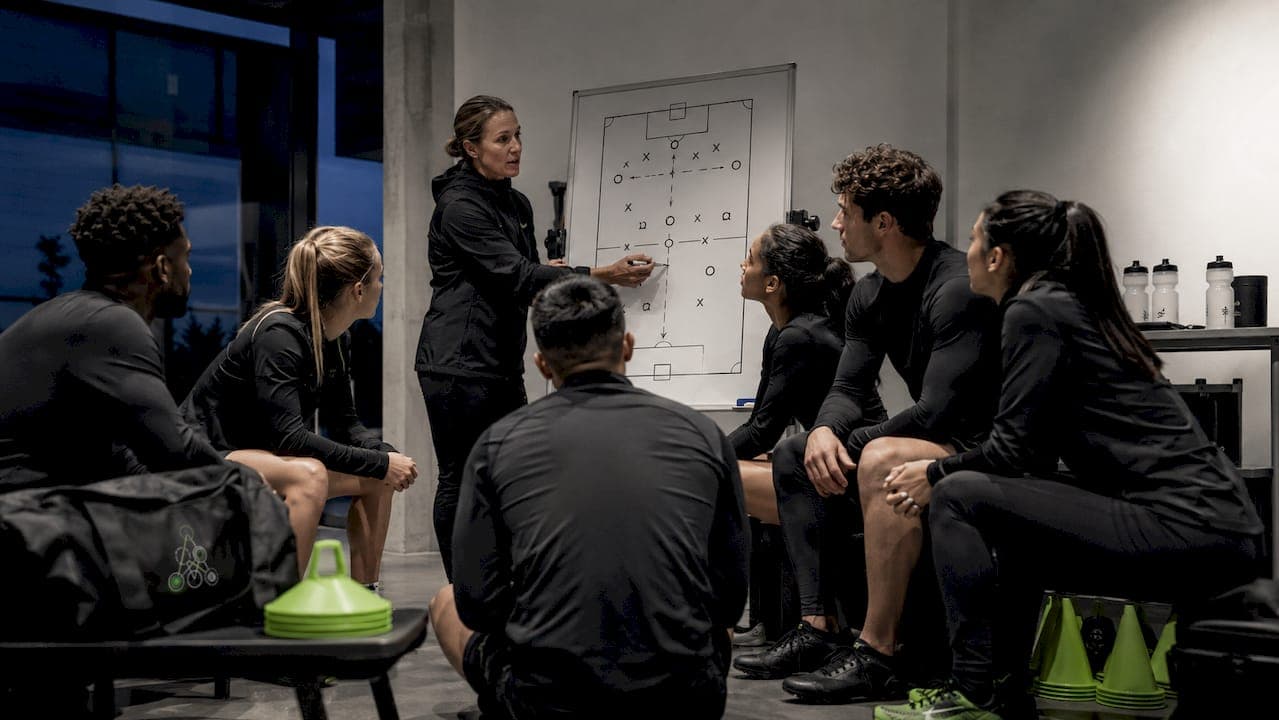
A shared mental model in sports is defined as the collective cognitive framework teammates hold about roles, strategies, and situational expectations, allowing them to coordinate without constant verbal communication. Research confirms that teams with stronger shared mental models show significantly higher team trust (r = 0.67) and subjective performance (r = 0.55). That correlation is not coincidental. When every athlete on the field carries the same internal map of how a play should unfold, decision speed rises and costly hesitation drops. Understanding what is shared mental model sports means understanding the cognitive engine behind elite team performance.
What is a shared mental model in sports?
A shared mental model (SMM) is the standard term in cognitive and sport psychology for what athletes informally call "being on the same page." It is a dynamic state, not a fixed document. Every teammate holds an internal representation of the team's tasks, each other's roles, and the strategies in play. When those representations align closely, the team functions as a single coordinated unit.
The concept originates in cognitive psychology and was adopted by sport psychology researchers to explain how teams coordinate under time pressure. In soccer, basketball, handball, and other fast-paced sports, verbal communication during live play is limited. SMMs fill that gap. A midfielder who knows exactly where the striker will move does not need a shout. The anticipation is already built in.

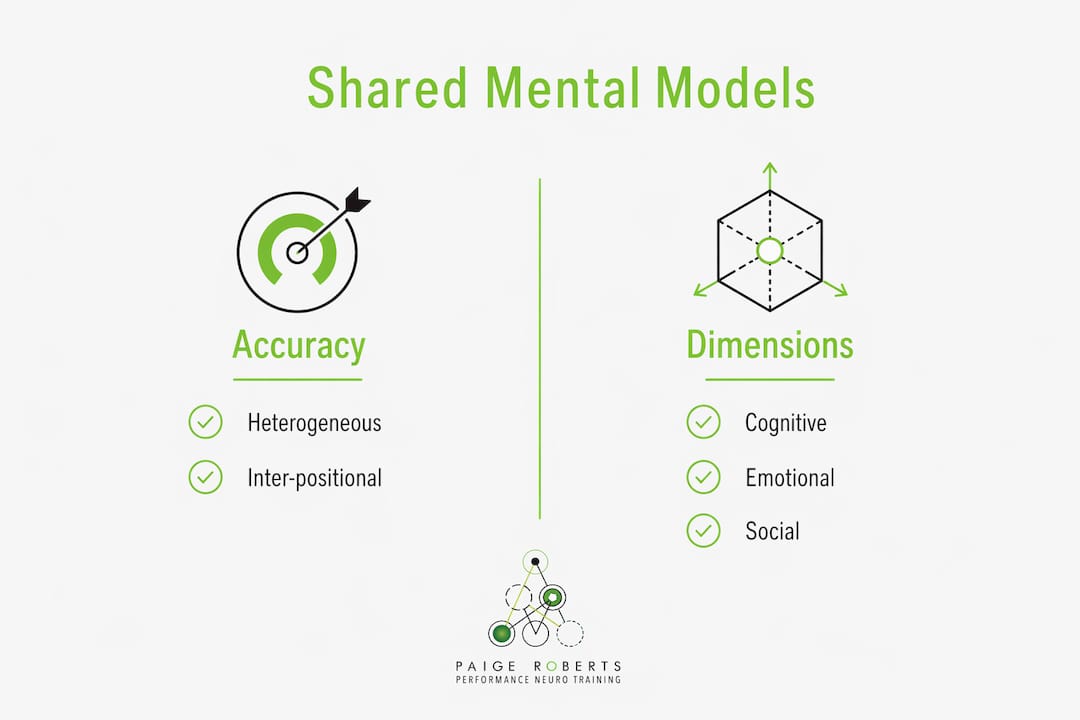
Team cognition in sport is shaped by five main dimensions: cognitive, emotional, neurological, social, and developmental. Each dimension contributes to how well teammates read each other in real time. Coaches who address only the cognitive layer, through playbooks and film sessions, leave the emotional and social layers underdeveloped, which limits how deeply the model is shared.
What key components constitute shared mental models in sports teams?
SMMs in sports break down into two measurable components: heterogeneous accuracy and inter-positional accuracy. Understanding both is the first step toward building them deliberately.
Heterogeneous accuracy refers to each athlete's understanding of their own role within the team system. A point guard who knows precisely when to initiate a pick-and-roll, and why, holds strong heterogeneous accuracy. Inter-positional accuracy goes further. It describes how well each athlete understands their teammates' tasks and decision triggers. Integrating Cognitive Task Analysis into team review sessions measurably improves both components in elite teams.
| Component | Definition | Performance Impact |
|---|---|---|
| Heterogeneous accuracy | Individual understands their own role deeply | Faster personal decision-making |
| Inter-positional accuracy | Individual understands teammates' roles | Anticipation and implicit coordination |
| Emotional alignment | Teammates share situational emotional reads | Reduced panic under pressure |
| Social trust | Confidence in teammates' competence | Willingness to act without confirmation |
The emotional and social dimensions are frequently underestimated. A team can memorize every play and still collapse under pressure if emotional alignment is absent. Psychological safety, the belief that speaking up or making a mistake will not result in blame, directly supports how openly athletes update their shared understanding during competition.
Pro Tip: After each training session, ask athletes to write one sentence describing what they think a specific teammate was trying to accomplish on a key play. Comparing those answers reveals inter-positional accuracy gaps faster than any survey.
How do shared mental models develop during training and competition?
SMMs are not built once and stored. They require continuous updating across the entire season cycle. Pre-game preparation, in-game adaptation, and post-game review each play a distinct role in that process.
Before competition, structured communication sessions align subjective mental maps. Failing to align players' subjective perceptions is one of the most common reasons teams break down when executing strategies under pressure. Coaches who run film sessions without asking players to verbalize their interpretations miss the alignment step entirely.
During competition, SMMs update in real time through brief verbal cues, body language, and positional adjustments. Elite teams train these micro-updates deliberately. CTA-based off-field review sessions break plays into cognitive chunks, which accelerates shared understanding across the roster.
Several "meso factors" shape how well SMMs develop over time:
- Constructive conflict: Teams that avoid disagreement often lack deep shared understanding. Constructive conflict, trust, and shared goals are all necessary for building true SMMs at the elite level.
- Trust: Athletes act on their shared model only when they trust that teammates will do the same.
- Shared goals: Alignment on outcomes, not just tactics, keeps the model coherent across different game states.
- Psychological safety: Athletes update their mental models more accurately when they feel safe flagging confusion. Coaches can build this through team psychological safety practices that normalize open communication.
Pro Tip: Schedule a 10-minute "conflict debrief" after scrimmages where athletes openly disagree about what a play was supposed to look like. Productive disagreement is the fastest path to genuine alignment.
Why are shared mental models essential for high performance?
The core performance benefit of a well-developed SMM is implicit coordination. SMMs enable anticipation without verbal communication, which is critical in fast-paced sports where there is no time to confirm intentions. A basketball defender who knows their teammate will rotate left does not wait for a signal. They move before the play develops.
This anticipation effect compounds under pressure. When game stakes rise, verbal communication becomes less reliable. Noise, adrenaline, and cognitive load all reduce the quality of real-time instruction. Teams with strong SMMs maintain coordination precisely when communication breaks down. Teams without them revert to individual decision-making, which fragments the collective strategy.
Specific performance benefits include:
- Faster decision-making: Athletes spend less cognitive energy assessing what teammates will do and more on reading the opponent.
- Better execution under fatigue: Late-game situations demand automatic responses. SMMs make those responses consistent across the team.
- Higher team cohesion: Shared understanding builds interpersonal trust, which reinforces the model itself.
- Reduced coaching dependency: Teams with strong SMMs self-correct during play rather than waiting for sideline instruction.
The team performance neuroscience behind SMMs also explains why athletes who have experienced performance anxiety or trauma responses often struggle to access their shared model under pressure. When the nervous system is in a threat state, the brain prioritizes survival over coordination. Addressing that nervous system response is a prerequisite for SMMs to function at full capacity.
For youth athletes developing their first team systems, platforms like GoD1Golf.com demonstrate how early coaching structures can build the role clarity and communication habits that SMMs require at higher levels.
How can coaches develop and measure shared mental models?
Building SMMs requires deliberate methods, not just more practice time. The following steps give coaches and sports psychologists a structured path.
- Run Cognitive Task Analysis sessions. CTA breaks down specific plays or decisions into the cognitive steps each athlete takes. Elite soccer teams use CTA during video review to expose gaps between what coaches intend and what players understand.
- Use scenario visualization. Have athletes mentally rehearse specific game situations from multiple positions, not just their own. This builds inter-positional accuracy without additional physical load.
- Introduce structured communication protocols. Brief pre-play verbal confirmations during practice train athletes to align their mental maps before execution.
- Integrate psychological safety checks. Athletes who feel safe admitting confusion update their mental models more accurately. A team mental training program that includes regular check-ins on role clarity accelerates SMM development.
- Measure progress beyond surveys. Traditional questionnaires capture self-reported understanding, which is often inaccurate. VR simulations for SMM measurement show strong potential for objective assessment by measuring decision congruence between teammates in real-time scenarios.
Measurement matters because you cannot improve what you cannot see. The shift from questionnaires toward high-fidelity tools like VR reflects a broader move in sport psychology toward objective data. Decision congruence, the degree to which two athletes make the same choice in the same simulated situation, serves as a direct proxy for SMM strength.
Coaches should integrate SMM development into the full season cycle, not just preseason. Early season work focuses on building the base model through CTA and communication protocols. Midseason work maintains and updates the model as opponents adapt. Late season work stress-tests the model under simulated high-pressure conditions so athletes can access it automatically when it counts most.
Key Takeaways
Shared mental models are the cognitive foundation of elite team performance, built through deliberate practice, structured communication, and trust.
| Point | Details |
|---|---|
| Core definition | SMMs are collective cognitive frameworks that allow teams to coordinate without constant verbal communication. |
| Two key components | Heterogeneous accuracy (own role) and inter-positional accuracy (teammates' roles) both drive tactical performance. |
| Trust and conflict | Constructive conflict and psychological safety are necessary conditions for deep shared understanding. |
| Measurement evolution | VR-based decision congruence testing gives coaches more objective SMM data than self-report surveys alone. |
| Nervous system link | Athletes in threat states cannot fully access their shared mental model; addressing nervous system regulation is foundational. |
What coaches consistently get wrong about shared mental models
Most coaches I work with understand the concept of shared mental models intellectually. Where they consistently fall short is in treating SMM development as a one-time preseason task. They run a team-building camp, align on the playbook, and assume the model is set. It is not. The model degrades every time a new opponent forces a tactical adjustment, every time a key player is injured, and every time a losing streak shifts the emotional climate of the team.
The second mistake I see constantly is overemphasis on physical drills while neglecting players' subjective understanding of game situations. You can run the same drill 200 times and still have five athletes with five different interpretations of its purpose. That gap does not close through repetition. It closes through structured conversation, deliberate conflict, and honest assessment of where individual mental maps diverge.
The third thing most coaches miss is the nervous system piece. An athlete carrying unresolved performance anxiety or trauma does not have full access to their cognitive resources during competition. Their shared mental model may be technically sound, but their nervous system pulls them out of the collective and into self-protection. No amount of tactical review fixes that. It requires direct nervous system work, which is exactly where mental performance optimization becomes non-negotiable for elite teams.
The teams that get this right treat SMM development as a living process. They schedule it, measure it, and revisit it throughout the season. They create space for productive disagreement. And they address the individual nervous system states that determine whether each athlete can actually access the shared model when the game is on the line.
— Paige
How Robertsneurotraining supports team mental performance
Shared mental models require more than tactical alignment. They require athletes whose nervous systems are regulated enough to access collective understanding under pressure. Robertsneurotraining, led by Dr. Paige Roberts, works directly with athletes and teams to address the nervous system barriers that block full cognitive and emotional participation in team coordination.

The Energy Optimization Workbook gives athletes a structured starting point for understanding and managing the mental energy that shared mental models demand. For teams seeking deeper support, Robertsneurotraining's neurotraining services include Alpha Imprinting and individualized nervous system training designed to help athletes perform at their cognitive best when team coordination matters most.
FAQ
What is a shared mental model in sports?
A shared mental model in sports is a collective cognitive framework that teammates hold about roles, tasks, and strategies, allowing them to coordinate and anticipate each other's actions without relying on constant verbal communication.
Why are shared mental models important for team performance?
Teams with stronger shared mental models show significantly higher trust and subjective performance, because aligned mental maps enable faster decisions and implicit coordination under pressure.
How do coaches build shared mental models in their teams?
Coaches build shared mental models through Cognitive Task Analysis sessions, scenario visualization, structured communication protocols, and psychological safety practices that encourage athletes to openly align their understanding of game situations.
How are shared mental models measured in sports?
Traditional measurement uses self-report surveys, but emerging VR simulation methods measure decision congruence between teammates in real-time scenarios, providing a more objective assessment of SMM strength.
Can individual mental blocks affect a team's shared mental model?
Yes. Athletes experiencing performance anxiety, trauma responses, or nervous system dysregulation cannot fully access their cognitive resources during competition, which disrupts their ability to participate in and contribute to the team's shared mental model.