

Nervous system reprogramming is the intentional process of changing how your autonomic nervous system responds to stress, trauma, and performance pressure by retraining its automatic patterns through behavioral, somatic, and neuromodulation-based methods. In sports psychology, this process is recognized as a core mechanism behind mental resilience, helping athletes move out of chronic fight-or-flight states and into the regulated, focused states required for peak performance. The standard clinical term for this work is autonomic regulation training, though nervous system reprogramming has become the widely used umbrella phrase across coaching, therapy, and performance science. Methods like Somatic Experiencing®, intentional breathwork, and closed-loop vagus nerve stimulation each target different layers of this process, from behavioral habits to molecular brain changes.
What is nervous system reprogramming, and how does it work?
Nervous system reprogramming refers to learning-based regulation that alters automatic stress responses by combining behavioral, therapeutic, and body-centered techniques to shift autonomic reactivity. The autonomic nervous system operates in two primary modes: the sympathetic system, which drives fight-or-flight responses, and the parasympathetic system, which governs rest and recovery. When chronic stress or trauma locks you into sympathetic dominance, your capacity to think clearly, recover physically, and perform under pressure collapses. Reprogramming targets that lock.
The neuroscience behind this is concrete. Repeated or chronic stress causes structural brain remodeling in the hippocampus and amygdala, reducing plasticity, triggering dendritic retraction, and amplifying fear responses. This means trauma and sustained performance anxiety do not just feel bad. They physically reshape the brain in ways that make regulation harder over time. The goal of reprogramming is to reverse that trajectory.

At the molecular level, stress modifies key genes including NR3C1, FKBP5, and BDNF through epigenetic changes like methylation and histone acetylation, which alter how resilient or vulnerable your nervous system becomes. Critically, many of these changes are partially reversible with targeted intervention. That reversibility is the scientific foundation for why reprogramming works.
Neurorehabilitation research confirms that reprogramming reshapes network-level activity across the brain, not just isolated regions. Repeated practice and intentional therapy design are what move maladaptive patterns toward healthy regulation. One session does not rewire a nervous system. Consistent, graduated exposure does.
| Mechanism | What changes | Why it matters |
|---|---|---|
| Neuroplasticity | Dendritic growth, synaptic strength | Restores capacity for calm and focus |
| Epigenetic modification | Gene expression for stress resilience | Partially reverses trauma-driven vulnerability |
| Network reorganization | Connectivity between amygdala, prefrontal cortex | Improves emotional regulation and decision-making |
| Autonomic balance | Sympathetic vs. parasympathetic tone | Shifts body from reactive to regulated states |
What are the most effective methods for reprogramming the nervous system?
The techniques for nervous system reprogramming fall into three broad categories: somatic therapies, behavioral practices, and biomedical neuromodulation. Each targets a different entry point into the nervous system, and the most durable results typically come from combining approaches.
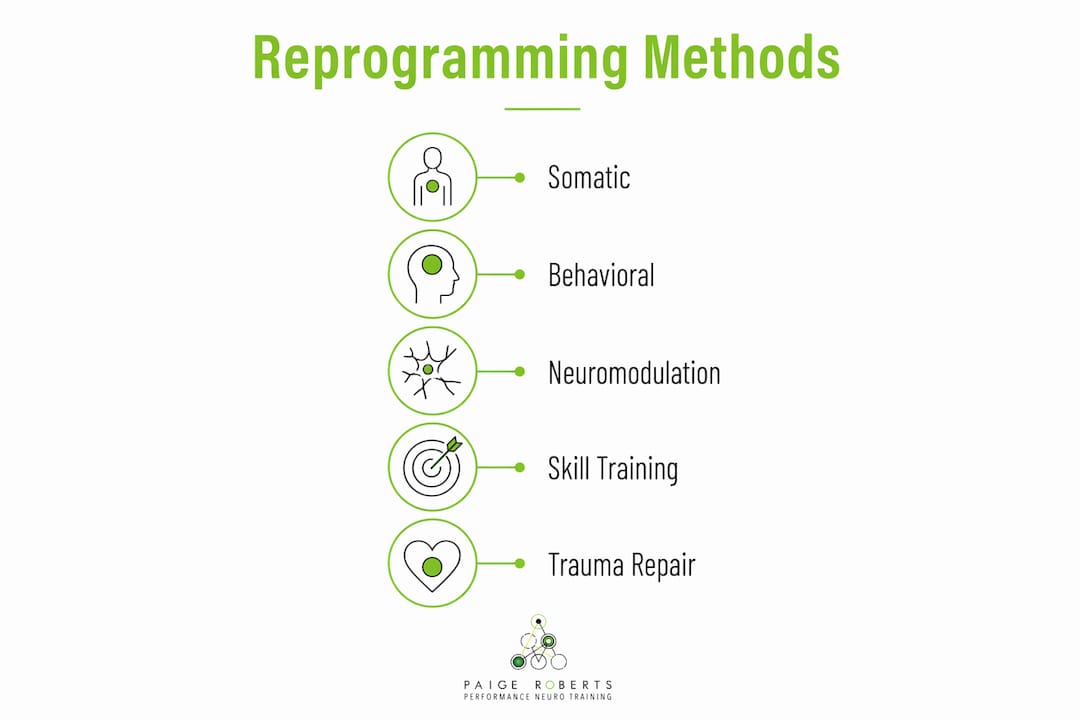
Somatic therapies work directly through body sensation and movement. Somatic Experiencing®, developed by Dr. Peter Levine, uses a technique called pendulation to guide the nervous system between states of activation and safety in small, manageable increments. This titration principle prevents the nervous system from flooding while still building tolerance. Athletes who have experienced sports injuries or performance trauma often find somatic work particularly effective because it addresses the body-level imprints that talk therapy alone cannot reach.
Behavioral and lifestyle practices form the daily infrastructure of nervous system healing:
- Intentional breathwork such as box breathing or extended exhale techniques directly activates the parasympathetic system within minutes.
- Cold exposure and movement shift autonomic tone and build stress tolerance when practiced consistently.
- Grounding techniques like bilateral tapping or sensory anchoring interrupt sympathetic spirals in real time.
- Sleep and recovery protocols are non-negotiable. The nervous system consolidates regulation during sleep, making post-workout recovery as neurologically important as the training itself.
Biomedical neuromodulation represents the frontier of nervous system therapy. A 2025 Nature study demonstrated that closed-loop vagus nerve stimulation combined with task-focused rehabilitation produced statistically significant clinical gains across 36 sessions involving approximately 12,000 stimulations. This bottom-up biological approach directly modulates synaptic plasticity, illustrating that reprogramming can occur at a hardware level, not just through behavioral change.
Pro Tip: When evaluating any nervous system reprogramming program, ask whether it emphasizes skill training, trauma reprocessing, or neuromodulation. These are distinct mechanisms, and the right emphasis depends on whether your primary challenge is performance anxiety, unresolved trauma, or a structural regulation deficit.
How does nervous system reprogramming improve sports performance and mental resilience?
Chronic fight-or-flight activation without adequate recovery leads directly to distress, anxiety, and burnout. For athletes, this is not abstract. It shows up as the yips, competition freeze, post-injury fear of re-injury, and the inability to access skills in high-pressure moments that feel automatic in practice. Nervous system reprogramming addresses the root cause of these patterns rather than managing symptoms.
The key insight from sports psychology neuroscience is that regulation skills must be practiced at realistic intensities to transfer to competition. Here is a practical framework for integrating nervous system resets into athletic training:
- Baseline assessment. Identify your personal stress signatures: racing heart, tunnel vision, muscle bracing, or mental blanking. Knowing your pattern is the first step to interrupting it.
- Low-intensity daily practice. Build a 5-minute morning regulation routine using breathwork or body scanning. This trains the nervous system to return to calm when the stakes are low.
- Graduated intensity rehearsal. Practice regulation techniques during training at increasing stress levels. Practicing at match-like intensities teaches the nervous system to recover under realistic competitive pressure, not just in quiet rooms.
- Pre-competition protocols. Develop a 3-to-5-minute pre-performance routine that anchors your nervous system before high-stakes moments. This could combine breathwork, movement, and a sensory grounding cue.
- Post-competition recovery. Actively downregulate after competition using slow breathing or light movement to prevent stress accumulation across a season.
The neuroscience of sports psychology confirms that nervous system flexibility, the ability to move between activation and recovery states on demand, is a trainable skill. Olympic-level athletes do not have less stress. They have better regulation.
Pro Tip: Do not wait until competition day to use your regulation tools. The nervous system learns through repetition. Athletes who practice breathwork only when anxious are training a crisis response. Athletes who practice it daily are building a regulation reflex.
What are the limits and scientific debates around nervous system reprogramming?
Nervous system reprogramming improves dynamic regulation. It does not eliminate stress, and practitioners who promise otherwise are overstating the evidence. The goal is a nervous system that can move fluidly between activation and recovery states, not one that never activates at all. Reprogramming restores dynamic flexibility rather than producing permanent calm.
The most significant scientific controversy in this space involves polyvagal theory, which has become a popular explanatory framework in trauma therapy and nervous system coaching. A 2026 expert evaluation published in Clinical Neuropsychiatry concluded that polyvagal theory's major claims lack current neurophysiological and evolutionary support. This does not mean the practices associated with polyvagal theory are ineffective. It means the theoretical explanation for why they work is contested.
"Polyvagal-based explanations should be treated as hypothesis-generators, not confirmed mechanisms. Practitioners who present them as established neuroscience risk undermining client trust when the science is scrutinized."
The practical implication for athletes and coaches is clear. When a program references vagus nerve effects or heart rate variability improvements, those claims are empirically plausible and worth pursuing. The specific theoretical framework used to explain them is less important than whether the methods produce measurable results. Demand transparency from any practitioner about what is evidence-based and what remains theoretical.
Individual variability also matters significantly. The effects of nervous system reprogramming differ based on trauma history, baseline autonomic tone, the modality used, and consistency of practice. Someone with complex trauma will likely need a different approach and longer timeline than an athlete managing situational performance anxiety. Comparing results across individuals without accounting for these factors produces misleading expectations.
Key takeaways
Nervous system reprogramming works by combining behavioral practice, somatic therapy, and neuromodulation to restore the autonomic system's capacity to shift between activation and recovery states, which is the foundation of mental resilience in sports and life.
| Point | Details |
|---|---|
| Core definition | Reprogramming alters automatic stress responses through repeated, graduated nervous system training. |
| Biological basis | Chronic stress reshapes the brain epigenetically; targeted intervention partially reverses these changes. |
| Most effective methods | Somatic Experiencing®, intentional breathwork, and vagus nerve stimulation each target different system layers. |
| Sports application | Regulation skills must be rehearsed at competitive intensities to transfer to high-pressure performance. |
| Scientific honesty | Polyvagal theory remains contested; focus on empirically supported methods and measurable outcomes. |
What I've learned working at the intersection of trauma and athletic performance
Most athletes who come to me are not looking for relaxation. They are looking for access. Access to the skills they already have, the confidence they have already earned, and the performance they know they are capable of. What nervous system reprogramming actually delivers, when done well, is exactly that.
What I have seen repeatedly is that the athletes who struggle most are not the ones with the least talent. They are the ones whose nervous systems learned, often from injury or early life stress, that high-stakes moments are dangerous. That learning is not a character flaw. It is a survival adaptation that has outlived its usefulness. The work is not about becoming someone different. It is about updating an outdated program.
I am also direct with athletes about what this process is not. It is not a single session reset. It is not a breathing technique you use once before a game and expect to transform your performance. Durable change requires consistent practice across weeks and months, ideally at increasing intensities that mirror real competition. The athletes I have seen make the most significant shifts are the ones who treat regulation training with the same seriousness they give physical conditioning.
One more thing I want to be honest about: not every framework you encounter in this space is equally supported by science. I use methods grounded in neuroscience and clinical evidence, including Alpha Imprinting, which targets the specific autonomic patterns that block athletic flow. I am transparent about what is established and what is still being studied. That transparency is not a weakness in a program. It is a sign of integrity.
— Paige
How Robertsneurotraining can help you train your nervous system for performance
If performance anxiety, post-injury fear, or unresolved stress is blocking your athletic potential, Robertsneurotraining offers a neuroscience-based program built specifically for athletes at every level.
Dr. Paige Roberts leads a structured approach that combines nervous system regulation techniques with Alpha Imprinting, a method designed to clear mental blocks and restore the state of flow that competitive performance demands. Athletes from Olympic medalists to professional league players have used this program to reclaim and expand their performance after injury and trauma. Whether you are dealing with competition freeze, chronic anxiety, or the psychological aftermath of a serious injury, Robertsneurotraining provides a personalized path to mental resilience grounded in real neuroscience. Explore the program and take the first step toward optimizing your athletic energy and performance.
FAQ
What is nervous system reprogramming in simple terms?
Nervous system reprogramming is the process of retraining your body's automatic stress responses through repeated behavioral, somatic, or biomedical techniques. The goal is to shift from chronic fight-or-flight reactivity toward balanced regulation and recovery.
How long does it take to reprogram the nervous system?
There is no universal timeline, but network-level neural changes require consistent, repeated practice over weeks to months. Biomedical interventions like vagus nerve stimulation showed measurable gains across 36 structured sessions in clinical research.
Can nervous system reprogramming help with sports performance anxiety?
Yes. Practicing regulation skills at match-like training intensities builds the nervous system's ability to recover under competitive pressure, directly reducing performance anxiety and improving mental readiness.
Is polyvagal theory the scientific basis for nervous system reprogramming?
Polyvagal theory is one explanatory framework, but a 2026 expert review found its core claims lack neurophysiological support. Effective reprogramming methods can be used and evaluated independently of this theoretical model.
What is the difference between a nervous system reset and full reprogramming?
A nervous system reset refers to small, sustainable daily habits that help the body return to calm in the short term. Full reprogramming involves sustained practice that produces lasting changes in autonomic reactivity and brain network organization.