

Group confidence changes outcomes, but not the way most locker-room speeches assume. Collective efficacy raises effort, cuts free-riding, and sharpens persistence. It also breeds blind spots when it arrives too early or outruns actual skill. Albert Bandura's foundational work established the upside; the Gervais & Goldstein experimental framework found induced overconfidence raised individual effort by roughly 21%.
- Helps when: the task is routine, skills are well matched, and feedback flows freely.
- Harms when: confidence outpaces competence, arrives before evidence, or silences dissent.
Key Takeaways
Group confidence raises effort and reduces free-riding on well-matched tasks, but the same confidence turns into a liability once it outpaces skill or silences dissent.
| Point | Details |
|---|---|
| Effort gains are real but bounded | Overconfidence raised effort 21.1% and team revenue 6.4% in lab conditions, with diminishing returns past a threshold. |
| Bottlenecks flip the effect | Low-competency bottlenecks turn high group efficacy from an asset into a liability. |
| Early overconfidence suppresses debate | Very high early efficacy can reduce process conflict needed to catch bad strategy. |
| Calibration beats raw confidence | Confidence aligned with actual accuracy predicts whether group discussion helps or hurts. |
| Measure at multiple points | Confidence and perceived performance run in reciprocal feedback loops, so single-point measurement misses the dynamic. |
A Coach's Honest Take
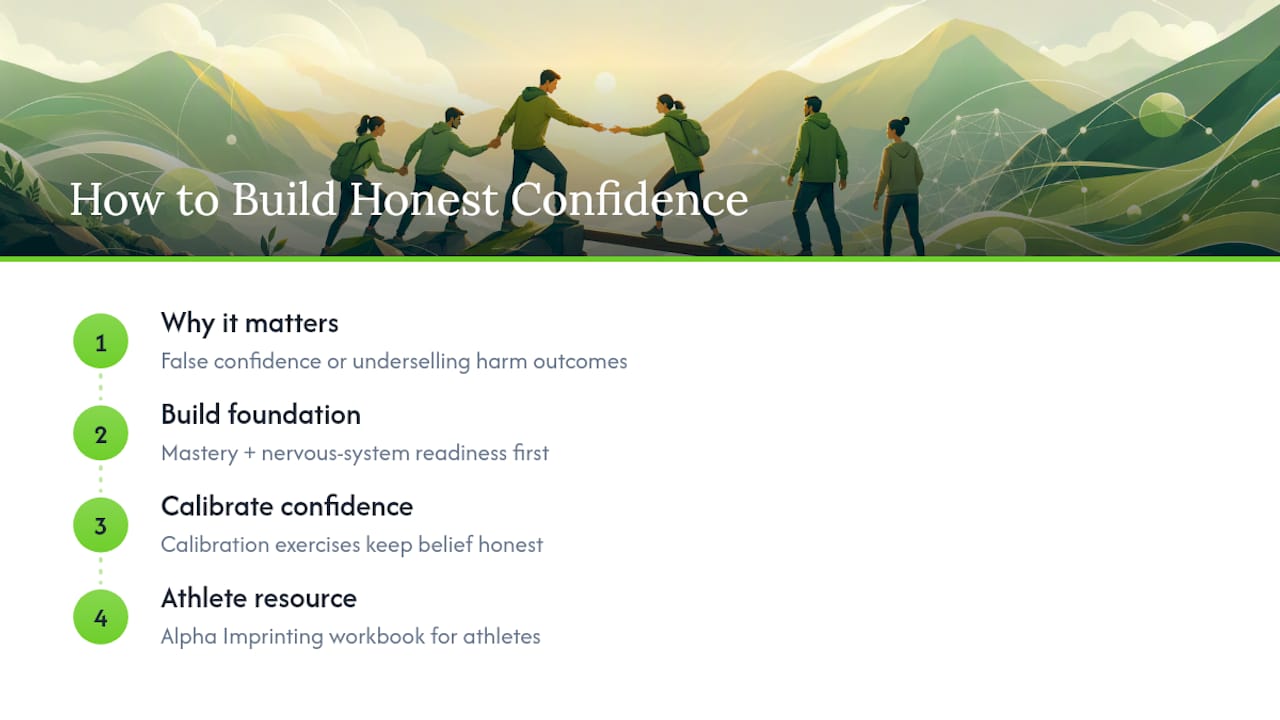
I've watched teams talk themselves into confidence they hadn't earned, and I've watched skilled teams undersell themselves into hesitation. Both cost outcomes. My guiding principle: build confidence from mastery and nervous-system readiness first, then let calibration exercises keep it honest. The Alpha Imprinting workbook exists for athletes who want to work that layer directly.
Table of Contents
- What Is Group Confidence, and How Does It Differ From Individual Belief?
- How Does Team Confidence Change Behavior and Decisions?
- Does Research Support a Positive or Negative Effect?
- When Does Group Confidence Help vs. Hurt Performance?
- How Do You Measure Group Confidence in Practice?
- What Interventions Actually Calibrate Group Confidence?
- How Neuroscience-Informed Coaching Fits Into Confidence Calibration
- Sources
What Is Group Confidence, and How Does It Differ From Individual Belief?
Researchers split this into two constructs. Collective efficacy is a team's shared belief it can execute a specific task, like closing out a fourth quarter or hitting a sales target. Group potency is broader: a generalized sense the group is good at things, not any one thing in particular.
Neither is just individual confidence added up. A team of five confident individuals can still doubt the group's ability to coordinate, and vice versa. That gap matters for measurement.
- To gauge collective efficacy, ask about a specific upcoming task.
- To gauge group potency, ask about the team's general capability across situations.
- Task-specific efficacy predicts operational results like revenue and service quality far more reliably than general potency does.
How Does Team Confidence Change Behavior and Decisions?
Confidence rewires how a group works before anyone notices a scoreboard change. Members push harder, set steeper goals, and stop coasting on teammates' effort. The mechanism runs through several channels at once:
- Increased effort and persistence on difficult tasks
- Reduced free-riding, since members trust the group is pulling its weight
- Riskier, more ambitious goal-setting
- Decreased vigilance in scanning for problems or dissenting information
- Weaker responsiveness to negative feedback once confidence sets in
The Gervais & Goldstein data quantifies the first two: in a lab teamwork experiment, inducing overconfidence pushed individual effort up 21.1%, lifted average team revenue by 6.4%, and measurably reduced free riding. But the same study found an inverse-U pattern on individual payoff, meaning the effort gains stop paying off past a certain point.
These pathways also loop back on themselves. Soccer teams studied at halftime showed confidence predicting perceived second-half performance, which then predicted confidence again. On routine, well-drilled tasks, the effort mechanism dominates. On complex or unfamiliar tasks, the vigilance and feedback mechanisms matter more, and that's exactly where overconfidence gets expensive.
Does Research Support a Positive or Negative Effect?
The honest answer is both, depending on where you look. Lab experiments generally show a clean upside: overconfidence raises effort and reduces free-riding, at least until it overshoots. Field data tells a messier, more conditional story.
- A study across 41 work groups and 389 employees found group efficacy generally helps performance, but the relationship reverses when the group has a low-competency bottleneck.
- Newly formed teams with very high early collective efficacy showed reduced process conflict, the healthy procedural debate that catches bad strategy before it calcifies. That's the groupthink pathway.
- Meta-analytic work rooted in Bandura's social cognitive theory still finds efficacy links to challenging goal-setting and better coordination as the modal outcome, with these boundary conditions as the exception, not the rule.
Pro Tip: Lab effect sizes (like that 21% effort bump) come from controlled, low-complexity tasks. Weight them down for real-world, non-routine work where a bottleneck or premature consensus can flip the sign of the effect.
When Does Group Confidence Help vs. Hurt Performance?

Run this checklist before deciding whether to amplify or dial back team confidence.
Likely to help:
- Routine or well-practiced tasks
- High, evenly distributed skill across members
- Tight calibration, meaning the most knowledgeable members are also the most confident
- Fast, honest feedback loops
Likely to harm:
- Non-routine or novel tasks
- A low-competency bottleneck dragging on group capacity
- Overconfidence arriving before any real evidence
- Poor information sharing or reluctance to raise concerns
Watch for red flags: fewer questions asked in meetings, pushback against critical feedback, or a team fixating on a goal before testing it. Any of those should trigger a pre-mortem or a red-team review before the plan ships.
How Do You Measure Group Confidence in Practice?
A handful of Likert-style questions surface most of what you need. Ask members to rate agreement (1 to 7) with: "I am confident this team can execute [specific upcoming task]" for collective efficacy, and "This team generally performs well across different challenges" for potency. Scores clustering high and tight across members suggest healthy alignment; high average with wide spread suggests miscalibration.
- Measure early, before the group has real evidence of performance.
- Measure again at a midpoint, ideally after some feedback has landed.
- Measure post-event and compare the trajectory, not just the endpoint.
During meetings, count how often members ask clarifying questions versus simply agree. Collective confidence calibration, meaning the most accurate members are also the most confident ones, predicts whether group discussion improves judgment or degrades it.
What Interventions Actually Calibrate Group Confidence?
Ranked by what to prioritize first:
- Skill-based mastery and deliberate practice. Confidence built on real competence resists the inverted-U problem better than confidence built on hype.
- Structured feedback loops with measurable KPIs. Short, frequent feedback cycles (weekly, not quarterly) catch drift before it compounds.
- Calibration exercises. Run a pre-mortem: ask the team to assume the project failed and work backward to causes, before launch, not after.
- Role clarification and shared mental models. Ambiguity about who owns what breeds false confidence in coverage that doesn't exist.
- Targeted hiring or reassignment. If a low-competency bottleneck exists, no amount of confidence coaching fixes it; the fix is structural.
For psychological safety practices that preserve feedback-seeking while confidence grows, pair calibration drills with consistent coaching routines. Consistency in coaching approach reinforces the mastery pathway better than one-off pep talks.
Pro Tip: When the goal is raising effort and capability, invest in individual mastery drills before team confidence-building exercises. Faked "confident culture" signaling rarely survives contact with a hard task.
How Neuroscience-Informed Coaching Fits Into Confidence Calibration
A team can look confident on paper and still carry unresolved nervous-system responses from prior injury, pressure, or setback that surface as hesitation under load. Calibration exercises catch strategic blind spots; they don't always catch a body still bracing for the last collision.
- Nervous-system preparation addresses the physiological layer confidence surveys miss entirely.
- Pairing that work with calibration drills (pre-mortems, structured feedback) closes the gap between stated confidence and executable confidence.
- Team performance neuroscience work suggests bringing in specialist support once a team has plateaued despite good calibration practices, not as a first-line fix.
When an athlete's nervous system is still running an old threat response, no amount of pre-mortem planning will surface it. That's a different layer than strategic overconfidence, and it needs a different tool.
Dr. Paige Roberts developed the Alpha Imprinting process specifically for that layer.
Sources
- When Does Group Efficacy Deteriorate Group Performance? Implications of Group Competency - PMC
- Collective calibration predicts when group discussion improves accuracy (ScienceDirect, 2021)