

Before your next high-stakes meeting, do this: stand tall, take one slow breath in for four counts and out for six, plant both feet flat on the floor, and say your anchor phrase silently ("I'm prepared. I'm here."). That 30-second reset activates your parasympathetic nervous system and narrows the gap between activation and control.
Three things to do in the first 60 seconds before or during a meeting:
- Plant your feet, drop your shoulders, and breathe out longer than you breathe in (4 counts in, 6 out).
- Name one concrete thing you can see, one you can feel (chair, floor), and one you can hear. Grounding interrupts the cognitive narrowing that anxiety triggers.
- Reframe the physical sensation: "This is activation, not danger. My body is ready."
After the event, spend five minutes writing what went well before you analyze what didn't. Then schedule one micro-practice before the next high-stakes situation.
Pro Tip: If you experience chest pain, difficulty breathing, or a sense of impending doom during a meeting, stop and seek immediate medical attention. These symptoms require urgent evaluation before any performance intervention.
Key Takeaways
Executive performance anxiety is a trainable nervous-system response, not a fixed trait, and the most effective approach combines immediate physiological reset techniques with structured medium-term training and, where needed, clinical support.
| Point | Details |
|---|---|
| Immediate reset | Use a 4-count inhale, 6-count exhale, plus grounding and an anchor phrase in the 60 seconds before or during a high-stakes event. |
| Clinical red flags | Panic attacks, career-shaping avoidance, or persistent worry beyond the event require specialist assessment, not self-help alone. |
| Medium-term plan | An 8–10 week program combining CBT, graduated exposure, and energy management builds durable resilience. |
| Leadership lever | Leaders who model vulnerability reduce team anxiety and stress contagion, per Harvard Medical School research. |
| Robertsneurotraining | The Alpha Imprinting protocol offers nervous-system retraining via telehealth for executives whose anxiety is tied to specific high-stakes performance contexts. |
Table of Contents
- What Is Executive Performance Anxiety and What Triggers It?
- When Does Performance Anxiety Become a Clinical Concern?
- How to Manage Performance Anxiety in the Moment
- Short- and Medium-Term Training to Build Lasting Resilience
- How to Reduce Perfectionism and Fear of Failure
- How Leaders Can Reduce Performance Anxiety Across Their Teams
- When to Consider Medication or Specialist Interventions
- How Alpha Imprinting and Performance Neuro Training Work
- Why Executives Should Treat Performance Anxiety as Solvable
- Robertsneurotraining's Performance Neuro Training for Executives
- Sources
What Is Executive Performance Anxiety and What Triggers It?
Executive performance anxiety is the acute stress response that fires when the perceived stakes of a performance situation outpace your confidence in your ability to meet them. It is situational and context-specific, which separates it from generalized anxiety disorder (GAD), where worry is persistent, pervasive, and not tied to a single trigger. Most executives experience it before board presentations, investor pitches, media appearances, or critical negotiations.
The sympathetic nervous system drives the physical cascade: perceived threat triggers sympathetic activation, which releases adrenaline and cortisol, narrows cognitive bandwidth, and produces the racing heart, tremor, and shallow breathing that feel so disruptive on stage. The body is doing exactly what it evolved to do. The problem is that a board meeting is not a predator.
Common triggers in executive roles include:
- Spotlighting: The sense that every word and expression is being evaluated and remembered.
- High stakes with ambiguous feedback: Decisions that affect hundreds of people but produce no immediate signal of success or failure.
- Perfectionism: An internal standard that treats "very good" as failure.
- Fear of reputational loss: Anxiety about how a single poor performance might redefine how peers and reports see you.
- Sleep deprivation and energy depletion: Both lower the activation threshold, so anxiety fires faster and harder.
According to CNBC, the Development Dimensions International Global Leadership Forecast found that a majority of leaders reported increased stress in 2025, a figure that reflects how normalized high-pressure performance has become at the top.
Imposter syndrome vs. performance anxiety: These overlap but are distinct. Imposter syndrome is a chronic identity belief ("I don't belong here and will eventually be exposed"). Executive performance anxiety is a situational physiological response. You can have one without the other, and the interventions differ. Imposter syndrome responds better to identity-level work; performance anxiety responds faster to physiological and behavioral training.
When Does Performance Anxiety Become a Clinical Concern?
Situational anxiety before a big presentation is normal. The line into clinical territory is crossed when the anxiety becomes frequent enough to impair function, when avoidance starts shaping career decisions, or when worry persists well beyond the performance situation itself.
Red flags that warrant specialist assessment:
- Panic attacks (sudden intense fear with physical symptoms: racing heart, chest tightness, dizziness) occurring more than occasionally.
- Declining or avoiding high-visibility opportunities specifically because of anxiety.
- Persistent worry that continues for days after an event, unrelated to actual outcomes.
- Sleep disruption, irritability, or concentration problems that are chronic rather than pre-event.
- Any thoughts of self-harm or suicidality, which require immediate clinical contact.
The Cleveland Clinic's guidance on generalized anxiety disorder is a useful lay-language starting point for understanding when symptoms cross into disorder territory.
Referral pathway: Start with your primary care physician to rule out medical contributors (thyroid dysfunction, cardiovascular issues). From there, a therapist trained in cognitive behavioral therapy (CBT) or acceptance and commitment therapy (ACT) is the evidence-supported first step. If symptoms are severe or medication is being considered, a psychiatrist should be involved.
Pro Tip: When selecting a therapist, ask two questions: "Do you use outcome measures to track progress?" and "Have you worked with high-performance professionals?" A clinician who tracks outcomes and understands the executive context will move faster and waste less of your time.
How to Manage Performance Anxiety in the Moment
The goal in-the-moment is not to eliminate activation but to redirect it. Athletes and executives who perform best under pressure have trained a recovery sequence so thoroughly it runs automatically. You can build the same.
Pre-event ritual (30–90 seconds):
- Stand or sit tall. Posture affects hormone levels and perceived confidence.
- Breathe in for 4 counts, hold for 1, out for 6. Repeat three times.
- Say your anchor phrase silently. Keep it short and factual: "Prepared. Present. Ready."
- Run a 15-second mental rehearsal: see yourself opening the meeting calmly and clearly.
When nerves hit mid-meeting, use this sequence:
- Notice the sensation without labeling it as bad ("I feel activated").
- Press both feet into the floor. This physical anchor interrupts the spiral.
- Take one slow breath before your next sentence. No one notices; it reads as composure.
- Slow your speaking pace. Under stress, most people speak 20–30% faster than optimal. Deliberate pauses signal authority.
- Reframe internally: "This feeling means I care. That's useful."
- Return attention to the other person or the content, not your internal state.
- After the meeting, note what you did well before reviewing anything else.
Research on performance coaching techniques shows that rehearsal and breath work adapted from athletic training translate directly to executive performance contexts, reducing physiological activation and improving delivery under pressure.
Voice and pacing: Aim for roughly 130–150 words per minute in high-stakes settings. Slower than your anxious default, faster than a monotone. Deliberate pauses of two to three seconds after key points read as confidence, not hesitation.

Short- and Medium-Term Training to Build Lasting Resilience
A single technique used once will not rewire a well-established anxiety response. What works is a structured 8–12 week plan that combines cognitive work, graduated exposure, and physical recovery.
Effective approaches:
- CBT: Targets the thought patterns that amplify anxiety. A peer-reviewed review on PMC supports CBT and exposure-based interventions as effective for performance-related anxiety.
- ACT: Teaches psychological flexibility, helping you act on values even when anxiety is present.
- Graduated exposure: Systematically practice lower-stakes versions of the feared situation (small team presentations before all-hands meetings).
- Energy management: BCG's research on executive fitness frames an executive career as an endurance event and identifies sleep, delegation, and reflection as the three highest-leverage recovery inputs.
Sample 10-week timetable:
| Weeks | Focus | Weekly target |
|---|---|---|
| 1–2 | Baseline and breath training | 10 min breath practice daily; anxiety log |
| 3–4 | CBT thought records | 3 thought records per week; 1 low-stakes exposure |
| 5–6 | Graduated exposure | 2 rehearsal sessions; 1 recorded practice presentation |
| 7–8 | Energy audit | Sleep target 7–8 hrs; delegation review; 1 coaching session |
| 9–10 | Integration and consolidation | Full rehearsal of a real upcoming event; review progress metrics |
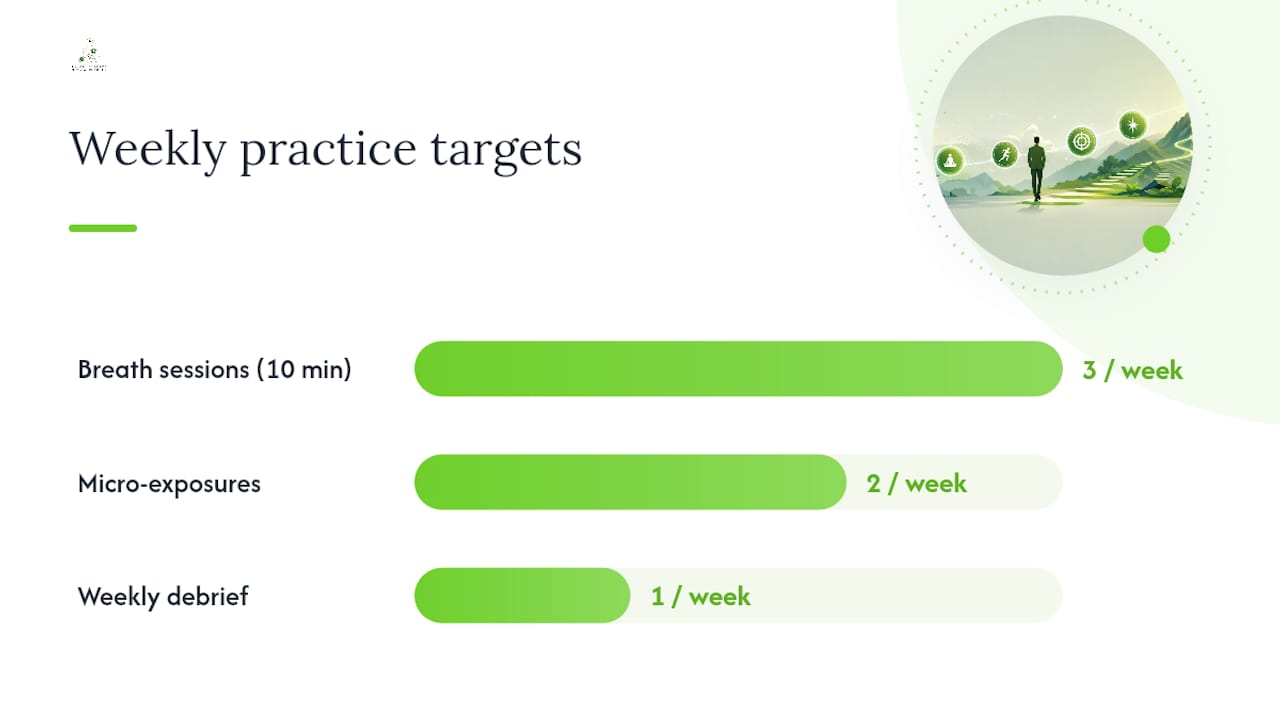
Measurable practice goals: three breath-practice sessions per week (10 minutes each), two micro-exposures per week (a short presentation to a small group), and one weekly debrief reviewing what worked.
Pro Tip: Combining coaching with CBT therapy produces faster, more durable change than either alone. Coaching addresses skill gaps and rehearsal; therapy addresses the identity-level beliefs that fuel perfectionism. Add a team-level intervention (see the leadership section) and you reduce the environmental triggers at the same time.
How to Reduce Perfectionism and Fear of Failure
Perfectionism in executives rarely looks like fussiness. It looks like over-clarifying decisions that are already clear, reviewing work that a capable report already reviewed, and refusing to delegate anything that carries reputational weight. The anxiety underneath is: "If this fails, it reflects on me."
Common perfectionism scripts to watch for:
- "I'll just check this one more time before it goes out."
- "No one else can present this the way I can."
- "If I delegate this and it goes wrong, I own the damage."
Two interventions that work:
1. The evidence log. When a perfectionist thought fires, write it down and then list three pieces of evidence that contradict it. "No one else can present this" becomes: "Sarah presented the Q3 results clearly. Marcus ran the client kickoff without me. The team handled the crisis call last month." The log builds a factual counter-narrative over time.
2. Calibrated delegation. Use a specific script to reduce the anxiety of handing off: "I'm giving you full ownership of X. My success criteria are [specific, measurable outcome]. Check in with me at [specific milestone], and I'll stay out of the details unless you flag something." This script transfers ownership without abandoning accountability, which is the part perfectionism resists.
Reframing failure as feedback: Run micro-experiments. Pick one decision per week that you would normally over-review and release it at "good enough." Track the outcome. Most of the time, the result is indistinguishable from your over-reviewed version. That data is more persuasive than any mindset advice.
How Leaders Can Reduce Performance Anxiety Across Their Teams
Individual techniques only go so far when the environment itself generates anxiety. Leaders who address the structural causes of performance anxiety at work reduce it for everyone, including themselves.
Harvard Medical School Professional Education reports that leaders who share their own experiences with anxiety reduce shame among their teams and create psychologically safer environments that perform better. Modeling vulnerability is not weakness. It is one of the highest-leverage leadership behaviors available.
Policy and ritual examples:
- Pre-meeting rehearsal time: Block 15 minutes before any high-stakes presentation for the presenter to run a dry-run. Normalize it as preparation, not remediation.
- Structured debrief rituals: After major presentations or decisions, run a "what worked / what we'd adjust" debrief within 48 hours. This separates learning from blame.
- Invited vulnerability sessions: Quarterly, share one thing that challenged you personally as a leader. Ask one or two direct reports to do the same.
- Clear decision protocols: Ambiguity about who owns a decision is a primary anxiety driver. Publish a simple RACI or decision-rights framework for recurring decisions.
Leader scripts to normalize anxiety:
- "Before big presentations, I still get nervous. Here's what I do: [brief technique]."
- "I want us to treat mistakes as information. What did we learn from this one?"
Building psychological safety in your team also reduces what researchers call "stress contagion," the unconscious transmission of a leader's anxiety state to their reports. A calmer leader, even one who is privately anxious but has trained recovery skills, produces a measurably calmer team.
Pro Tip: Review your meeting formats. Back-to-back meetings with no transition time are one of the most reliable anxiety amplifiers in executive schedules. A 10-minute buffer between meetings is not a luxury; it is a recovery window that directly affects your next meeting's quality.
When to Consider Medication or Specialist Interventions
For some executives, the physiological symptoms of performance anxiety (tremor, racing heart, voice instability) are severe enough that behavioral techniques alone are insufficient for high-stakes situations. In those cases, a clinician may consider short-term pharmacologic support.
Beta blockers (propranolol is the most commonly discussed) block the peripheral effects of adrenaline: they reduce heart rate, tremor, and the physical sensation of anxiety without sedating the mind. They do not reduce the cognitive or emotional experience of anxiety, only its physical expression. They are typically used situationally, not daily, and require a prescription and medical evaluation.
Safety notes and considerations:
- Beta blockers are contraindicated in asthma, certain cardiac conditions, and with some other medications. A physician must evaluate before prescribing.
- They can affect voice quality in some individuals, which matters for executives who rely on vocal delivery.
- They do not address the underlying anxiety pattern. Medication without concurrent behavioral training tends to produce dependence on the drug for performance situations.
Clinical literature on pharmacologic management of anxiety supports situational use under clinician supervision, alongside behavioral interventions, for performance-related symptoms.
When to involve a psychiatrist: If your anxiety is severe, persistent, or accompanied by depression, a psychiatrist can evaluate whether medication beyond situational beta blockers is appropriate. Therapy-only approaches are the right starting point for most executives; medication becomes relevant when symptoms are severe enough to prevent engagement with therapy.
Finding the right clinician: Look for a psychiatrist or therapist who lists high-performance populations, athletes, or executives in their practice description. Ask about their familiarity with performance contexts and whether they use standardized outcome measures (GAD-7, PHQ-9) to track progress objectively.
How Alpha Imprinting and Performance Neuro Training Work
Most performance interventions address either the mind (CBT, coaching) or the body (breath work, exercise) in isolation. Alpha Imprinting, the proprietary protocol at the core of Robertsneurotraining's Performance Neuro Training, targets the nervous system directly and works to retrain the maladaptive activation patterns that fire in high-stakes situations.
The method pairs exposure-like elements with targeted rehearsal and neural state conditioning. The goal is to replace the automatic threat response with a trained performance response, so that the same physiological activation that currently produces anxiety instead produces focus and readiness. Sessions are available via telehealth, making the program accessible without geographic restriction.
What to expect across a program:
- Early sessions: Assessment of current nervous-system patterns, identification of specific triggers, and introduction of foundational retraining techniques.
- Mid-program: Graduated exposure work, rehearsal under simulated pressure, and integration of breath and anchoring protocols.
- Later sessions: Consolidation, stress-testing the new response under higher-stakes conditions, and building independence from the protocol.
Who typically benefits: Executives, founders, surgeons, and other high performers whose anxiety is tied to specific performance contexts rather than generalized disorder. The program is also used with competitive athletes across professional leagues, where the performance-anxiety overlap with executive contexts is direct.
Pro Tip: If you are currently in clinical treatment for an anxiety disorder, discuss Robertsneurotraining's program with your therapist or psychiatrist before starting. The two approaches are compatible, but your clinician should know what you're doing so they can coordinate care.
| Program element | What it addresses |
|---|---|
| Alpha Imprinting protocol | Nervous-system retraining; replaces threat response with performance state |
| Telehealth 1:1 sessions | Accessible, private coaching without geographic limits |
| 10-week Energy Optimization Program | Sleep, recovery, and energy management for sustained performance |
| Group workshops and cohort programs | Team-level anxiety reduction and psychological safety building |
Why Executives Should Treat Performance Anxiety as Solvable
The executives I work with most often arrive convinced that their anxiety is a character flaw or a sign they've reached their ceiling. Neither is true. What I see consistently is a nervous system that learned the wrong response to high-stakes situations, often years before the executive role, and has been running that pattern on autopilot ever since. The pattern is not permanent. The nervous system is trainable.
One thing I've observed repeatedly: the executives who make the fastest progress are not the ones who try hardest to suppress anxiety. They're the ones who get curious about it. They stop fighting the activation and start asking what it's trying to protect. That shift, from resistance to inquiry, is often the turning point.
Robertsneurotraining's Performance Neuro Training for Executives
Executives dealing with performance anxiety at work have more options than they did a decade ago, but most programs still treat the symptom rather than the system. Robertsneurotraining's approach goes further: the Alpha Imprinting protocol retrain the nervous system at the source, not just the thought patterns sitting on top of it.
Relevant offerings for executives include 1:1 Performance Neuro Training via telehealth, the 10-week Energy Optimization Program, and group workshops for leadership teams. The intake process begins with an assessment of your specific performance triggers and nervous-system patterns, so the program is calibrated to your situation rather than a generic protocol.
If clinical care is needed first (see the red flags section above), Robertsneurotraining can work alongside your therapist or psychiatrist. To book an assessment or learn more about what the program involves, visit Robertsneurotraining.
Sources
These sources back the claims in this article and are worth bookmarking when you talk to a clinician or coach.
- Helping Employees Overcome Performance Anxiety | Harvard Medical School Professional
- Sympathetic nervous system (SNS) and fight-or-flight | Cleveland Clinic
- Ncbi
- Executives are burning out and they don't know how to handle it | CNBC
When you bring these sources to a clinician or coach, frame it as: "I've read the evidence for CBT and exposure. I want a treatment plan that uses outcome measures so we can track progress." That framing signals you are goal-oriented and will accelerate the clinical relationship considerably.
This article provides general information only and is not a substitute for professional medical, psychological, or psychiatric advice. Consult a qualified clinician for assessment and treatment of anxiety symptoms.