

Life stressors impacting professional performance are defined as external and internal pressures from personal, financial, family, and health domains that reduce a professional's cognitive capacity, emotional stability, and productive output at work. Chronic stress is not a character flaw or a productivity problem. It is a physiological and psychological event that reshapes how your brain functions under pressure. Research from the American Medical Association confirms that chronic stress disrupts concentration, memory, and physical health, raising the risk for heart disease and cognitive lapses. The good news is that once you understand the specific stressors driving your decline, you can address them with precision.
1. How work-life balance issues undermine professional effectiveness
Work-life balance is the leading global employee stressor, surpassing job performance pressure and unclear objectives. That finding comes from a 2026 study covering 47 countries and over 100,000 organizations. When the boundary between work and personal life blurs, professionals lose the mental recovery time their brains need to sustain focus and motivation.
The consequences compound quickly. Only 54% of workers rate their wellbeing as "good" or "thriving," down from 63%, with 43% pointing to excessive workload as the primary driver of burnout. Burnout does not just make you tired. It reduces decision quality, increases errors, and raises absenteeism rates.

Working parents face a specific version of this problem. 54% of full-time working parents find balancing work and family responsibilities difficult, and 46% report they cannot give full effort at work because of this struggle. That is nearly half the working parent population operating below their own performance ceiling every day.
Common work-life conflict patterns include:
- Answering work messages during family dinners or weekends
- Skipping personal health appointments to meet deadlines
- Feeling guilty at work when thinking about home, and guilty at home when thinking about work
- Losing sleep due to unresolved work tasks cycling through your mind
Pro Tip: Set a physical "shutdown ritual" at the end of each workday. Close your laptop, write tomorrow's top three tasks, and take a five-minute walk. This signals your nervous system that the workday is over and reduces the mental spillover that erodes personal recovery time.
2. Personal life challenges that disrupt workplace productivity
Personal life challenges at work are the stressors professionals carry through the office door without anyone seeing them. Caregiving responsibilities, financial strain, relationship conflict, and health concerns all compete for the same cognitive bandwidth your job demands.
Financial stress is one of the most underestimated performance disruptors. When professionals worry about debt, housing costs, or job security, the brain's threat-detection system stays activated. That activation pulls attention away from complex tasks and toward survival-mode thinking. You cannot do your best analytical work when part of your brain is running financial worst-case scenarios.
Health concerns follow a similar pattern. A professional managing a chronic illness, a difficult diagnosis, or a family member's medical crisis brings that weight into every meeting and deadline. The cognitive load of managing medical logistics alone can equal a part-time job.
The most common personal life stressors that reduce workplace output include:
- Caregiving demands for children, aging parents, or ill family members
- Financial pressure from debt, housing costs, or income instability
- Relationship conflict at home that generates emotional residue during work hours
- Personal health issues that reduce physical energy and mental stamina
- Grief and loss that impair concentration and motivation for weeks or months
- Major life transitions such as divorce, relocation, or a new child
Each of these stressors activates the body's stress response. That response was designed for short-term threats, not the sustained, low-grade pressure that defines modern professional life.
3. The physiological mechanisms behind stress and work performance
Stress hormones explain why emotional stress at the workplace feels like a cognitive problem. When you perceive a threat, your adrenal glands release cortisol and adrenaline. These hormones redirect blood flow toward muscles and away from the prefrontal cortex, the brain region responsible for planning, judgment, and impulse control.
The short-term result is sharper physical reactions but slower, less accurate thinking. The long-term result of sustained cortisol exposure is memory impairment, reduced attention span, and weakened immune function. Chronic stress is directly linked to higher risks for heart disease, mental illness, and cognitive lapses, according to the American Medical Association.
Mental health consequences compound the physical ones. Anxiety, depression, and burnout are not separate from stress. They are downstream effects of a nervous system that has been running in overdrive for too long without adequate recovery.
"Stress responses serve as important signals. Denial is ineffective. Effective management includes calming techniques and addressing stress sources directly." — Stanford University researchers
Behavioral consequences include social withdrawal, increased risk of substance misuse, and disengagement from work responsibilities. These behaviors reduce professional effectiveness and damage workplace relationships over time.
Pro Tip: When you feel acute stress during a workday, try box breathing: inhale for four counts, hold for four, exhale for four, hold for four. Focused breathing reduces cortisol output and restores the sense of control your prefrontal cortex needs to function well.
4. How to identify and address stress to sustain peak performance
Overcoming work stressors starts with recognition, not reaction. Most professionals notice the symptoms of stress before they identify the source. Fatigue, irritability, and reduced output are signals worth investigating, not suppressing.
Stanford researchers confirm that denial of stress is ineffective. The most effective approach combines physical calming techniques with problem-focused coping that targets the actual stressor. Treating only the symptoms without addressing the source produces temporary relief at best.
The following strategies build sustainable stress resilience for professionals:
- Name the stressor specifically. "I am overwhelmed" is not specific enough. "I am overwhelmed because I have three competing deadlines and no childcare backup this week" gives you something to act on.
- Apply cognitive reframing. Viewing stress as a challenge rather than a threat measurably improves performance, particularly for professionals with high grit. Reframing does not minimize the problem. It changes your relationship to it.
- Set workload boundaries explicitly. Communicate capacity limits to managers and colleagues before you hit the wall, not after. Proactive boundary setting reduces the guilt cycle that drains mental energy.
- Practice gratitude deliberately. Gratitude practice reframes negative thought patterns and supports sustained mental focus during high-stress periods. Three specific things you are grateful for, written each morning, shifts the brain's default scanning mode from threat to opportunity.
- Create physical transition rituals. Post-work rituals such as a walk, a workout, or a defined "closing" routine help professionals detach mentally and prevent work stress from intruding on personal recovery time.
- Recognize high-demand phases as temporary. Consciously adjusting boundaries during intense work periods, rather than expecting static balance, reduces chronic stress and guilt. Knowing a hard phase has an end date changes how your nervous system responds to it.
- Combine physical and cognitive coping. Pairing calming practices like meditation or breathing with direct problem-solving maximizes stress reduction and builds long-term resilience. Neither approach alone is as effective as both together.
For professionals who want a deeper framework, the stress management process for high-performing professionals offers structured mental skills that complement these strategies.
5. Why work-life balance is dynamic, not a fixed destination
Work-life balance is not a static state that you achieve and maintain. Psychology Today's 2026 analysis identifies a common professional trap: treating balance as a fixed target leads to perfectionism and unsustainable workload expectations. The result is a constant sense of failure, even when you are performing well.
Balance shifts week to week, season to season, and career phase to career phase. A product launch month looks different from a slow quarter. A new baby changes the equation entirely. The professionals who sustain performance over years are not the ones who achieve perfect balance. They are the ones who recalibrate quickly when the equation shifts.
Mental performance optimization techniques developed in elite athletic contexts apply directly here. Athletes train their nervous systems to perform under pressure by building adaptability, not rigidity. Professionals benefit from the same approach.
Key Takeaways
Life stressors reduce professional performance by disrupting the cognitive, emotional, and physiological systems that focus, motivation, and output depend on.
| Point | Details |
|---|---|
| Work-life balance is the top stressor | A 2026 global study of 100,000+ organizations ranked it above job performance pressure. |
| Cortisol impairs the prefrontal cortex | Chronic stress hormones reduce planning, judgment, and memory needed for complex work. |
| Personal stressors carry into the office | Financial strain, caregiving, and health concerns consume cognitive bandwidth during work hours. |
| Denial makes stress worse | Stanford researchers confirm that addressing stress sources directly outperforms avoidance. |
| Dynamic balance beats static perfectionism | Recalibrating expectations during high-demand phases reduces chronic stress and guilt. |
My experience with stress cycles and professional performance
I have worked with professionals and athletes long enough to know that the ones who struggle most are rarely the least capable. They are often the most driven. And that drive is exactly what makes stress so dangerous for them.
The pattern I see repeatedly is this: a high performer hits a difficult life phase, whether it is a family crisis, a financial shock, or a health scare, and instead of adjusting their professional expectations temporarily, they push harder. They treat the stress as a weakness to overcome rather than a signal to interpret. The result is not resilience. It is a faster path to burnout.
What actually works is treating stress as data. Your nervous system is telling you something specific. The job is to listen accurately, not to silence the signal. When I work with clients using Alpha Imprinting techniques, the goal is not to eliminate stress. It is to retrain the nervous system's response so that stress becomes information rather than interference.
The professionals who perform best over long careers are not the ones who experience less stress. They are the ones who have built a nervous system that processes stress without being hijacked by it. That is a trainable skill, not a personality trait.
— Paige
Robertsneurotraining: nervous system training for stressed professionals
Stress does not just affect your mood. It rewires how your brain processes information, manages attention, and sustains motivation under pressure.
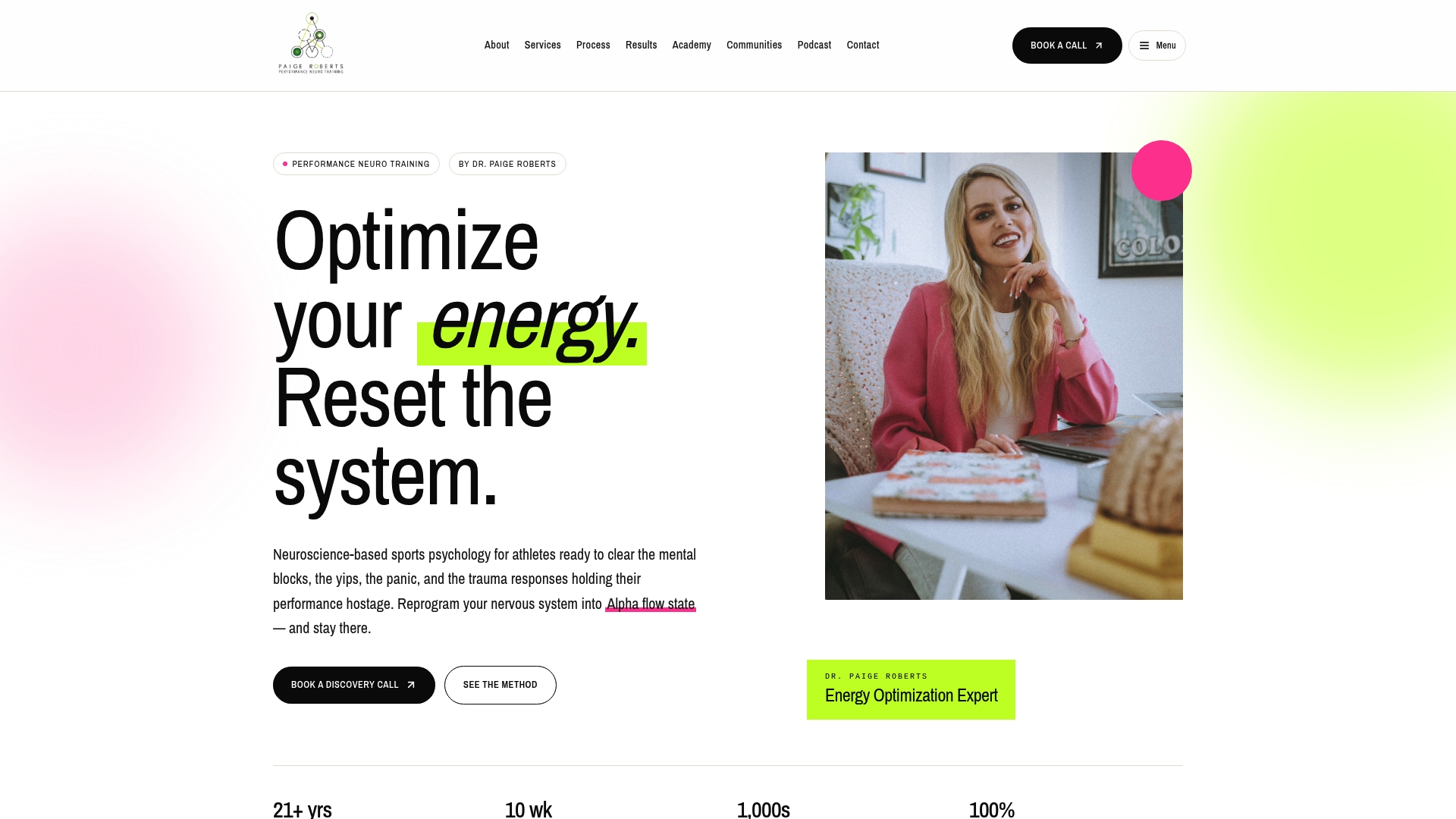
Robertsneurotraining, led by Dr. Paige Roberts, works directly with the nervous system to clear the mental blocks that chronic stress creates. The Alpha Imprinting program uses neuroscience-based techniques to reprogram stress responses, restore mental clarity, and help professionals return to a state of focused, high-output performance. QEEG brain scans identify exactly where stress is disrupting cognitive function, so every intervention is targeted rather than generic. If stress is costing you performance, precision matters.
FAQ
What are the most common life stressors affecting work performance?
Work-life conflict, financial pressure, caregiving demands, health concerns, and relationship stress are the most common. Each activates the body's stress response, which reduces cognitive capacity and professional output.
How does stress physically affect job performance?
Cortisol and adrenaline redirect blood flow away from the prefrontal cortex, impairing planning, memory, and judgment. The American Medical Association links chronic stress to cognitive lapses, heart disease, and mental illness.
Can stress ever improve professional performance?
Viewing stress as a challenge rather than a threat can improve performance, particularly for professionals with high grit. Short-term stress activates focus, but only when the nervous system has adequate recovery time between demands.
What is the fastest way to reduce stress during a workday?
Box breathing, four counts in, four hold, four out, four hold, reduces cortisol output within minutes. Stanford research confirms that focused breathing restores the sense of control needed for effective professional functioning.
How do I know if my work-life balance issues are affecting my performance?
Key signs include persistent fatigue, difficulty concentrating, reduced motivation, and a sense of falling behind despite working long hours. If 46% of working parents report being unable to give full effort at work, the cause is almost always structural, not personal.