

Unresolved trauma performance is defined as the interference of unprocessed traumatic experiences with an athlete's ability to focus, regulate emotions, and execute physical skills under pressure. The clinical term for this pattern is trauma-related performance impairment, and it affects far more athletes than coaches or sports psychologists typically recognize. Difficulty focusing due to past trauma affects 90% of people studied in academic performance research, with 72% reporting that anxiety, depression, or PTSD directly reduced their motivation. These numbers translate directly to the sports arena, where the same nervous system disruptions show up as mental blocks, panic responses, and unexplained performance drops. If you have ever felt your body freeze at a critical moment despite months of preparation, unresolved trauma may be the reason.
What is unresolved trauma performance and how does it affect athletes?
Unresolved trauma performance describes the gap between an athlete's trained ability and their actual output when past trauma activates the nervous system. The key word is "unresolved." Trauma that has never been processed stays encoded in the nervous system as a survival threat. When competition conditions trigger that encoding, the brain shifts resources away from skilled performance and toward self-protection.
Unresolved trauma impairs emotional regulation, attention, and physiological stability, often mimicking laziness or lack of motivation. That misreading is costly. Coaches push harder, athletes train longer, and the performance gap widens because the root cause goes untreated.

The impact of unresolved trauma is not always dramatic. Trauma often manifests as chronic restlessness or burnout rather than obvious panic in high-performing individuals. An athlete may win consistently but feel no satisfaction after success, or they may hit a ceiling they cannot explain through technique alone.
Pro Tip: If your performance drops specifically in high-stakes situations but holds steady in practice, a nervous system trauma response is a more likely cause than a skill deficit.
Understanding the distinction between a skill problem and a nervous system problem changes everything. Skill problems respond to more practice. Nervous system problems require a different kind of work entirely, one focused on nervous system reprogramming for athletes rather than repetition.
What are the signs of unresolved trauma affecting performance?
Recognizing the signs of unresolved trauma is the first step toward addressing them. The symptoms fall into three categories: emotional, cognitive, and physical.
Emotional signs
- Irritability or emotional outbursts before or after competition
- Emotional numbness or feeling disconnected from the sport you once loved
- Difficulty trusting coaches, teammates, or your own judgment
- Persistent fear of failure that feels disproportionate to the actual stakes
- Short-lived relief after wins, followed quickly by anxiety about the next event
Cognitive signs
- Impaired concentration during drills or competition
- Procrastination around training, which 78% of trauma-affected individuals link directly to trauma
- Memory gaps or difficulty retaining coaching instructions
- Intrusive thoughts during performance
- Difficulty making decisions under pressure
Physical signs
Common physical manifestations include sleep disturbances, chronic pain without a clear injury source, a heightened startle response, and muscle tension that does not resolve with physical therapy. These symptoms drain the cognitive resources an athlete needs to perform. Common unresolved trauma symptoms include sleep disturbances, chronic pain, emotional numbness, and social withdrawal.
The physical signs are often the last ones athletes report because sports culture trains people to push through physical discomfort. That habit makes trauma harder to identify and longer to address.
Pro Tip: Track your symptoms across practice and competition settings. A pattern that worsens specifically under pressure points toward nervous system dysregulation rather than a physical injury.
How does the nervous system create performance blocks?
Performance blocks result from accumulated trauma triggering nervous system fight, flight, or freeze responses, causing a brain-body disconnect. This is the core mechanism behind trauma-related performance impairment. The brain detects a threat signal, real or perceived, and pulls the body out of the automatic, fluid state required for skilled performance.
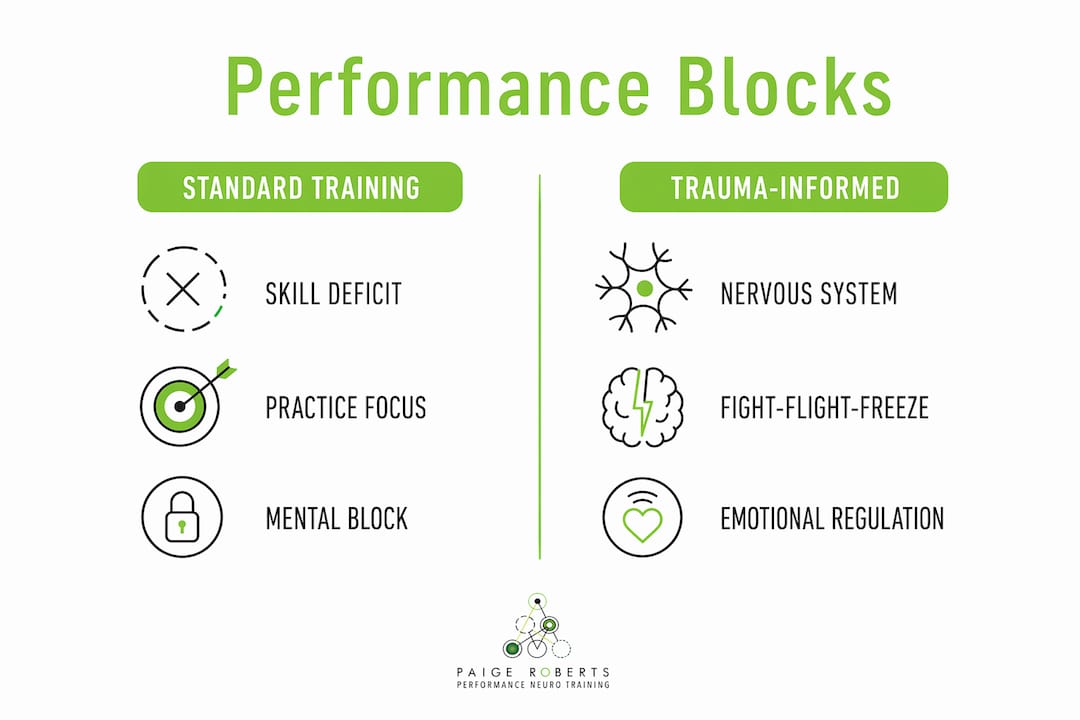
The freeze response is particularly misunderstood in sports. An athlete who freezes at the free-throw line or blanks during a gymnastics routine is not mentally weak. Their nervous system has classified the moment as dangerous based on past experience. The body is doing exactly what it was trained to do by trauma.
Increased practice often worsens performance blocks because they are nervous system responses, not just mental blocks. Forcing more repetitions reinforces the fight-flight-freeze state rather than resolving it. This is the counterintuitive truth that separates trauma-informed coaching from conventional sports psychology.
Trauma changes brain structure, affecting cognitive resources under pressure and leading to burnout if nervous system regulation is ignored. Regulation is the prerequisite for sustained skill expression, not a soft add-on to physical training.
A secondary layer complicates recovery further. Secondary gain can cause subconscious clinging to performance blocks to avoid the pressure that comes with success. An athlete who fears the expectations that follow a breakthrough may unconsciously protect themselves by underperforming. Therapeutic reprogramming through approaches like EMDR addresses this layer directly.
The table below contrasts two approaches to performance blocks so you can see why the response to trauma-driven blocks must differ from standard training interventions.
| Approach | Standard training | Trauma-informed intervention |
|---|---|---|
| Core assumption | Skill deficit | Nervous system dysregulation |
| Primary method | Increased repetition | Regulation before rehearsal |
| Response to pressure | More practice under pressure | Gradual exposure with safety |
| Goal | Technical correction | Nervous system reprogramming |
| Risk if misapplied | Overtraining | Retraumatization |
Pro Tip: If a coach's first response to a performance block is "you need to practice more," ask whether the block appears specifically in high-pressure situations. If it does, the nervous system needs attention before the skill does.
Trauma-informed approaches to healing performance blocks
Effective recovery from trauma-related performance impairment requires body-based healing, not mental effort alone. The following approaches have the strongest evidence base for athletes dealing with unresolved trauma.
-
EMDR (Eye Movement Desensitization and Reprocessing): EMDR directly targets the stored trauma memory and reduces its charge on the nervous system. Athletes report that performance blocks dissolve after EMDR without additional technical work, because the nervous system trigger is removed at the source.
-
Heart Rate Variability (HRV) training: HRV biofeedback teaches athletes to regulate their autonomic nervous system in real time. Higher HRV correlates with better emotional regulation and faster recovery from stress. Trauma-informed development reduces internal friction, helping athletes sustain performance by recognizing and regulating tension before it escalates.
-
Nervous system reprogramming: Methods like Alpha Imprinting, used by Robertsneurotraining, work directly on the nervous system's encoded survival responses. The goal is to replace the threat signal with a regulated, performance-ready state. This approach targets the root cause rather than managing symptoms.
-
Trauma-informed visualization: Standard visualization can backfire for trauma-affected athletes. Visualization techniques may trigger flashbacks or panic in trauma-affected athletes, so trauma-informed visualization prioritizes nervous system regulation before any mental rehearsal begins. The sequence matters: regulate first, then rehearse.
-
Neurofeedback: Neurofeedback trains the brain to produce regulated states by providing real-time feedback on brainwave activity. Athletes with trauma histories often show dysregulated brainwave patterns that neurofeedback can directly address.
-
Psychological safety in coaching: Trauma-informed practices for sports professionals emphasize creating environments where athletes feel safe enough for the nervous system to downregulate. Safety is not a luxury. It is a physiological requirement for performance.
Coping with unresolved trauma in a sports context also benefits from wellness practices that support emotional regulation, including breathwork and somatic awareness techniques that complement clinical interventions.
Key Takeaways
Unresolved trauma performance impairment is a nervous system condition, not a character flaw, and it requires body-based regulation before skill-focused training can produce lasting results.
| Point | Details |
|---|---|
| Core definition | Unresolved trauma disrupts nervous system regulation, impairing focus, emotional control, and physical execution under pressure. |
| More practice backfires | Increasing training volume worsens trauma-driven blocks because repetition reinforces the fight-flight-freeze state. |
| Signs span three domains | Emotional numbness, cognitive interference, and physical symptoms like chronic pain all signal unresolved trauma in athletes. |
| Regulation precedes rehearsal | Trauma-informed visualization and mental rehearsal require nervous system regulation first to avoid retraumatization. |
| Body-based healing works | Approaches like EMDR, HRV training, and nervous system reprogramming address trauma at the source, not just the symptom. |
What I've learned about trauma that coaches rarely say out loud
The most common mistake I see is athletes being told to "push through it." That advice works for fatigue. It does not work for a nervous system that has classified competition as a survival threat. Pushing through a trauma response does not resolve it. It deepens it.
What surprises most athletes I work with is how invisible their trauma has been, even to themselves. They come in thinking they have a mental toughness problem. What they actually have is a nervous system that learned to protect them at some point, and never got the signal that the threat had passed. That is not weakness. That is biology.
The second thing I want you to hear is this: the fact that you are still performing at all, despite carrying unresolved trauma, says something significant about your resilience. You have been compensating for a nervous system running in survival mode. Imagine what becomes possible when that load is removed.
Self-blame is the most counterproductive response to trauma-related performance issues. The nervous system does not respond to willpower. It responds to safety, regulation, and gradual reprogramming. Patience is not passive. It is the active work of building a new baseline.
— Paige
How Robertsneurotraining addresses trauma-related performance blocks
Athletes who recognize these patterns in themselves often need more than talk therapy or extra practice time. Robertsneurotraining offers a neuroscience-based path forward, built specifically for athletes whose performance is limited by nervous system dysregulation rooted in past trauma or injury.

The Alpha Imprinting program works directly on the nervous system's encoded threat responses, replacing survival states with the regulated, flow-ready states that peak performance requires. QEEG brain scans identify the specific dysregulation patterns driving your performance blocks, so the work is targeted rather than generic. Olympic Medalists and professional athletes across major leagues have used these methods to break through blocks that years of conventional training could not resolve. If you are ready to address the root cause, explore the full services at Robertsneurotraining.
FAQ
What is unresolved trauma performance impairment?
Unresolved trauma performance impairment is the disruption of an athlete's focus, emotional regulation, and physical execution caused by unprocessed traumatic experiences stored in the nervous system. It differs from a skill deficit because it activates specifically under pressure rather than consistently across all training conditions.
Can unresolved trauma look like laziness or lack of motivation?
Unresolved trauma frequently mimics laziness or low motivation because it drains the cognitive and physiological resources needed for effort and engagement. Research confirms that trauma-related symptoms including emotional numbness and procrastination are nervous system responses, not character flaws.
Why does more practice make some performance blocks worse?
Increased practice worsens trauma-driven performance blocks because the block is a nervous system fight-flight-freeze response, not a skill gap. Forcing more repetitions under pressure reinforces the threat signal rather than resolving it, which is why body-based regulation must precede additional training volume.
What therapy works best for trauma-related performance blocks?
EMDR has the strongest evidence base for resolving the stored trauma memories that drive performance blocks. Nervous system reprogramming methods, HRV biofeedback, and neurofeedback complement EMDR by building the regulated baseline athletes need to perform consistently under pressure.
How do I know if my performance anxiety is trauma-related?
Trauma-related performance anxiety typically appears specifically in high-stakes situations while practice performance remains strong, and it often coexists with physical symptoms like sleep disturbances, chronic tension, or a heightened startle response. A QEEG brain scan or trauma-informed assessment can identify the nervous system patterns driving the anxiety.