
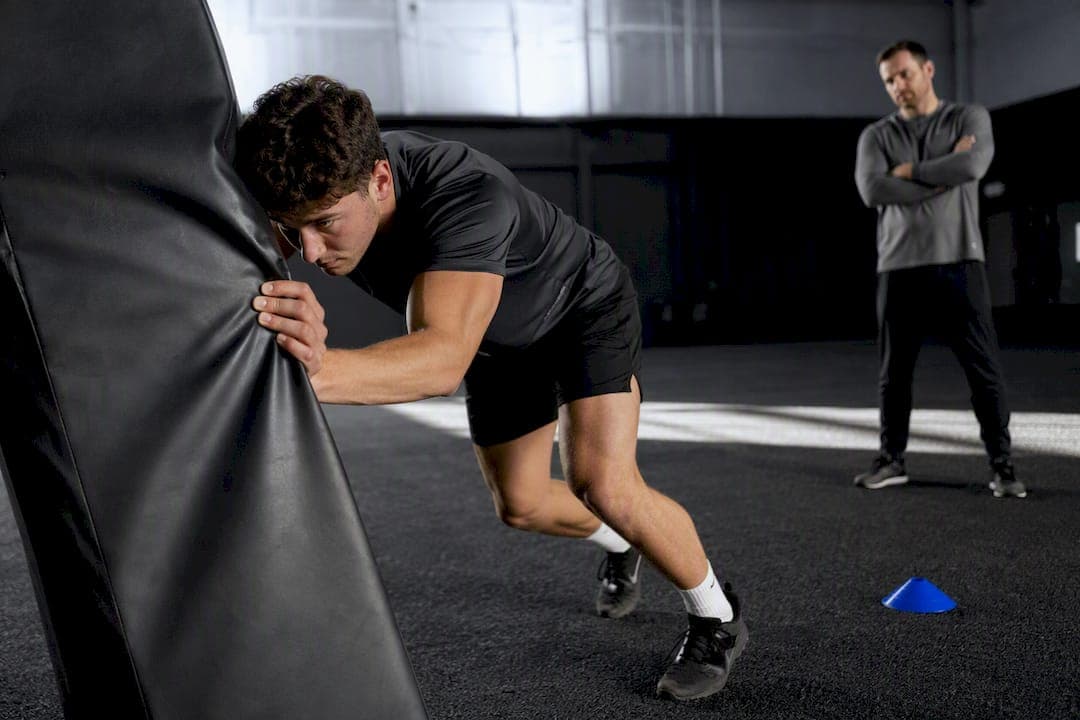
Screen for fear before you retest movement. If an athlete is hesitating on tackles, contested balls, or collisions after an injury, run a validated fear-avoidance measure and start a structured, sport-specific graded exposure plan alongside physical rehab. Addressing fear directly, rather than waiting for more strength or balance work to fix it, shortens recovery and restores performance. Athletes with deeper autonomic or trauma-driven reactions may need nervous-system training layered on top.
TL;DR:
- Fear of contact can significantly delay full recovery, with higher kinesiophobia scores correlating to longer return-to-play timelines.
- Reassess fear levels before contact sessions and after initial improvement to detect rebounds and prevent premature clearance.
- Use sport-specific graded exposure phases, tracking fear scores and hesitation to restore confidence safely under load.
- Standard tests may miss fear-driven deficits; incorporate dual-task stability and reaction time under simulated contact to ensure true readiness.
- Deep trauma responses may require nervous-system training layered on exposure therapy to accelerate progress and reduce anxiety triggers.
Table of Contents
- What Fear of Contact Means for Athletes
- Why Fear-Avoidance Predicts Worse Recovery
- How to Screen and Monitor Fear of Contact
- A Step-by-Step Graded Exposure Ladder for Contact
- Objective Checks That Catch Hidden Fear-Driven Deficits
- How Performance Neuro Training Fits Alongside Exposure
- Getting Professional Support for Contact Fear
- Key Studies and Resources to Read Next
- Sources
- FAQ
What Fear of Contact Means for Athletes
Fear of contact describes avoidance of tackles, collisions, or close physical engagement after an injury, concussion, or a traumatic play. It is not general anxiety and it is not the same as being cautious. It is a specific behavioral pattern that shows up on the field, not just in a questionnaire.
Coaches and clinicians usually spot it before an athlete names it. Watch for:
- Hesitation before contact drills, or pulling out of contested plays a beat too early
- Altered timing on tackles, blocks, or 50/50 balls, even when strength testing looks normal
- Slower reaction time specifically in contact scenarios, not in isolated drills
- Verbal minimizing ("I'm fine") paired with visible avoidance behavior on video
Sport medicine now has validated tools built for exactly this. The Tampa Scale of Kinesiophobia (TSK), the Fear-Avoidance Components Scale (FACS), and the sport-specific Athlete Fear Avoidance Questionnaire (AFAQ) each measure fear-avoidance with solid psychometric backing, and each has a slightly different use case depending on whether you're screening a single injury or tracking a full return-to-sport arc.
Why Fear-Avoidance Predicts Worse Recovery
Fear-avoidance is not a soft variable clinician can safely ignore. It changes outcomes in measurable ways.
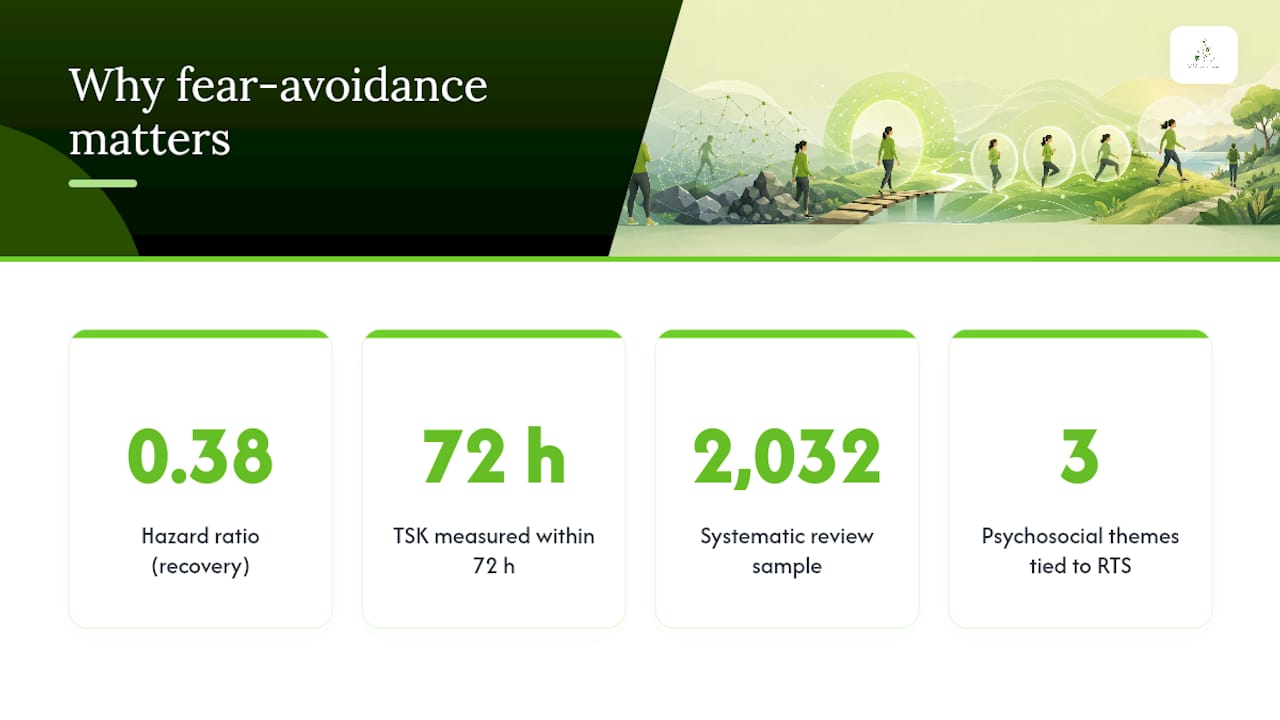
A prospective cohort of adults ages 18 to 50 found fear-avoidant patients had a markedly lower likelihood of recovering at any given point (hazard ratio 0.38, 95% CI 0.15 to 0.96) compared with non-fear-avoidant patients, along with worse symptoms, reaction time, and vestibular scores. That is not a marginal effect. It is one of the largest single predictors of a stalled recovery timeline in the concussion literature.
The pattern holds in athletes specifically. Collegiate athletes with higher kinesiophobia scores measured within 72 hours of a concussion took longer to reach clinical recovery, with each additional TSK point associated with an increase in recovery time. Across a wide score range between high and low fear groups, that adds up to real days on the shelf.
A broader picture backs this up. A systematic review across 2,032 athletes found fear consistently emerging as one of three core psychosocial themes tied to return-to-sport after concussion, alongside emotional and contextual factors. The same body of research shows fear frequently rebounds right as athletes approach their first cleared contact session, not before.
How to Screen and Monitor Fear of Contact
Screening only works if it happens more than once. A single intake questionnaire tells you where an athlete started and not whether the plan is working.
- Baseline within the first week. Administer TSK-13 or TSK-17, or FACS, depending on your team's existing protocol.
- Pre-contact reassessment. Rerun the same tool right before clearing the athlete for contact drills, since fear often rebounds at this transition rather than before it.
- At discharge. Confirm scores have stabilized, not just improved once.
- Before the first live-contact session. This is the highest-risk point for a fear spike and the point most programs skip.
Interpretation matters more than the raw number. A TSK score of 37 or higher generally flags meaningful kinesiophobia worth addressing directly, and FACS scores in the 41 to 100 range indicate elevated fear-avoidance under the cutoffs used in recent cohort work. AFAQ scores that approach typical musculoskeletal-injury levels, even after a concussion, suggest fear has become the dominant limiter rather than physical deficit.
Pro Tip: If your team lacks time for a full instrument, ask one question consistently at every check-in: "On a scale of 0 to 10, how much are you avoiding contact you'd normally take?" It won't replace TSK or FACS, but tracked weekly, it catches a rebound before game film does.
A Step-by-Step Graded Exposure Ladder for Contact
Graded exposure therapy (GET) works by repeated, controlled, sport-relevant exposure to the exact thing being avoided, not by generic conditioning. The GET FAB trial, a manualized 12-session protocol currently being tested after mild traumatic brain injury, is built on that principle: safely eliciting the avoided activity in context beats prescribing more low-intensity cardio.
A sport-specific ladder generally moves through five phases:
- Non-contact rehearsal. Walk through the mechanics of the previously feared play at low speed, no opponent.
- Anticipated-contact drills with pads. Introduce predictable, low-force contact where the athlete controls timing.
- Controlled partner impact. Add a partner delivering contact at a known intensity and known moment.
- Supervised live-contact with cognitive load. Combine contact with a decision (read a defender, track a second target) since real fear often only surfaces under load.
- Full integration. Return to unscripted, game-speed contact in practice before competition.
Each phase needs homework and a measurable checkpoint, not just a coach's gut call on readiness. Track:
- Fear score before and after each session, using the same instrument from screening
- Hesitation on video, frame by frame if possible
- Self-reported confidence on a 0 to 10 scale for the specific drill just completed
For athletes showing autonomic symptoms alongside fear, racing heart rate, freezing, or a panic response tied to the memory of the injury, pairing exposure with brief cognitive behavioral techniques or nervous-system regulation work tends to move things faster than exposure alone. Intensive exposure therapy pilot data supports concentrated, repeated exposure phases over sporadic ones.
Pro Tip: Set a simple decision rule in advance: progress if fear score drops or holds flat for two consecutive sessions, pause if it spikes without a clear reason, regress one phase if hesitation reappears on video for two sessions running.
Objective Checks That Catch Hidden Fear-Driven Deficits
Standard return-to-play testing clears a lot of athletes who are still, quietly, afraid.
A single-task balance test can look completely normal while fear is still driving real performance loss. Recent work found athletes at return-to-play had significantly higher fear of movement than uninjured controls despite showing no significant difference on static or dynamic postural stability. The deficit only shows up when the brain has to do two things at once, which is exactly what a real game demands.
Add these checks before clearing full contact:
- Dual-task stability drills: balance or agility work while tracking a number sequence or calling out colors
- Reaction time under contact anticipation: measure response speed specifically when contact is expected, not in a neutral drill
- Decision-making under contested pressure: does the athlete still make the correct read when a hit is likely?
- Video observation markers: hesitation, altered footwork, or pulling out of a play half a second early
Document readiness with specifics, not a gut check: reaction time back within a normal range for that athlete, hesitation absent across two consecutive live sessions, and decision accuracy holding steady under contested pressure. Pairing these functional checks with a fear-avoidance score is what actually catches the athletes who pass every physical test but still flinch on the fifth tackle.
How Performance Neuro Training Fits Alongside Exposure
Graded exposure gets most athletes through fear of contact. Some carry a deeper trauma response, panic, freezing, a nervous system stuck in fight-or-flight around the moment of injury, that exposure alone moves slowly. That's where nervous-system training earns its place.
Alpha Imprinting works alongside graded exposure rather than replacing it: assess fear and behavioral markers first, target the specific exposures the athlete is avoiding, then layer in nervous-system work for the residual autonomic response that drills alone don't touch. For teams, that sequencing runs the same way at scale, group screening, targeted exposure work, then individualized nervous-system sessions for athletes who need it.
— Paige
Getting Professional Support for Contact Fear
Not every athlete needs the same level of intervention. A team seeing widespread hesitation after a rough season fits a group Alpha Imprinting workshop, where coaches and clinicians can screen an entire roster and target the athletes who need follow-up. An individual case with a complicated injury history or symptoms that won't resolve on a normal timeline is often better served starting with a QEEG brain scan to see what's actually happening before building a plan around it. Athletes carrying a specific traumatic memory tied to one play or one collision tend to respond well to Brainspotting for Sports 1.0, which targets that memory directly instead of working around it.
A typical intake starts with a conversation about what's actually showing up, hesitation on specific plays, a reaction time issue, a full-blown panic response, and maps that against a screening tool and a proposed plan before anything is booked. Clinicians building their own protocol can start with the Five Step Rehab Plan for a practical framework to run alongside physical rehab. If you're ready to move past guesswork on a specific athlete or an entire roster, book a consult through Roberts Neurotraining's services page and start with a screening call.
Key Studies and Resources to Read Next
- Fear-avoidant adults have worse clinical outcomes and recovery time after concussion, the prospective cohort behind the recovery-likelihood figures above
- Which psychosocial factors are associated with return to sport following concussion? A systematic review
- The influence of kinesiophobia on time to clinical recovery in collegiate athletes with concussion
- GET FAB clinical trial protocol for graded exposure therapy after mTBI
- Five Step Rehab Plan for clinicians and the Return-to-Sport mental readiness indicators guide
This article is general information, not a substitute for advice from a qualified doctor. Consult a qualified healthcare professional about your own circumstances before acting on anything here.
Sources
- Fear-avoidant adults have worse clinical outcomes and recovery time after concussion (prospective cohort)
- Which psychosocial factors are associated with return to sport following concussion? A systematic review
- The influence of kinesiophobia on time to clinical recovery in collegiate athletes with concussion
FAQ
What Is Fear of Contact in Sports?
It is avoidance of tackles, collisions, or close physical engagement after an injury, concussion, or traumatic play, distinct from general caution and measurable with tools like the TSK, FACS, or AFAQ.
How Do I Know If an Athlete Has Fear of Contact vs. a Physical Limitation?
Pair a fear-avoidance score with dual-task performance checks; an athlete who passes single-task balance tests but hesitates under contact anticipation or cognitive load is showing fear-driven, not physical, limitation.
How Long Does Graded Exposure Take to Reduce Fear of Contact?
Timelines vary by athlete and injury severity, but manualized protocols like GET FAB run 12 sessions, and progression should follow fear scores and video-observed hesitation rather than a fixed calendar.
Can Nervous-System Training Help With Fear of Contact?
Yes, for athletes carrying a deeper trauma or panic response tied to the injury, nervous-system approaches can complement graded exposure rather than replace it.
What Does Working With Roberts Neurotraining Cost?
Pricing depends on the service. The Group & Team Alpha Imprinting program, the 12-Week Energy Optimization Program, QEEG Brain Scans, and Brainspotting for Sports 1.0 are offered; please consult the website for current pricing.