
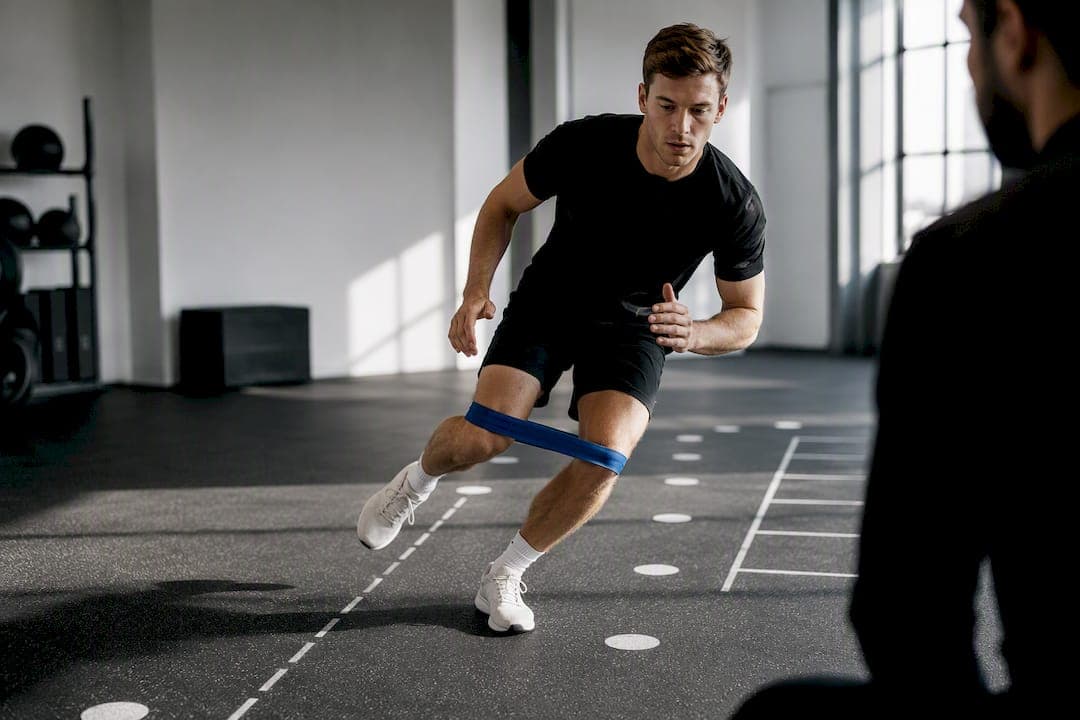
Fear of re-injury is common after a sports injury, but it is not permanent, and it responds well to the right combination of assessment and training. The most effective approach pairs validated psychological screening with graded exposure to feared movements, cognitive reframing, and close coordination with your rehab team. Success looks like measurable confidence gains alongside physical readiness, not just cleared imaging or a strength test passed in isolation.
TL;DR:
- Most athletes experience fear of re-injury, which can delay return-to-sport and affect movement quality even after physical clearance.
- Validated tools like the Tampa Scale of Kinesiophobia measure fear levels and should be monitored alongside physical tests for a comprehensive assessment.
- Combining psychological approaches such as cognitive reframing, graded exposure, and neuromuscular training is essential to effectively reduce fear-related avoidance behaviors.
- Persistent fear scores despite progress or signs like mood disruption and avoidance behaviors warrant escalation to multidisciplinary care, including mental health professionals.
- Incorporating nervous-system training, like Alpha Imprinting, can help address underlying reactivity and improve confidence, especially in athletes with trauma-related stress responses.
Table of Contents
- What Fear of Re-Injury Is and Why It Matters for Rehab
- How Clinicians Measure Fear: Validated Tools and Score Thresholds
- Evidence-Based Interventions That Reduce Fear of Re-Injury
- A Step-by-Step Plan for Working Through Fear During Rehab
- When to Escalate: Red Flags and Multidisciplinary Care
- Nervous-System Training and Alpha Imprinting: Where It Fits
- A Clinical Note From Dr. Paige Roberts
- Where Robertsneurotraining Fits Into Your Recovery
- Sources
What Fear of Re-Injury Is and Why It Matters for Rehab
Fear of re-injury refers to the anticipatory anxiety an athlete feels about getting hurt again during activity, often triggered by movements, positions, or game situations that resemble the original injury event. It gets used almost interchangeably with two related but distinct terms. Kinesiophobia is a broader, clinical construct describing an irrational fear of movement or activity resulting from a feeling of vulnerability to injury, and it's usually measured with standardized scales. Reinjury anxiety leans more toward the emotional, situational fear tied specifically to returning to the sport that caused the original injury. In practice, clinicians often use these terms loosely, but the distinction matters when you're picking an assessment tool or designing an intervention.
This isn't a minor psychological footnote. Systematic reviews report that fear of re-injury and kinesiophobia show up across injury cohorts consistently, and higher fear scores track with worse functional outcomes and lower return-to-sport rates. For many athletes, especially after ACL reconstruction or significant tendon injuries, psychological readiness lags behind physical readiness by weeks or months. You can pass every strength and hop test your physical therapist throws at you and still freeze the first time you have to cut hard on a recovered knee in a live scrimmage.
The mechanism behind this is well documented. The fear-avoidance model explains how pain or injury memory triggers avoidance behavior, which then leads to deconditioning, altered movement patterns, and heightened attention to threat cues. Fear also produces neuromuscular inhibition: your brain, sensing risk, dampens muscle activation around the injured joint, which shows up as compensatory mechanics, like landing asymmetrically or favoring the uninjured side.
The downstream clinical consequences are concrete:
- Delayed return to play, sometimes stretching well past the point of physical clearance
- Reduced functional performance on tasks the athlete could technically perform
- Compensatory movement patterns that increase load on other joints
- Elevated risk of secondary injury, since fear-driven mechanics are often less efficient and less protective than natural movement
How Clinicians Measure Fear: Validated Tools and Score Thresholds
You cannot manage what you do not measure, and this is exactly where a lot of rehab programs fall short. The most widely used instrument is the Tampa Scale of Kinesiophobia (TSK), a 17-item questionnaire (a shortened 11-item version, the TSK-11, is common in sports settings) that captures fear-related avoidance of movement. Reviews identify the TSK as the predominant scale for assessing kinesiophobia in injured athletes, and elevated scores correlate with poorer physical and psychological outcomes across injury types.
Quick reference: common assessment tools
| Tool | What it measures | Typical use |
|---|---|---|
| TSK / TSK-11 | Movement-related fear and avoidance | General kinesiophobia screening at intake and follow-up |
| I-PRRS (Injury-Psychological Readiness to Return to Sport) | Confidence in physical ability to perform without re-injury | Pre-return-to-play readiness check |
| ACL-RSI | Psychological readiness specific to ACL return-to-sport | Sport-specific RTP decision-making |
| RIAI (Reinjury Anxiety Inventory) | Anxiety intensity and frequency tied to reinjury concerns | Prognostic screening and monitoring over time |
Higher reinjury anxiety, measured through tools like the RIAI, has been shown to predict return-to-sport outcomes, and different psychological profiles carry different reinjury risk. That's a strong argument for tracking these scores at more than one point in rehab, not just at the final clearance visit.
A few caveats matter here. No single score gives you a clean go/no-go answer. A high TSK score paired with strong strength and hop-test symmetry means something different than the same score paired with weak objective numbers. And kinesiophobia tends to decline naturally as physical symptoms improve, but a meaningful subgroup of athletes, particularly after ACL and Achilles injuries, stays psychologically stuck long after tissue healing is complete. Those scores don't move on their own without targeted intervention. That's the group this article is really written for.
Evidence-Based Interventions That Reduce Fear of Re-Injury
Multidisciplinary reviews point toward a consistent recipe: combine education, cognitive-behavioral strategies, graded exposure, and neuromuscular retraining rather than leaning on any single technique. Different tools solve different parts of the problem.
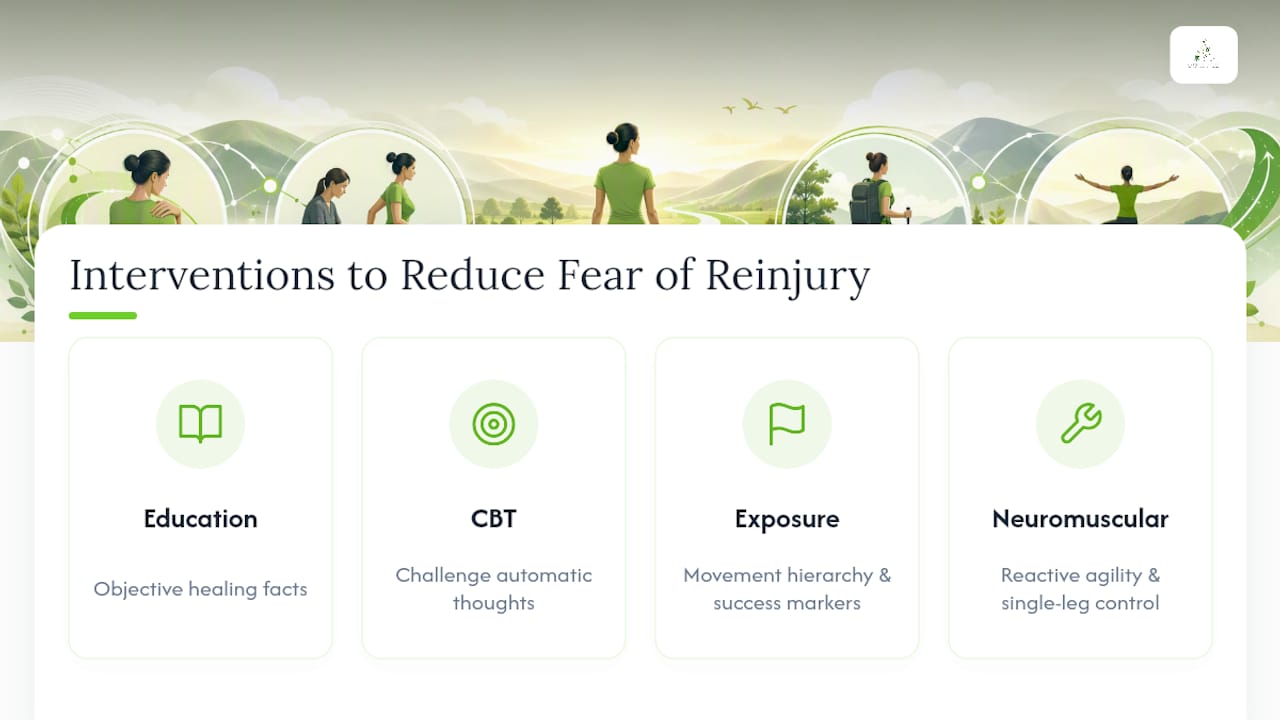
Cognitive-behavioral therapy (CBT) and cognitive reframing target the distorted thoughts that fuel avoidance, things like "if I plant my foot hard, my knee will give out again," even after full structural healing. A clinician trained in CBT techniques helps the athlete identify these automatic thoughts and test them against facts: current strength numbers, imaging results, surgeon clearance. Shifting attention toward objective, present-moment facts rather than injury memories helps contain the emotional spike that shows up right before a feared movement, and that containment is what makes graded exposure tolerable in the first place.
Graded exposure and progressive loading is the backbone of most rehab-based fear reduction. You build a hierarchy of feared movements, from least to most threatening, and work through them systematically with objective success markers at each rung. A soccer player fearful of cutting might progress from straight-line jogging, to controlled cutting movements at increasingly challenging speeds, to full-speed direction changes under fatigue, with each step cleared only when pain, symmetry, and movement quality hit defined thresholds.
Acceptance and Commitment Therapy (ACT) takes a different route. Instead of trying to eliminate fear, ACT teaches athletes to notice the fear, accept its presence, and commit to values-driven action anyway. This works especially well for athletes who've tried to "think positive" their way out of fear and found it doesn't stick; ACT-based approaches reframe the goal from "feel no fear" to "act on what matters despite the fear."
Imagery, motor imagery, and VR exposure give athletes a safe rehearsal space. Mental rehearsal of the feared movement activates overlapping neural pathways to actually performing it, and early VR-based exposure work suggests it can safely reproduce sport scenarios for controlled desensitization. Our visualization guide walks through scripting these sessions in more detail.
Pro Tip: Pair every exposure step with a specific, measurable success criterion, not a vague feeling of "it went okay." Something like pain under 2 out of 10, symmetrical landing on video review, or matching reactive strength scores between limbs. Vague criteria let fear quietly veto progress without anyone noticing.
None of this works in isolation from the physical side. Neuromuscular retraining, things like reactive agility drills and single-leg control work, rebuilds the movement confidence that fear has eroded, and it should run in parallel with the psychological strategies above, not after them.
A Step-by-Step Plan for Working Through Fear During Rehab
This sequence gives you and your clinician a shared framework, not a substitute for individualized medical guidance.
-
Get a baseline screen. Ask your physical therapist or athletic trainer to pair a TSK-11 or I-PRRS score with your standard strength and movement testing. This tells you whether fear is tracking with, ahead of, or behind your physical progress.
-
Write a values-driven goal statement. Not "I want to not be scared," but something like "I want to compete at nationals this season because this sport matters to me." This anchors motivation on high-fear days when confidence dips.
-
Build a graded exposure ladder. List every sport-specific movement you're avoiding, from mildly uncomfortable to genuinely dreaded. Assign an objective success criterion to each rung before you start, not after.
-
Practice daily mental skills. Spend five minutes reframing catastrophic thoughts with facts (clearance status, current strength numbers), run a short motor imagery script of the next day's hardest drill, and use slow diaphragmatic breathing before high-fear reps to keep your nervous system out of full alarm mode.
-
Set weekly milestones and a return-to-play checklist. Review your ladder progress, updated psych scores, and physical test results with your clinician every week. Before clearing full return, confirm that fear scores, strength symmetry, and sport-specific movement quality are all aligned, not just one or two out of three.
Pro Tip: Log your exposure ladder progress in a shared document with your clinician. Athletes who track this in writing tend to notice fear-driven avoidance patterns much faster than athletes relying on memory alone.
Tracking mental readiness alongside physical metrics is worth formalizing; our return-to-sport mental readiness guide breaks down the specific indicators clinicians look for at each checkpoint. Objective video feedback, like the kind used in individual player-focused recording programs, can also help athletes see their own movement quality improving, which does more for confidence than a verbal reassurance ever will.
When to Escalate: Red Flags and Multidisciplinary Care
Most fear of re-injury resolves with the framework above, given consistent effort over several weeks. Some cases need more.
Watch for these red flags:
- TSK or RIAI scores that stay elevated despite two or more full graded exposure cycles
- Worsening mood, sleep disruption, or irritability alongside physical rehab
- Avoidance behavior that persists even after strength and movement tests are fully cleared
- Panic-level responses (racing heart, shortness of breath, dissociation) triggered by specific drills
If fear metrics haven't budged after four to six weeks of active exposure work, that's a reasonable point to bring in a sports psychologist or licensed mental health professional rather than continuing the same protocol indefinitely. A coordinated care team, typically the physical therapist or athletic trainer, the surgeon or physician, and a mental performance or psychology specialist, works best when everyone shares the same return-to-play criteria and communicates on a set schedule rather than in isolated silos. Our psychological injury recovery overview covers what that shared decision-making process typically involves.
Nervous-System Training and Alpha Imprinting: Where It Fits
Dr. Paige Roberts developed Alpha Imprinting as a neuroscience-based method for retraining the nervous system's stress response, separate from, and intended to complement, the graded exposure and cognitive work described above. In plain terms, the approach uses guided sessions (often supported by QEEG brain scans and light or audio-visual protocols) aimed at helping the nervous system exit a chronic threat state and settle into a calmer baseline, which theoretically makes exposure work and skill execution easier to access under pressure.
Athletes carrying panic responses, performance anxiety, or unresolved trauma from a traumatic injury event sometimes plateau with standard exposure protocols alone. The aim of nervous-system-focused work is to address that underlying reactivity directly, so the athlete can access flow states again rather than white-knuckling through drills while still on high alert.
This is presented as a complementary layer, not a replacement for validated rehab protocols. Robertsneurotraining recommends integrating nervous-system training alongside, not instead of, physical therapy, strength testing, and graded exposure work supervised by your medical team. It's worth being direct about where the evidence currently stands: peer-reviewed validation of Alpha Imprinting specifically is still developing, and detailed case-study data is not yet publicly published. Athletes and clinicians evaluating this option should treat it as an emerging adjunct, with more validation and case-study detail to follow as research matures. More on our nervous-system approach to recovery is available for readers who want the fuller picture.
A Clinical Note From Dr. Paige Roberts
I've watched too many technically "recovered" athletes stall out not because their tissue failed them, but because their nervous system never got the memo that the danger had passed. The scales and exposure ladders in this article are genuinely useful. I use versions of them constantly. But they work faster when the nervous system underneath them isn't stuck in a low-grade alarm state.
My core philosophy: fear of re-injury is a signal, not a character flaw, and it responds best to structure plus calm, not willpower alone. If you take one thing from this: today, pick the smallest movement on your fear ladder and do it once, deliberately, with a clinician or coach watching. Confidence gets built in small, verified reps, not in a single moment of bravery.
— Paige
Where Robertsneurotraining Fits Into Your Recovery
Standard rehab gives you the exposure ladder and the strength numbers. This service adds an element often missed in typical programs: addressing the nervous system's stress response to help exposure steps become effective under pressure. This isn't a replacement for your physical therapist or your graded exposure plan; it's the layer that helps that plan land when your body still feels braced for impact.

If you want a self-guided starting point, the Energy Optimization Workbook walks through practical nervous-system exercises you can pair with whatever exposure ladder your clinician has already built. If you'd rather understand the science first, our research and clinical collaboration page lays out where the evidence currently stands and where validation work is ongoing. And if you're ready to work directly with someone on panic, performance anxiety, or a stalled return to sport, our process page explains how 1:1 sessions and the 10-week program are structured. Book a session and bring your current fear scores. It gives us a real starting point instead of a guess.
Sources
- Fear of Reinjury in Athletes: Implications for Rehabilitation
- Returning to Sports after Injury: How to Overcome Your Fear