

Guide athletes through trauma responses with a safety first script, two regulation tools, and a clear referral plan, in that order. This applies to coaches, parents, athletic trainers, and anyone who spends regular hours with an athlete. Say something calm and simple first. Then use a short breathing or grounding cue to bring their nervous system out of high alert. Only after that do you check for immediate safety risks: are they hurt, are they in danger, do they need someone besides you right now.
Here's the four-step version you can use before you finish reading:
- Speak low and slow. "I'm here. You're safe. Take your time."
- Offer a choice, not a command. "Do you want to sit down or keep moving?"
- Use one grounding tool. Name five things they can see, or count four breaths in and six out.
- Set a follow-up. Tell them you'll check in tomorrow, and actually do it.
Key Takeaways
Trauma-informed coaching works when safety comes first, regulation tools are practiced before a crisis, and referral pathways are clear and known in advance.
| Point | Details |
|---|---|
| Lead with safety, not questions | Use a calm voice and simple choices before asking what happened. |
| Practice regulation before crisis | Rehearse box breathing and grounding with the whole team, not just flagged athletes. |
| Know your referral thresholds | Escalate for imminent risk, disclosure, persistent dysregulation, or medical red flags. |
| Treat RTP as biopsychosocial | Track psychological readiness alongside physical benchmarks during rehab. |
| Coaching has limits | Robertsneurotraining's nervous-system coaching supports regulation and performance but refers out for clinical-level trauma care. |
Resources for Coach Education and Policy Development
- SafeSport's trauma-sensitive coaching toolkit for handouts and staff training materials.
- SAMHSA's trauma and violence resources for organizational policy language.
- The TIC-6 SPARCS preprint for a full framework write-up.
- The biopsychosocial RTP framework for rehab and return-to-play integration.
Use these to build or update team policy, cite in coach education, or hand directly to staff for onboarding.
Table of Contents
- What Trauma Is and How It Changes Athletic Performance
- Common Trauma Responses in Sport
- Immediate Steps When a Trauma Response Occurs
- Trauma-Informed Coaching Principles You Can Actually Use
- When to Refer and How to Report Safely
- Bringing Trauma-Informed Practice Into Rehab and Return to Play
- A Practical Toolkit You Can Use This Week
- How Nervous-System Coaching Fits Into This Picture
- Frequently Asked Questions
- Sources
What Trauma Is and How It Changes Athletic Performance
Trauma is what happens when the nervous system gets overwhelmed by an event, or repeated events, and the body's threat-detection system stays stuck in the "on" position long after the danger has passed. In sport, that stuck alarm system shows up as an athlete who freezes at contact drills, overreacts to a coach's raised voice, or can't seem to "just relax" no matter how many times you tell them to.
The brain systems that handle arousal, attention, and threat detection get reshaped by trauma exposure, and that reshaping produces different symptoms depending on the athlete's age and situation, according to NCBI's overview of trauma's psychiatric effects. A younger athlete might act out or regress; an older one might over-control every variable they can. Neither is being difficult on purpose.
This matters for performance because a nervous system on high alert narrows the "performance window," the range where an athlete can take in coaching, adjust technique, and stay flexible under pressure. Outside that window, athletes either shut down (dissociation, going through the motions) or spike into fight-or-flight (snapping at teammates, refusing feedback). You can read more about how this narrowing affects coachability from a neuroscience angle.

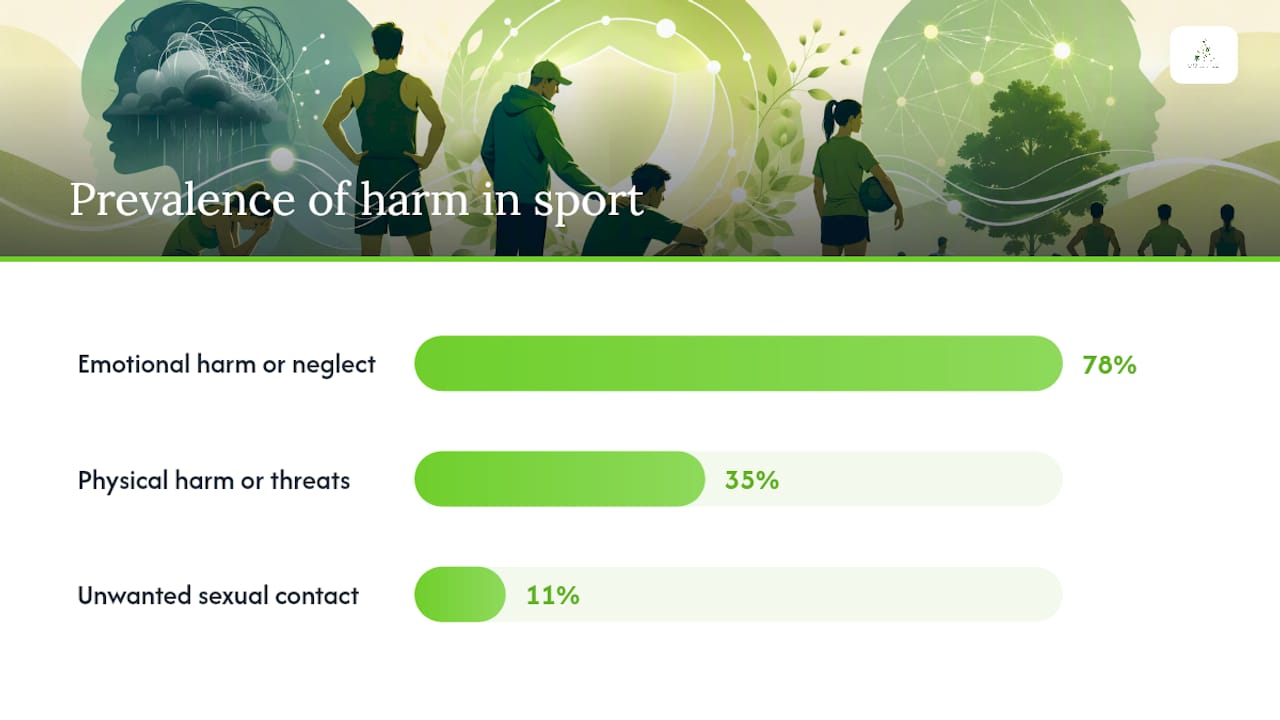
How common is this really? More common than most programs assume. Survey data from the U.S. Center for SafeSport found that roughly 78% of athletes reported experiencing emotional harm or neglect in sport, with 35% reporting physical harm or threats and 11% reporting unwanted sexual contact. That means most rosters include athletes carrying some trauma exposure, whether or not it originated in sport.
Common Trauma Responses in Sport
Trauma responses in athletes rarely look like what people picture. They look like coachable moments gone wrong, or discipline problems that never quite make sense.
- Fight: Sudden aggression toward a teammate over a minor foul, disproportionate to the trigger.
- Flight: An athlete who "forgets" practice repeatedly or finds excuses to leave the field during contact drills.
- Freeze or dissociation: Blank stare during a play call, or an athlete who physically performs the drill but seems mentally absent.
- Overcompliance: The athlete who never says no, apologizes constantly, and pushes through pain without reporting it.
- Somatic complaints: Recurring stomachaches or headaches before specific practices or opponents, with no clear medical cause.
- Sudden performance drop: A consistent performer who suddenly can't execute a skill they've had for years, often tied to a specific cue (a sound, a position, a coach's tone).
A youth swimmer who suddenly can't dive off the blocks after a near-drowning years earlier isn't being dramatic. A college linebacker who goes quiet and overcompliant after a coaching change that echoes a past controlling relationship isn't lacking grit. Younger athletes tend to externalize (tantrums, refusal), while older athletes often internalize into perfectionism or silence, per NCBI's developmental trauma research.
Pro Tip: Behavior is communication. Before you label something as an attitude problem, ask yourself what the behavior might be protecting the athlete from.
Immediate Steps When a Trauma Response Occurs
When you see one of these responses in real time, the sequence matters more than the perfect words.
- Check safety first. Is anyone at physical risk right now? Address that before anything else.
- Lower the arousal. Drop your own voice volume and pace. Loud, fast responses escalate a dysregulated nervous system.
- Offer choices, not demands. "Water break or keep going?" restores a sense of control that trauma often strips away.
- Skip the interrogation. Don't ask "why" repeatedly in the moment. Save the cause-finding for a private conversation later.
- Document and plan. Note what happened, when, and set a specific follow-up time within 24 to 72 hours.
Two regulation tools work fast enough to use mid-practice:
- Box breathing (20 seconds): In for 4 counts, hold for 4, out for 4, hold for 4. Repeat twice.
- 5-4-3-2-1 grounding (30 seconds): Name 5 things you see, 4 you hear, 3 you feel, 2 you smell, 1 you taste. This pulls attention out of the past and into the present room.
Script for in-session de-escalation: "I see you're having a hard moment. You're not in trouble. Let's take three breaths together, then we'll figure out the next step."
Script for a private check-in: "I noticed practice felt tough today. You don't have to explain anything, but I want you to know I'm here if you want to talk, now or later."
Pro Tip: Before you respond to a dysregulated athlete, take your own 30-second reset: one slow breath, unclench your jaw, drop your shoulders. Regulation is relational, so your calm becomes contagious before your words do.
More somatic-specific coping techniques are covered in this guide to coping strategies for trauma-related symptoms.
Trauma-Informed Coaching Principles You Can Actually Use
Trauma-informed care rests on a handful of principles that show up across every major framework: safety, trustworthiness, peer support, collaboration, empowerment, and attention to cultural context, according to SAMHSA's trauma guidance. Sport-specific versions distill this further into what's sometimes called the Four R's: realize the prevalence of trauma, recognize its signs, respond appropriately, and resist re-traumatizing practices.
One framework built specifically for athletic settings, the TIC-6 SPARCS model, organizes trauma-informed coaching into six domains, with Safety acting as the gateway domain that makes the other five possible. Here's how each domain translates into something you can actually do at practice:
- Safety → Predictable routines, consistent start and end times, permission before any physical touch or spotting.
- Power → Give athletes real choices in warmups, drill order, or pacing whenever the sport allows it.
- Attribution → Frame setbacks as situational, not character flaws ("that rep was off" not "you're not trying").
- Regulation → Build breathing or movement resets into transitions between drills, for everyone, not just flagged athletes.
- Connection → Short, consistent one-on-one check-ins, even 60 seconds, on a regular schedule.
- Systems → A written referral pathway every staff member knows, not something improvised in the moment.
Coaches should not attempt to diagnose, interpret childhood history, or run anything resembling therapy — for guidance on how sports culture often overlooks girls' unique needs, see Girls Aren’t Failing Sports – Why Sports Are Failing Girls. Your job is regulation and referral, not treatment. Coach preparedness for trauma-affected athletes remains low across most programs, which is exactly why brief, practical training matters more than theory.
When to Refer and How to Report Safely
Some situations require more than a script and a breathing exercise. Refer or escalate when you see any of these:
- Imminent risk to the athlete or others (statements of self-harm, threats, safety concerns).
- Disclosure of abuse or harm, past or present, from any source.
- Persistent dysregulation that interferes with safety or return-to-play decisions over multiple sessions.
- Medical red flags such as fainting, chest pain, or symptoms beyond emotional distress.
The referral process itself doesn't need to be complicated:
- Contact your organization's designated safeguarding officer or mental health liaison first.
- Document what you observed in plain, factual language, not interpretation.
- Preserve the athlete's confidentiality and agency wherever legally possible; tell them what you're doing and why.
- Follow your organization's mandated reporting requirements exactly as written.
The U.S. Center for SafeSport provides toolkits built specifically for this, and SAMHSA's National Helpline offers a crisis referral point when an athlete needs support beyond what your program can provide.
Bringing Trauma-Informed Practice Into Rehab and Return to Play
Injury recovery is often where trauma responses surface most clearly, because physical vulnerability reopens old patterns of fear and helplessness. A biopsychosocial approach treats psychological readiness as a measurable factor in return-to-play planning, not an afterthought, per a recent rehabilitation framework paper. Tools like the I-PRRS (Injury Psychological Readiness to Return to Sport) scale give coaches and athletic trainers a way to track that readiness alongside strength and range-of-motion benchmarks.
Practical session adjustments during rehab and return include:
- Building predictable structure into every rehab session, so the athlete knows what's coming.
- Using graded exposure to reintroduce triggering movements or contact at a pace the athlete controls.
- Rehearsing high-pressure scenarios at low stakes before reintroducing them in competition.
Psychological strategies like CBT-based approaches, imagery, and mindfulness improve rehab adherence and reduce re-injury anxiety, which is why a coach, athletic trainer, and sport psychologist working as a coordinated triad tends to outperform any one of them working alone. Shared decision-making, where the athlete has real input on RTP timing, reinforces the same power and choice principles that make regulation possible in the first place. For readers building this out further, return-to-sport mental readiness indicators and the biopsychosocial injury model both cover measurement in more depth.
A Practical Toolkit You Can Use This Week
Copy these directly. Adapt the wording to your sport and age group.
De-escalation script: "I'm right here. Nothing bad is going to happen. Let's breathe together for a few seconds, then we'll figure out next steps."

Private check-in script: "I want to check in about earlier. You don't owe me an explanation, but I care about how you're doing, on and off the field."
24 to 72 hour follow-up checklist:
- Did the athlete return to normal engagement in practice?
- Has any new somatic complaint or behavior pattern appeared?
- Does a referral conversation need to happen now, or can you keep monitoring?
10-minute team or parent debrief agenda:
- State what happened, in neutral, factual terms (2 minutes).
- Reaffirm safety and confidentiality expectations (2 minutes).
- Open the floor for athlete voice, questions, or concerns (4 minutes).
- Close with the follow-up plan and who's responsible for it (2 minutes).
Staff training in 15 to 30 minutes: Run through the four immediate steps above, practice the two regulation exercises as a group, and role-play one de-escalation script with a partner. Repeat monthly until it's automatic rather than something staff have to think through under pressure.
How Nervous-System Coaching Fits Into This Picture
Programs like Robertsneurotraining apply nervous-system regulation methods that map directly onto the Regulation and Connection domains of trauma-informed coaching: teaching the body to shift out of a stuck threat response through repeatable, brief protocols rather than talk-based processing alone. This kind of work tends to focus on the physiological layer, arousal, breath patterns, activation cycles, that sits underneath the behaviors coaches see on the field.
That said, coaching is not therapy, and no nervous-system protocol replaces clinical care when an athlete meets criteria for PTSD, reports ongoing safety concerns, or shows symptoms that interfere with daily functioning outside of sport. The line is simple:
- Coaching scope: regulation tools, predictable structure, performance-focused nervous-system work.
- Clinical referral needed: persistent trauma symptoms, safety disclosures, or when an athlete or parent asks for more support than a coach can ethically provide.
More on how nervous-system retraining works and where its limits sit is covered in reprogramming the nervous system for performance.
Why This Approach Changes Outcomes
As a practitioner working in this space, I've seen how much changes when an athlete gets a predictable, choice-based response instead of pressure to "push through." Small, consistent regulation habits, practiced weekly rather than only in crisis, build the kind of trust that lets an athlete actually perform again.
Get Practical Support for Trauma-Informed Coaching and Recovery
Robertsneurotraining gives coaches, parents, and athletes a nervous-system-first alternative to guesswork when performance blocks trace back to stress or past trauma, without asking anyone to sit through months of talk therapy first. The Energy Optimization Workbook walks athletes and families through the same regulation routines covered in this guide, built into a structured, self-paced format.

Beyond the workbook, Robertsneurotraining offers 1:1 coaching, group workshops, and direct collaboration with athletic trainers and coaching staff on return-to-play cases where psychological readiness is part of the picture. None of this replaces clinical therapy. It's nervous-system training and performance coaching, with clear referral pathways built in for athletes who need clinical-level support. If you want to see how the process works step by step, review the coaching process and book an initial conversation to find the right starting point for your athlete or team.
Frequently Asked Questions
What does it mean to guide athletes through trauma responses in the moment? It means using a calm, low-arousal voice, offering choices instead of commands, applying a brief grounding or breathing exercise, and checking for safety risks before addressing the cause of the reaction.
How do I tell the difference between a trauma response and a discipline problem? Trauma responses tend to be disproportionate to the trigger, recurring around specific cues, and paired with physical signs like a blank stare, shaking, or sudden withdrawal. Discipline issues are usually more consistent and tied to clear behavioral choices rather than a startled or frozen reaction.
When should a coach refer an athlete to a mental health professional instead of handling it themselves? Refer immediately for any disclosure of abuse, statements about self-harm, or persistent dysregulation that affects safety or return-to-play decisions over multiple sessions. When in doubt, loop in your organization's designated safeguarding contact.
Can trauma-informed coaching actually improve athletic performance? Yes. A regulated nervous system widens the performance window, the range where an athlete can absorb coaching and adapt under pressure, so reducing chronic threat activation tends to improve focus, coachability, and consistency.
Is trauma-informed coaching the same as therapy? No. Coaching focuses on regulation, structure, and choice within an athletic context. Clinical therapy addresses diagnosis and treatment of trauma-related conditions, and coaches should refer out when an athlete's needs go beyond what practical coaching tools can address.
This article is general information, not a substitute for advice from a qualified doctor. Consult a qualified healthcare professional about your own circumstances before acting on anything here.
Sources
- Raising trauma awareness in sport
- The mind as rehabilitation co-pilot: An integrated biopsychosocial framework for injury recovery and return-to-performance
- Trauma and violence resources — SAMHSA
- Concepts of trauma and psychiatric sequelae — NCBI Bookshelf