

Mental performance recovery after brain injury is the process of regaining cognitive functions and mental resilience through structured rehabilitation and targeted neurological training. The field of cognitive rehabilitation therapy (CRT) defines this recovery as a systematic effort to restore executive functions, memory, and attention by capitalizing on the brain's capacity to rewire itself. Mild traumatic brain injuries often recover significantly within weeks to months, while moderate-to-severe injuries require long-term, multi-domain therapy for the best outcomes. Robertsneurotraining applies this same neuroplasticity-based framework to athletes rebuilding mental performance after sports-related brain trauma.
What are the most effective cognitive rehabilitation techniques for brain injury recovery?
Cognitive rehabilitation therapy is a structured process that uses neuroplasticity to restore executive functions through two core approaches: restorative training and compensatory strategies. Restorative training aims to rebuild damaged neural pathways directly. Compensatory strategies teach the brain to route around deficits using new methods. Both approaches serve a distinct purpose, and most effective programs combine them.

Restorative exercises target specific cognitive domains. Memory drills, such as spaced repetition and visual association techniques, rebuild encoding and recall. Attention training uses tasks that gradually increase in complexity, like the Trail-Making Test format, to rebuild sustained and divided attention. Executive function exercises include planning tasks, problem-solving sequences, and working memory challenges that mirror real-world demands.
Digital cognitive training enhances memory and attention more effectively than traditional methods in post-concussion syndrome patients. Research shows that 45-minute sessions, five days per week over six weeks produced statistically significant improvement on Digit Span and Trail-Making Tests. That result confirms that frequency and consistency matter as much as the type of exercise.
Skill transfer is where most programs fall short. Gains made in clinical drills do not automatically carry over to daily life. Functional application requires explicit practice in real-world settings, such as navigating a grocery store, managing a schedule, or following a multi-step work task. Therapy that stops at the clinic level leaves a significant gap.
Key cognitive rehabilitation techniques include:
- Spaced repetition memory training: Rebuilds encoding by reviewing information at increasing intervals.
- Attention process training (APT): Targets sustained, selective, and divided attention through graded tasks.
- Executive function drills: Planning and sequencing exercises that mirror workplace or home demands.
- Digital cognitive training platforms: Structured software-based programs with measurable progress tracking.
- Real-world skill transfer practice: Deliberate rehearsal of daily tasks in natural environments.
Pro Tip: Schedule cognitive training at the same time each day. Consistent timing reinforces neural pathway formation and reduces the mental load of deciding when to practice.
How can resilience training enhance mental performance recovery after brain injury?
Resilience is a set of deliberate, repeatable skills, not an innate personality trait. Reframing thinking and regulating emotions are trainable behaviors that support mental adaptability under pressure. For brain injury survivors, this distinction matters because it means resilience can be built systematically, regardless of where you start.
Mental resilience training works by replacing reactive coping with a structured internal response. Techniques include cognitive reframing, where you identify distorted thought patterns and replace them with accurate ones, and emotional regulation practices like controlled breathing and grounding exercises. These methods reduce the psychological interference that slows cognitive recovery.
Mobile-based resilience training programs produce significant, sustained improvements in mental well-being and resilience outcomes. Trials showed intervention groups significantly outperformed control groups, with results at p < 0.001 and β = 11.851 in resilience measures. That level of effect size is clinically meaningful, not just statistically notable.
"Mental resilience training replaces willpower with a repeatable internal structure that supports mental endurance under adversity." This principle applies directly to brain injury recovery, where willpower alone depletes quickly under cognitive fatigue.
Integrating resilience training with cognitive rehabilitation produces compounding benefits. Cognitive exercises rebuild function. Resilience training maintains the psychological stability needed to keep practicing. Without both, many survivors plateau or abandon their programs during difficult stretches. The combination is what sustains long-term mental fitness after injury.
For athletes, Robertsneurotraining's approach to mental reprogramming directly addresses this integration, targeting the nervous system patterns that create mental blocks alongside the cognitive deficits left by injury.
What role does neuroplasticity-focused training play in brain injury recovery?
Neuroplasticity is the brain's ability to reorganize itself by forming new neural connections in response to learning and experience. After a brain injury, this capacity becomes the primary mechanism for recovery. Structured practice builds new neural pathways and helps the brain bypass damaged regions to restore function.
The design of neuroplasticity-focused training follows specific principles. Repetition drives pathway formation. Novelty challenges the brain to adapt. Increasing difficulty prevents plateaus. Consistent scheduling prevents regression. Each principle has a direct application in recovery program design.
A practical neuroplasticity training progression looks like this:
- Baseline assessment: Identify which cognitive domains are most affected using standardized tools.
- Single-domain drills: Begin with focused exercises targeting one area, such as working memory or processing speed.
- Dual-task training: Combine two cognitive or physical tasks simultaneously to build neural integration, for example, walking while reciting sequences.
- Multitasking drills: Introduce three or more concurrent demands that mirror real-world complexity.
- Scheduled review and progression: Reassess every two to four weeks and increase difficulty based on performance data.
The neuroscience approach to concussion rehabilitation confirms that multi-domain programming, combining physical and cognitive exercises, accelerates neural reorganization more effectively than single-domain approaches.
| Training type | Primary target | Example exercise |
|---|---|---|
| Single-domain cognitive | Memory or attention | Digit span recall tasks |
| Dual-task training | Neural integration | Walking while counting backward |
| Multitasking drills | Executive function | Sorting tasks under time pressure |
| Physical-cognitive combo | Brain-body connection | Balance board with verbal recall |
Pro Tip: Keep a training log with date, task type, and performance score. Reviewing it weekly shows you patterns in your best and worst days, which helps you adjust pacing before fatigue becomes a setback.
What support systems and lifestyle adjustments aid mental performance recovery?
Recovery from brain injury does not happen in isolation. Integrated multidisciplinary care including strength, conditioning, cognitive retraining, and sleep optimization improves recovery outcomes significantly. Each element addresses a different layer of the recovery process, and removing any one of them slows the whole system.
Family and caregiver involvement directly affects recovery speed and consistency. Caregivers who understand pacing, recognize fatigue signals, and support structured routines reduce the cognitive burden on the person recovering. A caregiver who pushes for more activity than the brain can handle at a given stage creates setbacks, not progress.
Mental health treatment is not optional. Depression and anxiety act as cognitive noise that impairs the brain's ability to rewire. Treating these conditions unlocks cognitive improvements that training alone cannot achieve. Survivors who address mental health alongside cognitive rehabilitation consistently outperform those who focus only on cognitive drills.
Sleep is the brain's primary repair window. During deep sleep, the brain consolidates new neural connections formed during the day's training. Disrupted sleep directly undermines neuroplasticity. Prioritizing sleep hygiene, including consistent sleep and wake times, a dark and cool room, and limiting screens before bed, is a recovery intervention, not just a lifestyle preference.
Key lifestyle adjustments that support brain injury cognitive health include:
- Cognitive pacing: Schedule demanding mental tasks during peak energy hours and protect rest periods.
- Structured daily tools: Use checklists, planners, and phone reminders to reduce working memory load.
- Nutrition support: Prioritize omega-3 fatty acids, hydration, and stable blood sugar to support brain function.
- Social engagement: Regular, low-demand social interaction maintains emotional regulation and motivation.
- Physical activity: Even light aerobic exercise increases blood flow to the brain and supports neuroplasticity.
For athletes, the neurological training benefits of post-concussion programs extend beyond the clinic into daily performance habits that reinforce recovery.
What are common challenges and mistakes during mental performance recovery?
Recovery from brain injury is not linear. Progress comes in waves, with periods of clear improvement followed by plateaus or temporary regression. Expecting a straight upward line sets survivors up for discouragement when the inevitable dips arrive.
The most common mistake is pushing through mental fatigue. Mental fatigue limits cognitive capacity during recovery, and pushing through it triggers setbacks rather than progress. The brain needs recovery time between training sessions just as muscles do after physical exercise. Ignoring fatigue signals is the fastest way to lose ground.
"Pacing cognitive work and taking sensory-neutral breaks is not a sign of weakness. It is the mechanism that keeps the brain in a trainable state." Survivors who internalize this principle recover faster than those who treat rest as failure.
Skill transfer outside clinical settings is the second major challenge. Gains made in structured exercises do not automatically appear in daily life. Survivors often perform well in therapy sessions but struggle with the same cognitive demands at home or at work. Explicit practice in natural environments, not just in clinical drills, closes this gap.
Common challenges and how to address them:
- Mental fatigue: Build mandatory rest periods into your daily schedule before fatigue appears, not after.
- Motivation loss: Track small wins daily. Progress in brain injury recovery is often invisible until you compare week one to week six.
- Skill transfer gaps: Practice target skills in the actual environments where you need them, such as at work or in social settings.
- Sensory overload: Identify your personal overload triggers, such as noise, screens, or crowds, and reduce exposure during high-demand cognitive periods.
- Inconsistent practice: Tie cognitive training to an existing daily habit, such as after breakfast, to build a reliable routine.
The post-concussion recovery framework at Robertsneurotraining addresses these challenges directly by building pacing and real-world skill transfer into the program structure from the start.
Key Takeaways
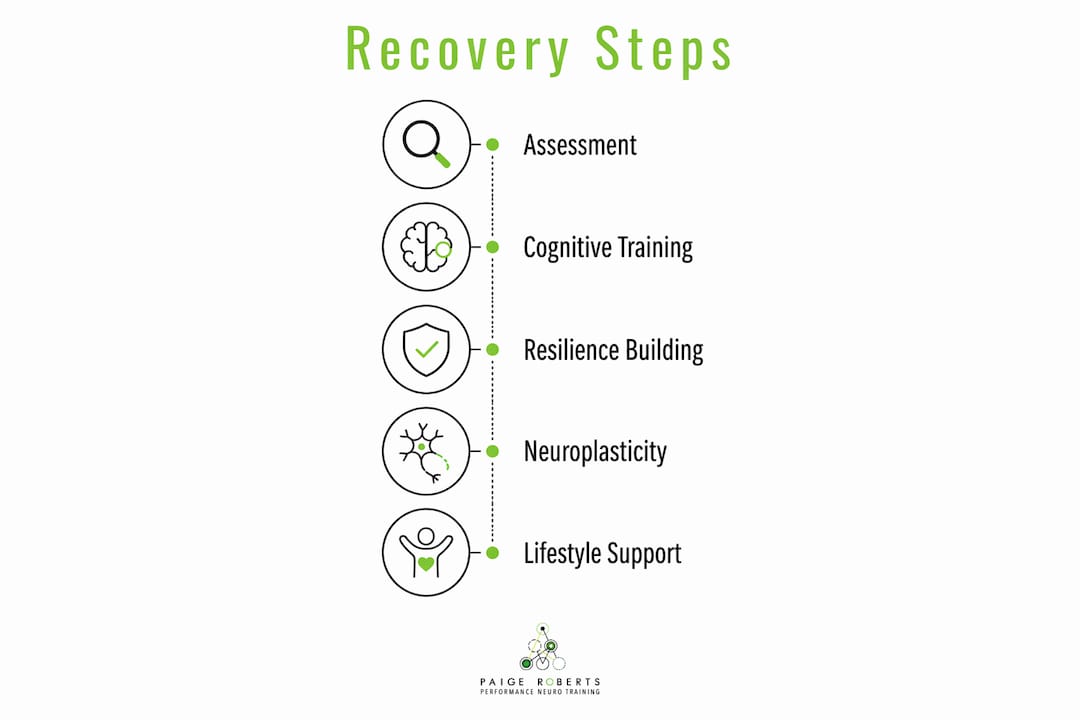
Effective mental performance recovery after brain injury requires combining cognitive rehabilitation, resilience training, neuroplasticity-focused exercises, and consistent lifestyle support rather than relying on any single approach.
| Point | Details |
|---|---|
| Cognitive rehabilitation is the foundation | Use restorative and compensatory techniques targeting memory, attention, and executive function. |
| Resilience is a trainable skill | Deliberate practices like reframing and emotional regulation sustain recovery through difficult periods. |
| Neuroplasticity requires consistent structure | Scheduled, progressive training builds new neural pathways and prevents regression. |
| Lifestyle factors are recovery tools | Sleep, nutrition, pacing, and mental health treatment directly affect how fast the brain rewires. |
| Skill transfer needs explicit practice | Gains from clinical drills must be rehearsed in real-world settings to become functional. |
What I've learned from working with brain injury recovery
Recovery timelines vary more than most people expect. I have worked with athletes who showed meaningful cognitive improvement within eight weeks and others who needed six months before the same gains appeared. The difference almost never came down to injury severity alone. It came down to how consistently they integrated every domain of recovery, not just the cognitive drills.
The biggest mistake I see is treating mental performance recovery as a symptom-management exercise. Survivors focus on reducing headaches or managing fatigue, and they stop there. Real recovery goes further. It means reprogramming the nervous system's response patterns, rebuilding the mental structures that support performance under pressure, and addressing the emotional residue that brain injuries leave behind.
What actually works is the combination. Cognitive training without resilience work creates a fragile foundation. Resilience training without cognitive structure produces motivation without direction. Sleep and nutrition without structured training leaves the brain's repair capacity underused. The athletes I see make the most progress are the ones who commit to all of it at once, even when it feels like too much.
The breakthrough moments are real. They come later than people expect, and they often arrive quietly. One day a task that required full concentration becomes automatic. That is neuroplasticity in action. Patience and structured persistence are what get you there. Building mental toughness under pressure is not separate from cognitive recovery. It is part of the same process.
— Paige
How Robertsneurotraining supports your recovery
Robertsneurotraining, led by Dr. Paige Roberts, applies a neuroscience-based approach to mental performance recovery that goes beyond standard rehabilitation protocols.

The program combines QEEG brain scan assessments to map your specific neural patterns with Alpha Imprinting, a method designed to reprogram the nervous system and clear the mental blocks that standard cognitive therapy does not address. Every program is built around your individual brain profile, not a generic protocol. Athletes across professional and amateur levels have used this approach to recover cognitive function, rebuild mental resilience, and return to peak performance. Review the full neurotraining services to find the right starting point for your recovery.
FAQ
What is cognitive rehabilitation therapy for brain injury?
Cognitive rehabilitation therapy (CRT) is a structured program that uses neuroplasticity to restore executive functions, memory, and attention after brain injury. It combines restorative exercises that rebuild neural pathways with compensatory strategies that teach the brain to work around deficits.
How long does mental performance recovery take after a brain injury?
Mild traumatic brain injuries often show significant recovery within weeks to months. Moderate-to-severe injuries typically require long-term, multi-domain therapy, and timelines vary widely based on injury severity, consistency of treatment, and lifestyle factors like sleep and mental health support.
Does resilience training actually help after a brain injury?
Yes. Mobile-based resilience training programs have shown significant, sustained improvements in mental well-being, with intervention groups outperforming control groups at p < 0.001 in clinical trials. Resilience training reduces the psychological interference that slows cognitive retraining.
What is neuroplasticity and why does it matter for recovery?
Neuroplasticity is the brain's ability to form new neural connections in response to learning and structured practice. After a brain injury, it is the primary mechanism through which lost functions are restored or rerouted, making consistent, progressive training the core driver of recovery.
How does Robertsneurotraining differ from standard cognitive rehabilitation?
Robertsneurotraining uses QEEG brain scans to assess individual neural patterns and applies Alpha Imprinting to reprogram nervous system responses, targeting mental blocks and performance anxiety that standard cognitive rehabilitation does not address. The approach is built specifically for athletes recovering from brain trauma and sports-related injuries.