

A complete mental warm-up routine for athletes takes 3–7 minutes and delivers one measurable outcome: you step into competition or practice with your attention locked in, your arousal calibrated, and a clear performance intention already set. Think of it as flipping a switch your body already knows how to flip, once you've trained it.
Here's what the routine covers:
- Recognize your current mental state (tense? flat? scattered?)
- Regulate arousal with controlled breathing using a paced inhale and exhale
- Refocus using a vivid imagery sequence of your first key action
- Anchor with a physical cue (fist clench, tap, or breath) tied to a cue word
- Affirm with one short self-talk statement conveying readiness and focus
One-line script to memorize: "Breathe in, visualize, say your cue, feel ready, perform."
Research backs this structure. A 5-minute mental warm-up that includes goal setting, imagery, arousal regulation, and positive self-talk was associated with greater readiness to perform in youth and collegiate soccer players and was rated acceptable during a full season of use.
Key Takeaways
A structured 3–7 minute mental warm-up that follows the Recognize → Regulate → Refocus sequence reliably improves pre-competition readiness when practiced consistently across weeks, not just on game day.
| Point | Details |
|---|---|
| Run the 5-minute script today | Use the timing table in this article: breath, imagery, arousal check, tactical cue, final anchor. |
| Sequence it mid-warm-up | Insert the mental warm-up after general physical activation and before sport-specific drills for most sports. |
| Practice 3x per week minimum | Consistency over four weeks is what makes the routine automatic under competition pressure. |
| Match technique to arousal need | Precision sports need centering; explosive sports need activation. Wrong direction undermines the routine. |
| Robertsneurotraining for deeper work | When persistent mental blocks or anxiety don't respond to the routine, 1:1 Performance Neuro Training and Alpha Imprinting address the nervous-system root cause. |
Table of Contents
- Your 5-minute mental warm-up script, step by step
- The core techniques every mental warm-up should include
- What the research actually says about mental warm-ups
- How to fit the mental warm-up into your existing pre-game routine
- Sport-specific tweaks, common mistakes, and quick fixes
- A 4-week plan to make the routine automatic
- Why the 3R framework changes how I think about mental preparation
- What Robertsneurotraining offers when the routine isn't enough
- Sources
Your 5-minute mental warm-up script, step by step
This script runs exactly five minutes. Coaches can read it aloud; athletes can memorize it after a few weeks of practice.
| Time | Step | What to do / say |
|---|---|---|
| 0:00–0:30 | Anchor breath | Three slow breaths with controlled inhale and exhale. Coach says: "Find your breath. Let everything else drop." |
| 0:30–1:30 | Imagery | See your first key action in vivid detail: the feel of the ball, the sound of the crowd, your body moving exactly right. Coach says: "Run your best play in your mind, start to finish." |
| 1:30–2:30 | Arousal check | Rate your energy 1–10. Too high? Slow your exhale. Too low? Take a sharp inhale and shake out your hands. Coach says: "Find your zone. Not too hot, not too cold." |
| 2:30–4:30 | Tactical cue + rehearsal | Name your one performance intention for today ("Attack the first ball," "Stay low on the serve"). Replay it mentally twice. Coach says: "What's your job today? See yourself doing it." |
| 4:30–5:00 | Final anchor | Perform your physical cue (fist clench, chest tap, or a single sharp breath). Say your cue word aloud or silently. Coach says: "Lock it in. You're ready." |
Solo adaptation: Athletes can run this with a printed card or a phone timer. The imagery and self-talk steps work just as well with eyes closed in a quiet corner of the locker room.
Team locker-room version: A coach leads the breathing and imagery steps aloud, then gives athletes 60 seconds of silence for personal rehearsal before the final group anchor (e.g., a team word said together on three).
The core techniques every mental warm-up should include
Each element in the script above does a specific job. Here's what the science says about each one, plus a phrase you can use right now.

Imagery (visualization): Mental rehearsal activates motor pathways nearly identically to physical execution. The goal is not daydreaming. You run a specific, sensory-rich mental clip of your performance: what you see, hear, and feel in your body. Example: "I step up to the free-throw line. I feel the ball in my hands. I release. It goes in." Imagery is listed by the USOPC as one of the core trainable mental skills for Team USA athletes.
Breathwork and centering: Controlled breathing directly shifts your autonomic state. A longer exhale activates the parasympathetic branch and lowers heart rate. A sharp inhale does the opposite. Knowing which direction you need to go is half the skill. For a deeper look at how breathing affects performance, the mechanism is well-documented in exercise science. Example phrase: "Four in, six out. Again."
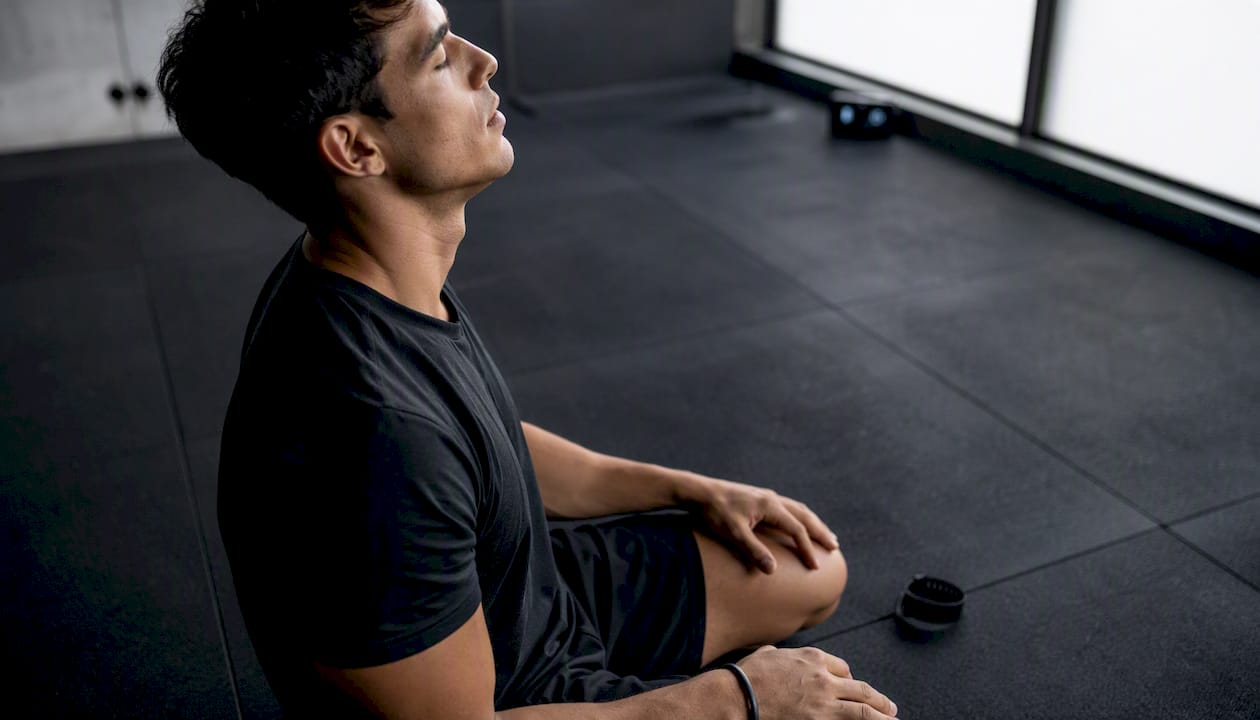
Arousal regulation: Neither calm nor fired-up is universally optimal. Your target zone depends on the sport and the moment. Explosive power athletes often need higher activation; precision athletes (archers, golfers, tennis players) usually need lower. Teach athletes to self-rate on a simple 1–10 scale, then apply the right tool.
Positive self-talk and cue words: Short, specific, present-tense statements outperform vague affirmations. "Stay low" beats "I am a great athlete." Cue words work because they compress a complex movement pattern into a single trigger. Example: "Explode," "Smooth," "Trust it."
Anchoring: A physical gesture (fist clench, tap on the chest, a specific breath) paired repeatedly with a peak-readiness state becomes a conditioned trigger. Over weeks, the gesture alone begins to call up that state. Olympic-level practitioners emphasize anchoring and short, pre-planned strategies as the most reliable tools for managing expected stressors during competition.
Acceptance: Athletes who try to suppress anxious thoughts before competition tend to amplify them. Acceptance-based handling means noticing the thought ("I'm nervous about the first quarter") without fighting it, then redirecting attention to the task. The 3R framework (Recognize → Regulate → Refocus) formalizes this as a cyclical, real-time self-regulation process that works across contexts.
Pro Tip: Sequence imagery before high-arousal activation, not after. Running a vivid mental rehearsal while already over-activated produces fragmented, anxious imagery. Get calm first, then see the performance clearly.
What the research actually says about mental warm-ups
The evidence is promising and worth taking seriously, with a few honest caveats.
The systematic review and meta-analysis covering psychological interventions for athletic performance found moderate effect sizes for psychological skills training, mindfulness and acceptance approaches, and imagery compared to control conditions. Effect size estimates across subgroups ranged from roughly g = 0.67 to g = 0.83 for some techniques. The catch: those effects were not stable after sensitivity analyses that excluded lower-quality study designs and focused on objective performance outcomes. That's not a reason to abandon the approach. It's a reason to set realistic expectations.
| Technique | Effect estimate | Confidence | Practical note |
|---|---|---|---|
| Imagery | Moderate (g ~0.67–0.83 in some subgroups) | Moderate, drops in sensitivity analyses | Most reliable when practiced consistently over weeks |
| Psychological skills training (PST) | Moderate | Moderate | Needs coach support and repetition to stick |
| Mindfulness/acceptance | Moderate | Moderate | Especially useful for managing pre-competition anxiety |
| Brief cognitive warm-up drills | Emerging, context-dependent | Low-to-moderate | Best evidence in tasks requiring sustained attention |
Integrating brief cognitive drills into warm-ups can improve cognitive readiness and give athletes a performance head-start in certain contexts, particularly sports that demand rapid decision-making. The effect is real but not universal.
The practical takeaway for coaches: expect modest-to-moderate gains in readiness and focus, not miracles. The athletes who benefit most are those who practice the routine consistently across weeks, not just on game day. Heterogeneity in results across studies also means that what works for a soccer midfielder may need adjustment for a gymnast or a swimmer.
How to fit the mental warm-up into your existing pre-game routine
Placement matters. A five-minute mindfulness session immediately before a 100-meter sprint is probably the wrong call. Here's how to sequence it intelligently.
Three sequencing options:
- Mental-first: Run the mental warm-up before any physical activity. Works well for precision sports (golf, archery, tennis) where calm focus is the target state from the start.
- Mental-in-mid: Insert the mental warm-up between general physical warm-up and sport-specific drills. The body is already warm, heart rate is moderate, and athletes are more receptive to imagery. This is the most versatile option.
- Mental-last: Run it as the final 5 minutes before competition begins. Best for athletes who need a sharp focus lock-in after a long warm-up. Keep it short and anchor-heavy.
Practical timing by pre-game window:
| Window | Suggested structure |
|---|---|
| 5 minutes total | 8 min physical activation → 5 min mental warm-up → 2 min team anchor |
| — | 15 min physical warm-up → 10 min sport-specific drills → 5 min mental warm-up |
| 60 minutes total | 20 min physical → 15 min tactical review → 15 min sport-specific → 5 min mental → 5 min team ritual |
Simple rules of thumb:
- Keep the mental warm-up to 5–7 minutes maximum before competition.
- Avoid long meditation (10+ minutes) immediately before explosive efforts; it can drop arousal below the optimal zone.
- Repeat short anchor cues (one breath + cue word) during timeouts, between sets, or at stoppages to maintain the state you built pre-game.
- Pair the mental warm-up with a consistent physical cue (lacing up shoes, walking onto the field) so the physical action begins to trigger the mental state automatically. For more on nervous system preparation and how to sequence calming versus activating techniques, the underlying physiology is worth understanding.
Sport-specific tweaks, common mistakes, and quick fixes
Common mistakes and their fixes:
- Script too long: Athletes zone out after 90 seconds of coach narration. Cut anything that isn't breathing, imagery, or a cue word. If it takes more than 7 minutes, it's too long.
- Wrong arousal target: A sprinter running a calming body-scan before the blocks will feel sluggish. Match the technique to the sport's demand. Explosive sports need activating cues; precision sports need centering.
- Excessive inward focus: Overthinking mechanics during the imagery step creates anxiety, not readiness. Imagery should be outcome-focused ("I make the catch") not process-obsessed ("I position my elbow at exactly 90 degrees").
- Skipping it on easy practice days: Consistency builds the habit. Athletes who only run the routine on competition days never automate it.
Sport-specific adjustments:
- Explosive power sports (sprinting, weightlifting, football): Shorten the breathing step, amplify the arousal activation (sharp inhale, physical shake-out), and use high-energy cue words ("Explode," "Dominate," "Now").
- Precision sports (golf, tennis, archery, baseball): Extend the centering breath, use slow-motion imagery, and choose calming cue words ("Smooth," "Trust," "Easy"). For tennis-specific applications, the precision-focus protocol translates directly.
- Team sports (basketball, soccer, lacrosse): Add a shared team anchor at the end. Individual imagery stays personal; the final cue word or gesture is collective.
Individual differences:
- Anxious athletes: Start with the breath step, extend it to 90 seconds, and use acceptance language ("I notice I'm nervous. That's fine. Back to the breath.").
- Low-arousal athletes: Skip the long exhale. Use a sharp inhale, a physical shake-out, and high-energy imagery with sound and movement.
- Athletes who dislike imagery: Replace the visual rehearsal with a kinesthetic one. Ask them to feel the movement in their body rather than see it.
Quick coach interventions during competition:
- Reset cue: "One breath. One word. Back in."
- Re-anchoring phrase: "What's your job right now? Just that."
- Micro-breathing: Three breaths, no narration, hand on chest.
Pro Tip: Athletes who resist the routine usually resist the label, not the practice. Drop the phrase "mental warm-up" and call it "your two-minute focus routine." Adoption rates improve noticeably when the framing feels athletic rather than therapeutic.
A 4-week plan to make the routine automatic
The goal is not a coached intervention. The goal is a habit that runs without prompting.
-
Week 1: Learn and rehearse. Run the full 5-minute script at every practice, coach-led. Athletes follow along without pressure to perform it perfectly. Focus on familiarity with the sequence. Evaluation prompt: "Did you complete all five steps? Which felt awkward?"
-
Week 2: Integrate with the physical warm-up. Insert the mental warm-up into the mid-warm-up slot (after general activation, before sport-specific drills). Athletes begin self-rating their readiness on a 1–10 scale before and after the routine. Track whether the post-routine score is consistently higher. Evaluation prompt: "What was your readiness score before and after?"
-
Week 3: Simulate competition pressure. Run the routine before a scrimmage or high-intensity drill block. Introduce mild distractions (music, crowd noise, a coach giving instructions nearby) so athletes practice maintaining focus under realistic conditions. Evaluation prompt: "Did the routine hold up when things got noisy?"
-
Week 4: Automate under mild pressure. Athletes run the routine independently, without coach narration. The coach observes and gives brief feedback afterward. Begin pairing the anchor cue with a consistent physical trigger (walking through the tunnel, stepping onto the court). Evaluation prompt: "Can you run it in under 5 minutes without the script?"
Consistency is the only metric that matters in month one. Three sessions per week beats one perfect session per week. Short, frequent repetitions build the neural pathway faster than occasional long sessions. Pair the routine with physical cues, use peer feedback or brief video review when available, and gradually increase the pressure in practice so the routine is stress-tested before it's needed in competition. For a systematic approach to elite athlete mindset training, the progression principles map directly onto this 4-week structure.
Why the 3R framework changes how I think about mental preparation
Most coaches treat mental preparation as a pre-game checklist. Run through it, check the box, go compete. That framing misses the most important part: the mental warm-up is not a one-time event. It's the first rep of a skill you'll need to deploy repeatedly during competition, often under pressure, often in under 10 seconds.
The 3R framework (Recognize → Regulate → Refocus) reframes the whole thing. You're not just calming athletes down before the whistle. You're training them to notice when their state has shifted, correct it in real time, and return to the task. That's a different skill than "doing a breathing exercise." It's metacognitive self-regulation, and it's trainable.
What I've seen consistently in working with athletes across sports is that the ones who perform best under pressure aren't the ones who feel no anxiety. They're the ones who've practiced noticing it and moving through it quickly. The mental warm-up builds that capacity, rep by rep. When an athlete tells me the routine "stopped working," it usually means one of two things: they've been skipping it in practice, or the underlying issue is deeper than a warm-up can reach. A persistent mental block, a trauma response, or a nervous system stuck in a threat state won't resolve with five minutes of breathing. That's when individualized support becomes the right next step.
What Robertsneurotraining offers when the routine isn't enough
A solid mental warm-up handles day-to-day readiness. When the block runs deeper, a different level of support is needed.
Robertsneurotraining works with competitive athletes, teams, and high performers whose mental barriers go beyond what a pre-game script can fix: panic responses that override training, performance anxiety tied to past injury, or a nervous system that won't settle regardless of the breathing technique. The approach is neuroscience-based, not generic sports psychology. Services include 1:1 Performance Neuro Training, the proprietary Alpha Imprinting protocol for clearing deep-seated mental blocks, and the 10-week Energy Optimization Program, all available via telehealth. Athletes leave with measurable outcomes, not just coping strategies. If the 5-minute routine isn't moving the needle after four weeks of consistent practice, start with the free workbook or book a consult to find out what's actually in the way.
Sources
- A Mental Warm-Up
- Bridging brain and body: a 3R framework for real-time self-regulation strategies in sport
- Effects of Psychological Interventions to Enhance Athletic Performance: A Systematic Review and Meta-Analysis
- Be mentally ready for anything: techniques from Olympians
- Mental performance resources — Team USA / USOPC
- Why you need to warm up your brain, not just your muscles
This article is general information, not a substitute for advice from a qualified doctor. Consult a qualified healthcare professional about your own circumstances before acting on anything here.