

Nervous system priming is the deliberate activation of neural pathways before athletic performance to sharpen motor control, reaction time, and muscular readiness. The concept sits at the intersection of neuroscience and sports science, and it answers a question every serious athlete faces: why do some warm-ups produce peak output while others leave you flat? Understanding nervous system priming gives you a framework to stop guessing and start preparing with intention. Robertsneurotraining, led by Dr. Paige Roberts, applies this science through protocols that address both the physical and psychological dimensions of readiness, including its proprietary Alpha Imprinting method.
What is nervous system priming for athletes?
Nervous system priming is defined as the intentional stimulation of the central and autonomic nervous systems before competition or training to produce a state of heightened neural readiness. The goal is not maximum arousal. The goal is calibrated activation, where your motor units fire faster, your reaction time shortens, and your brain stays sharp under pressure.
The term "priming" comes from neuroscience research on post-activation potentiation (PAP), which describes how a prior muscular contraction enhances the force output of subsequent contractions. Athletes use this principle by performing specific exercises or protocols before their main event to "prime" the neural circuitry that controls speed, power, and coordination.
Polyvagal theory, developed by Dr. Stephen Porges, adds another layer. It explains how the vagus nerve regulates the body's shift between threat responses and calm, focused states. Priming that ignores autonomic balance risks pushing athletes into sympathetic overdrive, which produces anxiety, tunnel vision, and poor decision-making. Effective priming targets both the central nervous system for physical output and the autonomic nervous system for composure.

Heart rate variability (HRV) serves as the most practical biomarker for tracking this balance. HRV monitors nervous system readiness and resilience under pressure, giving athletes and coaches a measurable signal of whether the nervous system is primed or depleted before competition.
What physiological processes underlie nervous system priming?
Priming works through three overlapping mechanisms: motor unit recruitment, neural firing rate, and autonomic regulation.
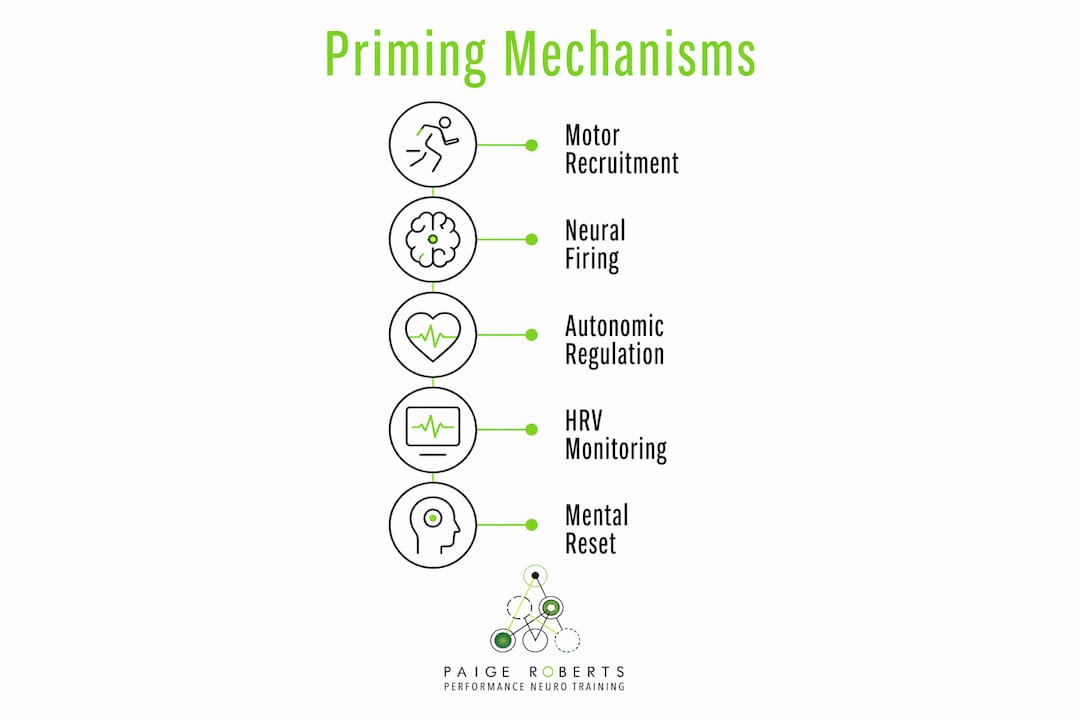
Motor unit recruitment refers to how many muscle fibers your nervous system activates during a movement. A cold, unprimed nervous system recruits fewer motor units, which means less force and slower movement. A primed nervous system recruits more units from the first rep of competition.
Neural firing rate and synchronization determine how quickly and efficiently signals travel from your brain to your muscles. Priming exercises increase the rate of neural discharge and improve the synchronization of motor neuron firing. The result is faster, more coordinated movement without additional physical effort.
Autonomic regulation is the piece most athletes overlook. The autonomic nervous system controls heart rate, breathing, and stress hormone output. When the sympathetic branch dominates without counterbalance, performance suffers. Vagus nerve stimulation enhances physiological resilience and executive function under pressure by activating the parasympathetic branch, keeping the prefrontal cortex online for decision-making.
Key physiological benefits of nervous system priming include:
- Faster motor unit recruitment at competition onset
- Increased neural firing rate for speed and power output
- Improved neuromuscular synchronization for coordination
- Reduced time to peak force production
- Balanced autonomic state that supports focus without panic
Pro Tip: Monitor your HRV each morning during a competition week. A drop of more than 10% from your baseline signals that your nervous system needs recovery, not more priming volume.
Which nervous system priming techniques are effective for athletes?
84% of practitioners who prescribe priming exercises report benefits from resistance-based protocols. That figure comes from a survey of 69 sports practitioners, and it reflects a broad consensus that physical priming works when applied correctly.
Resistance-based priming
Traditional resistance priming uses low-volume, moderate-to-heavy loads to activate the neuromuscular system before competition. A common protocol involves 3 sets of 3 repetitions at 85% of one-rep maximum, performed 8–24 hours before the event. The load triggers post-activation potentiation without causing fatigue that would blunt performance.
Low-volume ballistic exercises offer a practical alternative for athletes traveling or working with limited equipment. Medicine ball slams, jump squats, and banded sprints deliver the neural stimulus without heavy loads. Explosive movements activate the central nervous system and prepare it for maximal output, making them a reliable pre-competition tool.
Breathing resets and vagus nerve activation
Breathing resets are critical in priming protocols to transition from anxious to controlled activation states before competition. Slow-paced breathing at 5–6 breaths per minute activates the vagus nerve and shifts the autonomic balance toward parasympathetic engagement. This does not reduce arousal. It refines it, keeping the athlete alert without tipping into panic.
Transcutaneous auricular vagus nerve stimulation (taVNS) represents an emerging tool in this category. taVNS modulates cortical arousal and enhances motor planning, learning, and executive function in athletes. While not yet standard practice, it points to where autonomic priming is heading.
Pre-competition progressive warm-up with mental reset
A structured 60-minute pre-race protocol moves through four stages: a chemical primer (light movement to raise core temperature), a breathing reset, a progressive warm-up, and a mental reset. This protocol runs from T-60 to T-10 minutes before competition and produces measurable improvements in readiness without pre-race fatigue.
| Method | Best for | Key advantage | Limitation |
|---|---|---|---|
| Heavy resistance priming | Power and sprint athletes | Strong PAP effect | Requires 8+ hours recovery window |
| Ballistic/explosive priming | Travel or limited equipment | Low fatigue, high neural stimulus | Less PAP effect than heavy loads |
| Slow-paced breathing reset | Anxiety management | Activates vagal tone, reduces panic | Requires practice to execute under stress |
| Progressive warm-up protocol | Pre-race readiness | Integrates physical and mental prep | Time-dependent (60-minute window) |
Pro Tip: Combine a 3-rep explosive movement (medicine ball slam or jump squat) with 5 slow breaths immediately after. This pairs central nervous system activation with autonomic reset in under 3 minutes.
How to optimize timing and avoid overtraining in nervous system priming?
Timing is the variable most athletes get wrong. Priming too close to competition produces residual fatigue. Priming too early loses the neural potentiation effect before the event begins.
-
Schedule heavy priming 8 hours before competition. A systematic review of 15 studies covering 262 athletes found that priming improves sprint performance most reliably when performed approximately 8 hours before activity, with an effect size of SMD=0.40. That gap allows full recovery while preserving the neural potentiation window.
-
Use short explosive protocols within 60 minutes of competition. Light-load ballistic work and breathing resets fit inside the 60-minute pre-competition window without causing fatigue. These are not replacements for earlier heavy priming. They are the final neural activation layer.
-
Watch for CNS overtraining signals. Signs of CNS overtraining include persistent fatigue, irritability, prolonged soreness, and performance plateaus. These symptoms differ from normal physical tiredness because they persist through rest days and worsen with additional training load.
-
Reduce priming volume during competition weeks. The nervous system does not recover as fast as muscle tissue. A priming session that works well in training can become a liability during a competition week if volume is not reduced by 30–50%.
-
Integrate psychological regulation into every session. Athletes who overshoot sympathetic activation through excessive priming volume often report feeling "wired but slow." Pairing physical priming with a structured mental reset prevents this state and keeps the prefrontal cortex engaged.
Pro Tip: If you feel flat on competition day despite priming, the problem is usually timing or volume, not the method. Log your priming sessions with HRV data for three competition cycles to find your personal optimal window.
What mental and autonomic strategies complement physical priming?
Physical priming without autonomic regulation produces an athlete who is physically ready but mentally fragile. The two systems must work together.
Stress activates the sympathetic nervous system in ways that support performance, but balanced activation with ventral vagal engagement is what keeps focus and decision-making intact under competitive pressure. The ventral vagal state, described in Polyvagal theory, is the physiological condition where an athlete feels alert, connected, and in control. Losing it mid-competition is what athletes describe as "choking."
Elite athletes treat composure as a physiological skill, training their nervous systems to view pressure as survivable rather than threatening. This is not a mindset trick. It is a trainable neural adaptation that changes how the brain processes threat signals.
Practical autonomic strategies that complement physical priming include:
- Slow-paced breathing (5–6 breaths per minute): Directly stimulates vagal tone and reduces cortisol output before competition
- HRV biofeedback: Gives real-time data on autonomic balance so athletes can adjust their pre-competition routine based on actual nervous system state
- Cognitive reframing: Reinterpreting pre-competition nervousness as readiness rather than threat shifts the autonomic response from fear to focus
- Bottom-up breathing combined with top-down reframing: Integrating these two approaches supports optimal autonomic balance and maintains performance composure under stress
The athletic mindset required for consistent performance is not separate from nervous system training. It is the output of a well-regulated autonomic system. Athletes who train their breathing and cognitive responses alongside their physical priming build a more reliable competitive state than those who rely on physical preparation alone.
Sports psychology research consistently shows that mental preparation strategies integrated with physical training produce better competitive outcomes than either approach used in isolation.
Key Takeaways
Nervous system priming works best when physical activation, autonomic regulation, and precise timing are combined into a single pre-competition protocol.
| Point | Details |
|---|---|
| Define priming correctly | Priming is calibrated neural activation, not maximum arousal before competition. |
| Time heavy priming at 8 hours | Research shows sprint performance improves most when heavy priming precedes activity by about 8 hours. |
| Use breathing resets every session | Slow-paced breathing activates vagal tone and prevents sympathetic overdrive before competition. |
| Watch for CNS overtraining | Persistent fatigue, irritability, and performance plateaus signal nervous system fatigue, not just physical tiredness. |
| Combine physical and mental priming | Integrating bottom-up breathing with cognitive reframing produces more consistent competitive composure than physical priming alone. |
What I've learned about priming that most programs miss
Most priming programs focus entirely on the physical side and treat the breathing reset as an afterthought. That is a mistake I see repeatedly, even with experienced athletes. The breathing component is not a cooldown. It is the mechanism that determines whether your physical activation translates into focused performance or anxious overexertion.
The athletes I work with who see the most consistent results are not the ones doing the heaviest priming loads. They are the ones who have learned to calibrate their nervous system state, recognizing the difference between productive activation and the kind of tension that tightens their movement and clouds their thinking. Low-load ballistic priming combined with a structured breathing reset often outperforms high-intensity priming for athletes who carry anxiety into competition.
The other insight that rarely appears in standard programs: nervousness is not the enemy. It is raw energy. The goal of nervous system priming is not to eliminate that energy but to direct it. When athletes reprogram their nervous systems to interpret pre-competition arousal as readiness rather than threat, their performance becomes far more consistent across different competitive environments. That shift is physiological, not motivational. It requires training, not willpower.
— Paige
How Robertsneurotraining supports your nervous system preparation
Athletes who understand priming theory still need structured support to apply it consistently under real competitive pressure.
Robertsneurotraining, led by Dr. Paige Roberts, offers neuroscience-based protocols that address both the physical and autonomic dimensions of nervous system readiness. The Alpha Imprinting method goes beyond standard priming by reprogramming the nervous system at the level of stored stress responses, trauma patterns, and mental blocks that standard warm-up routines cannot reach. Athletes across professional leagues and Olympic programs have used this approach to clear performance anxiety and achieve consistent flow states in competition. If your current preparation leaves you flat, anxious, or inconsistent, nervous system training built around your specific sport and history is the next step.
FAQ
What is nervous system priming in sports?
Nervous system priming is the intentional activation of neural pathways before athletic performance to improve motor unit recruitment, reaction time, and autonomic readiness. It combines physical exercises and breathing protocols to produce a calibrated state of arousal before competition.
How long before competition should you prime your nervous system?
Heavy resistance priming works best approximately 8 hours before competition, based on a systematic review of 15 studies covering 262 athletes. Light ballistic exercises and breathing resets can be performed within 60 minutes of the event.
What are the signs of CNS overtraining?
Signs of central nervous system overtraining include persistent fatigue, irritability, prolonged muscle soreness, and performance plateaus that do not resolve with rest days. These differ from normal physical fatigue because they worsen with continued training load.
Can breathing exercises actually prime the nervous system?
Yes. Slow-paced breathing at 5–6 breaths per minute directly stimulates the vagus nerve, shifts autonomic balance toward parasympathetic engagement, and reduces cortisol output before competition. Breathing resets are a core component of effective pre-race priming protocols.
How does Robertsneurotraining differ from standard priming programs?
Robertsneurotraining uses Alpha Imprinting to address stored stress responses, trauma patterns, and mental blocks that standard physical priming cannot reach. The approach targets nervous system reprogramming at a deeper level, producing consistent performance improvements for athletes dealing with anxiety, injury recovery, and performance blocks.