

If you're searching for mindfulathletetraining.com alternatives, the clearest answer is Performance Neuro Training by Dr. Paige Roberts at Robertsneurotraining. It uses QEEG brain scanning, biometric tracking, and the proprietary Alpha Imprinting protocol to produce measurable nervous-system changes, not just relaxation habits. Olympic medalists have credited the method with real performance shifts, and the practitioner credentials back every claim.
For athletes and coaches who want to map the full field before deciding, here are the main approach categories worth evaluating:
- Neuroscience-based nervous-system training (e.g., Robertsneurotraining): QEEG, Alpha Imprinting, biometric KPIs
- CMPC-backed sport psychology: credentialed mental performance consultants, validated psychological scales
- Biofeedback/HRV programs: device-driven, real-time physiological feedback
- CBT for performance: cognitive-behavioral techniques adapted for competitive sport
- Targeted mindfulness protocols: sport-specific mindfulness with practitioner oversight
Table of Contents
- How do the main alternative approaches actually compare?
- How do you choose the right alternative for your sport and level?
- What outcomes and timelines should you realistically expect?
- When is an alternative unlikely to help?
- How do you trial alternatives without overcommitting?
- How does pricing compare across alternative approaches?
- What do customer support and satisfaction signals tell you?
- Key Takeaways
- Why practitioner-led neuroscience programs outperform generic apps
- Performance Neuro Training: what it includes and how to start
- Useful sources for verifying claims and digging deeper
How do the main alternative approaches actually compare?
The table below maps each approach across the dimensions that matter most to competitive athletes and coaches.
| Approach | Evidence base | Practitioner credentials | Biometric tracking | Delivery | Best for |
|---|---|---|---|---|---|
| Neuroscience-based (Robertsneurotraining) | Practitioner-led protocols with QEEG and pre/post baselines | PhD-level, sport-specific | QEEG, HRV, performance KPIs | 1:1 telehealth, in-home devices | Elite athletes, injury recovery, performance blocks |
| CMPC sport psychology | Systematic reviews support combined cognitive + stress-recovery approaches | CMPC-certified | Validated scales (e.g., resilience, focus) | 1:1 or group, in-person or telehealth | Competitive athletes needing credentialed mental skills work |
| Biofeedback/HRV programs | Biometric tracking differentiates high-performance from generic wellness | Varies widely | HRV, galvanic skin response | Device-assisted, app-guided | Athletes focused on arousal regulation and recovery |
| CBT for performance | Strong general evidence; sport adaptation varies | Licensed psychologist or CMPC | Minimal biometrics | 1:1 therapy or structured program | Athletes with anxiety, mental blocks, or trauma history |
| Targeted mindfulness protocols | Positive correlation between mindfulness and resilience; effects vary by sport and level | Ranges from CMPC to uncredentialed | Rarely included | Apps, group courses, practitioner-led sessions | Recreational to mid-level competitive athletes |
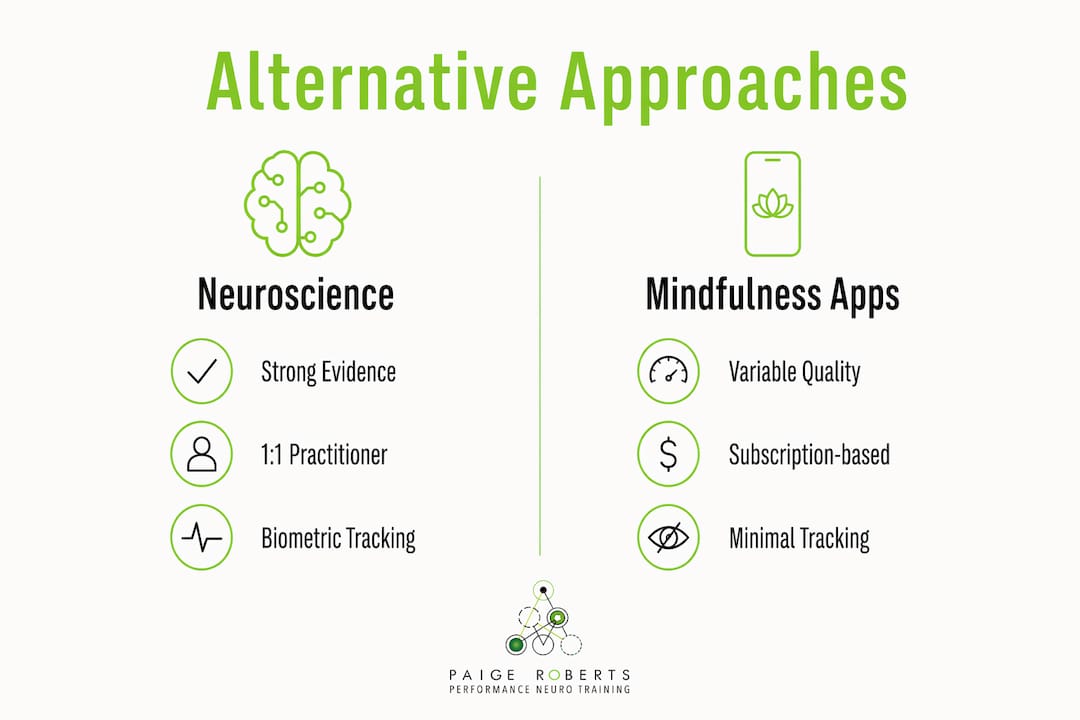
Neuroscience-based programs stand out on measurable tracking and sport specificity. The tradeoff is cost and access: 1:1 practitioner time is priced accordingly.
CMPC sport psychology is the credentialed standard. The Association for Applied Sport Psychology recommends athletes prioritize CMPC access over consumer apps, and for good reason. The weakness is that many CMPC practitioners do not use biometric tools, so progress tracking can stay subjective.

Biofeedback/HRV programs give you objective data but often lack the sport-specific programming to translate that data into competitive gains.
CBT for performance works well for athletes whose blocks have a clinical root. It is not designed for peak-performance optimization in athletes who are already performing well but want more.
Targeted mindfulness protocols are the most accessible and the most variable in quality. Sport-specific mindfulness courses with practitioner instruction outperform generic apps, but the gap between a well-designed program and a generic one is wide. Hybrid apps that pair on-demand content with optional CMPC access sit in the middle.
How do you choose the right alternative for your sport and level?
Start with three questions before you evaluate any provider:
- What is the primary demand of your sport? Explosive power sports (sprinting, weightlifting) stress the nervous system differently than endurance or precision sports. Your program should reflect that.
- What is your competitive level? Elite and professional athletes need biometric accountability and sport-specific protocols. Recreational athletes can often get meaningful gains from structured mindfulness or CBT alone.
- Is this about recovery or performance expansion? Injury recovery, trauma responses, and panic under pressure call for nervous-system retraining. General mental skills development is a different scope.
Once you have those answers, run this checklist with any provider you're considering:
- Ask for the practitioner's credentials (CMPC, PhD, licensed clinician).
- Ask what objective measures they use to track progress (HRV, QEEG, validated scales).
- Ask for a sample timeline and what outcomes past clients have seen.
- Ask whether a short trial period is available before a full commitment.
- Ask about their cancellation or refund policy.
Red flags to watch for: vague outcome language ("you'll feel better"), no baseline assessment, no sport-specific exercises, credentials that are coaching certifications rather than clinical or CMPC-level, and no pre/post measurement plan.
Pro Tip: Before booking any program, verify CMPC credentials directly through the AASP consultant finder. A credential check takes two minutes and filters out a significant portion of the market.
What outcomes and timelines should you realistically expect?
Most athletes working with a practitioner-led program see measurable shifts in focus, arousal control, and resilience within 6–10 weeks when a structured protocol is followed with pre/post baselines. That timeline assumes consistent sessions and a program designed around your sport's specific demands.
A cross-sectional study of 177 athletes found a positive correlation between mindfulness practice and mental resilience, with meaningful variation across sport types and experience levels. The takeaway: effects are real but not uniform, which is exactly why sport-specific design matters.
Combined cognitive and stress-recovery approaches consistently outperform single-method interventions in systematic reviews. A program that only teaches breathing techniques, without addressing cognitive patterns or nervous-system regulation, will plateau faster.
Here are the metrics worth tracking during any trial:
| Metric | What it measures | Tracking method |
|---|---|---|
| HRV (resting) | Nervous system recovery and readiness | Wearable device (daily) |
| Pre-competition anxiety score | Subjective arousal and confidence | Validated scale (e.g., CSAI-2) |
| QEEG markers | Brainwave patterns linked to focus and flow | Clinical QEEG scan |
| Performance-specific KPI | Sport-relevant output (e.g., free throw %, split time) | Coach-recorded |
| Resilience scale score | Psychological resilience pre/post | Validated questionnaire |
Athletes working with Robertsneurotraining's Alpha Imprinting protocol have reported clearing long-standing performance blocks, including panic responses and trauma-linked anxiety, that had not responded to traditional sport psychology. Olympic medalists have cited the work as a direct contributor to competitive results.
When is an alternative unlikely to help?
Consumer mindfulness apps without practitioner oversight rarely shift elite performance in any meaningful, lasting way. That is not a knock on mindfulness as a skill. It is a structural problem: generic apps miss sport specificity and accountability, and without those two elements, practice does not transfer to competition.
Watch for these red flags in any program you evaluate:
- No intake assessment or baseline measurement
- Content that is identical for all sports and all levels
- No CMPC or equivalent clinical credential listed for the practitioner
- Outcome promises that are entirely subjective ("feel calmer," "perform with confidence")
- No option to speak with a practitioner, only pre-recorded content
One important scope note: mental performance coaching and clinical mental health care are not the same thing. If an athlete is dealing with clinical depression, PTSD, disordered eating, or substance use, a performance coach is not the right first stop. Those situations call for a licensed clinical psychologist or psychiatrist. A good performance practitioner will recognize this boundary and refer out when appropriate.
How do you trial alternatives without overcommitting?
The most practical approach is a short pilot with defined checkpoints. Run a 2–4 week trial with pre-measures taken before the first session and post-measures at the end. That window is long enough to see whether the approach is producing any signal and short enough to cut losses if it is not.
Follow these steps:
- Baseline assessment: Record your HRV, complete a validated resilience or anxiety scale, and note one or two sport-specific performance KPIs before the first session.
- Book an initial consultation: Most credentialed practitioners offer an intake call. Use it to ask the credential and outcome questions from the checklist above.
- Run 3–5 sessions over 2–4 weeks: Maintain consistent practice between sessions as instructed.
- Re-measure at the end: Compare HRV, scale scores, and your sport KPIs against the baseline.
- Evaluate fit: If the practitioner cannot show you any movement on at least one objective measure, that is useful information.
Check platform usability before you commit: Is telehealth available? Can you reschedule easily? Is there a clear cancellation policy? These logistics matter more than they seem when you're mid-season.
Robertsneurotraining's process page walks through exactly what a client can expect from intake through active training, which makes it a useful reference for what a well-structured pilot should look like.
How does pricing compare across alternative approaches?
Pricing in this space varies more than most athletes expect, and the range reflects real differences in what you're getting.
1:1 practitioner-led programs (CMPC, PhD-level, or neuroscience-based like Robertsneurotraining) typically run at professional consulting rates. Robertsneurotraining's model is fee-for-service: individual sessions, the 10-week Energy Optimization Program, group workshops, and optional in-home device add-ons. Pricing is not publicly listed and is discussed during intake.
Hybrid app + CMPC access models sit in the middle. You pay a subscription for on-demand content, then pay separately for any 1:1 practitioner time. The total cost depends heavily on how much live access you use.
Pure app-based mindfulness programs are the lowest-cost option, often under $20/month. The tradeoff is everything discussed above: no baseline, no sport specificity, no practitioner accountability.
Biofeedback/HRV device programs carry an upfront hardware cost plus optional coaching. Devices range from consumer-grade wearables to clinical-grade equipment. The coaching layer, if any, is priced separately.
For elite athletes and professional teams, the relevant comparison is not monthly cost but cost-per-outcome. A program that produces measurable, lasting performance gains is worth more than a cheaper one that produces none.
What do customer support and satisfaction signals tell you?
Satisfaction in this category is hard to assess from public ratings alone, because the most meaningful outcomes (performance at competition, recovery from injury-related mental blocks) are not captured in app store reviews.
The most reliable satisfaction signals for practitioner-led programs are:
- Named athlete testimonials with specific outcomes: not "I felt better" but "I competed at the Olympic level after clearing a panic response that had blocked me for two years."
- Practitioner responsiveness: Can you reach your practitioner between sessions? Is there a clear support structure?
- Documented methodology: Programs with published or clearly described protocols (like Alpha Imprinting) give you something to evaluate before you commit.
Robertsneurotraining publishes testimonials from Olympic medalists with specific performance outcomes, which is a stronger signal than aggregate star ratings. For mental performance coaching broadly, the practitioner's ability to explain their method clearly and point to documented outcomes is the most reliable proxy for quality.
App-based programs with large user bases will have more public reviews, but volume does not equal relevance. A five-star review from a recreational runner does not tell you much about what a Division I soccer player will experience.
Key Takeaways
Neuroscience-based, practitioner-led programs with biometric tracking produce the most measurable outcomes for competitive athletes, and Robertsneurotraining's Performance Neuro Training is the strongest option in that category.
| Point | Details |
|---|---|
| Credentials matter most | Verify CMPC, PhD, or clinical licensure before committing to any program. |
| Biometrics separate programs | HRV, QEEG, and validated scales are what distinguish measurable programs from generic ones. |
| Trial before committing | A 2–4 week pilot with pre/post measures is the lowest-risk way to validate fit. |
| Sport specificity is non-negotiable | Effects of mindfulness and resilience training vary by sport type and competitive level. |
| Robertsneurotraining | Performance Neuro Training uses Alpha Imprinting and QEEG to deliver measurable, sport-specific nervous-system results. |
Why practitioner-led neuroscience programs outperform generic apps
Most of the conversation about mental training for athletes still centers on mindfulness apps and breathing exercises. Those tools are not useless, but for competitive athletes, they are often the wrong starting point.
The athletes I work with come in after years of trying the standard approaches: meditation apps, visualization scripts, CBT worksheets. Some of those tools helped at the margins. None of them addressed the nervous-system patterns that were actually driving the performance blocks. A panic response before competition is not a thinking problem. It is a wiring problem, and it needs a different kind of intervention.
Alpha Imprinting works at that level. QEEG gives us an objective map of what is happening in the brain before and after training. That is not a marketing claim. It is a measurement. And measurement is what separates a program that works from one that feels like it works.
If you are a competitive athlete or a coach building a mental performance program for your team, the question worth asking is not "which app should we use?" It is "what does measurable progress look like for this athlete, and which approach can actually produce it?" The answer to that question almost always points toward practitioner-led, biometric-tracked work. Start with an assessment, set your KPIs, and hold the program accountable to them.
Performance Neuro Training: what it includes and how to start
Robertsneurotraining offers something most mindful athlete training substitutes do not: a documented, neuroscience-based protocol with objective measurement built in from day one.
The core offerings include 1:1 Performance Neuro Training sessions via telehealth, the proprietary Alpha Imprinting protocol for nervous-system reprogramming, the 10-week Energy Optimization Program, QEEG brain scanning, and in-home light and audio-visual devices for between-session work. Group workshops and cohort programs are available for teams. Each engagement begins with a baseline assessment so progress is measurable from the start.
For athletes who want a low-friction entry point, the Energy Optimization Workbook is a practical starting resource. For a full picture of the process before booking, the process page walks through every step from intake to active training. To book a consultation or learn more about the program, visit robertsneurotraining.com.
Useful sources for verifying claims and digging deeper
The following sources are worth bookmarking when you're evaluating any mental performance program:
- PubMed Central (PMC): The primary database for peer-reviewed sports psychology and mindfulness research. Look for studies with defined athlete populations, sample sizes, and validated measurement tools.
- Association for Applied Sport Psychology (AASP): The governing body for CMPC credentialing in the U.S. Use the consultant finder to verify practitioner credentials before booking.
- Sports Business Journal: Covers the business and technology side of athlete mental performance, including market analysis of biometric tools and program models.
When assessing any source, check for: named practitioner credentials, described methodology, pre/post outcome data, and sport-specific sample populations. Sources that describe outcomes only in subjective terms ("athletes reported feeling better") without measurement data are worth treating with skepticism. Prefer programs and research that include CMPC credentials, biometric evidence, and documented protocols.