
Yes, negative self-talk reliably lowers confidence and raises competition anxiety, and it measurably hurts performance. The fastest fix is not to force positivity. Swap the negative line for a short, fact-based bridge statement or an instructional cue tied to the very next action. Evidence, causes, and a full practice routine follow below.
TL;DR:
- Negative self-talk predicts lower confidence and higher physical and mental anxiety, impairing decision-making and muscle relaxation during competition.
- Common triggers include goal-performance gaps, social comparison, injury, fatigue, and high-stakes moments, creating automatic self-criticism loops.
- Replacing negative statements with fact-based bridge statements and coupling them with instructional or motivational cues improves mental resilience.
- Consistent practice of rephrasing thoughts and tracking negative self-talk helps foster gradual, measurable improvements over two to three weeks.
- When negative self-talk persists despite these techniques or causes panic and mood issues, professional neurotraining or mental performance coaching can address underlying nervous system responses.
Table of Contents
- What Negative Self-Talk Does to Athletic Performance
- Why Athletes Fall Into Negative Self-Talk
- Negative Self-Talk Examples and Sport-Ready Replacements
- What the Research Actually Supports
- Techniques That Actually Change the Pattern
- A Practice Routine You Can Start This Week
- When to Bring In Professional Support
- Tracking Your Self-Talk Over Time
- Cultural and Gender Patterns Worth Knowing
- A Note on Consistency, Not Perfection
- How Performance Neuro Training Fits Into Your Mental Game
- Sources
What Negative Self-Talk Does to Athletic Performance
Negative self-talk is not just an unpleasant mental habit. Research on competitive gymnasts found it directly predicts lower self-confidence and higher pre-competition anxiety, both somatic and cognitive, according to a PLOS One path analysis. The effect on confidence carried a moderate negative beta, and the effect on somatic anxiety, the physical jitters before you compete, showed a similarly moderate positive beta. Those numbers describe a real mechanical link between what you say to yourself and how your body reacts under pressure.
The pathway runs through a few overlapping systems. When a thought like "I always choke in the fourth quarter" fires, your brain treats it as a threat signal. That triggers the same appraisal system used for physical danger, which narrows attention onto the threat itself rather than the task. Working memory, the mental workspace you need for split-second decisions, gets crowded out by the worry. Muscles tighten in anticipation of failure, burning energy you need for the actual movement.
This plays out in recognizable ways on the field or court:
- A hitter steps into the box thinking about the last strikeout instead of the pitcher's release point, and hesitates a fraction of a second too long.
- A free-throw shooter who just missed one starts consciously thinking about elbow angle and follow-through, and the shot loses the fluid rhythm that got him to the line in the first place.
- A distance runner tells herself she is "falling apart" at mile 20, and that thought alone raises perceived effort even before her pace actually drops.
Pro Tip: Notice where your negative self-talk shows up most: before competition, mid-performance after a mistake, or during recovery. The timing tells you which technique to reach for first.
None of this means athletes who talk to themselves harshly are weak-minded. It means self-talk is a lever, and right now it might be working against you instead of for you.
Why Athletes Fall Into Negative Self-Talk
The single biggest trigger is not a bad mood or a lack of toughness. It is the gap between what you expected to happen and what actually happened. A study of cross-country runners found that goal-performance discrepancies predicted negative self-talk with a beta of 0.55, stronger than general anxiety measures, in the research on pre-competition anxiety and goal-performance discrepancies. Miss your split, miss your mark, miss your block assignment, and the internal criticism follows almost automatically.
Beyond that core trigger, a handful of situations tend to bring negative self-talk out reliably:
- Ego-involving climates. Teams or programs that emphasize winning and comparison over improvement push athletes toward self-judgment instead of self-coaching.
- Injury and fatigue. A body that is not responding the way it used to invites doubt, especially during return-to-play.
- Social comparison. Watching a teammate or rival perform well activates a very personal, very unkind internal commentary.
- High-stakes moments. Championship games, tryouts, and contract years raise the emotional cost of every mistake, which raises the volume of the inner critic.
Repeat any of these enough times and the brain builds a habit loop. A specific cue, missing a shot, a bad rep, a coach's raised eyebrow, comes to trigger the same critical phrase automatically, without conscious choice. That automaticity is exactly why athletes can't just "decide" to stop it. The cue has to be interrupted with something else.
Negative Self-Talk Examples and Sport-Ready Replacements
Not all self-talk is the same, and treating it that way is a common mistake. Instructional self-talk focuses attention on a specific technical cue ("elbow up," "eyes on the target"). Motivational self-talk focuses on effort and drive ("push through," "stay aggressive"). Research on shooting athletes found both styles support performance, but they work best when matched to the task: instructional cues for accuracy and precision work, motivational cues for endurance and power, according to the PMC study on shooting athletes. Negative or self-critical talk, by contrast, rarely helps anything.
Here are common negative statements paired with realistic replacements:
- "I'm useless out here" → "One rep at a time. Focus on form."
- "I always blow it in the clutch" → "I've hit this shot before. Same routine, same result."
- "Everyone's watching me fail" → "Eyes on the target. Nothing else exists right now."
- "I'm too slow for this level" → "My last split was faster than I think. Trust the pace."
- "My coach is going to bench me" → "Next play. That's the only one that matters."
- "I can't recover from this deficit" → "One point at a time closes any gap."
- "My body is breaking down" → "Breathe out, reset stance, go again."
- "I don't belong on this team" → "I earned this spot. Play the game in front of me."
- "I'm going to choke like last time" → "Different day, different rep. Elbow up, follow through."
- "I have nothing left" → "Ten more strides. Then reassess."
Pick instructional replacements for precision tasks like shooting, serving, or putting, and motivational replacements for tasks that demand sustained output like sprints, sets, or rounds.
What the Research Actually Supports
The strongest evidence on self-talk comes from a small set of well-designed studies, not decades of consensus, and it is worth being precise about what they actually show. The PLOS One gymnastics study is the clearest data point linking negative self-talk to lower confidence (beta negative 0.229) and higher somatic anxiety (beta 0.320) in competition settings. That is a correlational finding, not proof that changing your self-talk alone will fix your nerves, but it is a consistent signal across the athletes studied.
The PMC study on shooting athletes adds a practical layer: self-talk interventions were linked to greater effort, more enjoyment, and higher perceived competence, and the benefit depended on matching the type of cue to the task. Practitioner guidance from Nike's coverage of bridge statements converges with the same idea from a different angle, arguing that fact-based, realistic phrases outperform inflated positive affirmations because the brain doesn't buy claims that contradict its own recent experience.
A few honest limits matter here:
- Most self-talk studies use small to moderate samples within specific sports, so results don't automatically generalize across every discipline.
- Self-talk is one input among many, alongside sleep, training load, and team dynamics, so it rarely explains performance on its own.
The Oxford Research Encyclopedia overview of decades of self-talk literature notes that measurement itself is tricky. What athletes report thinking and what they actually think under pressure don't always match.
Techniques That Actually Change the Pattern
Fixing negative self-talk is a skill you train, not a switch you flip. Here is the sequence that shows up across applied sport psychology and the research reviewed above.
- Notice the thought without judging it. Name it plainly: "There's the doubt thought again." Labeling a thought reduces its grip more than fighting it does.
- Run a quick evidence test. Ask: is this actually true right now, or is it an old story? "I always choke" rarely survives a fair look at your actual record.
- Reframe into a bridge statement. Replace the exaggerated claim with a specific, fact-based line tied to something real you've done before. This is the technique Nike's practitioner guidance recommends over generic positive affirmations, because a phrase like "I've made this shot 70% of the time this season" is credible to your own brain in a way that "I'm unstoppable" is not.
- Attach an instructional or motivational cue to the next action, chosen by task type as covered above.
- Pair the verbal cue with a physiological reset. Box breathing, four seconds in, four seconds hold, four seconds out, four seconds hold, lowers arousal fast enough to use between plays or before a serve.
Why not just suppress the negative thought and move on? Because thought suppression tends to backfire. Applied psychology literature on cognitive restructuring and reappraisal consistently finds that pushing a thought away makes it more likely to resurface, often stronger. Labeling and reappraising the thought, rather than fighting it, gives your brain somewhere to put it instead of a wall to slam it against.
Pro Tip: Write your bridge statements down before competition, not during it. Under pressure, you default to whatever is already rehearsed, not whatever sounds good in the moment.
The PMC shooting study also found that self-talk interventions correlated with greater intrinsic motivation, meaning athletes who trained this skill didn't just perform better, they reported enjoying the sport more. That's a meaningful side effect worth mentioning to any athlete who thinks mental skills work is just extra homework.
A Practice Routine You Can Start This Week
Building a new self-talk pattern takes repetition under mild pressure, not a single insight in a quiet room. Two routines cover most of what you need.
Daily routine (10 to 15 minutes):
- Write down every negative thought you noticed in training or competition that day.
- Convert each one into a fact-based bridge statement.
- Say each bridge statement out loud, not just in your head.
- Rehearse one bridge statement under mild simulated pressure, a timed drill, a fatigue set, a crowd noise recording.
- Note which replacement felt natural and which felt forced.
- Adjust the forced ones until they sound like something you'd actually say.
- Review the week's list every Sunday to spot repeating triggers.
Pre-competition micro-routine (under 2 minutes):
- Box breathe for four rounds to lower baseline arousal.
- State one instructional cue tied to your first action (serve toss, first stride, opening set).
- Say your strongest bridge statement once, out loud or silently.
- Set a single process goal for the first few minutes, not an outcome goal.
- Repeat the instructional cue between reps, points, or possessions as needed.
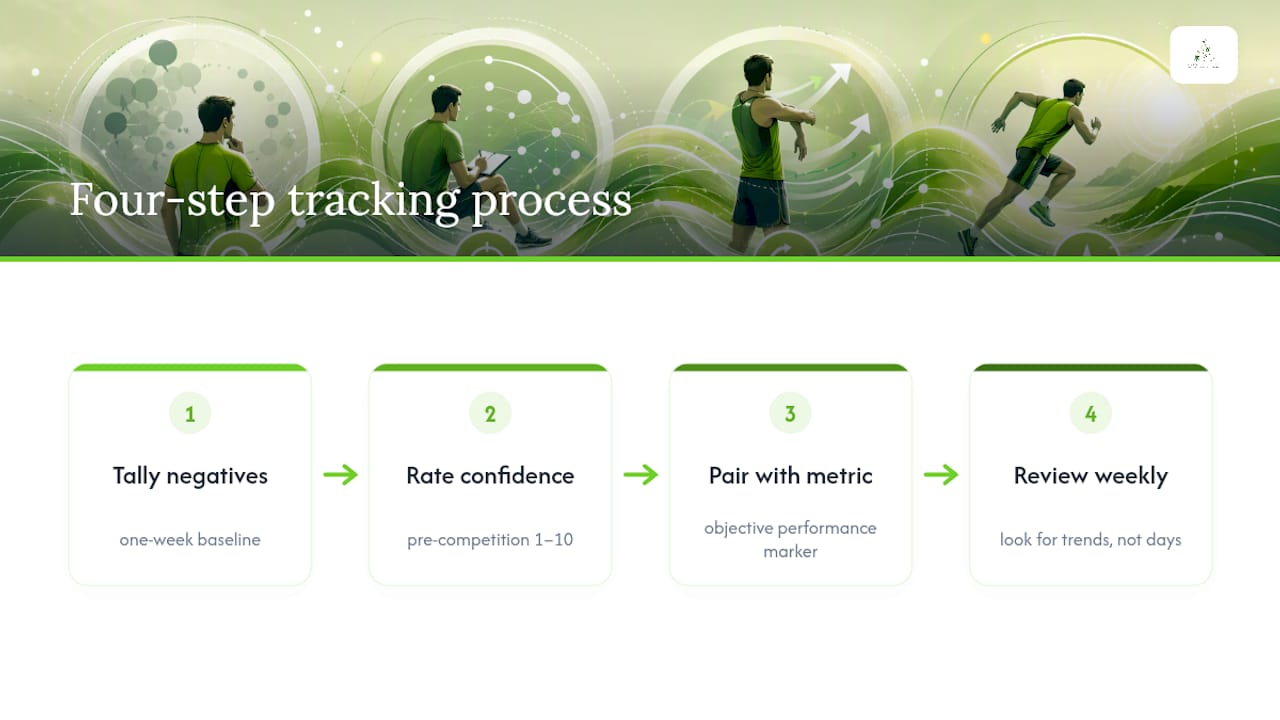
Track progress with something concrete: count negative thoughts per session, rate pre-competition confidence on a 1 to 10 scale, and log basic performance markers. Patterns show up in two to three weeks, not overnight.
When to Bring In Professional Support
Self-directed work handles most everyday negative self-talk. Some situations call for more structured help.
- Panic-level anxiety before competition that doesn't ease with breathing or bridge statements.
- Trauma responses tied to a specific injury, crash, or fall that resurface every time you approach that skill again.
- A performance plateau despite months of consistent, honest mental skills practice.
- Negative self-talk that has started bleeding into mood, sleep, or motivation outside of sport, a pattern Runner's World has reported as a signal worth taking seriously rather than pushing through.
Options at that point range from licensed sport psychology providers and CMPC-certified mental performance consultants to nervous-system-focused approaches like neurotraining, which work with the body's stress response directly rather than through cognitive talk alone.
A neuroscience-based neurotraining approach addresses the nervous system side using QEEG-informed assessment and a proprietary method called Alpha Imprinting, designed to help athletes clear stuck trauma or panic responses that verbal reframing alone hasn't resolved. This approach is offered as 1:1 sessions or a structured 10-week program, and it complements rather than replaces the cognitive techniques covered above. You can read more about how mental performance coaching fits alongside self-talk training.
Tracking Your Self-Talk Over Time
You cannot improve what you don't measure, and self-talk is easy to lose track of because most of it happens automatically. A simple frequency count works better than trying to judge whether you're "getting better" from memory. Tally negative thoughts during practice for one week without trying to change them, just observe. That baseline number matters more than any single good or bad session.
A 1 to 10 confidence rating taken right before competition, logged consistently, tends to reveal patterns athletes miss in the moment. A shooter might discover her confidence drops specifically before road games, not home games, which points to a location-specific trigger rather than a general confidence problem.
Pair the subjective ratings with objective performance markers where you can. A pitcher might track first-pitch strike percentage alongside a pre-inning confidence score. A gymnast might log fall rate on a specific apparatus against a self-talk tally from that event. When the numbers move together, that's the pattern worth addressing directly. When they don't, the negative self-talk might be a symptom of something else, fatigue, technical breakdown, poor sleep, rather than the root cause.
Review the log weekly, not daily. Daily review invites overreaction to single bad sessions. Weekly review shows the actual trend, and trends are what mental skills training is meant to change.
Cultural and Gender Patterns Worth Knowing
Negative self-talk doesn't show up identically across every athlete population, and assuming it does can lead to mismatched interventions. Athletes from cultures that emphasize collective harmony over individual achievement sometimes internalize failure as letting the team or family down, which produces a different flavor of self-criticism than the purely individual "I failed myself" pattern common in more individualist sport cultures. The content of the negative thought shifts even when the underlying mechanism, confidence dropping, anxiety rising, stays the same.
Gender differences show up less in whether athletes experience negative self-talk and more in how openly it gets discussed and addressed. Some research and applied practice suggests female athletes report negative self-talk related to body image and comparison more frequently, while male athletes more often report self-talk tied to competitiveness and status within the team hierarchy. Neither pattern is universal, and plenty of individual variation exists within any group.
What matters practically is this: a bridge statement or instructional cue that works for one athlete's specific triggers might miss the point entirely for another. A technique built around "trust your training" lands differently for an athlete whose self-doubt centers on belonging than for one whose self-doubt centers on a specific missed rep. Effective self-talk coaching adjusts the content of the replacement phrase to the actual source of the doubt, not just the general technique.
A Note on Consistency, Not Perfection
Small, repeatable experiments beat one dramatic mindset overhaul. Try one bridge statement for a week before adding another. Some will feel awkward at first and that's normal, not a sign you're doing it wrong.
Realistic expectations matter here. Athletes who've worked through this rarely describe an overnight switch, more a gradual shift where the old thought still shows up but loses its grip faster. Pair the verbal work with physical rehearsal under mild pressure, since a phrase you've only said in a quiet room rarely survives contact with real competition.
— Paige
How Performance Neuro Training Fits Into Your Mental Game
Bridge statements and instructional cues handle a lot of ground, but some athletes hit a wall that verbal reframing alone doesn't move. That is usually a nervous system issue, not a mindset issue, and it needs a different tool. Performance Neuro Training works directly with the nervous system rather than only the thoughts sitting on top of it.

The core offering includes one-on-one neurotraining built around Alpha Imprinting, a protocol designed to help clear stuck panic or trauma responses left over from an injury or a past high-stakes failure that keeps resurfacing no matter how many bridge statements you rehearse. Sessions can be conducted through telehealth, and there is a focused 10-week Energy Optimization Program or standalone sessions depending on individual needs. Group and training options are also available.
If your negative self-talk keeps circling back to the same injury, the same moment, or the same plateau despite consistent practice, the next step is worth taking. Check out the services overview to see how the process starts and what a first session looks like.
Sources
- Positive and negative spontaneous self-talk and performance in gymnastics: The role of contextual, personal and situational factors | PLOS One
- The Effects of Self-Talk on Shooting Athletes’ Motivation - PMC
- The Best Type of Self-Talk to Improve Your Performance — Nike
- Negative self-talk during sport performance: Relationships with pre-competition anxiety and goal-performance discrepancies