
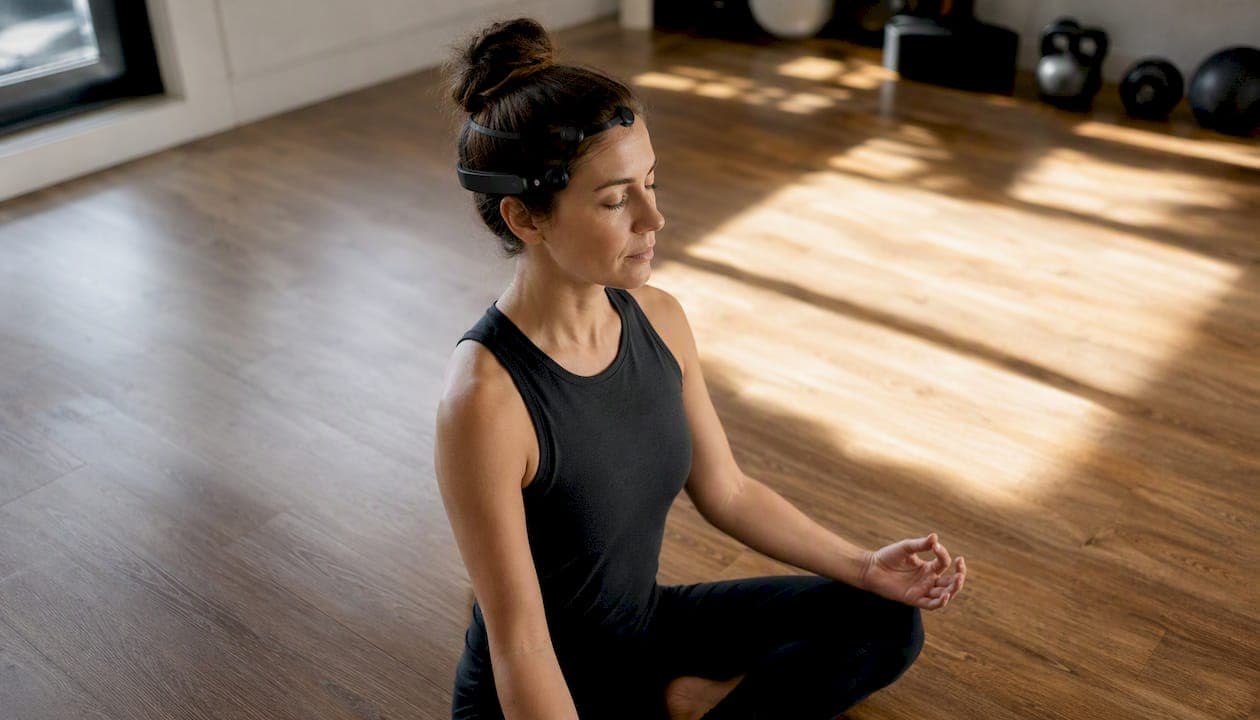
After a concussion, nervous system dysregulation is a chronic threat-mode state that produces anxiety, panic, and flow-block during competition, and the single best first step is an objective baseline assessment using QEEG and HRV to map your neural signatures before any retraining begins. Most athletes who struggle with post-concussion performance blocks are not mentally weak. Their nervous systems are stuck in a pattern that willpower alone cannot override.
- The brain's threat-detection circuitry stays overactive long after physical symptoms resolve.
- Resting alpha power drops, reducing the brain's ability to suppress distractions and access flow.
- HRV falls, signaling autonomic imbalance that biases every decision toward self-protection.
- Performance anxiety, avoidance, and inconsistent execution follow — not from lack of effort, but from a nervous system that has not been retrained.
Performance Neuro Training and its Alpha Imprinting protocol represent a research-aligned path from that assessment to measurable recovery. The rest of this guide explains the mechanism, the methods, and the steps to get there.
Key Takeaways
Nervous-system dysregulation after concussion is a trainable neural state, not a character flaw — and objective measurement with QEEG and HRV is the only reliable way to confirm it and track recovery.
| Point | Details |
|---|---|
| Dysregulation is measurable | Reduced resting alpha power and lower HRV are objective markers of post-concussion threat bias. |
| Alpha upregulation targets flow | Alpha NFT increased resting alpha power and improved motor-imagery performance in controlled samples. |
| Assess before you retrain | QEEG plus HRV at rest and under cognitive load gives the most actionable retraining roadmap. |
| Programs run 6–12 weeks | Effective protocols combine alpha or SMR neurofeedback, HRV biofeedback, and sport-specific transfer with objective retesting. |
| Robertsneurotraining's approach | Alpha Imprinting is a QEEG-guided, alpha-upregulation protocol with measurable endpoints, available via telehealth for athletes at all levels. |
Table of Contents
- How does nervous system dysregulation show up in athletes?
- Why does a concussion put your nervous system into threat mode?
- What retraining methods actually change the nervous system?
- How do you measure dysregulation and track real progress?
- What does a retraining program actually look like?
- A 6-step plan you can start before formal retraining
- When is this a medical question, not a retraining question?
- How to choose a retraining provider (and why Alpha Imprinting fits the criteria)
- What does the evidence actually say?
- Why nervous-system retraining is the right frame for post-concussion performance
- Performance Neuro Training: what the program includes and how to start
- Sources
How does nervous system dysregulation show up in athletes?
The symptoms are specific and often misread as confidence problems or poor preparation. Athletes report panic on contact — a sudden freeze or flinch response during routine plays that never triggered it before. The inability to access flow is almost universal: the automatic, effortless execution that defined peak performance feels locked behind a wall of hyperarousal.
Common performance symptoms include:
- Panic or startle response on contact or sudden movement
- Over-arousal during low-demand drills or warm-up
- Avoidance of specific situations (heading the ball, taking a hit, aggressive play)
- Inconsistent decision-making under mild pressure
- Inability to sustain focus or enter a flow state during competition
Coaches notice different signals. Breath-holding before contact, a rapid heart rate during light technical drills, and a heightened startle reflex are all observable without any equipment. These common mental performance issues after concussion are not attitude problems — they are autonomic signatures.
Pro Tip: Run a quick field screen: ask the athlete to breathe at a slow, controlled pace (5 seconds in, 5 seconds out) for 60 seconds, then check resting HR. If HR stays elevated or the athlete cannot sustain the rhythm, prioritize a formal HRV and QEEG assessment before returning to full-contact practice.
Why does a concussion put your nervous system into threat mode?
Dysregulation after concussion is a shift toward sympathetic dominance and reduced parasympathetic tone. The brain's threat-detection circuits, particularly the amygdala and anterior cingulate cortex, become hyperresponsive. The prefrontal cortex, which normally applies the brakes, loses influence. The result is a nervous system biased toward survival rather than performance.
This imbalance shows up in measurable signals:
- Reduced HRV: Lower heart rate variability reflects diminished vagal tone and reduced capacity to shift between arousal states. Elevated anxiety is associated with reduced HRV and sympathetic dominance, factors that directly impair athletic performance and recovery.
- Altered resting alpha power: EEG recordings show reduced posterior and frontal alpha-band activity, which correlates with impaired distractor suppression and reduced cognitive control.
- Disrupted fronto-parietal connectivity: Communication between attention-regulation and motor-planning networks becomes less efficient.
Alpha rhythms matter specifically because alpha-band upregulation supports distractor suppression and cognitive control, clearing task-irrelevant cortical noise so the athlete can process what matters. When alpha power is chronically low, the brain cannot filter effectively. Every stimulus competes for attention. That is why post-concussion athletes describe feeling overwhelmed by environments that never used to bother them. The alpha state's role in athletic peak performance is not abstract — it is the neurophysiological foundation of flow.
A systematic review linking post-concussion exercise intolerance to altered cardiovascular autonomic regulation confirms that autonomic dysfunction is a consistent finding after concussion, though direct mechanistic proof and standardized autonomic test batteries remain areas of active research.
What retraining methods actually change the nervous system?
Retraining methods work by changing how the brain and autonomic nervous system respond to perceived threat. The method you choose should follow measurement data and athlete-specific goals, not guesswork.
The main evidence-aligned options:
- Alpha Imprinting: A targeted alpha upregulation protocol that uses guided neural training to shift the brain out of chronic threat mode and toward the alpha-dominant state associated with flow and motor imagery. This is the core method used in Performance Neuro Training.
- QEEG-guided neurofeedback: Real-time EEG feedback trains specific brain regions to produce target frequencies. QEEG maps guide which sites and bands to train, replacing subjective guesses with objective neural data.
- Alpha NFT (neurofeedback training): A controlled study found alpha NFT increased resting alpha power and improved motor-imagery performance, with individual responsiveness varying between responders and non-responders.
- HRV biofeedback: Slow-paced breathing protocols train the autonomic nervous system to increase vagal tone and shift toward parasympathetic dominance. Combined with neurofeedback, applied protocols show measurable improvements in stress regulation and neurocognitive efficiency.
- Multimodal neural feedback (EEG + fNIRS + eye-tracking): Preliminary computational models suggest combined protocols can improve executive and tactical cognition, though empirical athlete-level validation is still limited.
Neurofeedback training is a non-invasive method that can teach athletes to regulate mental states, with small studies showing improvements in attention, working memory, and sport-specific mental skills. Evidence is preliminary and heterogeneous across studies, but the mechanistic rationale is solid.
Short alpha upregulation priming sessions may also accelerate neurofeedback learning by reducing task-irrelevant cortical activity before formal training begins — a design feature worth asking any provider about.
How do you measure dysregulation and track real progress?
Baseline QEEG combined with HRV and sport-specific performance tasks gives the most actionable roadmap. Without objective measures, you are managing symptoms by feel — which is exactly how dysregulated nervous systems mislead their owners.
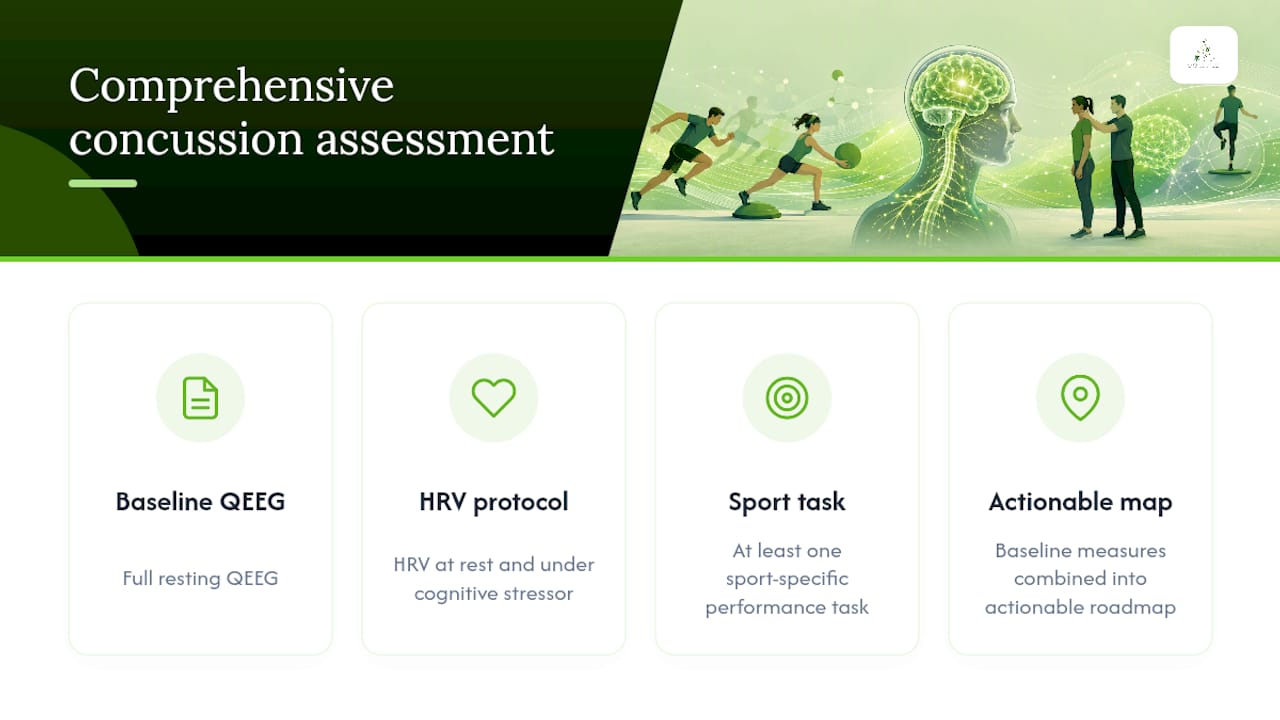
Dual-task HRV protocols reveal autonomic alterations in concussed athletes that resting measures alone can miss — meaning cognitive stressors during assessment are not optional extras.
Coaches arranging assessment should confirm the provider runs: a full resting QEEG, HRV at rest and under a cognitive stressor, and at least one sport-specific performance task. Anything less leaves gaps in the retraining map.
What does a retraining program actually look like?
Most effective programs combine assessment, focused neural training (alpha or SMR neurofeedback), HRV biofeedback, and practice transfer across 6–12 weeks with objective retesting at mid-point and completion.
- Weeks 1–2: Full QEEG and HRV baseline. Identify target sites, bands, and autonomic markers. Set performance benchmarks.
- Weeks 3–5: Alpha upregulation sessions (2–3 per week). Short HRV biofeedback protocols. Begin simplified imagery rehearsal tied to sport-specific scenarios.
- Weeks 6–8: Increase session complexity. Introduce dual-task and cognitive-stressor protocols. Mid-program retest: compare alpha power, HRV, and performance task scores to baseline.
- Weeks 9–12: Transfer training — apply regulated states to sport-specific drills. Final retest and outcome summary.
Realistic milestones include measurable HRV improvement, increased resting alpha power, fewer panic episodes during contact drills, and faster decision-making on sport-specific tasks. Individual variation is real: baseline EEG profile, sleep quality, and session engagement all predict how quickly someone responds. Athletes with severely disrupted sleep often need sleep and regulatory-system stabilization addressed concurrently for retraining to hold.
A 6-step plan you can start before formal retraining
Six steps you can begin today, before or while arranging a formal QEEG assessment:
-
Regulated breathing (10 minutes daily): 5 seconds in, 5 seconds out. This is the fastest way to shift autonomic tone without equipment.
-
Basic HRV check: Use a validated wearable (Polar H10, Garmin, Whoop) to establish a morning resting HRV baseline. Track it daily for two weeks.
-
Simplified imagery rehearsal: Spend 5 minutes visualizing one sport-specific scenario in a calm, controlled state. Keep it brief and positive.
-
Sleep optimization: Consistent sleep and wake times, no screens 60 minutes before bed. Sleep is when neural consolidation happens.
-
Graded exercise tolerance check: Begin with low-intensity aerobic activity (walking, easy cycling). If symptoms spike, stop and log it — this is data for your provider.
-
Schedule a QEEG baseline: Find a provider with documented QEEG experience and sports neuroscience background. Bring your HRV log and symptom notes.
Pro Tip: Before the formal assessment, run the 60-second regulated breathing test from the field screen above. If HR does not drop at least 5–8 beats per minute by the end of the minute, flag it for your provider — it suggests autonomic flexibility is already compromised and assessment should be prioritized.
For additional nervous system regulation techniques that complement formal retraining, practical self-regulation tools can help bridge the gap while you arrange assessment.
When is this a medical question, not a retraining question?
Most flow-block and anxiety after concussion benefit from nervous-system retraining. Medical evaluation is required when new or worsening neurological signs appear, or when physiological symptoms persist beyond what retraining can address.
Seek medical attention immediately if you notice: sudden worsening of headache, repeated vomiting, progressive balance loss, fainting or near-fainting during light activity, new visual disturbances, or any neurological decline. These are not retraining problems — they are medical emergencies.
Red flags that require a physician, not a performance coach:
- Headaches that worsen with any physical or cognitive activity
- Fainting or loss of consciousness after the initial injury
- Progressive balance or coordination loss
- Uncontrolled vomiting
- New or worsening vision or hearing changes
When you do see a provider, bring your HRV log, a written symptom timeline, and any performance task data you have collected. This speeds triage and helps a physician distinguish autonomic concerns from structural ones.
How to choose a retraining provider (and why Alpha Imprinting fits the criteria)
Choose providers who use objective baseline measures, publish measurable protocols, and set clear retesting milestones. Subjective assessment alone is not sufficient for a nervous system problem that shows up in EEG and HRV data.
Provider selection checklist:
- Conducts a full resting QEEG before any training begins
- Measures HRV at rest and under cognitive load
- Sets sport-specific performance benchmarks at intake
- Uses individualized training targets (not a one-size protocol)
- Retests at mid-program and post-program with the same metrics
- Has documented experience with athletes and sports neuroscience
- Offers telehealth capability for session continuity
Alpha Imprinting meets these criteria. The protocol is QEEG-guided, targets alpha-band upregulation with measurable endpoints, and is designed specifically for athletes recovering performance after concussion or trauma. Olympic medalists and professional athletes have used Performance Neuro Training to document measurable performance gains. Telehealth delivery means geography is not a barrier.
What does the evidence actually say?
The strongest signal in the literature connects autonomic imbalance, reduced HRV, and performance anxiety — and preliminary trials show alpha neurofeedback and combined approaches can shift those markers.
Key findings:
- Reduced HRV and sympathetic dominance are consistently associated with elevated performance anxiety in athletes, with direct implications for recovery and peak output.
- A systematic review of neurofeedback in football found preliminary cognitive and psychophysiological benefits, though small samples and heterogeneous protocols limit definitive conclusions.
- Alpha NFT increased resting alpha power and improved motor-imagery performance in a controlled sample, with responders gaining more than non-responders.
- Eye-tracking combined with neurofeedback improved decision-making and technical skills in a youth football sample, suggesting combined approaches have applied value.
- Multimodal neural feedback models predict gains in executive and tactical cognition, with empirical validation ongoing.
Two patterns emerge consistently from applied work: athletes who complete QEEG-guided programs with objective retesting show measurable changes in resting alpha power and HRV, and those changes correlate with reduced panic episodes and improved sport-specific decision metrics. The evidence base is preliminary, not definitive — but the mechanistic rationale and early outcomes are strong enough to justify structured retraining over waiting.
Why nervous-system retraining is the right frame for post-concussion performance
Most athletes who come to me after a concussion have already done everything right on the physical side. They have cleared return-to-play protocols. Their imaging is clean. Their coaches say they look fine. But they cannot find flow. They flinch. They second-guess decisions they used to make automatically.
The reason is straightforward: physical recovery and neural recovery are not the same thing. A nervous system that learned threat during a concussion will keep running that program until something specifically targets and changes it. Talk therapy helps with the story around the experience. Repetition builds physical conditioning. Neither one directly retunes the autonomic and cortical patterns that produce panic and flow-block.
That is why the focus at Robertsneurotraining is on objective measurement first, targeted neural training second, and measurable retesting throughout. Alpha power, HRV, and sport-specific performance tasks are not abstract metrics — they are the athlete's nervous system, made visible. When those numbers move, performance follows.
Performance Neuro Training: what the program includes and how to start
Athletes dealing with post-concussion anxiety, panic, and flow-block get a structured, measurement-driven path back to peak performance through Performance Neuro Training.
The program begins with a QEEG brain scan and HRV baseline, establishing the exact neural and autonomic signatures driving your performance blocks. From there, Alpha Imprinting sessions target alpha-band upregulation through a protocol built specifically for competitive athletes — not a generic wellness approach. Sessions are available via telehealth, so location is not a constraint. Retesting at mid-program and program completion gives you a concrete before-and-after neural map.
Athletes across professional leagues, Olympic programs, and high-performance amateur sport have used this program to document measurable gains in HRV, resting alpha power, and on-field decision metrics. The concussion recovery program page outlines logistics and booking. If you are ready to stop managing symptoms and start retraining the system, that is the next step.
Sources
- A Review of Neurofeedback Training for Improving Sport Performance From the Perspective of User Experience (Frontiers in Neuroscience, 2021)
- Alpha-band NFT improves MI-BCI performance (PMC article)