
Expect to pay $300 to $2,000 for a single qEEG brain map in the United States, with most clinics landing somewhere between $600 and $1,400 for a fully interpreted report. A full neurofeedback course, if your provider recommends one, typically runs $2,000 to $8,000 total once you add up 20 to 40 sessions at $100 to $300 each. Insurance sometimes helps if a neurologist orders the EEG for a documented condition like epilepsy, but if you're pursuing a qEEG for ADHD, anxiety, or athletic performance, budget to pay cash. Most plans still classify those uses as investigational.
Here's the quick breakdown before you call a clinic:
- Single qEEG assessment: $300 to $2,000, depending on report depth and who interprets it
- Neurofeedback, per session: $100 to $300, with sessions running 30 to 50 minutes
- Full course total: commonly $2,000 to $8,000 across 20 to 40 sessions
- Insurance: more likely for epilepsy or presurgical mapping, unlikely for ADHD or performance work
Quick fact: One clinic's published pricing lists a full qEEG/brain mapping package at $1,200, with add-on neurofeedback sessions priced at $175 each, giving you a real anchor point for what a mid-tier quote looks like (Baker Neuropsychology).
Key Takeaways
A qEEG in the U.S. commonly costs $300 to $2,000 upfront, with most patients paying cash unless a neurologist documents a clear medical necessity.
| Point | Details |
|---|---|
| Typical qEEG price | Expect $300 to $2,000, with most clinics quoting $600 to $1,400 for an interpreted report. |
| Neurofeedback course total | Budget $2,000 to $8,000 for 20 to 40 sessions at $100 to $300 each. |
| Insurance reality | Coverage is more likely for epilepsy or presurgical use; ADHD and performance uses are usually cash-pay. |
| Get it in writing | Request an itemized quote confirming clinician interpretation before you book. |
| Athlete-specific approach | Roberts Neurotraining uses qEEG only when it directly informs a performance or concussion training plan. |
This article is general information, not a substitute for advice from a qualified doctor. Consult a qualified healthcare professional about your own circumstances before acting on anything here.
Table of Contents
- qEEG Cost Bands: What Low, Mid, and High Price Actually Buy
- What Happens During a qEEG Appointment (And What Costs Extra)
- Neurofeedback Session Pricing and What a Full Course Actually Costs
- Does Insurance Cover qEEG Testing?
- How Clinics Set Their Prices (And How to Get a Fair Quote)
- When a qEEG Actually Earns Its Price Tag
- Navigating an Insurance Claim for a qEEG, Step by Step
- Investing in a Brain Map When You're an Athlete
- Get a QEEG-Guided Training Plan, Not Just a Brain Map
- Sources
qEEG Cost Bands: What Low, Mid, and High Price Actually Buy
Not all qEEG quotes are the same product wearing different price tags. The band you land in tells you a lot about what's included before you even ask a question.
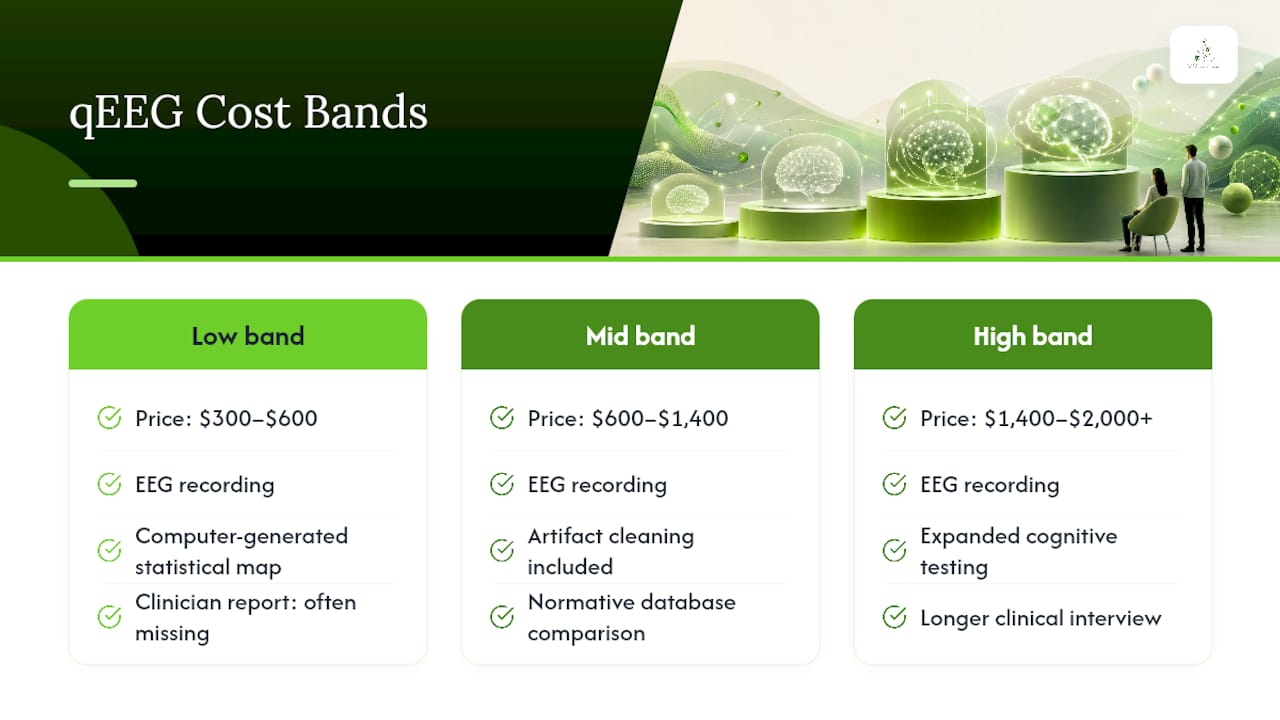
Low band ($300–$600). These packages usually cover the EEG recording itself and a computer-generated statistical map. What's often missing is a licensed clinician sitting down and writing a narrative interpretation tied to your specific concern. You get data, not necessarily a plan.
Mid band ($600–$1,400). This is where most people land, and it's where clinics like Foundation Medical Group report the bulk of their pricing sits. You're typically getting the recording, artifact cleaning, a normative database comparison, and a written report from a clinician who reviewed the actual data rather than just signing off on software output.
High band ($1,400–$2,000+). Expect expanded cognitive testing, a longer clinical interview, or a more detailed report meant to support insurance appeals or return-to-play decisions. Baker Neuropsychology's higher tier, for example, sits around $2,000 once extra testing is bundled in.
Factors affecting price differences include location-based overhead, the level of clinician interpreting the qEEG (licensed neuropsychologist or technician), and variation in payer-negotiated rates for billing codes across states, which contribute to wide price variability (The Summit Wellness Group).
Always ask for an itemized quote before you book. A number without a breakdown tells you nothing about which band you're actually paying for.
What Happens During a qEEG Appointment (And What Costs Extra)
A qEEG visit isn't just "get wired up and wait." It's a sequence of distinct steps, and knowing them helps you spot which parts of a quote are standard and which are add-ons padding the bill.
- Clinical interview (15 to 30 minutes). The clinician asks about your history, symptoms, or performance concerns before recording anything.
- EEG acquisition (20 to 40 minutes). You wear a cap with sensors while sitting quietly, eyes open and closed, sometimes during a simple task.
- Artifact cleaning (done after your visit). Technicians strip out noise from muscle movement, eye blinks, and electrical interference before analysis.
- qEEG analysis and normative comparison. Software compares your brain activity to age-matched databases to flag statistical outliers.
- Clinical interpretation and written summary. A licensed provider reviews the raw output and writes findings tied to your actual concern, not just a printout of colored brain maps.
- Optional neurofeedback demo. Some clinics use the visit to show you a live sample session, occasionally at added cost.
Common add-ons that increase the base fee include detailed cognitive or neuropsychological testing batteries, third-party report writing for legal or medical documentation, and repeat mapping to track progress over time. Repeat maps done every few months for ongoing neurofeedback tracking can meaningfully raise your total spend across a program, according to clinic guidance from the Los Angeles Neurofeedback Center.
Pro Tip: Ask directly whether a licensed clinician interprets your report, or whether you're paying for a computer-generated map with no clinical read attached. That single question separates a $400 printout from a $1,200 diagnostic tool.
Neurofeedback Session Pricing and What a Full Course Actually Costs
A single neurofeedback session typically costs $100 to $300 and lasts 30 to 50 minutes. The real budgeting question isn't the per-session price. It's how many sessions your provider recommends, since most programs run 20 to 40 sessions before you see durable change.
Here's what that looks like in dollars once you multiply it out:
| Course Size | Per-Session Rate | Estimated Total |
|---|---|---|
| 20 sessions (low end) | $100 | $2,000 |
| 30 sessions (mid range) | $175 | $6,000 |
| 40 sessions (high end) | $175 | $12,000 |
Those totals don't include the initial qEEG map that usually kicks off the program, so add your assessment fee on top. A published example from Baker Neuropsychology prices additional neurofeedback sessions at $175 each, which lands right in the middle of that table and matches what most patients report paying nationally.
A few things push the total higher than the sticker price suggests:
- Follow-up qEEG maps to track progress typically cost the same as the original assessment, and clinics often recommend one every few months
- Booster sessions after a program ends are usually billed at the standard per-session rate, not a discounted maintenance rate
- Bundled packages sometimes lower the effective per-session cost by 10 to 20 percent if you commit upfront
Ask any clinic to show you the math on a full course, not just the price of session one. A quote that only mentions the entry fee is hiding the number that actually matters.
Does Insurance Cover qEEG Testing?
Coverage depends almost entirely on why you're getting the test, not where you get it. Insurers generally accept EEG and qEEG for clear neurologic indications like epilepsy workups or presurgical planning. The ACNS has issued guidance supporting qEEG in those contexts while stopping short of endorsing it for psychiatric diagnosis.
That last part matters if you're seeking a qEEG for ADHD, anxiety, or athletic performance. Most private payers and Medicaid programs still label those uses investigational, which usually means a denial unless your physician can document a separate, qualifying medical necessity.
Before you assume you're covered, work through this:
- Call your insurer and ask specifically about CPT codes 95816 (routine EEG) and the digital analysis codes tied to qEEG interpretation
- Ask whether prior authorization is required, and get that authorization in writing before your appointment
- Request a medical necessity letter from your ordering physician if your case involves anything beyond a straightforward neurologic diagnosis
- Check your state's specific Medicaid coverage policy, since qEEG rules vary significantly by state
- Ask the clinic's billing office to run a benefits check and hand you a written estimate before you book
Cash-pay is common enough for ADHD and performance-related qEEG that most clinics have a standard self-pay rate ready to quote you on the spot.
How Clinics Set Their Prices (And How to Get a Fair Quote)
Every dollar in a qEEG quote traces back to a handful of cost drivers. Equipment quality and normative database licensing costs money, and that gets passed to you. Report depth matters too: a two-page computer printout costs less to produce than a ten-page clinician-written interpretation with treatment recommendations. Who reads your data, a technician versus a licensed neuropsychologist, changes the price. So does your zip code, since rent and staffing costs in a major metro push fees higher than in a smaller market.
Before you commit, ask every clinic the same set of questions so you're comparing apples to apples:
- Does the price include clinician interpretation, or just the raw map?
- Is a written summary with specific recommendations included, or billed separately?
- What's the cost of a follow-up map if you need one in three to six months?
- Are neurofeedback sessions bundled at a lower rate if purchased in a package?
- Does the clinic offer payment plans or a sliding scale for cash-pay patients?
A few tactics genuinely lower your out-of-pocket cost, including bundling services as seen in transparent pricing and membership bundles. Ask about bundled packages that combine the initial qEEG with a set number of neurofeedback sessions. Ask if a payment plan spreads the cost over several months without interest. Community mental health clinics sometimes offer sliding-scale qEEG services tied to income. And it never hurts to simply ask for a cash discount, since many practices quietly offer one to avoid insurance billing overhead.
Pro Tip: Get every quote in writing, itemized by component. Verbal estimates have a way of growing once billing codes get involved.
When a qEEG Actually Earns Its Price Tag
qEEG converts raw brainwave data into statistical maps, but the maps themselves don't diagnose anything. A 2020 review notes that clinical utility remains genuinely debated in the research community, and that's exactly why so many payers treat psychiatric and performance-related uses as investigational rather than standard care.
The value of a qEEG depends almost entirely on interpretation quality. A map without a qualified clinician reading it and connecting findings to a treatment plan is data without direction, not a diagnosis.
That framing comes straight from a 2026 review in Frontiers, which describes qEEG as an adjunct tool, useful alongside clinical judgment but never a replacement for full neuropsychological evaluation.
What separates a qEEG worth paying for from one that isn't:
- Artifact cleaning done properly before analysis, not skipped to save time
- Comparison against an established normative database, not an in-house benchmark nobody can verify
- A written interpretation from a licensed provider tied to your actual symptoms or performance concern
- A clear next step: what changes in your training or treatment plan because of what the map shows
Services missing these steps often cost less upfront and deliver less you can actually act on.
Navigating an Insurance Claim for a qEEG, Step by Step
Getting a qEEG claim approved takes more legwork than a routine doctor's visit, and skipping a step is usually what turns into a surprise bill.
Start before you ever schedule the test. Call your insurer's member services line and ask specifically whether CPT code 95816 (routine EEG) or the digital qEEG analysis codes require prior authorization. Many plans do, and booking without it is the single most common reason claims get denied outright.
Next, get your ordering physician involved early. If your qEEG relates to anything beyond a clear-cut neurologic diagnosis, ask for a written medical necessity letter that documents your symptoms, prior treatments tried, and why a qEEG is the appropriate next step. This document matters far more than any billing code when a claim gets reviewed.
Once your claim is submitted, track it. Insurers typically respond within 15 to 30 days, and a denial isn't necessarily final. If you're denied, request the specific denial reason in writing, then file an appeal that directly addresses that reason, ideally with your physician's support letter attached. Most insurers allow at least one internal appeal, and some states require an external review option after that.
Throughout this process, ask the clinic's billing department to run a benefits check on your behalf before your appointment. A five-minute call from their office can save you weeks of chasing a denied claim after the fact.
Investing in a Brain Map When You're an Athlete
A qEEG earns its cost when it changes what you actually do next, not when it just produces an interesting printout. If you're managing a concussion return-to-play decision, hit an unexplained performance plateau, or need targeted data to build a specific training protocol, the map is worth the spend. If you're mapping just to see what's there, the money is better spent elsewhere.
We only use qEEG data at Roberts Neurotraining when it directly shapes a training decision, not as a routine add-on to every intake. If you're weighing the cost, budget for the map alongside at least a few weeks of follow-up work, since a scan with no plan attached to it is money spent on curiosity, not performance.
— Paige
Get a QEEG-Guided Training Plan, Not Just a Brain Map
Most qEEG providers hand you a report and send you on your way. Roberts Neurotraining is different: your qEEG brain scan is read by a clinician and folded directly into a training plan built around your specific performance block, whether that's a concussion recovery, a competition slump, or a stress response that keeps showing up under pressure.
Every engagement includes the brain scan, a clinician-led interpretation session, and a clear path into our neurotraining work if the data points toward it, so you're never paying for a map that goes nowhere. Sessions run over telehealth, which keeps you out of a waiting room and into the actual work faster. If you want to know exactly what a program built around your results would look like and cost, review our process and request a written quote before you commit to anything.
Sources
- Quantitative EEG review (PMC)
- Frontiers 2026 — qEEG clinical utility
- Foundation Medical Group — qEEG brain mapping cost and insurance
- Baker Neuropsychology — Service Costs
- ACNS QEEG statement