
The best alternatives to elitepsychologygroup.com for competitive athletes are neuroscience-based performance programs that combine QEEG baseline brain scans, neurofeedback, HRV biofeedback, and integrated recovery protocols. Robertsneurotraining, led by Dr. Paige Roberts, is the recommended direct alternative, using the proprietary Alpha Imprinting method and QEEG-guided protocols across 1:1, cohort, and team formats.
If you are a competitive athlete or performance staff member, the three indicators that a program is worth your time are simple: it measures your nervous system objectively before and after, it tracks reaction time and accuracy in the field, and it coordinates with your existing coaches and support staff. Programs that skip any of those three steps are working on guesswork.
- Best-fit program types: QEEG-guided 1:1 coaching, integrated recovery cohorts, and team workshop formats
- Key metrics to expect: reaction time, accuracy, decisional clarity, HRV recovery markers
- Recommended starting point: Robertsneurotraining's discovery session and QEEG baseline scan
Table of Contents
- What do your neuroscience-based program alternatives actually look like?
- How do you evaluate alternatives and spot the ones worth your time?
- What does a credible neuroscience-based sports program actually include?
- Why is Performance Neuro Training the recommended direct alternative?
- How do you integrate neurotraining into an existing athlete schedule?
- What should you budget and how long does it take?
- Key Takeaways
- The gap between what neurotraining promises and what actually matters
- Ready to start with Performance Neuro Training?
- Selected sources and further reading
What do your neuroscience-based program alternatives actually look like?
| Program Type | Best For | Delivery | Assessment | Evidence & Tracking | Team Integration | Duration | Pricing Model | Expected Outcomes |
|---|---|---|---|---|---|---|---|---|
| QEEG-guided 1:1 coaching | Elite individual athletes | In-person / telehealth | QEEG baseline + session neurometrics | Objective (EEG, HRV) | Optional staff coordination | 8–12 weeks | Per-session or package | Reaction time, accuracy, flow state |
| Remote cohort program | Teams, multi-athlete groups | Telehealth / async | Questionnaire + optional QEEG | Mixed | Group check-ins | 10 weeks | Per-athlete cohort rate | Cognitive readiness, recovery speed |
| On-site team workshop | Coaching staff + full roster | Onsite | Questionnaire or brief EEG | Limited | Built-in | 1–3 days | Day rate | Awareness, shared protocols |
| Post-concussion recovery | Return-to-play athletes | 1:1 in-person | QEEG required | Objective (QEEG, IVA) | Mandatory staff loop | 6–12 weeks | Package | Symptom resolution, cognitive return |
| In-home device program | Maintenance / off-season | Self-directed + remote check-ins | Baseline scan at start | Device-tracked | Minimal | Ongoing | Device + subscription | HRV recovery, sleep, focus |
Quick read on each format:
- QEEG-guided 1:1 coaching delivers the most precise outcomes but requires the most scheduling commitment.
- Remote cohort programs lower per-athlete cost significantly, though objective tracking depth varies by provider.
- On-site workshops build shared language across a coaching staff but rarely produce individual neurometric data.
- Post-concussion programs must include QEEG. Any provider skipping that baseline for return-to-play work is a red flag.
- In-home devices work best as a maintenance layer, not a primary intervention.
Red flags at a glance: no objective baseline assessment, outcomes measured only by self-report, no coordination with team staff, vague protocol descriptions with no published parameters.
How do you evaluate alternatives and spot the ones worth your time?
Choose providers that use objective baseline measures, publish their protocol parameters, and track neurometrics session by session. That standard, which leading researchers now call standardized precision, is the clearest dividing line between programs with reproducible results and those running isolated experiments.
Hard criteria to apply:
- QEEG baseline scan available before training begins
- Session-by-session neurometric tracking (not just pre/post)
- Credentialed practitioner with published or verifiable protocol parameters
- Integration pathway with your S&C coach, physiotherapist, or team staff
- Validated sham or blinding practices for neurofeedback claims, given that scoping reviews have found limited blinding and low use of inert sham controls across many published studies
- Transparent data reporting you can share with your performance team
Questions to ask any provider before signing:
- What does your baseline assessment include, and can I see a sample neurometric report?
- Which frequency bands do you train, and why for my sport?
- How do you coordinate with my coaching staff or physio?
- What does a typical 8-week timeline look like, session by session?
- How do you measure field transfer, not just lab improvement?
Red flags: outcomes described only in subjective terms ("athletes feel more focused"), no mention of a baseline scan, inability to name the specific protocols used, no staff coordination process.
Pro Tip: Ask any prospective provider to share a de-identified sample report showing pre/post reaction-time or HRV changes. A credible program produces this without hesitation. If the response is vague, that tells you everything.
What does a credible neuroscience-based sports program actually include?
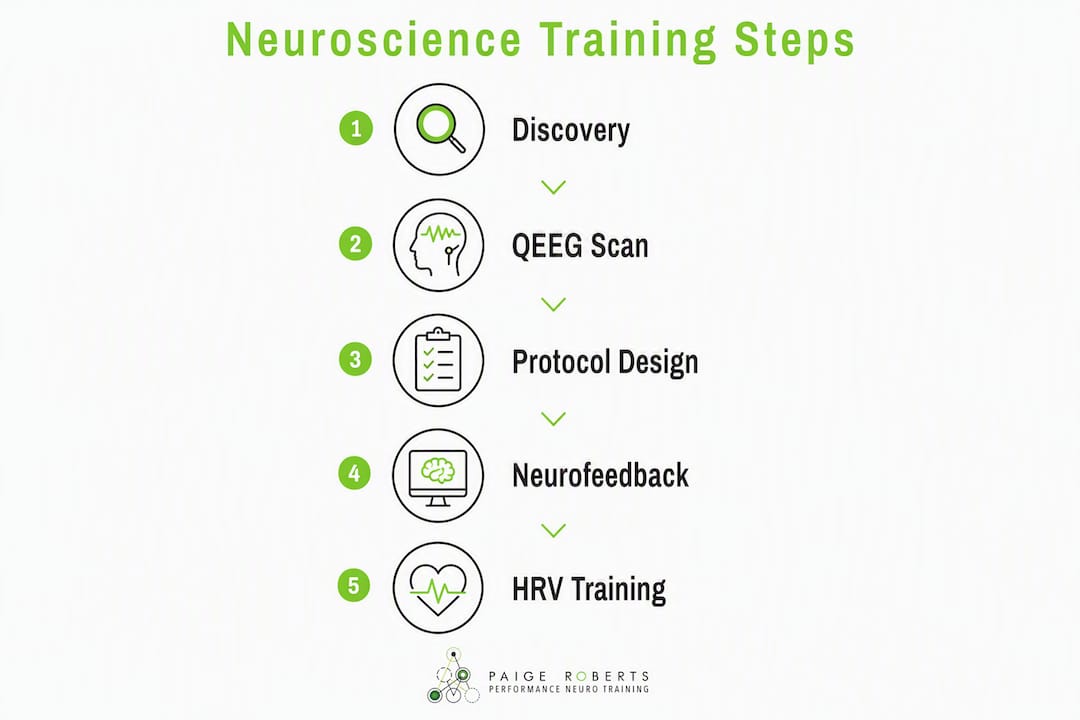
Credible programs combine a QEEG discovery phase, individualized protocol design, iterative neurofeedback and HRV training, and measurable field transfer tests. The sequence matters as much as the components.
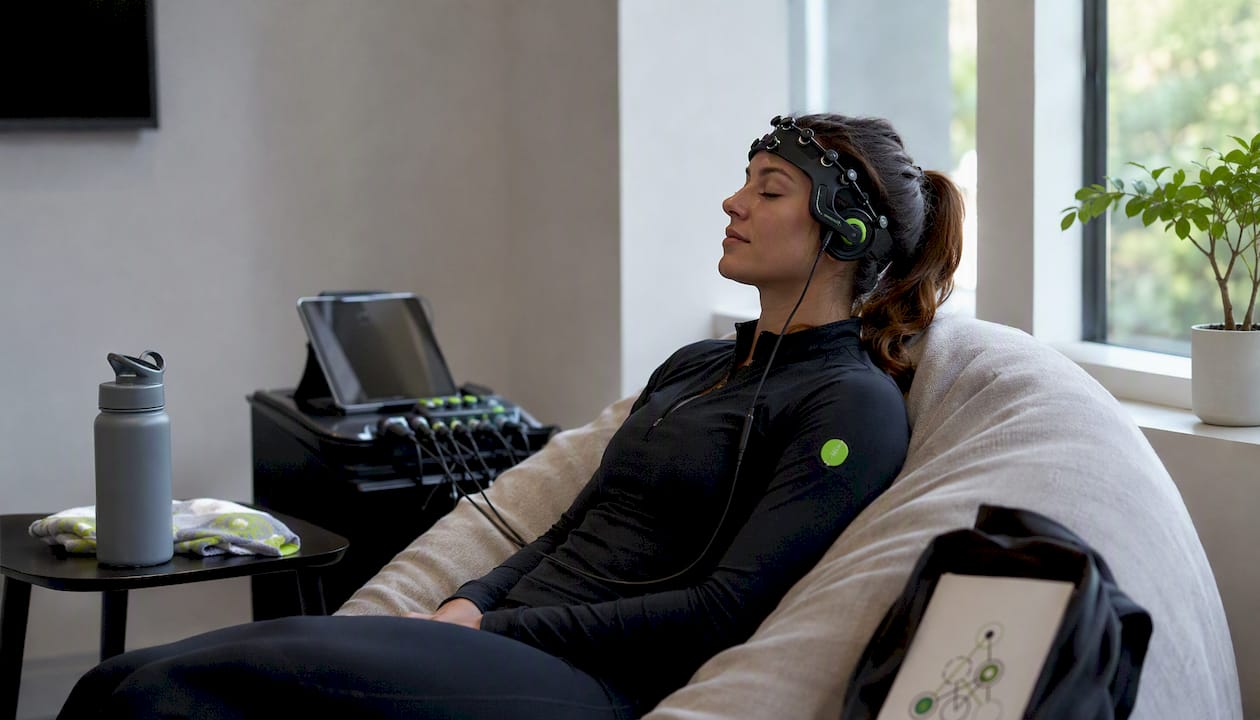
A typical timeline runs: discovery session and intake (week 1), QEEG baseline scan and reporting (week 1–2), targeted training block with session-by-session neurometric tracking (weeks 2–10), field integration checks (mid-program), and follow-up QEEG at program close or 3–6 months post-completion.
The three mandatory pillars, as described across systematic reviews of neurofeedback protocols in sports, are cognitive readiness, physiological recovery, and technical precision. Each maps to specific neurometrics:
| Neurometric | Training Target | Performance Outcome |
|---|---|---|
| SMR increase | Fine-motor stability | Improved accuracy (shooting, golf, tennis) |
| HRV RMSSD increase | Autonomic recovery | Faster post-exertion recovery, sustained flow |
| High Beta reduction | Cognitive overload / anxiety | Reduced freeze response, cleaner decisions |
| Alpha coherence | Attentional regulation | Visuospatial precision, calm focus |
A randomized longitudinal study of professional athletes using an integrated five-component neurorecovery protocol reported Improvements in RMSSD, reductions in High Beta, and gains in SMR power were observed, alongside reductions in cognitive fatigue and improved decisional clarity within 24–36 hours of application.
Typical measurable outcomes to expect:
- Reaction time improvements, often measurable within 4–8 sessions
- Accuracy gains in sport-specific technical tasks
- Reduced cognitive fatigue in late-game or high-pressure situations
- Faster autonomic recovery between training blocks
Neuroscience-based training for athletes works precisely because it targets the nervous system's role in all three pillars simultaneously, rather than treating cognition and recovery as separate tracks.
Why is Performance Neuro Training the recommended direct alternative?
Robertsneurotraining stands out because it combines QEEG baseline scans, the proprietary Alpha Imprinting method, integrated recovery modalities, and session-by-session neurometric tracking across every delivery format it offers.
Client offerings:
- 1:1 Performance Neuro Training (in-person and telehealth)
- Alpha Imprinting protocol for nervous system reprogramming
- 10-week Energy Optimization Program
- Team workshops and cohort programs
- Telehealth sessions and in-home light and audio-visual devices
- Concussion and performance recovery programs
Alpha Imprinting is the core differentiator. It targets the nervous system patterns underlying mental blocks, performance anxiety, panic responses, and trauma-linked freeze states that standard sports psychology tools do not reach at the neurophysiological level. Athletes who have hit a ceiling despite solid physical conditioning often find the ceiling is neurological, not physical.
Dr. Paige Roberts leads the program. Trust signals include QEEG-guided assessment, standardized protocols with reproducible parameters, and tracked performance metrics that can be shared with a full performance staff.
Who each format serves best:
- Elite individual athletes: 1:1 coaching with full QEEG baseline and Alpha Imprinting
- Teams and coaching staff: workshops and cohort programs with group neurometric benchmarks
- Return-to-play athletes: post-concussion recovery using QEEG-guided neurofeedback, supported by published case evidence showing normalization of QEEG profiles after targeted sessions
How do you integrate neurotraining into an existing athlete schedule?
Neurotraining works best as a complementary microcycle activity scheduled inside recovery windows, not stacked on top of peak training load. The goal is to train the nervous system when it can absorb and consolidate, not when it is already depleted.
Scheduling checklist:
- Schedule sessions 24–48 hours after high-intensity competition or heavy training days
- Avoid same-day neurotraining and maximal physical output
- During travel weeks, use telehealth or in-home device protocols to maintain continuity
- Build a 10-week block around the season's natural load trough, not its peak
- Flag match days and travel windows to your provider before the program starts
Staff coordination steps:
- Assign one point of contact (S&C coach or physio) to receive neurometric reports
- Share HRV and reaction-time data with the full performance team at monthly intervals
- Set clear return-to-play neurometric thresholds in writing before a concussion protocol begins
- Align neurotraining session goals with the week's tactical and physical priorities
Team performance neuroscience works best when the neurotraining provider is treated as part of the performance staff, not a separate vendor. Providers who resist staff data-sharing are worth questioning.
Pro Tip: Run a short reaction-time drill (a simple light-board or app-based test takes under three minutes) on the same day as a neurotraining session and again 48 hours later. That field check confirms whether lab neurometric gains are transferring to sport-specific speed.
What should you budget and how long does it take?
Expect an initial discovery and baseline phase of one to two sessions plus a QEEG scan, followed by an intensive training block of 4–10 weeks, and maintenance or follow-up scans at 3–6 months.
Typical U.S. pricing signals:
- Individual QEEG baseline assessment: ranges from a few hundred to over a thousand dollars depending on provider and report depth
- Per-session 1:1 coaching: generally higher per-session cost, offset by faster individual progress
- Packaged 8–12 week programs: bundled pricing lowers per-session cost and typically includes baseline and follow-up scans
- Team workshop day rates: priced per day or per athlete, making cohort formats the most cost-efficient per-athlete option
- In-home device add-ons: one-time hardware cost plus optional subscription for remote protocol support
Neurometric or performance improvements are typically measurable within several sessions. Field transfer, where lab gains show up in competition performance, tends to consolidate over time. Elite athletes often see subtler but more durable cognitive gains than novices, as sport-specific neurofeedback research consistently shows.
Pricing varies most by delivery format. One-on-one programs carry the highest per-session cost. Cohort and remote formats reduce per-athlete spend substantially, making them practical for teams managing multiple athletes simultaneously.
Key Takeaways
The single most important step when evaluating neuroscience-based performance alternatives is to require a QEEG baseline scan and session-by-session neurometric tracking before committing to any program.
| Point | Details |
|---|---|
| Require objective assessment | Ask every provider for a QEEG baseline scan and a sample pre/post neurometric report before signing. |
| Match format to athlete need | Use 1:1 coaching for elite individuals, cohort programs for teams, and QEEG-guided protocols for post-concussion return-to-play. |
| Integrate with existing staff | Assign one staff point of contact for neurometric data and align session scheduling to recovery windows, not peak load days. |
| Expect measurable results by week 8 | Neurometric improvements are typically trackable within 4–8 sessions; field transfer consolidates in the program's second month. |
| Robertsneurotraining | Offers QEEG baseline scans, Alpha Imprinting, the 10-week Energy Optimization Program, and team formats with tracked neurometric outcomes. |
The gap between what neurotraining promises and what actually matters
Most athletes who come to neurotraining arrive after trying everything else. They have the physical conditioning, the tactical preparation, the sports psychology workbooks. What they have not addressed is the nervous system pattern that fires before the conscious mind can intervene: the freeze before a penalty kick, the accuracy drop under crowd noise, the decision hesitation that costs a tenth of a second.
The conventional wisdom in performance psychology still treats these as mental habits to be talked through. The neuroscience says otherwise. These are trained neurological responses, and they respond to neurological retraining, not conversation. That is the premise behind Alpha Imprinting, and it is why programs built on objective neurometrics rather than self-report produce outcomes that hold under competition pressure.
What practitioners underestimate is the staff integration piece. A program that runs in isolation from the S&C coach and physiotherapist will produce measurable lab gains that quietly disappear when the athlete returns to full training load. The research on integrated recovery models is clear on this: neurotech works as systematic support for physical and tactical training, not as a standalone intervention. The programs worth recommending are the ones that insist on that coordination from day one.
Ready to start with Performance Neuro Training?
If you want a QEEG-driven alternative with tracked outcomes and a protocol built around your sport and schedule, the clearest next step is a discovery session with Robertsneurotraining. Unlike general performance coaching or questionnaire-only programs, the process starts with objective data about your nervous system, not a self-assessment form.
Here is what the onboarding looks like:
- Schedule your discovery call via the Roberts Neurotraining process page
- Complete your QEEG baseline scan and intake so Dr. Paige Roberts can map your neurological starting point
- Review your individualized plan, including session format, frequency, and staff coordination steps
- Begin your training block, with neurometric tracking from session one
Bring recent performance data, your competition and travel schedule, and your key staff contact's information to the first call. Onboarding from discovery to first training session typically takes one to two weeks. To learn more about the core method, the Alpha Imprinting page explains the protocol in detail.
Selected sources and further reading
- Effects of real-time EEG neurofeedback training on cognitive, mental, and motor performance in elite athletes: a systematic review and meta-analysis — Reports a pooled SMD of 1.26 for attention, motor control, and anxiety regulation; the call for standardized protocols is the key practitioner takeaway.
- Neurofeedback Training Protocols in Sports: A Systematic Review of Recent Advances — Maps specific frequency band protocols (SMR, beta, alpha) to sport-specific outcomes; essential for understanding why protocol choice matters.
- NEURORECOVERY ELITE: Accelerating Autonomic and Cerebral Post Exertion Recovery — Randomized longitudinal study documenting objective HRV and EEG improvements in professional athletes using an integrated five-component protocol.
- EEG-Based Neurofeedback in Athletes and Non-Athletes: A Scoping Review — Identifies methodological gaps (limited blinding, no sham controls) that practitioners should ask providers about directly.
- A Review of Neurofeedback Training for Improving Sport Performance From the Perspective of User Experience — Proposes athlete-facing classification of neurofeedback schemes (attention-focusing, relaxation, monitoring-guided) that helps coaches match program type to athlete need.
- The Effects of QEEG-Guided Neurofeedback on Postconcussion Syndrome — Case report documenting QEEG normalization and symptom resolution after 22 sessions of QEEG-guided neurofeedback in a concussed athlete; directly relevant to return-to-play protocols.
- Neurofeedback Training Protocols in Sports: A Systematic Review — Describes the three-pillar framework (cognitive readiness, physiological recovery, technical precision) that credible programs are built around.