
Yes, with a real caveat: audio-visual (AV) neuromodulation, specifically the light-based sessions used inside multimodal nervous-system reprogramming, can measurably reduce performance anxiety and help restore flow, but only as part of a structured protocol, not as a standalone light bulb you sit under. Randomized trials on multimodal programs that include photic stimulation report meaningful drops in anxiety and improvements in motor speed. That's a conditional yes, backed by clinical data, not a marketing promise.
The rationale is straightforward. Trials combining EEG neurofeedback, tVNS, HRV biofeedback, and photic stimulation consistently report better cortical-autonomic regulation than any single tool alone.
- Verdict: conditional yes, when delivered as part of a supervised, multimodal protocol
- Rationale: RCTs and clinical protocols (EMOTIACT, MENTAL CORE) show reduced anxiety and improved reaction metrics
- Next step: request a QEEG-informed intake with a qualified neurotraining provider before starting any protocol
TL;DR:
- Neuromodulation using light and sound is effective for anxiety when delivered through supervised, multimodal protocols that include neurofeedback, tVNS, and HRV biofeedback.
- Evidence supports objective improvements in motor speed and anxiety reduction in small-scale studies, but larger, diverse samples are needed for definitive proof.
- This approach is best for athletes dealing with performance anxiety, trauma, or being mentally stuck, with effects often seen within several weeks of consistent practice.
- Medical contraindications such as seizure history, implants, or pregnancy must be addressed with healthcare professionals before starting neuromodulation sessions.
Table of Contents
- Red Light Therapy for Athletes: What This Term Actually Means Here
- What Does the Research Say About Light-Based Neuromodulation for Anxiety?
- How a Typical Neuromodulation Session Is Structured
- Who Actually Benefits, and What's a Realistic Timeline?
- Safety Checks Before Starting Photic Stimulation
- A Practitioner's View on Where This Fits
- How Roberts Neurotraining Applies This in Practice
- Key Takeaways
- Sources
Red Light Therapy for Athletes: What This Term Actually Means Here
When people search "red light therapy athletes," most land on articles about LED panels aimed at sore quads. That's not what this article covers. Here, red light and audio-visual (AV) stimulation refer to a neuromodulation input, a tool that helps regulate brainwave activity and autonomic tone, not a tissue-recovery treatment.
Inside Performance Neuro Training's in-clinic and in-home protocols, photic stimulation is paired with the Alpha Imprinting process to help the nervous system settle into more stable, competition-ready patterns. The light pulses at specific frequencies designed to nudge cortical oscillations toward states associated with calm focus, the same territory neurofeedback targets, but delivered passively through light and sound rather than active brainwave training alone. You can read more about how that reprogramming works in what nervous system reprogramming actually does for athletes.
A few clarifications worth stating outright:
- This is photic (light-based) brain stimulation for anxiety and flow states, not LED or laser photobiomodulation for muscle soreness or tissue repair.
- Devices are used in-clinic during sessions and, in supervised cases, at home as part of an ongoing protocol.
- The goal is autonomic and cortical regulation, measured through HRV and QEEG, not localized healing.
If you came here looking for recovery-focused light therapy for sore muscles, this isn't that article, and conflating the two categories is where a lot of confusion in this space starts.
What Does the Research Say About Light-Based Neuromodulation for Anxiety?
The evidence is real, published, and still early. Three data points carry the most weight for athletes evaluating this approach.
- A randomized, double-blind trial delivered daily transcranial bright light through the ear canals to professional ice-hockey players over 24 days. Motor time with a visual warning signal dropped from 127 ±43 milliseconds to 94 ±26 milliseconds in the treatment group, a statistically significant improvement (p = 0.024) documented in the psychomotor speed trial published on PMC. That's an objective, task-relevant speed gain, not a subjective mood report.
- The EMOTIACT protocol, which sequences EEG neurofeedback, tVNS, HRV biofeedback, binaural audio, and cerebral photobiomodulation, produced significant reductions in physiological stress and improved heart rate variability in athletes facing high-stakes matches.
- MENTAL CORE, an eight-session multimodal trial in elite youth athletes that included photobiomodulation, reported a 60% reduction in performance anxiety metrics and large gains in neuro-cardiac coherence.
A systematic review of 24 sports neurofeedback studies found that personalized, concentrated protocols consistently improved reaction time, attention, and emotional regulation across most randomized trials reviewed.
None of this is settled science at scale. Sample sizes in the multimodal trials run small, often a few dozen athletes, and results cluster around specific sports (ice hockey, archery, youth competitive teams). Replication in larger, more diverse athlete populations hasn't happened yet. Treat the findings as a strong early signal, not a guarantee.
How a Typical Neuromodulation Session Is Structured
Sessions built around this approach tend to follow a sequence borrowed directly from the clinical trials above, not an arbitrary order.
- EEG neurofeedback (roughly 15-20 minutes): trains prefrontal inhibitory control first, since regulating top-down cortical activity before touching the autonomic system produces better downstream results.
- tVNS or vagus nerve stimulation (10-15 minutes): anchors autonomic tone, lowering sympathetic overdrive tied to competitive anxiety.
- HRV biofeedback (10 minutes): reinforces the vagal shift with real-time heart rate variability feedback.
- Binaural audio and photic light stimulation (10-15 minutes): consolidates the session, often pulsed in the alpha range near 10 Hz, the frequency band most associated with relaxed alertness.
Most protocols run two to three sessions per week over several weeks, with QEEG scans at intake and at intervals to guide dosing. This isn't a passive experience you can improvise with a consumer light panel. Clinician-guided dosing and QEEG baselines matter because the "right" frequency and duration vary by individual brainwave profile.
Pro Tip: Track your motor reaction time and HRV (specifically RMSSD) before starting and every few weeks after. Those two numbers, more than how you "feel," tell you whether the protocol is working.
Who Actually Benefits, and What's a Realistic Timeline?
This approach fits a specific profile best: athletes dealing with performance anxiety, freeze responses tied to past injury or trauma, or a sense of being mentally "stuck" despite physical readiness. If you choke under pressure in ways that don't match your training, this is the territory it addresses.
- Best candidates: competitive athletes with anxiety-driven performance drops, trauma responses from past injuries, or blocked flow states despite solid physical conditioning.
- Realistic timeline: measurable shifts in HRV and reported anxiety often show up within a few weeks, with fuller consolidation across a full training cycle.
- Real limits: this isn't a first-line treatment for severe psychiatric conditions, effect sizes vary by sport and individual, and the evidence base still rests on relatively small trials.
- When to escalate: persistent panic, dissociation, or trauma symptoms outside the athletic context warrant a referral to a licensed mental health professional before or alongside neurotraining.
Safety Checks Before Starting Photic Stimulation
Light and AV neuromodulation carries a low risk profile, but a few contraindications deserve real attention, not a footnote.
- Flag a history of seizures, photosensitive epilepsy, or implanted electronic devices before any session; medical clearance comes first.
- Pregnancy warrants a conversation with your physician before starting.
- Stop and reassess if mood, sleep, or anxiety symptoms worsen unexpectedly during a protocol.
- Teams should treat informed consent and transparency about the method as standard, and athletes should confirm the approach aligns with their sport's competition and anti-doping policies.
- QEEG-informed personalization, not a generic setting, is what separates responsible dosing from guesswork.
A Practitioner's View on Where This Fits
I've watched athletes plateau not from lack of talent but from a nervous system stuck in a threat response left over from an old injury or a bad competitive memory. Photic stimulation and binaural audio aren't the whole fix. They're the consolidation layer that helps the cortical work of neurofeedback and the autonomic work of tVNS actually stick.
If you're evaluating a provider, ask two questions before you book anything: do they run a QEEG baseline, and can they define a measurable performance target beyond "feeling calmer"? A provider who can't answer both isn't running a clinical protocol.
— Paige
How Roberts Neurotraining Applies This in Practice
Robertsneurotraining runs this exact sequence, not a scaled-down version of it. Sessions combine QEEG-guided intake, 1:1 Performance Neuro Training, and in-home AV devices tied to the Alpha Imprinting protocol, so the photic and binaural components you just read about aren't theoretical here.
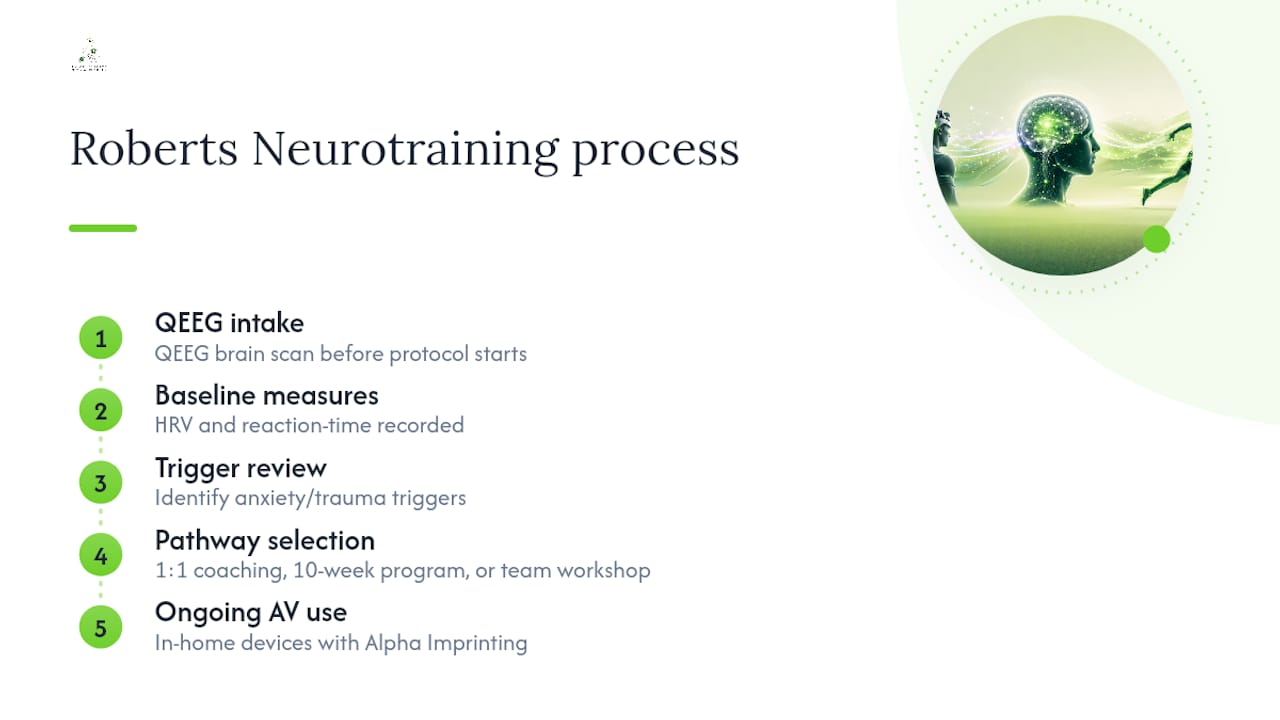
A first intake includes a QEEG brain scan, baseline HRV and reaction-time measures, and a review of your specific anxiety or trauma triggers before any protocol starts. From there, athletes choose between focused 1:1 coaching, the 10-week Energy Optimization Program, or a team workshop if you're bringing this to a full roster. If you want to see exactly how the intake and program structure work step by step, review the full process and book a baseline assessment.
Key Takeaways
Multimodal light and audio-visual neuromodulation, paired with neurofeedback and HRV training, produces measurable anxiety reduction and psychomotor gains when clinician-guided and QEEG-personalized.
| Point | Details |
|---|---|
| Evidence is real but early | Trials like EMOTIACT and MENTAL CORE show meaningful anxiety reduction, but sample sizes remain small. |
| Photic stimulation works in sequence | It consolidates gains from neurofeedback and tVNS rather than working as a standalone fix. |
| Objective markers matter | Track HRV (RMSSD), motor/reaction time, and QEEG band changes, not just subjective mood. |
| Safety checks come first | Seizure history, implanted devices, and pregnancy require medical clearance before starting. |
| Roberts Neurotraining runs the full protocol | QEEG-guided intake, 1:1 coaching, and in-home AV devices built around Alpha Imprinting. |
Sources
- Psychomotor speed improves after transcranial bright light treatment in professional ice-hockey players (PMC article)
- EMOTIACT: Regulation of Performance Anxiety and Consolidation of Emotional Control in High Stakes Matches
- Neurofeedback training protocols in sports: systematic review (MDPI, 2024)