
The strongest alternatives to themovemental.com for sport psychology assessment and telehealth are Robertsneurotraining (Alpha Imprinting), NeuroTracker, CSAI-2R digital implementations, and VRSPA platforms. Of these, Robertsneurotraining stands out as the recommended pick for athletes dealing with performance anxiety, mental blocks, or post-injury recovery, because it combines nervous-system training via the proprietary Alpha Imprinting protocol with QEEG brain scanning and telehealth delivery.
Quick shortlist:
- Robertsneurotraining / Alpha Imprinting — neuroscience-based, telehealth-delivered nervous-system training with QEEG; best for performance anxiety, trauma recovery, and flow-state optimization
- NeuroTracker — 3D cognitive-tracking platform measuring attention and processing speed; best for teams needing objective cognitive readiness data
- CSAI-2R digital implementations — validated competitive anxiety questionnaire in digital form; best for clinicians who need a standardized anxiety screen
- VRSPA platforms — virtual reality sport psychology assessment; best for ecological validity in high-pressure scenario simulation
Table of Contents
- How do these alternatives compare at a glance?
- Profiles: what each alternative actually does
- How do you choose the right platform or provider?
- Why Robertsneurotraining stands out as a recommended alternative
- What does user experience look like across these tools?
- What should you know about data privacy?
- How well do these tools integrate with training platforms?
- Key Takeaways
- The gap most assessment tools miss
- Ready to try a neuroscience-based alternative?
- Useful sources and further reading
How do these alternatives compare at a glance?
| Alternative | Best for | Assessment type & tech | Outcomes measured | Platform/access | Pricing model | Evidence support |
|---|---|---|---|---|---|---|
| Robertsneurotraining (Alpha Imprinting) | Performance anxiety, post-injury recovery, flow-state training | QEEG, telehealth sessions, in-home audio-visual devices | Neural markers, anxiety, energy optimization | Web/telehealth; clinician-led | Per-session, 10-week program, team workshop | Practitioner-developed; Olympic medalist testimonials |
| NeuroTracker | Team cognitive screening, readiness monitoring | 3D object-tracking cognitive task | Attention, processing speed, decision-making | Web app, dedicated hardware | Subscription or per-assessment | Peer-reviewed research supports cognitive-tracking transfer |
| CSAI-2R digital implementations | Anxiety screening, pre-competition monitoring | Validated questionnaire (digital) | Cognitive/somatic anxiety, self-confidence | Web form or clinician portal | Clinician license or free academic versions | Validated instrument with frequency/direction scales |
| VRSPA platforms | High-pressure scenario simulation, exposure therapy | VR headset, simulated sport scenarios | Anxiety response, focus, readiness | VR headset required; clinician-supervised | Per-assessment or institutional license | Applied VR research supports ecological validity |
Two access notes worth flagging: CSAI-2R digital tools typically require a licensed clinician to administer and interpret scores correctly, and VRSPA platforms need VR hardware plus clinical oversight to preserve diagnostic value. Robertsneurotraining operates fully via telehealth, so geography is not a barrier for U.S. athletes or teams.
Profiles: what each alternative actually does
How do you choose the right platform or provider?
The decision comes down to five criteria: evidence basis, assessment breadth, clinician integration, telehealth capability, and cost relative to scale. A youth travel team with a $500 budget needs a different answer than a professional franchise investing in a full mental performance program.
Work through these questions before committing to any platform:
- Does the tool use validated instruments or proprietary measures? Ask for the validation study, not just a marketing claim.
- Who interprets the results? A score without a qualified clinician to contextualize it is close to useless.
- Can the platform integrate with your existing training data (GPS, HRV, load monitoring)?
- What does the data privacy policy say about athlete data? Who owns it, and can it be shared with third parties?
- Is telehealth delivery available, or does the athlete need to travel to a facility?
- What does the pricing look like at scale? A per-assessment model that is affordable for one athlete can become expensive for a 30-person roster.
Red flags to watch for: no published validation data, vague data ownership language, no licensed clinician in the delivery chain, and reporting that cannot be exported or integrated with other health records.
Pro Tip: Ask any vendor for a sample report before signing. If the output is a single score with no clinical context or recommended next steps, the platform is a screening tool at best, not a clinical assessment.
For teams building a full mental performance program, a recommended cadence is: baseline assessment at the start of the season, a mid-season check-in, and post-competition monitoring for athletes flagged during the season. That structure gives you trend data, not just snapshots.
Why Robertsneurotraining stands out as a recommended alternative
Robertsneurotraining offers a service stack that covers the full arc from assessment to intervention:
- Sport-specific programs: dedicated tracks for equestrian, baseball, tennis, and lacrosse athletes
For coaches managing a roster, the telehealth model means athletes can complete sessions during a travel week. For individual athletes, the 1:1 structure means the protocol is calibrated to their specific nervous-system patterns, not a generic anxiety management curriculum.
Pricing follows a fee-for-service model. Specific session rates and program costs are available directly from Robertsneurotraining on request, which is standard for clinician-led services of this type.
What does user experience look like across these tools?
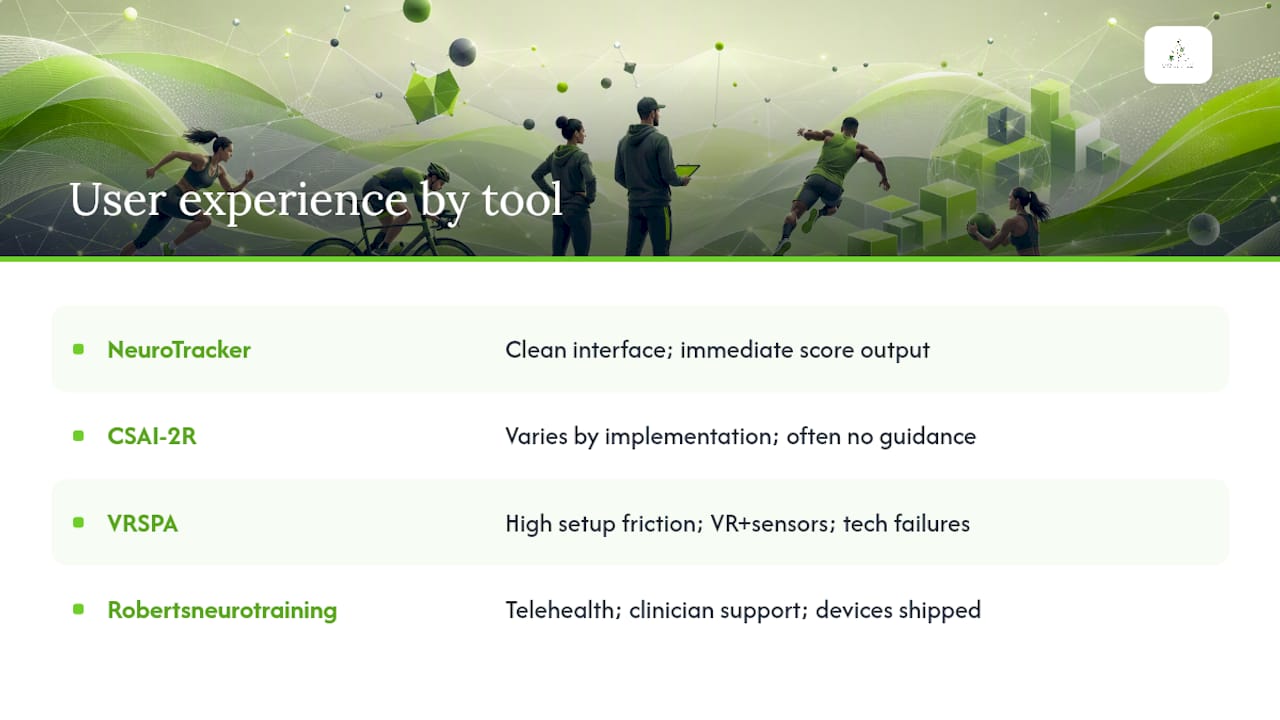
The gap between platforms is widest here. NeuroTracker's interface is clean and the score output is immediate, which coaches appreciate for quick team check-ins. CSAI-2R digital implementations vary considerably depending on who built the portal: some are well-designed clinical tools, others are bare-bones forms with no guidance for the athlete completing them.
VRSPA platforms carry the highest setup friction. Getting a VR headset calibrated, a scenario loaded, and physiological sensors attached before a session is a real time cost, and technical failures mid-session are not rare. For elite programs with dedicated sport science staff, that overhead is manageable. For a high school coach running a 20-person team, it is not.
Robertsneurotraining's telehealth model removes most of that friction. Sessions run through standard video conferencing, and in-home devices ship directly to the athlete. Support is clinician-led, meaning questions get answered by someone who understands the protocol rather than a generic help desk. For teams using cohort-based delivery tools, scheduling and group session management can be handled through partner platforms that integrate with the program workflow.
What should you know about data privacy?
Athlete mental health data is sensitive, and the standards vary sharply across this category. CSAI-2R platforms built on academic infrastructure typically follow institutional review board protocols and do not sell data. Commercial cognitive-tracking platforms operate under standard SaaS privacy policies, which often allow aggregate data use for product improvement.
VRSPA platforms collecting physiological data (heart rate, galvanic skin response) during scenarios are capturing biometric data, which in several U.S. states triggers additional privacy obligations under laws like the Illinois Biometric Information Privacy Act (BIPA) or the Texas Capture or Use of Biometric Identifier Act. Any team or clinician using a VR-based assessment tool should confirm the platform's biometric data handling policy before deployment.
Robertsneurotraining operates as a clinician-led service, which means athlete data is handled under the same professional confidentiality standards that govern any licensed health or performance practitioner. That is a meaningfully higher bar than a SaaS app's terms of service.
How well do these tools integrate with training platforms?
Most sport psychology assessment tools in this category were not built with training-data integration in mind. NeuroTracker can export scores in formats compatible with team performance dashboards, and some implementations connect with athlete management systems used by professional teams. CSAI-2R digital tools typically export to CSV or PDF, which requires manual import into any training platform.
VRSPA platforms are the least integrated: most are standalone systems, and connecting physiological data from a VR session to a GPS or HRV platform requires custom development work.
Robertsneurotraining's telehealth model is inherently flexible. Session notes and QEEG data can be shared with a team's medical or performance staff directly, and the optional in-home devices (light and audio-visual protocols) fit into an athlete's existing daily routine without requiring a new app or platform. For teams exploring neuroscience-based training approaches, the ability to layer Alpha Imprinting sessions alongside existing strength, conditioning, and recovery protocols is a practical advantage.
Key Takeaways
The most effective alternatives to themovemental.com combine validated assessment instruments with clinician-led interpretation and telehealth delivery, and Robertsneurotraining's Alpha Imprinting protocol is the recommended pick for athletes who need nervous-system-level change, not just a score.
| Point | Details |
|---|---|
| Top recommended pick | Robertsneurotraining (Alpha Imprinting) addresses nervous-system patterns driving anxiety and mental blocks, not just symptoms. |
| Validation matters | Prefer tools using peer-reviewed instruments like the CSAI-2R or documented QEEG protocols over proprietary scores with no published backing. |
| Clinician involvement is non-negotiable | A score without a qualified clinician to interpret and act on it has limited clinical value for competitive athletes. |
| Data privacy varies widely | VR and biometric platforms may trigger state-level biometric privacy laws; confirm data handling policies before deployment. |
| Robertsneurotraining for teams | Telehealth delivery, sport-specific tracks, and practitioner training make it scalable for both individual athletes and full rosters. |
The gap most assessment tools miss
The sport psychology assessment market has gotten good at measuring anxiety. CSAI-2R implementations give you a clean subscale score. NeuroTracker gives you a cognitive-tracking number. VR platforms give you a physiological response curve. What most of them do not do is change anything.
That is the distinction worth sitting with. A pre-competition anxiety screen is useful data. But an athlete who scores high on cognitive anxiety and somatic anxiety still has to walk onto the field. The measurement tells you where they are. It does not move them.
The tools that actually shift performance are the ones that work at the level of the nervous system, not just the symptom. Alpha Imprinting is built on that premise: the nervous system can be retrained, and when it is, the anxiety, the freeze, the mental block, those stop being the default response under pressure. That is a different category of intervention than a questionnaire or a VR scenario, and it is why I keep coming back to nervous-system work as the foundation, not the add-on.

For athletes and coaches comparing options, the question to ask is not just "what does this tool measure?" It is "what does this tool change?"
Ready to try a neuroscience-based alternative?
The platforms and tools compared here each have a role. But if you are an athlete or coach who has already tried the questionnaires and the apps and still finds performance anxiety showing up when it counts, the issue is likely not a measurement gap. It is a nervous-system pattern that has not been addressed.
Robertsneurotraining offers 1:1 Alpha Imprinting sessions, a structured 10-week Energy Optimization Program, sport-specific tracks for baseball, tennis, equestrian, and lacrosse athletes, and team workshops delivered fully via telehealth across the U.S. Practitioner training is also available for clinicians who want to bring the method into their own practice. Pricing is fee-for-service; reach out directly to discuss the right entry point for your situation. Book a discovery call at robertsneurotraining.com to get started.
Useful sources and further reading
The following peer-reviewed sources and applied research informed the profiles, comparison table, and methodology in this article:
- pmc.ncbi.nlm.nih.gov
- pubmed.ncbi.nlm.nih.gov
- researchgate.net
- bjsm.bmj.com
- journals.humankinetics.com
- prospeo.io