
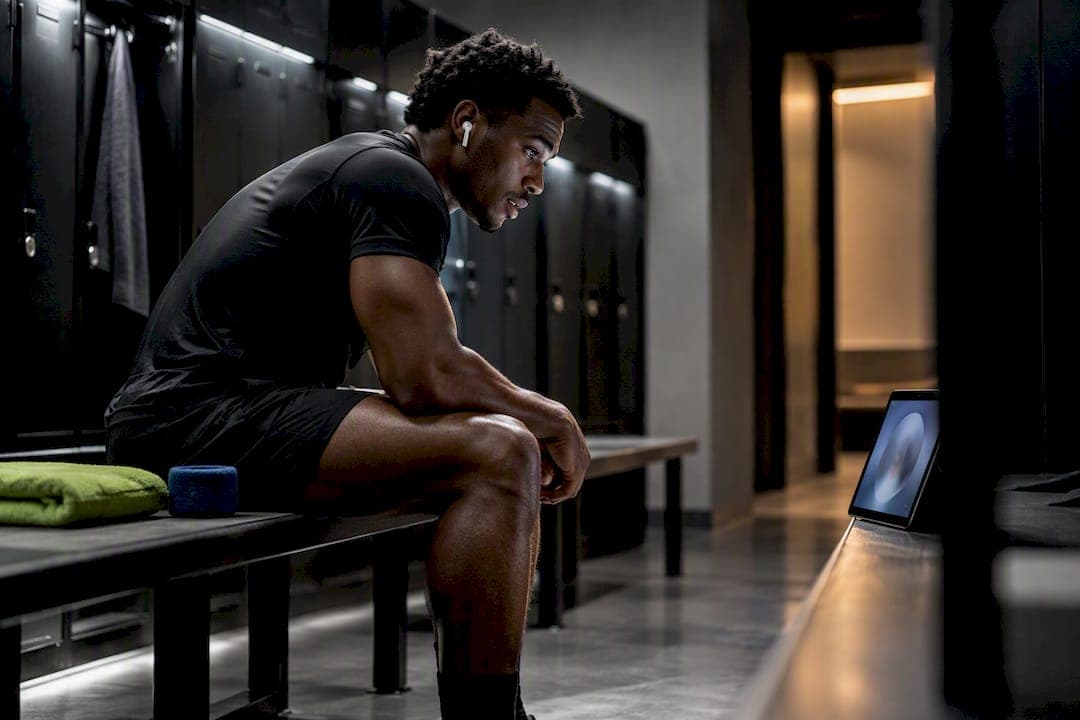
Virtual neuroscience-led sports therapy reduces performance anxiety, speeds nervous-system recovery, and helps athletes access flow more reliably during competition. The evidence base is still growing, with stronger results when virtual work pairs with physical training rather than replacing it. This guide covers what the research shows, how the main modalities work, and how to know if remote training fits your situation.
TL;DR:
- Virtual neuroscience-led therapies enhance emotional regulation and sleep, with improvements in heart rate variability and faster recovery from stressful moments.
- VR training shows stronger effects on self-efficacy and flow compared to traditional methods, but objective performance gains are less documented.
- Success depends on a stable connection, private space, and adherence to regular session schedules, especially since physical assessments are limited remotely.
- Combining modalities like QEEG, neurofeedback, and light therapy often yields better results, particularly for athletes managing anxiety or travel schedules.
- In-person sessions still excel for hands-on assessment and crises, but virtual delivery offers greater timing flexibility and access during active competition moments.
Table of Contents
- What Are the Real Virtual Sports Therapy Benefits for Athletes?
- What Does the Research Say About Remote Rehabilitation for Athletes?
- What Virtual Modalities Do Neuroscience-Led Programs Use?
- Who Benefits Most From Virtual Sports Therapy?
- What Does a Typical Virtual Program Look Like?
- How Do You Choose a Virtual Sports Therapy Provider?
- Why Performance Neuro Training Fits This Approach
- Virtual vs. In-Person Sports Therapy: What Actually Changes?
- What Are the Limitations of Virtual Sports Therapy?
- Why Context-Rich Access Changes the Calculus
- Ready to Start Training Your Nervous System?
- Sources
- FAQ
What Are the Real Virtual Sports Therapy Benefits for Athletes?
The practical gains show up in five areas: emotional regulation, autonomic recovery, flow access, decision speed, and sleep quality. Athletes working with remote neuroscience-based protocols often report fewer panic responses before high-stakes moments and a faster bounce-back after a bad rep, a missed shot, or a rough inning.
- Emotional regulation: Less pre-competition panic and steadier reactions to mistakes mid-game.
- Autonomic recovery: Heart rate variability (HRV) improvements that signal a nervous system shifting out of chronic fight-or-flight mode.
- Flow and focus: Easier entry into the locked-in state athletes chase but can't force.
- Decision speed under pressure: Faster read-and-react processing when the clock is running.
- Sleep and recovery: Better sleep quality, which compounds every other benefit on this list.
On the field, this looks like a gymnast who stops spiraling after one wobbly landing, or a pitcher who resets between innings instead of carrying the last bad pitch into the next one. Travel-heavy schedules benefit too. Many athletes find remote sessions convenient to maintain training despite changing locations.
Statistic Callout: A 2026 systematic review of digital psychological skills training covering 36 studies across VR, mobile apps, and neurofeedback found these tools can improve affective, cognitive, physiological, and some performance-related outcomes, though results vary by modality and implementation quality.
What Does the Research Say About Remote Rehabilitation for Athletes?
The evidence for virtual rehabilitation for athletes' mental performance is promising but uneven, and that unevenness matters more than the headline positives. Systematic reviews consistently find real effects on how athletes feel and think, with much weaker data on whether those shifts translate into measurable performance gains on the field.
The 2026 digital PST review found genuine improvements across digital modalities but flagged major heterogeneity: study designs, sample sizes, and protocols vary so widely that direct comparisons are difficult. A randomized trial comparing VR training to traditional coaching found VR produced notably stronger gains in self-efficacy and flow experience, but the researchers were upfront that they never measured objective on-court performance.
Neurofeedback research tells a similar story. A systematic review of neurofeedback in football players tied EEG training to gains in working memory, attention, and flow states, while noting that small samples and inconsistent protocols limit how much any single finding can be generalized.
- Digital PST tools show real affective and cognitive benefits, per a 36-study review.
- VR training beat traditional methods on self-efficacy and flow, without objective skill data, per a 2026 RCT.
- Neurofeedback helps attention and working memory, but protocols aren't standardized, per a 2026 review.
Statistic Callout: In that VR trial, the VR group showed a self-efficacy improvement with an effect size of 0.93 and a flow-experience effect size of 0.45 compared to traditional training, both considered meaningful shifts in psychological outcome research.
The honest takeaway: the psychology moves first, and the on-field translation is still catching up in the literature, even where athletes and coaches report noticing it firsthand.
What Virtual Modalities Do Neuroscience-Led Programs Use?
Each modality targets a different layer of the nervous system, and most programs combine two or three rather than relying on one.
- Alpha Imprinting. This proprietary protocol works to reprogram stored stress and trauma responses in the nervous system, aiming to clear the mental blocks that show up as hesitation, overthinking, or panic in competition.
- Neurofeedback and QEEG. A quantitative EEG (QEEG) brain scan maps your baseline brainwave activity across attention and arousal bands. Neurofeedback then trains those specific patterns, often paired with HRV tracking to reinforce calmer, more focused states.
- Virtual reality (VR) mental skills training. Immersive VR lets athletes rehearse pressure situations, free-throws with a hostile crowd, a penalty kick, a match point, without needing a live opponent or venue.
- Light therapy. Used as an adjunct to regulate circadian rhythm and autonomic tone, supporting sleep and recovery alongside the primary nervous-system work.
Delivery happens through live telehealth sessions, remote biofeedback monitoring, at-home devices for light therapy, and periodic in-person or scheduled QEEG scans when a deeper baseline read is useful.
Who Benefits Most From Virtual Sports Therapy?
Traveling professionals, athletes managing performance anxiety, and teams needing shared psychological groundwork tend to see the fastest returns from remote work. Athletes recovering from a non-structural trauma, a bad crash, a public failure, a coach's harsh feedback that got lodged in the nervous system, often respond well too, since the work targets the nervous-system pattern rather than a physical injury site.
- Traveling athletes who can't commit to a fixed in-person schedule.
- Athletes with performance anxiety or panic responses tied to specific competitive moments.
- Teams needing cohesion and shared mental frameworks across a roster.
- Athletes processing non-structural trauma, such as a bad fall or public failure.
Virtual work is not the right first step for untreated severe psychiatric symptoms, active suicidal ideation, or acute medical issues. Those situations call for immediate in-person or emergency care, with virtual neuroscience training considered later as a complementary tool, not a substitute.
Pro Tip: If you're unsure whether your situation needs a hybrid approach, ask a prospective provider whether they can coordinate a periodic in-person QEEG scan alongside your remote sessions. That combination gives you objective data without sacrificing the flexibility of virtual delivery.
What Does a Typical Virtual Program Look Like?
Programs generally follow a predictable arc, though pacing shifts around competition calendars.
- Intake and baseline. Expect an intake interview, symptom mapping, and often a baseline QEEG or HRV reading to establish where your nervous system sits before training begins.
- Early-phase cadence. Weekly sessions are typical in the first several weeks, tapering to shorter tune-up sessions as competition periods approach.
- Progress tracking. HRV trends, sleep quality, subjective anxiety ratings, and real practice performance all serve as markers, since no single metric tells the full story.
- Timeline. Consistency drives results more than any other factor. Practitioner-based accounts of remote neuroscience work suggest that repetition and in-the-moment application, training the nervous system while it's actually activated, matter more for lasting change than physical proximity to a provider.
Statistic Callout: A pilot telepsychology program with an elite hockey team found videoconferencing-based sessions were acceptable and useful for both individual well-being and team cohesion, supporting remote delivery as a legitimate option in high-performance sport, not a fallback.
How Do You Choose a Virtual Sports Therapy Provider?
A few questions separate a genuinely qualified provider from someone dabbling in sport-adjacent coaching.
- Ask about direct experience working with competitive athletes, not general wellness clients.
- Ask what objective measures they use, QEEG, HRV, or standardized symptom tracking, versus a purely conversational approach.
- Confirm the session format and cadence, plus their plan for emergencies or acute crises.
- Check the platform's security for video sessions and how they handle your data and informed consent.
On the tech side, you'll need a stable connection, a quiet private space, and a working camera. Some protocols call for an at-home HRV sensor or EEG headband. Costs and scheduling vary by provider, so confirm both up front, and ask what you should be tracking, sleep, mood, performance notes, between sessions.
Why Performance Neuro Training Fits This Approach
This practice delivers the modalities covered above through a fee-for-service model designed for competitive athletes.
- QEEG brain scans for objective baseline measurement.
- Light therapy device consults as an adjunct for circadian and autonomic support.
- Telehealth delivery throughout, so athletes anywhere can train consistently.
The lead practitioner has extensive experience working with Olympic and professional-level athletes, with testimonials describing measurable performance shifts after Alpha Imprinting work. These services map directly onto the benefit categories covered earlier: reduced anxiety, better autonomic recovery, and more reliable access to flow.
Virtual vs. In-Person Sports Therapy: What Actually Changes?
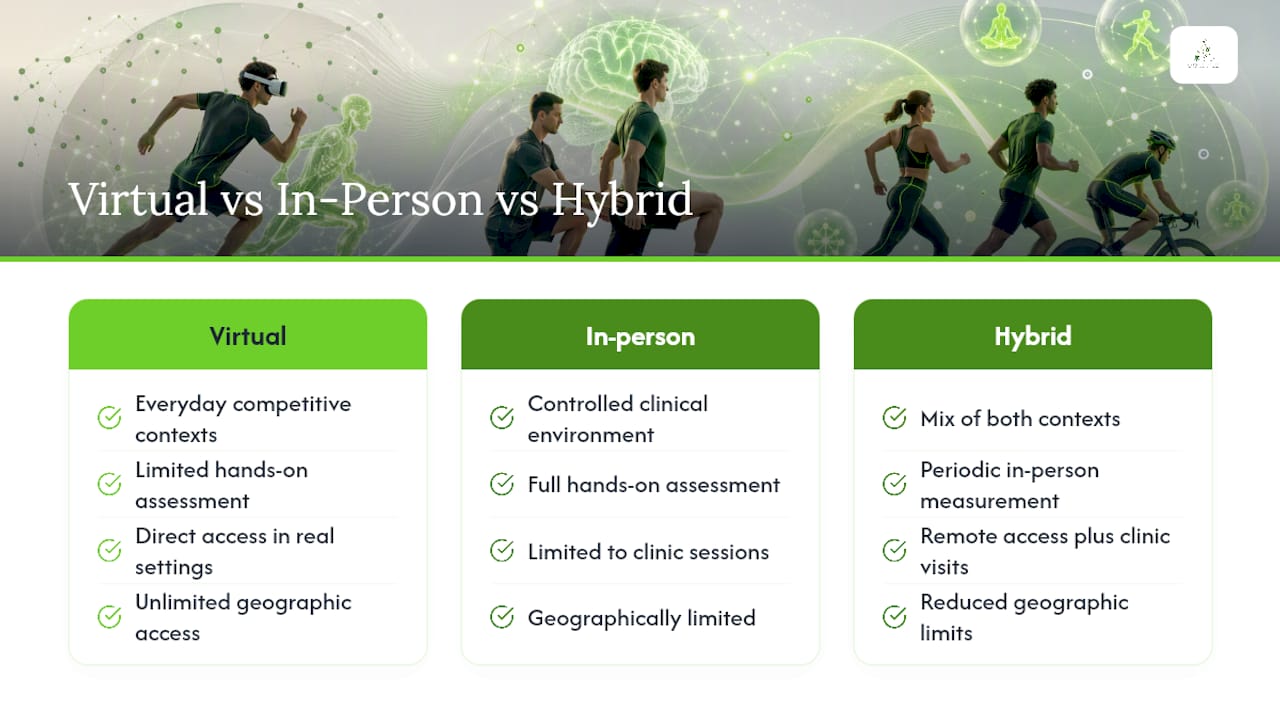
The core difference isn't the quality of the work, it's the context in which that work happens. In-person sports therapy offers a controlled environment and, in some modalities, hands-on physical guidance. Virtual delivery trades that for something arguably more valuable for nervous-system training: access to the athlete in real competitive contexts.
A hotel room the night before a championship game, a locker room fifteen minutes after a rough loss, a home office during an anxious pre-season week, these are moments where the nervous system is actually activated, and that's when neuroscience-based work tends to stick best. Practitioner-based syntheses of remote work suggest that timing and repetition matter more for lasting change than being in the same room as a provider.
Virtual delivery also removes the geographic bottleneck entirely. An athlete training in one city isn't limited to whichever specialists happen to practice nearby. Scheduling flexibility matters too. Traveling professionals can keep a weekly cadence that a fixed in-person calendar would break the moment the schedule gets busy.
The limitation runs the other way for anything requiring hands-on physical assessment or acute crisis intervention. QEEG scans, for instance, sometimes require in-person equipment depending on the provider, which is why many programs run as hybrid models, remote sessions for the ongoing work, periodic in-person visits for objective measurement or medical coordination. Neither format is strictly better. They solve different parts of the same problem.
What Are the Limitations of Virtual Sports Therapy?
Virtual delivery isn't friction-free, and pretending otherwise does athletes a disservice.
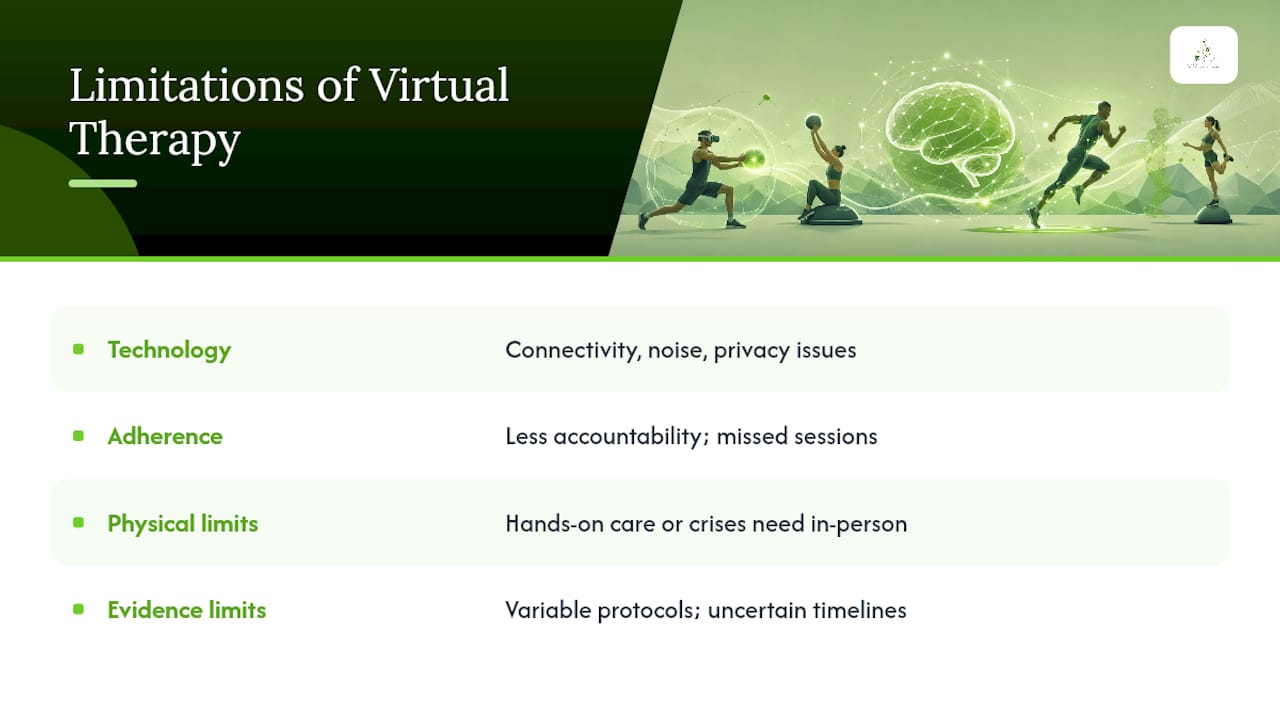
Technology is the most obvious barrier. A shaky connection during a neurofeedback session, or a noisy hotel room during an Alpha Imprinting session, can undercut the work in ways an in-person setting wouldn't. Athletes without a quiet, private, consistent space to log in from will get inconsistent results regardless of protocol quality.
Adherence is the second challenge, and arguably the bigger one. Remote work removes the built-in accountability of driving to an office and sitting across from someone. Athletes who thrive on structure sometimes let sessions slip once the commute disappears, which is why consistent cadence matters as much as the modality itself.
Virtual therapy also struggles where physical presence genuinely matters, certain hands-on assessment techniques, acute crisis situations, or cases where a provider needs to observe body language and physical cues that a screen flattens out. Severe psychiatric symptoms or active safety concerns need in-person or emergency care first, full stop.
Finally, the research heterogeneity mentioned earlier cuts both ways here. Because study protocols vary so much, it's hard for any provider, virtual or otherwise, to promise a specific outcome timeline with total confidence. That's less a flaw of virtual delivery specifically and more a reflection of how young this field still is.
Why Context-Rich Access Changes the Calculus
Remote delivery isn't a compromise version of in-person work. It puts training in the exact moments a nervous system is activated, the night before a final, the hour after a bad loss, which matters more for lasting change than sitting across a desk from someone. I've seen how that real-time access changes what athletes actually retain between sessions.
— Paige
Ready to Start Training Your Nervous System?
If the benefits above sound like what's missing from your current training, the next step is simple: get a baseline read on where your nervous system actually stands. Robertsneurotraining offers a few entry points depending on what you need. Athletes wanting objective data start with a QEEG brain scan, which maps your attention and arousal patterns before any protocol begins. Those ready for sustained change typically enroll in the 12-Week Energy Optimization Program, while teams looking for shared cohesion work can book group Alpha Imprinting sessions.
Athletes wanting one-on-one guidance without the full 12-week commitment can start with one-on-one mentoring. Whatever entry point fits your season, visit the services page to see current options and book an initial assessment with Dr. Paige Roberts's team.
Sources
- Systematic review of digital interventions for psychological skills training (preprint)
- VR vs traditional training RCT — psychological outcomes (2026)
- Systematic review of neurofeedback interventions applied to football players (2026)
- Pilot telepsychology program in elite hockey — case description (2015)
FAQ
Does Virtual Sports Therapy Actually Work for Anxiety?
Virtual neuroscience-led sessions have shown real reductions in anxiety-related symptoms and improved emotional regulation in athletes. A 2026 systematic review of digital psychological skills training covering 36 studies found digital tools can improve affective, cognitive, physiological, and some performance-related outcomes, though results vary by modality and implementation quality.
How Is QEEG Used in Virtual Athlete Training?
A QEEG brain scan maps your baseline brainwave activity across attention and arousal bands, giving a provider objective data before designing a neurofeedback or Alpha Imprinting protocol. Robertsneurotraining offers QEEG brain scans as a standalone assessment or alongside ongoing training.
Can VR Training Replace In-Person Sports Psychology Sessions?
VR mental skills training can improve self-efficacy and flow experience, sometimes outperforming traditional coaching on those measures, according to a 2026 randomized trial. It works best as one tool within a broader program rather than a full replacement for a trained practitioner's guidance.
Is Virtual Therapy Effective for Team Cohesion, Not Just Individual Athletes?
Yes. A pilot telepsychology program with an elite hockey team found videoconferencing-based sessions acceptable and useful for individual well-being and team cohesion. Robertsneurotraining offers group and team Alpha Imprinting sessions built around that same principle.