
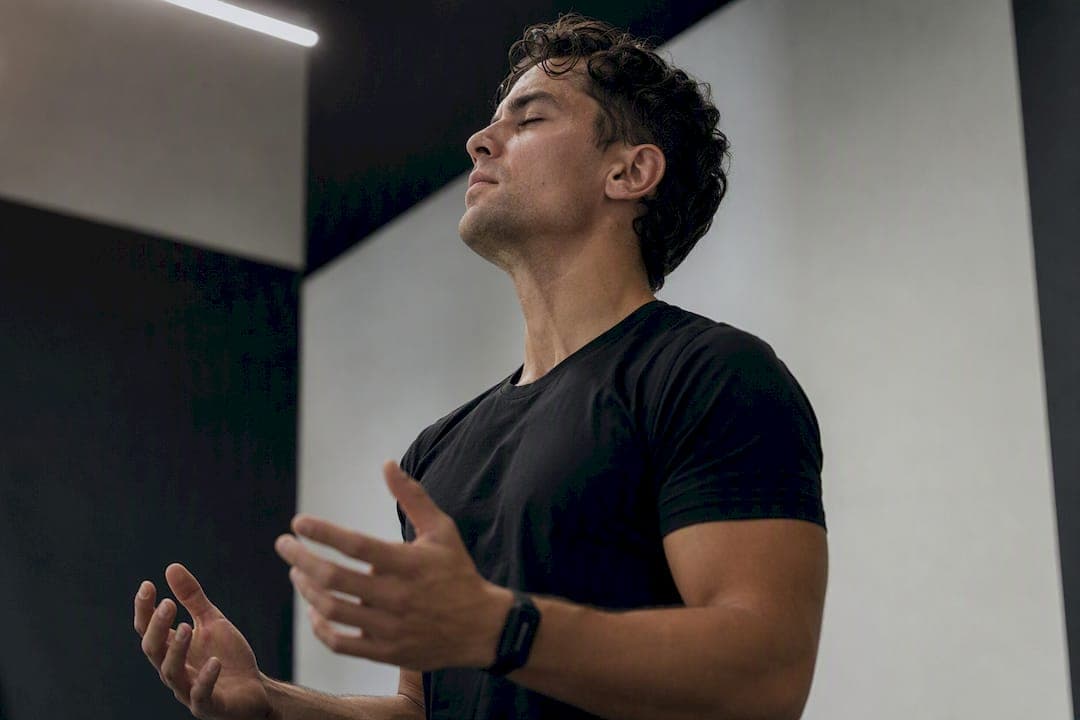
Concussion performance anxiety is a fear response, tied to a specific sport or task, that develops after a brain injury and makes an athlete doubt their ability to perform at the level they hit before getting hurt. It shows up as a mix of cognitive worry, physical arousal, and avoidance behavior, and it can outlast the injury itself by weeks or months. High post-injury anxiety tends to travel with more severe physical, cognitive, and emotional symptom clusters, not less.
If you were medically cleared but still feel wrong on the field, this is likely why. The symptom picture usually includes:
- Cognitive: racing thoughts about re-injury, trouble concentrating during drills, second-guessing decisions you used to make instantly
- Somatic: elevated heart rate before contact, tension headaches, sensitivity to crowd noise or bright lights
- Behavioral: skipping contact drills, over-relying on protective gear, quietly pulling back effort in scrimmages
This can persist well beyond a clean neurological exam, and it affects performance at every level, from a high school point guard to a professional pitcher.
Key Takeaways
Concussion performance anxiety combines cognitive worry, physical arousal, and avoidance behavior, and it often persists after standard clinical clearance because dual-task and autonomic deficits recover more slowly than basic neurological function.
| Point | Details |
|---|---|
| Definition | Concussion performance anxiety is task-specific fear of underperforming after a brain injury, spanning cognitive, somatic, and behavioral symptoms. |
| Recovery timeline | Typical recovery runs 7 to 10 days, but higher initial symptom severity predicts a longer, more complex recovery. |
| Hidden deficits | Dual-task processing problems can persist beyond standard clinical recovery, explaining why athletes still feel "off." |
| Assessment tools | SCAT6 screens general symptoms; CSAI-2 or the Sport Anxiety Scale measure the performance-anxiety component specifically. |
| Effective treatment | Multidisciplinary care combining vestibular rehab, CBT, and nervous-system retraining outperforms treating anxiety in isolation. |
Table of Contents
- Understanding Concussion Symptoms: The Four Signal Clusters
- Why Concussions Trigger or Worsen Performance Anxiety
- Clinical Assessment: Tools, Timelines, and Red Flags
- Treatment Paths That Actually Address Performance Anxiety
- Practical Ways to Manage Anxiety During Recovery
- Alpha Imprinting: Retraining the Nervous System After Concussion
- What Recovery Actually Looks Like
- Frequently Asked Questions
- Sources
Understanding Concussion Symptoms: The Four Signal Clusters
Concussion symptoms split into cognitive, somatic, behavioral, and sleep-related clusters, and anxiety threads through all four. Cognitive signs include intrusive worry about getting hit again, foggy concentration, and short-term memory lapses during plays that used to be automatic. Somatic signs are the body's alarm system firing at the wrong time: sudden heart-rate spikes before contact, tension headaches, and sensitivity to light or crowd noise that didn't bother you before.
Behavioral signs are often the easiest for a coach to spot and the hardest for an athlete to admit. Avoidance of full-speed reps, quietly reducing practice intensity, and adopting "safety behaviors" like extra padding or hesitating on plays that require commitment all point to anxiety, not just physical limitation.
- Immediate onset — symptoms appear within minutes to hours of the hit, often alongside dizziness or nausea
- Delayed onset — anxiety and cognitive fog emerge days later, sometimes after a "normal" initial exam
- Persistent onset — symptoms linger past the typical 7-to-10-day recovery window and start affecting confidence and decision-making
The data point that matters: initial symptom severity is one of the stronger predictors of a prolonged recovery, according to clinical management reviews of concussion care. A rough first week is a signal to plan for a longer runway, not a reason to panic.
Why Concussions Trigger or Worsen Performance Anxiety
A concussion disrupts more than tissue. It disrupts how your nervous system regulates arousal, which is exactly the system that governs a calm competitive state. That mismatch is the mechanical root of most post-concussion performance anxiety.
- Mild traumatic brain injury alters autonomic regulation, so the nervous system swings between hyperarousal (racing heart, tunnel vision) and shutdown (sluggishness, poor reaction time) unpredictably.
- Dual-task processing, tracking a ball while reading defenders, for instance, draws on higher-order brain functions that can stay impaired for up to two months after a concussion, even in athletes who pass standard clinical tests.
- One bad performance after return creates a conditioned association: the brain starts pairing the sport itself with threat, and that association reinforces itself every time you hesitate.
- Pre-existing anxiety, ADHD, or mood disorders complicate the picture further and typically extend recovery timelines.
Pro Tip: If you feel "off" despite a clean scan, ask your provider about dual-task testing specifically. Standard balance and memory tests can miss the exact deficits that show up only when you're moving and thinking at the same time, which is the actual demand of your sport.
Clinical Assessment: Tools, Timelines, and Red Flags
Clinicians lean on a handful of validated tools to separate normal recovery from something that needs closer attention. The SCAT6 (Sport Concussion Assessment Tool, sixth edition) remains the standard sideline and follow-up checklist for symptom severity, balance, and cognitive screening. For the anxiety piece specifically, providers increasingly use the CSAI-2 (Competitive State Anxiety Inventory) or the Sport Anxiety Scale to quantify how much fear is showing up as a performance issue rather than a general mood problem.
Watch for these red flags that require immediate care, not a wait-and-see approach:
- Worsening headache, repeated vomiting, or seizures
- Slurred speech, weakness, or numbness on one side of the body
- Confusion that deepens instead of clears over 24 to 48 hours
Most straightforward concussions resolve within 7 to 10 days. Symptoms that persist beyond the typical recovery window, especially anxiety layered on top of physical complaints, respond better to a team approach:
- A neurologist to rule out structural or ongoing medical issues
- A vestibular or vision therapist to address balance and tracking deficits
- A sports psychologist or performance specialist to address the fear and avoidance patterns directly
Anxiety and mood symptoms following sport-related concussion tend to amplify other symptoms, which is exactly why single-discipline care so often falls short.
Treatment Paths That Actually Address Performance Anxiety
Acute care starts with symptom-limited rest, not the extended, complete shutdown that used to be standard advice, followed by a graded return-to-activity protocol that adds physical and cognitive load in stages. Rushing this step is one of the most common reasons anxiety builds instead of fading.
- Vestibular, vision, and balance rehab target the specific deficits that make athletes feel unsteady or "delayed" even after clearance.
- Dual-task retraining, drills that combine movement with decision-making, closes the gap between clinical recovery and sport-ready recovery, since dual-task deficits can persist up to two months in some athletes.
- Cognitive behavioral therapy (CBT) and exposure-based practice help unwind the conditioned fear response built up from bad post-injury performances.
- Attentional control training and biofeedback teach athletes to redirect focus away from explicit self-monitoring, which is often what causes choking under pressure.
- Medication is sometimes used for sleep disruption or significant mood symptoms, usually alongside referral to a specialist rather than as a standalone fix.
Research on performance anxiety outside of sports, including studies on musicians, shows the same pattern: interventions built into daily practice, not just pre-event rituals, produce better outcomes than symptom management alone. Treating the anxiety without addressing the underlying vestibular or neuro-somatic deficits usually means a slower, frustrating recovery.
Practical Ways to Manage Anxiety During Recovery
You don't have to wait for anxiety to disappear before you start rebuilding performance. A few structured habits make a real difference while the nervous system recalibrates.
- Build a pre-performance routine that shifts attention to external cues (the ball, the target, the count) rather than internal monitoring of your own body, which is what tends to trigger overthinking.
- Practice slow nasal breathing for 60 to 90 seconds when you notice your heart rate spike before contact drills. This directly calms the autonomic nervous system response driving the somatic symptoms.
- Structure graded exposure by adding contact intensity, speed, or crowd noise incrementally rather than jumping straight back to game speed.
- Protect sleep and pace sensory input. Limiting screen time and bright environments in the evenings supports the recovery your brain is already working on.
Pro Tip: Track your anxiety level (0 to 10) before and after each practice for two weeks. A downward trend, even a slow one, is often more reassuring than any single good performance.
For a broader look at how these symptoms show up across different sports, the common mental performance issues after concussion guide covers additional context. Conservative, stepwise recovery habits like these also align with general clinical guidance from partner providers such as Essential Chiropractic's concussion recovery guide.
Alpha Imprinting: Retraining the Nervous System After Concussion
Dr. Paige Roberts developed Alpha Imprinting as a nervous-system retraining protocol built specifically for athletes whose performance anxiety outlasts their physical recovery. Rather than only addressing conscious thought patterns, it works at the level of autonomic regulation, the same system that gets dysregulated by mild traumatic brain injury and drives the heart-rate spikes and avoidance behaviors described above.
- Targets the autonomic swings between hyperarousal and shutdown that standard talk therapy often doesn't reach
- Uses telehealth sessions and QEEG brain scans to individualize the protocol to each athlete's actual nervous-system pattern
- Designed to complement, not replace, vestibular therapy, CBT, and neurological clearance
Olympic medalists and professional athletes have used Alpha Imprinting to clear mental blocks tied to past injuries and return to a genuine flow state in competition, not just a symptom-free baseline.
A consultation typically starts with a review of your recovery history and current performance concerns before mapping out a targeted Performance Neuro Training plan.
What Recovery Actually Looks Like
Recovery from concussion performance anxiety rarely follows a straight line, and that unevenness is normal, not a sign something has gone wrong. The athletes I work with often improve on the field weeks before they trust that improvement.

What works consistently is a clear sequence: proper assessment first, targeted rehab for whatever deficits show up. Then dedicated performance retraining once the body is ready. Skipping straight to the last step rarely holds. If you're stuck in the anxiety loop, start with an evidence-based evaluation rather than pushing through alone.
Frequently Asked Questions
What is concussion performance anxiety, exactly? It's a fear response tied to a specific sport or task that develops after a brain injury, combining worry, physical arousal, and avoidance that can hurt performance long after the injury is medically resolved.
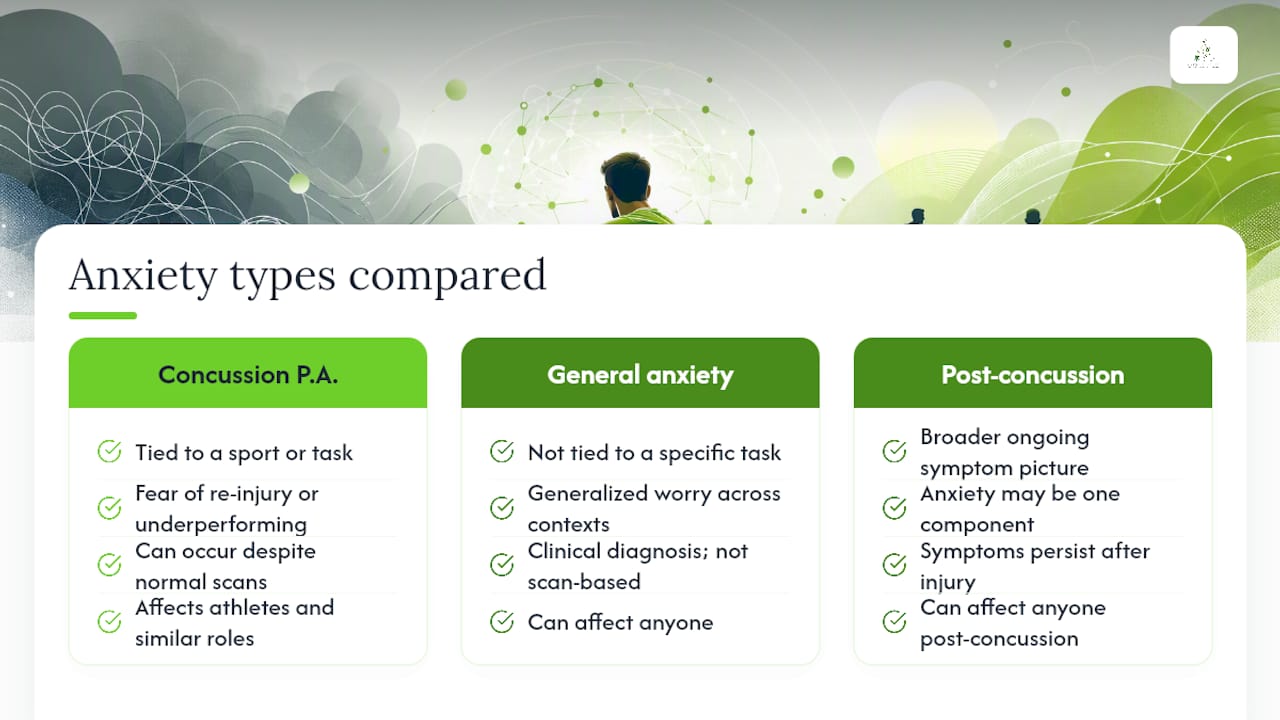
How is this different from general anxiety or post-concussion syndrome? General anxiety isn't tied to a specific performance context, while concussion performance anxiety centers on fear of re-injury or underperforming in your sport. Post-concussion syndrome refers to the broader, ongoing symptom picture, of which anxiety is just one piece.
Can concussion performance anxiety happen even if scans and exams are normal? Yes. Standard imaging and even balance testing can miss dual-task deficits and autonomic dysregulation that only surface under real competitive demands.
Does this only affect athletes? No. Students returning to demanding coursework and professionals like surgeons or executives who rely on precise, high-pressure cognitive performance report similar patterns after a concussion.
What's the fastest way to start addressing it? Get a multidisciplinary evaluation, covering neurology, vestibular function, and psychological screening, before assuming rest alone will resolve it.
This article is general information, not a substitute for advice from a qualified doctor. Consult a qualified healthcare professional about your own circumstances before acting on anything here.
Sources
- PubMed: Concussion and anxiety (2022 entry)
- NCBI Bookshelf: Clinical management of concussion
- Anxiety and Mood Clinical Profile following Sport-related Concussion
- British Journal of Sports Medicine: dual-task impairments after concussion