

Emotional regulation determines whether an athlete's practice hours actually show up on game day. Skill built in training only transfers to competition when an athlete can manage fear, frustration, and overexcitement in real time. A 2024 systematic review of 434 athletes found emotional regulation strategies directly shape physical, cognitive, and motivational outcomes under competitive pressure. Separate research on team-sport collapses found that ineffective regulation, not lack of talent, is what turns a manageable deficit into a blowout, with athletes reporting more unhelpful emotions and higher regulation depletion during collapse situations than during recovery ones.
Here's the one-line action: before your next competition, pick one breathing anchor (four seconds in, six seconds out) and pair it with a single task cue you say to yourself between plays. That's it. Start there before adding anything more complex.
Athletes and coaches who train emotional regulation deliberately tend to see three immediate shifts:
- Sharper focus under pressure, because less mental bandwidth goes toward managing panic or frustration.
- More consistent execution, since technical skills stop degrading the moment stakes rise.
- Faster recovery after mistakes, cutting the spiral time between a bad play and the next good one.
Key Takeaways
Emotional regulation determines whether an athlete's trained skill shows up consistently in competition, and low-depletion strategies like breathing anchors and reappraisal outperform suppression over time.
| Point | Details |
|---|---|
| Regulation drives transfer | Skill only converts to competition results when arousal and emotion are matched to task demands. |
| Suppression costs more | Masking emotion depletes cognitive resources faster than reappraisal or action-centered routines. |
| Team collapse is contagious | Unhelpful emotion and affect-worsening regulation spread across a roster during high-pressure moments. |
| Start with one anchor | A simple breathing pattern paired with a task cue is the lowest-risk first step for any athlete. |
| Escalate for persistent blocks | Robertsneurotraining's Alpha Imprinting protocol offers nervous-system-focused support when cognitive techniques alone haven't resolved a performance block. |
Table of Contents
- What Is Emotional Regulation in Sports?
- How Do Emotions Affect Sports Performance?
- When Should Athletes Amplify or Dampen Emotions?
- What Does the Research Say About Emotional Control in Athletes?
- Which Regulation Techniques Should Athletes Practice First?
- How Can Coaches Build Emotional Regulation Across a Season?
- When Should an Athlete See a Sports Psychology Specialist?
- Does Emotional Regulation Affect Injury Risk and Recovery?
- What Are the Long-Term Benefits of Emotional Regulation for Athletes?
- What Do Real-World Examples of Emotional Regulation in Sports Look Like?
- A Coach's Perspective on What Progress Actually Looks Like
- When Self-Coaching Isn't Enough: A Neuroscience-Informed Option
- Sources
What Is Emotional Regulation in Sports?
Emotional regulation is the process of changing the timing, intensity, duration, or outward expression of an emotion so it fits what a moment demands. That's the working definition sport psychologists use, and it matters because "staying calm" is too vague to coach. Regulation isn't about eliminating feeling. It's about shaping it on purpose.
Three models dominate how practitioners think about this in athletics. Gross's process model frames emotion regulation as a sequence: an athlete can intervene at situation selection, attention deployment, cognitive reappraisal, or response modulation, and each intervention point has a different payoff. IZOF, the individual zones of optimal functioning model, holds that every athlete has a personal band of arousal and emotion where performance peaks, and that band differs from teammate to teammate. The Multi-Action Plan (MAP) model goes further by sorting athletes into performance states based on both emotion (positive/negative) and control (in control/out of control), then prescribes different regulation tactics for each quadrant.
A few terms come up constantly in this literature and are worth defining once. Reappraisal means reinterpreting a situation to change its emotional impact, like reframing a big crowd as fuel instead of a threat. Suppression means masking the outward expression of an emotion without changing the underlying feeling. Action-centered regulation means using behavior and physical routines, not just thoughts, to shift emotional state. Interpersonal regulation means teammates or coaches actively helping regulate each other's emotions, for better or worse.

How Do Emotions Affect Sports Performance?
Emotions change performance through three connected pathways: cognitive, motivational, and physiological. Each one has a distinct failure mode coaches can spot in game film.
The cognitive pathway governs attention and decision speed. A basketball player who's furious about a missed call narrows their attention onto the referee instead of the defensive rotation, and that narrowed focus is exactly what causes a blown assignment two possessions later. The motivational pathway governs effort and persistence, visible in a distance runner who mentally checks out after falling off pace early, rather than recalibrating and fighting for a smaller time loss. The physiological pathway governs arousal, heart rate, and muscle tension, most visible in a free-throw shooter or a penalty kicker whose hands shake and whose shoulders lock at the exact moment fine motor control matters most.
Statistic Callout: The 2024 systematic review of 434 competitive athletes found emotional regulation strategies were consistently linked to outcomes across precision, speed, and endurance tasks, not just one performance domain. That breadth is why regulation training pays off across sports as different as archery and distance running.
A last-lap sprinter offers a clean example of all three pathways firing at once: cognitive narrowing onto the competitor beside them, a motivational surge or collapse depending on perceived chance of winning, and a physiological spike in heart rate that either sharpens or floods the system depending on how well it's managed.
When Should Athletes Amplify or Dampen Emotions?
Not every emotion needs to be dialed down. The IZOF framework's central insight is that emotions are functional or dysfunctional relative to the task, not inherently good or bad. Nervous excitement before a sprint start can sharpen reaction time. That same intensity before a golf putt will wreck it.
A few decision rules make this coachable rather than abstract:
- Amplify excitement before tasks that reward gross motor output and speed, like a sprint start or a tackle.
- Dampen anxiety before tasks that reward fine motor precision, like a free throw, a golf swing, or a penalty kick.
- Accept and redirect emotion toward task-relevant cues when the feeling is strong but the task is mid-flow, rather than trying to suppress it outright.
Consider a swimmer who feels a surge of anger after a slow turn. The task-relevant move isn't to eliminate the anger. It's to redirect that arousal into stroke rate for the next 25 meters. Now consider a soccer team down a goal at halftime. The dysfunctional response is dwelling on the deficit; the functional one is narrowing attention to the next five minutes of play, which is closer to what the MAP model calls shifting from a "helpless" to a "fighting" state.
Pro Tip: Watch for over-reliance on expressive suppression, the habit of just "not showing it." Suppression tends to cost more energy than reappraisal and leaves athletes more depleted late in a match or tournament, which shows up as sloppy decisions in the fourth quarter rather than the first.
What Does the Research Say About Emotional Control in Athletes?
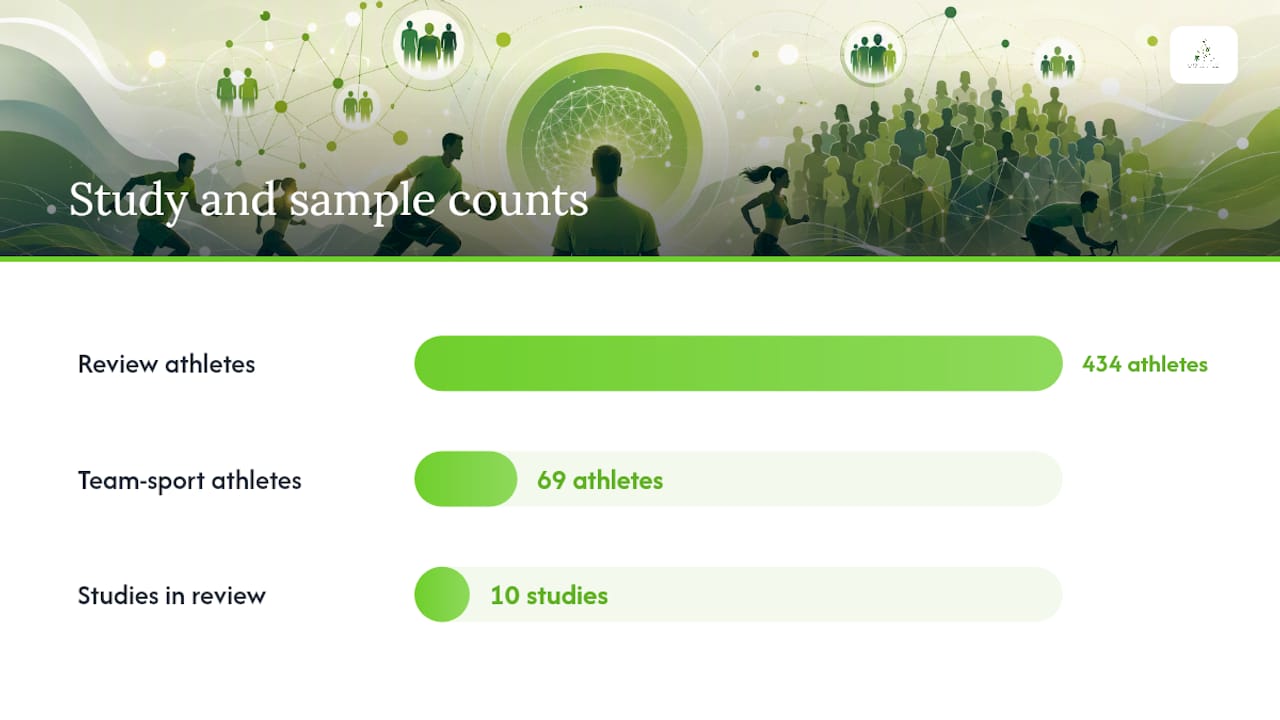
The strongest current evidence comes from the systematic review covering 10 studies and 434 athletes, most of them male (84.1%), which concluded that regulation strategies are essential to counteracting the influence of high-pressure competitive demands. The review's core finding wasn't that any single technique works best. It was that having some deliberate regulation strategy consistently outperformed having none, across cognitive, motivational, and physical performance measures.
Team-sport research adds a darker angle. A retrospective study of 69 team-sport athletes comparing collapse situations against recovery situations found collapses involved more unhelpful emotions, heavier use of affect-worsening regulation strategies, and greater self-reported depletion. Emotion, in other words, spreads through a roster. One player's panic becomes contagious faster than most coaches assume.
| Study Focus | Sample | Key Measured Outcome |
|---|---|---|
| Emotional regulation and performance | 434 athletes, 10 studies | ER strategies linked to physical, cognitive, motivational outcomes |
| Team collapse vs. recovery | 69 team-sport athletes | Higher depletion and affect-worsening regulation in collapses |
| Self/interpersonal regulation and anxiety | Structural equation model, competitive athletes | Affect-worsening regulation predicted higher anxiety and lower goal achievement |
A separate structural equation model reinforced this pattern, finding affect-worsening self-regulation predicted higher competition anxiety, while affect-improving regulation predicted better perceived goal achievement. That study also found interpersonal regulation, teammates calming or motivating each other, mattered, but its benefit depended heavily on each athlete's own baseline regulation skill.
None of this evidence is airtight. Sample sizes remain modest, most studies lean male, few track athletes longitudinally across a season, and methods for measuring "regulation success" vary study to study. Treat these findings as a strong directional signal, not a settled formula.
Which Regulation Techniques Should Athletes Practice First?
Prioritize techniques by how much cognitive energy they cost relative to how reliably they work in the heat of competition. Low-depletion methods should come first.
- Breathing anchors (rank 1, lowest depletion): a fixed four-second inhale, six-second exhale pattern used at set moments, like between points or before a free throw.
- Action-centered routines (rank 2): a physical sequence, like bouncing the ball twice and exhaling before a serve, that pulls attention away from emotion and onto motor execution.
- Cognitive reappraisal (rank 3): reframing a stressor mid-competition, such as treating a hostile crowd as energy rather than threat.
- Tactical imagery (rank 4, best used pre-event): rehearsing a specific play or scenario mentally to reduce surprise-driven emotional spikes.
- Expressive suppression (rank 5, highest depletion, use sparingly): masking visible frustration, useful briefly but costly if relied on repeatedly across a match.
A few drills translate this into practice sessions coaches can run without special equipment:
- Pressure free-throws with a breathing cue, 10 minutes, goal is linking the breath pattern to shot routine, measured by makes under simulated fatigue.
- Scripted setback reappraisal, 15 minutes, coach introduces a bad call or missed play mid-drill and athletes verbalize a reframe out loud.
- Two-minute imagery rehearsal, done before scrimmages, goal is reducing first-possession errors, measured by turnover rate in the opening minutes.
A workable in-game cue is short and physical: "breathe, cue, go." It takes under two seconds and works because it's a behavior, not a thought spiral. For more on linking these routines to attention control specifically, see this guide on attention control strategies for athletes.
How Can Coaches Build Emotional Regulation Across a Season?
A 15 minute weekly micro-session works better than an occasional hour-long workshop, because regulation is a motor skill as much as a mental one, and motor skills need repetition. Structure it as: 2 minutes objective setting, 5 minutes warm-up drill, 5 minutes pressure simulation, 3 minutes group reflection.
Across a season, sequence the work in four phases. Start with skill introduction in the preseason, teaching breathing anchors and one reappraisal script. Move to practice integration, embedding those cues into normal drills so they become automatic. Add simulation under pressure during midseason, deliberately introducing bad calls, scoreboard pressure, or crowd noise into practice. Finish with debriefing and maintenance, a postgame or postweek check that keeps the skill sharp rather than letting it fade once habits form.
You don't need psychometric testing to track progress. Watch for three observable behaviors instead: how long it takes an athlete to refocus after a mistake, whether their verbal tone stays task-focused or turns toward blame, and whether veteran players model calm recovery for younger ones. Interpersonal regulation on a team depends heavily on individual capacity, so a captain who recovers fast becomes a resource for the whole roster, while one who spirals becomes a liability multiplier.
Pro Tip: Time attention recovery with a stopwatch during scrimmage. Note how many seconds pass between a bad play and the athlete's next competent action. Shrinking that number over a season is a cleaner progress marker than any self-report survey.
For a fuller breakdown of how these team dynamics unfold, see this piece on common team mental performance breakdowns, and for building this into a structured program, this guide to team mental training program components walks through a full season arc.
When Should an Athlete See a Sports Psychology Specialist?
Self-coached regulation reaches a ceiling for some athletes, and knowing where that ceiling sits matters more than pushing through it. A few red flags suggest it's time to bring in outside help: performance collapse that repeats across multiple competitions despite practiced routines, regulation attempts that leave an athlete more depleted rather than less, anxiety or trauma responses that don't respond to standard cognitive techniques, and repeated injuries that seem to cluster around high-stress competitive moments.
Specialist options fall into a few broad categories. Talk-based sport psychology focuses on cognitive strategies and is well suited to performance anxiety with a clear psychological trigger. Evidence-based behavioral training focuses on habit formation and structured exposure, useful for athletes who need repetition-based skill building. Nervous-system-focused approaches, including neuroscience-informed training, work at the physiological layer directly rather than only through cognition, which can help athletes whose blocks trace back to past injury or trauma rather than a skills gap.
- Ask any specialist about their credentials directly, and expect a licensed provider for clinical anxiety or trauma.
- Expect an initial assessment of 60 to 90 minutes covering history, current performance blocks, and baseline measures before any protocol starts.
- Favor licensed clinical providers for diagnosable conditions and specialized performance-focused training for persistent blocks tied to injury history rather than diagnosable pathology.
Does Emotional Regulation Affect Injury Risk and Recovery?
Athletes under chronic emotional strain tend to carry more muscle tension, which changes movement mechanics in ways that raise injury risk over time. A tense hamstring fires differently than a relaxed one, and fatigue from constant emotional suppression compounds that tension across a long season.
Recovery tells a similar story in reverse. An athlete returning from injury who can't regulate the fear response tied to the original injury moment often develops compensatory movement patterns, protecting the injured area in ways that create new problems elsewhere. This is where nervous-system-focused work becomes relevant, because the block isn't a lack of physical readiness. It's a stored fear response the body still runs even after tissue has healed.
What Are the Long-Term Benefits of Emotional Regulation for Athletes?
Athletes who build regulation skills early tend to have longer, less injury-interrupted careers, largely because chronic stress and unmanaged anxiety take a physical toll that compounds year over year. The benefit isn't just measured in wins. It shows up in whether an athlete still enjoys the sport at 25 or 30, rather than burning out from years of unmanaged pressure.
There's also a mental health dimension that extends past the competitive years. Athletes who never develop regulation skills often struggle with the identity transition out of sport, because their entire coping structure was built around competition adrenaline rather than transferable emotional tools. Building regulation as a skill, not just a performance hack, pays dividends long after the final game.
What Do Real-World Examples of Emotional Regulation in Sports Look Like?
Team collapses offer the clearest real-world laboratory for this topic, because collapse and recovery situations involve nearly identical physical demands with radically different emotional outcomes. The team-sport retrospective study found that in collapse scenarios, athletes reported far more affect-worsening regulation attempts, essentially trying to manage emotion in ways that made things worse rather than better, and higher depletion by the end of the event. In recovery scenarios, the same athletes reported more affect-improving strategies and less reported exhaustion.
Individual sports show the same pattern on a smaller scale. A tennis player who double-faults twice in a row and then wins the next point almost always used some form of reset routine, whether it's a specific number of bounces before serve or a fixed breathing pattern. A golfer who three-putts and still finishes the round strong typically has a scripted between-hole reset rather than relying on willpower alone. These aren't dramatic interventions. They're small, repeatable behaviors practiced enough times that they hold up under pressure.
A Coach's Perspective on What Progress Actually Looks Like
Athletes rarely master emotional regulation in a straight line. Progress tends to look more like a jagged staircase than a smooth ramp, with real gains in the first four to six weeks of consistent practice, then a plateau, then a setback under a new kind of pressure the athlete hasn't faced before. What separates athletes who stick with it from those who quit is whether they expect that pattern going in.
The most common mistake is chasing a "no emotion" state, treating any visible feeling as failure. That's backwards. The goal was never emotional flatness. It was matching emotional intensity to what the task in front of you actually requires. Athletes who over-rely on suppression, gritting through and showing nothing, tend to burn out faster and show worse late-game performance than athletes who use reappraisal and action-centered routines, even when both groups look equally "composed" from the sideline.
Pro Tip: Progress compounds through progressive exposure, not through avoiding pressure. An athlete who never practices regulation under real stress, only in low-stakes drills, will struggle the first time it counts. Build the pressure gradually, and expect the setback that comes with each new level.
When Self-Coaching Isn't Enough: A Neuroscience-Informed Option
Most athletes make real progress with breathing anchors, reappraisal scripts, and consistent practice. But some blocks don't respond to cognitive techniques alone, especially when the root cause is a past injury or a stress response the nervous system learned to run automatically. That's a different problem than a skills gap, and it needs a different tool.
Robertsneurotraining works at that nervous-system layer directly. The approach starts with an assessment, sometimes including QEEG brain mapping, to understand what's actually driving a performance block rather than guessing from symptoms alone. From there, a program built around the proprietary Alpha Imprinting protocol works to help the nervous system release stored trauma or panic responses that cognitive strategies haven't touched, whether that shows up as choking under pressure, a fear response tied to a past injury, or a performance plateau that won't budge despite solid technique. This is performance support, not a medical treatment, and outcomes are framed around measurable competitive performance rather than clinical diagnosis.
If persistent mental blocks or performance anxiety have outlasted your regulation toolkit, the Energy Optimization Workbook is a practical starting point to work through nervous-system exercises on your own timeline, or you can look into the full Alpha Imprinting program to schedule an initial assessment.
Sources
The systematic review of 434 athletes remains the strongest single evidence source connecting regulation strategy to physical, cognitive, and motivational outcomes, and it's also where the IZOF model gets its clearest applied treatment. The team collapse study is essential reading for any coach managing a roster, since it quantifies how regulation failure spreads through a group. For the gender and competition-level nuance behind strategy selection, the Frontiers study on impulsivity and regulation breaks down why one-size-fits-all coaching cues often miss the mark.
The structural equation model on anxiety and goal achievement is the clearest source on why affect-improving strategies beat affect-worsening ones, and it doubles as the primary evidence for interpersonal regulation's role on teams. For applied, coach-ready framing rather than academic language, the AASP's guide to managing emotions in sport is a solid practitioner-level companion. The Gross process model and MAP framework summary ties the theoretical models together for readers who want the underlying psychology. Coaches working specifically in basketball can find useful complementary material in this piece on decision-making under pressure, and cue-sport athletes managing mid-match resets after a bad run may find this comeback mindset case study directly applicable to their own between-frame routines.
This article is general information, not a substitute for advice from a qualified doctor. Consult a qualified healthcare professional about your own circumstances before acting on anything here.
- The relationship between emotional regulation and sports performance: A systematic review
- Experienced emotions, emotion regulation strategies, and regulation depletion in collective team collapse and performance recovery situations