

Team trauma directly fractures a group's ability to perform by overwhelming members' psychological coping capacity and disrupting the interpersonal connections that make collaboration possible. When a team crosses from stress into trauma, the effects show up not just in individual behavior but in the collective fabric of how people work together. Here is what that actually looks like:
- Inability to complete work. Trauma overwhelms a team's psychological capacity, leaving members unable to execute the tasks they were hired to do.
- Relational breakdown. Trust erodes fast. Team bonds fracture as individuals retreat into self-protection rather than collaboration.
- Defense mechanisms take over. Cliques form. Blame shifts outward. Victim mentalities harden. These are not personality quirks; they are trauma responses.
- Helplessness and powerlessness. These sit at the center of every trauma experience, and they are contagious at the group level.
- Degraded output. When relationships break and coping capacity collapses, productivity follows. The team stops functioning as a unit.
Understanding why team trauma affects group performance is the first step toward doing something about it. The sections below give you the full picture, from early warning signs to neuroscience-backed recovery strategies.
How do you recognize the signs of trauma in a team?
Trauma in a team rarely announces itself cleanly. It tends to surface as a cluster of behavioral and operational shifts that, taken individually, look like attitude problems or performance slumps.
Watch for these specific indicators:
- Withdrawal and disengagement. Members go quiet in meetings, stop volunteering ideas, and reduce participation in group decisions.
- Increased absenteeism. Sick days spike. People find reasons to work remotely or miss team events.
- Fractured communication. Information hoarding replaces open sharing. Side conversations replace direct dialogue.
- Clique formation. Subgroups solidify around shared grievances rather than shared goals.
- Externalizing blame. The team consistently attributes failures to external forces, other departments, leadership, or circumstances, rather than examining internal dynamics.
- Victim mentality. A pervasive sense that "nothing we do matters" takes hold, which is a direct expression of the helplessness at trauma's core.
- Hypervigilance. Members become overly sensitive to perceived slights, criticism, or changes in leadership tone.
- Emotional numbing. The opposite of hypervigilance, but equally damaging: people stop reacting to problems that would normally prompt concern.
What makes these signs easy to misread is that trauma manifests as systemic dysfunction that looks like personality conflict. A manager who sees cliques and blame-shifting often responds with individual performance conversations, which deepens the isolation rather than addressing the root cause. The pattern is not a collection of difficult people. It is a team whose collective coping capacity has been overwhelmed.
Pro Tip: When you notice two or more of these signs appearing simultaneously across different team members, treat that as a systemic signal, not a coincidence. Reach out to unresolved trauma resources designed for performance contexts to sharpen your diagnostic lens.

What trauma does to employee well-being and group productivity
The effects of group trauma do not stay in the emotional lane. They move quickly into physical health, cognitive function, and measurable output.
Workplace trauma causes emotional distress, financial setbacks, career disruptions, and physical health problems, all of which feed into disengagement and reduced productivity. On the cognitive side, trauma reduces working memory and impairs emotional regulation, two capacities that are non-negotiable for sound decision-making and effective collaboration. A team member who cannot hold multiple pieces of information in mind simultaneously, or who reacts to feedback with a stress response rather than reflection, becomes a friction point in every group process.
Left unaddressed, these effects compound. What begins as one person's distress spreads through the group via emotional contagion, pulling down cohesion and output across the board. The long-term organizational consequences include chronic underperformance, elevated turnover, and a culture where psychological safety never fully recovers.
| Impact Area | Effect on Individuals | Effect on Group Performance |
|---|---|---|
| Emotional well-being | Anxiety, emotional exhaustion, disengagement | Reduced cohesion, increased interpersonal conflict |
| Cognitive function | Impaired working memory, poor decision-making | Slower problem-solving, more errors in execution |
| Physical health | Sleep disruption, stress-related illness, absenteeism | Higher absence rates, inconsistent team availability |
| Career and financial | Career disruption, reduced motivation | Loss of institutional knowledge, talent attrition |
| Relational trust | Withdrawal, hypervigilance, defensiveness | Communication breakdown, collaboration failure |
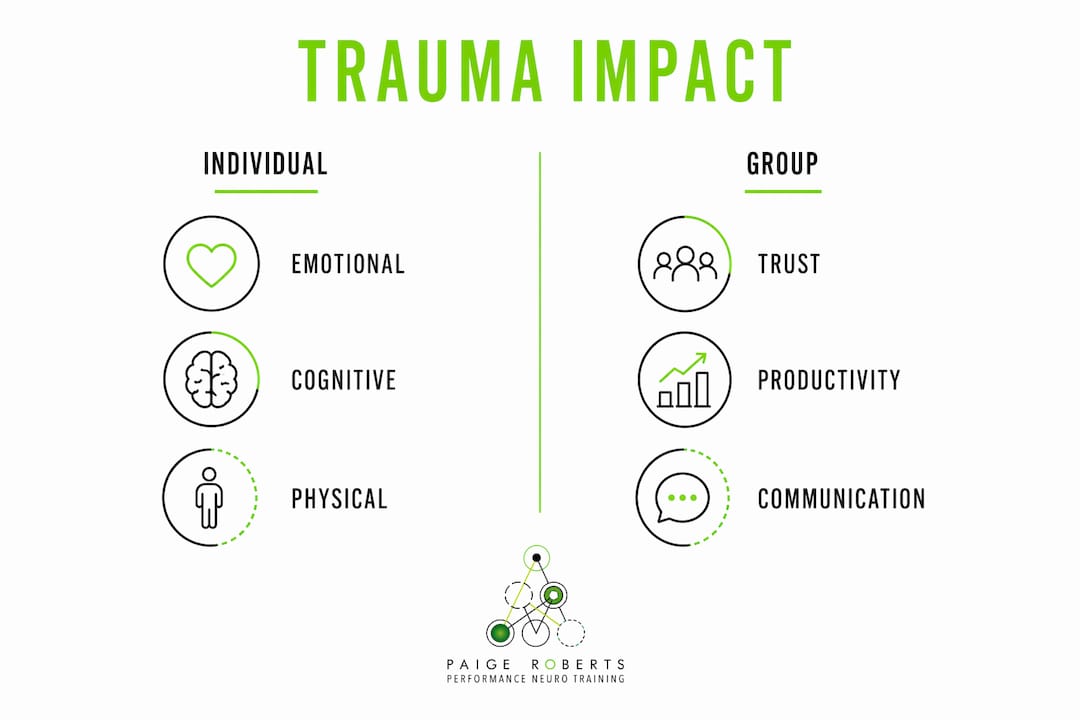
The table above reflects a pattern that plays out across industries: individual trauma effects aggregate into group-level dysfunction faster than most leaders expect. By the time productivity metrics visibly decline, the relational damage has usually been building for months.
Trauma-informed strategies that actually restore team performance
The instinct to monitor KPIs more closely when a team underperforms is understandable. It is also usually the wrong move when trauma is the root cause. Leaders frequently misattribute trauma-driven declines to individual capability, which worsens outcomes by adding pressure to people who are already overwhelmed.
Here is what works instead:
- Manage environmental boundaries. Protect the team from additional stressors coming from outside: senior leadership demands, client pressure, or organizational noise. Managers who lack the resolve to buffer their teams inadvertently amplify the trauma load.
- Diagnose systemic root causes first. Before any intervention, identify systemic friction rather than blaming individuals. Ask where, when, and why the team's capacity gets overwhelmed, not who is failing.
- Increase face-to-face communication. One team member with high negative affect disproportionately impairs group cohesion, and increased in-person contact is one of the most effective ways to counteract that pull. Regular team huddles create the shared context that trauma erodes.
- Create protected spaces for open dialogue. Team members know more about the barriers to their own performance than any manager does. Structured conversations where people can name what is happening, without judgment, shift the group from victim to agent. Explore psychological safety practices that translate directly to workplace team contexts.
- Delegate autonomy deliberately. The central experience of trauma is helplessness. Delegation, empowerment, and opportunities to learn directly counter that experience. This is not about loosening oversight; it is about giving people experiences of agency and efficacy.
- Acknowledge distress genuinely. Empty clichés leave people feeling more isolated. Genuine acknowledgment means sitting with someone, hearing their account, and responding with real empathy rather than a scripted reassurance.
- Model sustainable limits as a leader. Leaders who project a superhuman work ethic inadvertently signal that struggling is shameful. Working within visible boundaries, taking breaks, and delegating openly gives the team permission to do the same.
Pro Tip: Build shared mental models into your team's regular rhythm through brief pre-meeting alignment checks. When everyone understands the current priorities and each person's role in them, the cognitive load of uncertainty drops, and so does the ambient anxiety that trauma feeds on.
Effective trauma team leadership consistently involves shared goals, defined roles, closed-loop communication, and the psychological safety for members to flag problems without fear. These are not soft skills. They are the structural conditions that determine whether a team can function under strain.

What neuroscience reveals about trauma and team performance
The science behind why team trauma affects group performance goes deeper than behavior. It reaches into how the brain organizes knowledge, coordinates action, and maintains functioning under stress.
One of the most useful concepts here is the Transactive Memory System (TMS): a shared understanding within a team of who knows what and who handles which tasks. Research on hospital trauma teams found that increasing TMS improves hospital and ICU stay durations, demonstrating measurable performance gains. That is a concrete, measurable performance gain driven entirely by how well a team's collective knowledge is organized and accessed under pressure. When trauma disrupts this system, the cognitive collapse that follows is not metaphorical. People genuinely lose access to the distributed knowledge network they depend on.
Shared professional identity works as a parallel buffer. Shared identity enables teams to contain emotions and maintain functioning under trauma-induced stress, which is why teams with strong cohesion before a crisis tend to recover faster than those without it. The identity gives members something to anchor to when individual coping capacity runs thin.
High-performing teams under stress also maintain what researchers call shared mental models: proactive information sharing, mutual monitoring, and clear expectations about how the group will respond to new information. These models do not emerge naturally under pressure. They are built deliberately, through regular communication and structured team practices, before the pressure arrives.
This is where neuroscience-based approaches to performance recovery become relevant for organizational leaders, not just athletes. Techniques that retrain the nervous system's response to stress, restoring a state of flow and agency rather than freeze and helplessness, address the same neural mechanisms that trauma disrupts in any high-performance context. The mindset factors that drive recovery in fitness and wellness settings map directly onto what traumatized teams need: a shift from reactive survival mode to proactive, confident engagement.
How Robertsneurotraining can help teams and athletes overcome trauma-induced blocks
Robertsneurotraining, led by Dr. Paige Roberts, applies a neuroscience-based method called Alpha Imprinting to reprogram the nervous system's trauma responses. The approach directly targets the mental blocks, performance anxiety, and freeze states that trauma installs, replacing them with the neural patterns associated with flow, agency, and peak performance. Olympic medalists have used these techniques to recover from injury-related trauma and return to competition at a higher level than before.
For team leaders and organizational professionals, the implications extend beyond individual athletes. The same nervous system mechanisms that cause an athlete to freeze under pressure cause a traumatized team member to withdraw, shut down, or react defensively. Addressing those patterns at the neural level, rather than through behavioral coaching alone, produces faster and more durable results.
Key Takeaways
Team trauma degrades group performance by collapsing psychological coping capacity, fracturing relational trust, and triggering defense mechanisms that block collaboration and effective work.
| Point | Details |
|---|---|
| Trauma overwhelms capacity | Teams under trauma cannot complete work or maintain healthy relationships, regardless of individual skill levels. |
| Cognitive impairment spreads | Reduced working memory and emotional regulation impair decision-making and collaboration across the whole group. |
| TMS drives measurable gains | Increasing a team's Transactive Memory System measurably improves hospital ICU stay durations, showing the concrete value of shared knowledge structures. |
| Delegation counters helplessness | Giving team members autonomy and learning opportunities directly offsets the powerlessness that sits at trauma's core. |
| Shared identity buffers stress | Teams with strong collective identity contain emotions more effectively and maintain functioning longer under trauma-induced strain. |