
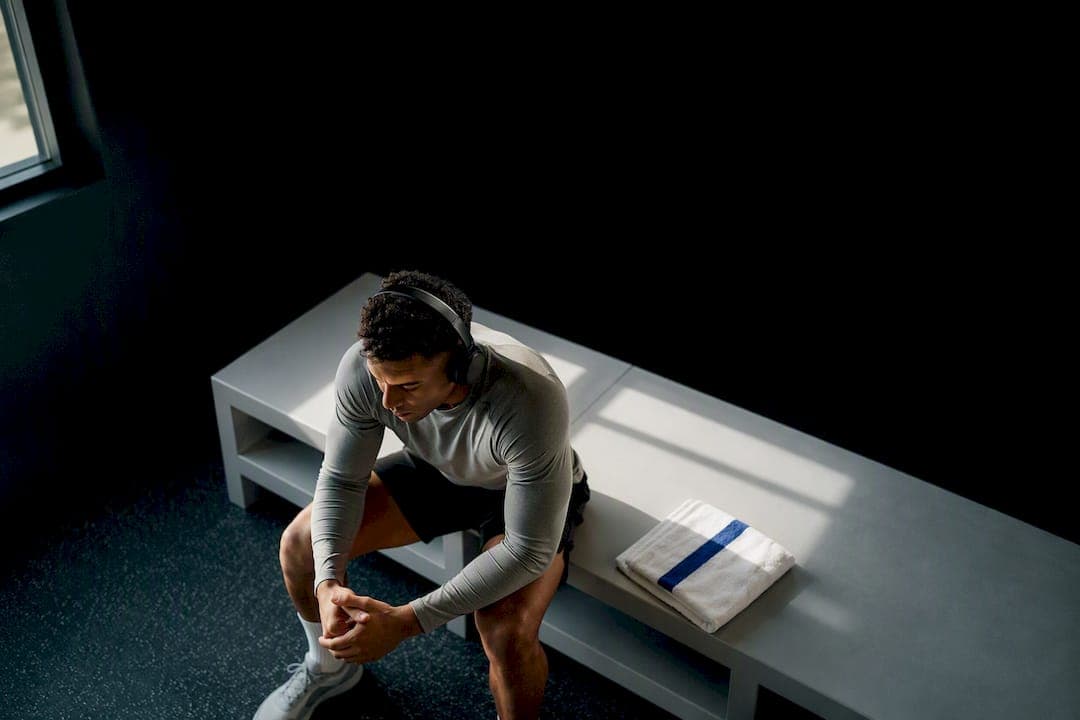
Clinician-led, QEEG-guided audio-visual entrainment (AVE) and binaural protocols, including the Alpha Imprinting method, can measurably improve focus and reduce performance blocks in competitive athletes. Providers like Roberts Neurotraining, under Dr. Paige Roberts, use randomized trial evidence and HRV tracking to personalize sessions rather than hand athletes a generic playlist. The benefit is real but bounded: expect acute and short-term gains, not a one-session fix.
TL;DR:
- Personalization through QEEG mapping is crucial, as frequencies targeted should match individual neural deviations, not generic charts or playlists.
- Short-term improvements are supported by small trials, such as increased striking speed and lowered perceived exertion in kickboxers using 15 Hz beta beats.
- Protocol timing matters: beta for pre-performance, alpha for emotional stabilization, and theta for recovery, with personalization based on actual brain maps.
- Clinician screening is essential, especially for seizure history, photosensitivity, or psychiatric conditions, to avoid adverse reactions.
- Continuous outcome tracking via HRV and performance metrics is necessary to reliably measure and adjust entrainment protocols.
Table of Contents
- What Are Binaural Beats for Focus in Clinical Neurotraining?
- What Does the Clinical Evidence Actually Show?
- How Do You Structure a Binaural Beats Protocol for Athletic Focus?
- Who Should Avoid AVE Without Medical Clearance First?
- How Do You Choose the Right Clinician or Program?
- How Roberts Neurotraining Applies QEEG-Guided Entrainment
- When Is Clinician-Led Entrainment Actually the Right Call?
- Ready to Start Your Own QEEG-Guided Protocol?
- Primary Sources for Further Reading
- Sources
What Are Binaural Beats for Focus in Clinical Neurotraining?
In a clinical neurotraining context, binaural beats for focus means something different from the playlist you'd stream before a study session. Audio-visual entrainment delivers a slightly different tone to each ear (or a synchronized light pulse alongside it), and the brain perceives a third phantom frequency that can nudge cortical activity toward a target rhythm. The clinical version starts with a quantitative EEG (QEEG) brain map that identifies where an athlete's neural activity deviates from what their sport demands, then selects a frequency to correct that specific pattern.
That's the split from consumer use: personalization versus a static file everyone hears the same way. A sprinter with elevated frontal slow-wave activity under pressure needs a different target than a golfer whose visual-motor integration lags after a concussion.
The clinician workflow typically runs like this — incorporating advanced eccentric loading techniques to build explosiveness alongside QEEG-guided entrainment:
- Intake interview covering performance history, injuries, and mental blocks
- Baseline QEEG scan to map deviations from sport-specific targets
- Frequency and modality selection (audio-only binaural or combined AVE)
- Supervised sessions, often via telehealth, with real-time adjustment
- Outcome tracking through repeat QEEG and physiological markers
What Does the Clinical Evidence Actually Show?
The strongest data point comes from a randomized crossover trial of 19 amateur kickboxers, where 15 Hz beta binaural beats layered into preferred music during inter-round recovery improved striking frequency and peak velocity while cutting perceived exertion and blood lactate. The effect sizes were large for a sports psychology study (η2p ≥ 0.29), though a sample of 19 fighters means the finding needs replication before anyone calls it settled science.
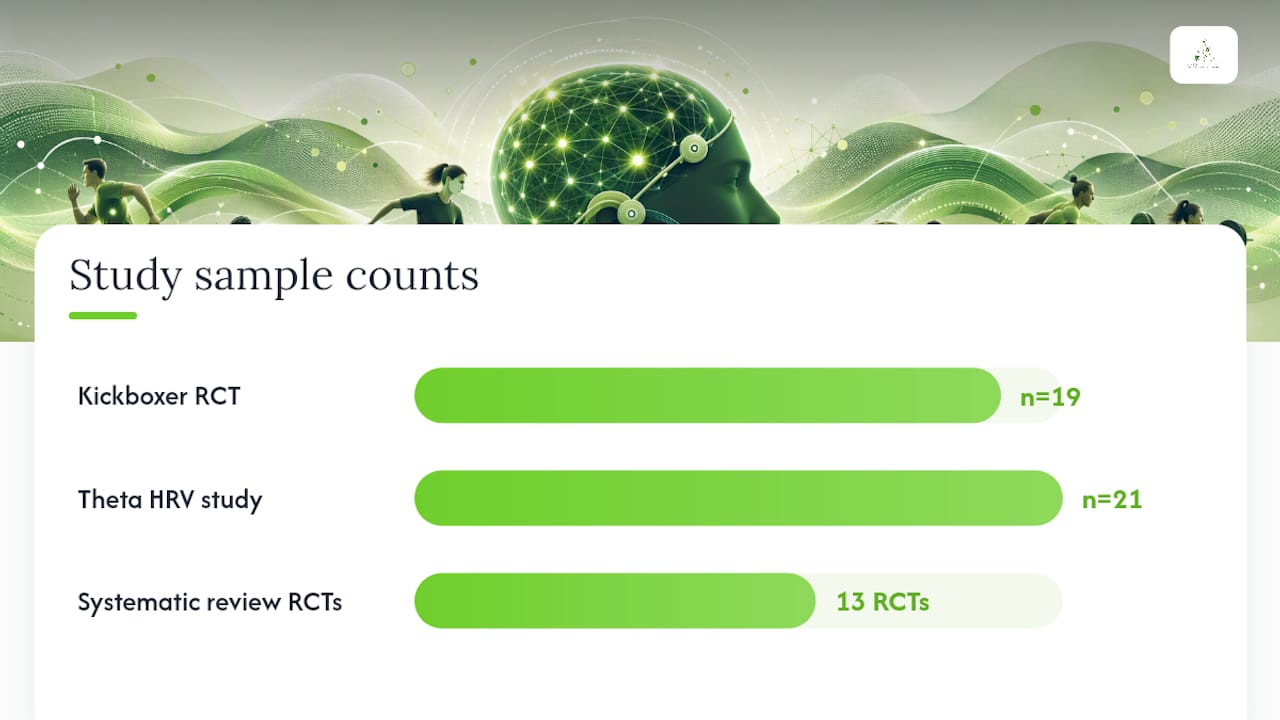
On the recovery side, a within-subject HRV study found that 20 minutes of theta-frequency binaural beats after exercise increased parasympathetic activation and predicted how relaxed subjects said they felt. That's a mechanism athletes care about directly: faster autonomic recovery between efforts.
Quick data snapshot:
- 15 Hz beta + music: improved striking metrics and lowered RPE/lactate in kickboxers (n=19)
- Theta post-exercise: raised HF-HRV and subjective relaxation (n=21)
- 14 Hz AVE over 4 weeks: measurable QEEG shifts tied to symptom improvement in a separate clinical population
A systematic review of EEG neurofeedback in sport found only 13 randomized trials met strict inclusion criteria out of a much larger pool, with inconsistent methods across most of them. That's the honest limit here: small-sample trials show consistent immediate autonomic and neurophysiological shifts, but long-term performance data is still catching up. It's the exact gap QEEG-guided targeting is meant to close, matching the stimulus to the individual brain instead of applying one frequency to everyone.
How Do You Structure a Binaural Beats Protocol for Athletic Focus?
Timing and frequency choice matter more than most athletes expect. A frequency that sharpens focus before a competition can backfire if used during the wrong window.
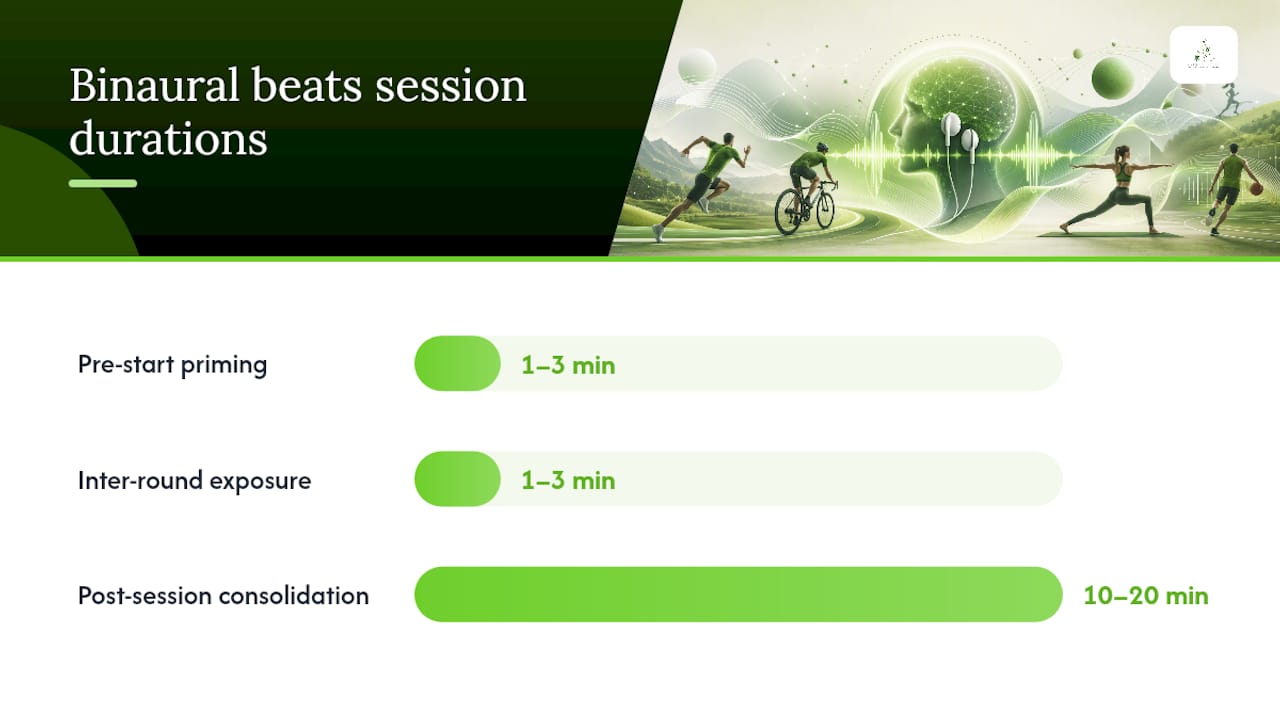
- Pre-start priming (1 to 3 minutes): Beta-range entrainment near 15 Hz for arousal and attentional readiness right before performance.
- Inter-round or between-set exposure (1 to 3 minutes): The same beta protocol, often embedded in preferred music, which the 2025 kickboxing trial linked to faster physiological recovery between efforts.
- Post-session consolidation (10 to 20 minutes): Theta (4 to 7 Hz) for parasympathetic recovery, or alpha (8 to 12 Hz) when the goal is emotional stabilization rather than deep relaxation.
Frequency selection should never be one-size-fits-all. Beta around 14 to 15 Hz tends to support attention and sensorimotor readiness, alpha sub-bands relate to stabilization and recall, and theta supports relaxation and recovery, but QEEG-guided personalization ties the choice to what an individual athlete's brain map actually shows rather than a generic chart.
On devices: headphones deliver binaural audio alone, which is simpler for travel and competition-day use. Combined AVE systems (light glasses paired with audio) add a visual entrainment channel, which pilot work on structured visual stimulation suggests can support short-term psychophysiological gains, but they require more setup and closer supervision at home.
Pro Tip: Track resting HRV and a simple RPE score before and after each block. A clinician can't personalize a protocol they can't measure, and neither can you.
Who Should Avoid AVE Without Medical Clearance First?
Screening comes before any session, not after a bad reaction.
- Personal or family history of seizures or epilepsy requires medical clearance before visual entrainment
- Photosensitivity should shift the protocol to audio-only binaural beats
- Severe psychiatric conditions or dissociative symptoms need a clinician's judgment call, not self-administration
- Implanted electronic devices (pacemakers, neurostimulators) require a supervising physician's sign-off
Once cleared, monitor for headache, dizziness, or unusual anxiety during early sessions and titrate exposure time down if they appear. This is precisely why clinician-led QEEG mapping and telehealth check-ins matter: someone qualified is watching the response, not just the protocol.
How Do You Choose the Right Clinician or Program?
Credentials first: look for a clinical license, documented QEEG training, and real experience with competitive athletes, not general wellness clients.
A legitimate program should include baseline QEEG scanning, individualized frequency targets tied to that scan, measurable outcome tracking session to session, and support for in-home devices between visits.
Ask prospective providers:
- Do you run a baseline QEEG before recommending a frequency?
- How do you personalize targets to my sport and my history?
- What outcome metrics do you track, and how often?
- Is telehealth supervision included between in-person visits?
- What's your experience with injury-related performance blocks?
- Do you support in-home AVE devices, and how?
- What's a realistic timeline before I see change?
- How do you screen for seizure history and photosensitivity?
Walk away from anyone selling a single frequency for every athlete, skipping outcome tracking entirely, or marketing a consumer playlist as a clinical treatment.
How Roberts Neurotraining Applies QEEG-Guided Entrainment
Roberts Neurotraining, under Dr. Paige Roberts, builds each athlete's program around a baseline QEEG scan, then layers in the proprietary Alpha Imprinting protocol to address trauma-driven performance blocks that a generic entrainment file can't touch. Sessions run through telehealth with in-home device support, and the 10-week Energy Optimization Program has helped athletes, including Olympic medalists, work through panic and post-injury anxiety that standard sports psychology missed.
When Is Clinician-Led Entrainment Actually the Right Call?
I recommend clinician-led AVE when an athlete has hit a wall that talk therapy or generic mental skills coaching hasn't moved. That's usually a persistent performance block, post-injury anxiety that shows up under competitive pressure, or a pattern where nothing standard has worked twice in a row.
Realistically, expect measurable shifts within a handful of sessions, not one. Start with a baseline QEEG, run a short supervised trial, and track HRV and outcome metrics before deciding whether to continue.
— Paige
Ready to Start Your Own QEEG-Guided Protocol?
Generic focus apps and off-the-shelf playlists can't personalize to your nervous system the way a baseline QEEG scan can. Roberts Neurotraining builds every protocol around your own brain map instead of a frequency picked for the average listener, which is the entire reason clinician-led work outperforms self-directed entrainment for athletes stuck on a real performance block.
First contact typically starts with a QEEG intake, a short supervised trial protocol, and outcome tracking so you and your clinician can see whether it's working, not guess. If you want a lower-commitment starting point, the Energy Optimization Workbook walks you through the same framework before you book a session. Athletes recovering from injury-related blocks can also see how the approach applies directly on the neuroscience-based recovery page. When you're ready for a full intake, reach out through Roberts Neurotraining to schedule your baseline QEEG and first supervised session.
Primary Sources for Further Reading
For verification, the kickboxing performance trial and its striking-velocity data are in Frontiers in Psychology (2025). The HRV and relaxation findings come from Frontiers in Psychology (2014). QEEG changes tied to AVE outcomes are documented in the ISNR Journal of Neurotherapy.
This article is general information, not a substitute for advice from a qualified doctor. Consult a qualified healthcare professional about your own circumstances before acting on anything here.
Sources
- Beta frequency binaural beats combined with preferred music enhance combat performance and recovery responses in amateur kickboxers: a randomized crossover trial
- QEEG correlates of auditory‑visual entrainment treatment efficacy of refractory depression