
Breathwork calms your nervous system faster than meditation does. Meditation builds attention and emotional resilience that lasts longer. If you're panicking before a race or spiraling before a meeting, breathe first. If you're trying to rewire how you handle stress over months, meditate consistently. Doing both, in that order, tends to work better than either alone, though intense breathwork isn't safe for everyone.
TL;DR:
- Breathwork techniques that emphasize longer exhalations, such as cyclic sighing and coherent breathing, can produce rapid calming effects within minutes.
- Meditation primarily enhances attention and emotional resilience over weeks or months, with effects manifesting gradually rather than acutely.
- Intense or hyperventilation-style breathwork can trigger dizziness or panic and may be unsuitable for those with certain health conditions or trauma histories.
- For immediate stress relief, breathwork is the most effective, while meditation is better suited for long-term reactivity reduction and focus building.
- Combining short breathwork sessions with regular meditation creates a fast-acting calm and sustained mental resilience over time.
Table of Contents
- Breathwork vs Meditation: What Breathwork Actually Is
- Meditation vs Mindfulness: What Meditation Trains
- How Do Breathwork and Meditation Compare Directly?
- What Does the Research Say About Breathwork and Meditation?
- Who Should Choose Breathwork or Meditation, and When Is It Risky?
- How Do You Choose Between Breathwork and Meditation?
- Simple Breathwork and Meditation Practices to Try Today
- What Athletes and High Performers Get Wrong About Nervous System Training
- When Self-Directed Practice Isn't Enough
- Sources
- FAQ
Breathwork vs Meditation: What Breathwork Actually Is
Breathwork means deliberately controlling the rate, depth, or pattern of your breathing instead of letting it run on autopilot. Your breathing is one of the few autonomic functions you can consciously override, and that override gives you direct access to your nervous system in a way that thinking your way calm rarely does.
Not all breathwork techniques aim for the same result. Some calm you down. Others rev you up. The distinction matters more than most people realize.
- Cyclic sighing: a double inhale through the nose followed by a long, slow exhale through the mouth. This is the technique behind the Stanford-linked trial showing rapid mood improvement.
- Box breathing: inhale, hold, exhale, hold, each for an equal count, usually four seconds.
- Coherent breathing: slow, even breaths around five to six per minute, a pace shown to reliably raise heart rate variability in structured breathing research.
- Diaphragmatic breathing: deep belly breathing that emphasizes the exhale and engages the vagus nerve.
- High-arousal methods like Wim Hof-style breathing or holotropic breathwork intentionally push you toward hyperventilation. They're a different tool entirely and not the place to start if your goal is calm.
The mechanism behind the calming techniques is fairly well understood. A longer exhale relative to inhale activates the vagus nerve and shifts your body toward parasympathetic dominance, which is the physiological state associated with feeling settled rather than on edge. Nasal breathing tends to slow the rate naturally compared to mouth breathing, which is part of why so many techniques specify it. Sessions lasting a few minutes can produce a noticeable subjective shift, which is the entire appeal of breathwork as a tool: it works on the timescale of an actual crisis, not a therapy arc.
Pro Tip: If you only remember one thing, remember the exhale. Almost every calming breathwork technique works by making your exhale longer than your inhale. Try a 4 count in, 6 or 8 count out, and you've got the core mechanism without needing to memorize a named protocol.
Meditation vs Mindfulness: What Meditation Trains
Meditation trains attention, not relaxation, though relaxation is often a side effect. That distinction confuses a lot of beginners who sit down expecting instant calm and instead get twenty minutes of noticing how loud their own thoughts are.
Meditation vs mindfulness is a common point of confusion worth clearing up: mindfulness is one meditation style, not a synonym for the whole category. The broader landscape includes several distinct approaches.
- Mindfulness meditation: observing thoughts, sensations, and breath without judgment, letting them pass rather than engaging.
- Concentrative meditation: fixing attention on a single point, like a candle flame, a mantra, or the breath itself.
- Loving-kindness meditation: directing goodwill toward yourself and others in a structured sequence.
- Guided meditation: following a narrated practice, often useful for beginners who find silent sitting difficult.
The NHS's guidance on learning to meditate makes a point that deserves more attention: a wandering mind isn't a sign you're doing it wrong. Noticing the wandering and returning to your anchor is the actual exercise, not a failure of the exercise.
The payoff builds over weeks and months rather than minutes. Longitudinal studies associate regular practice with better attention control, reduced rumination, and measurable changes in brain structure over time, and Mayo Clinic's overview of meditation frames it explicitly as a skill that starts small and extends with practice. Meditation doesn't interrupt a panic spiral the way a good exhale does. What it does instead is slowly change your baseline reactivity, so there's less spiraling to interrupt in the first place.
How Do Breathwork and Meditation Compare Directly?
Line the two up against each other and the differences sort into a few clear categories, each pointing toward a different use case depending on what you actually need in the moment.
- Immediacy of effect. Breathwork wins here, often producing a felt shift within minutes because it works directly on autonomic arousal. Meditation's effects accumulate over sessions and weeks rather than announcing themselves in a single sitting.
- Primary mechanism. Breathwork operates on the physiological layer, autonomic nervous system, vagal tone, respiratory rate. Meditation operates on the attentional and cognitive layer, training how you relate to thoughts and where your focus goes.
- Typical time commitment. A calming breathwork session runs three to ten minutes and can be repeated multiple times a day as needed. Meditation benefits from a steadier five to twenty minute daily rhythm, with consistency mattering more than any single session's length.
- Safety and contraindications. Meditation is broadly safe for almost everyone. Certain breathwork techniques, particularly the high-arousal, breath-holding, or hyperventilation styles, carry real contraindications covered in the next section.
- Best use case. Breathwork suits acute panic, pre-performance nerves, and getting to sleep faster. Meditation suits chronic stress patterns, rumination, and building the kind of durable emotional resilience that shows up months later, not minutes later.
The practical takeaway: if you're asking "what do I do right now," breathwork answers that question. If you're asking "how do I stop needing to ask that question so often," meditation is the longer answer. Athletes prepping for competition often need both on different timelines, cyclic sighing in the tunnel before the game, meditation as a season-long habit that lowers overall reactivity.
What Does the Research Say About Breathwork and Meditation?
The strongest current evidence for breathwork comes from a 2023 meta-analysis of 12 randomized controlled trials covering 785 adults, which found a small-to-medium reduction in subjective stress.
The pooled effect for stress reduction came in at g = −0.35 (95% CI −0.55 to −0.14, p = 0.0009), with comparable significant reductions for anxiety and depressive symptoms across the same trial pool.
That's a real signal, not a placebo-sized blip, though it's worth being honest about what "small-to-medium" means in practice: noticeable, not miraculous.
A separate 2023 remote randomized trial tested something more specific: five minutes of daily cyclic sighing against five minutes of equivalent daily mindfulness meditation over one month. The breathwork group showed greater improvements in positive affect and a bigger drop in resting respiratory rate than the meditation group, at matched time investment. That's a meaningful data point for anyone assuming meditation is always the superior long-game choice. At equal time, breath won on speed.
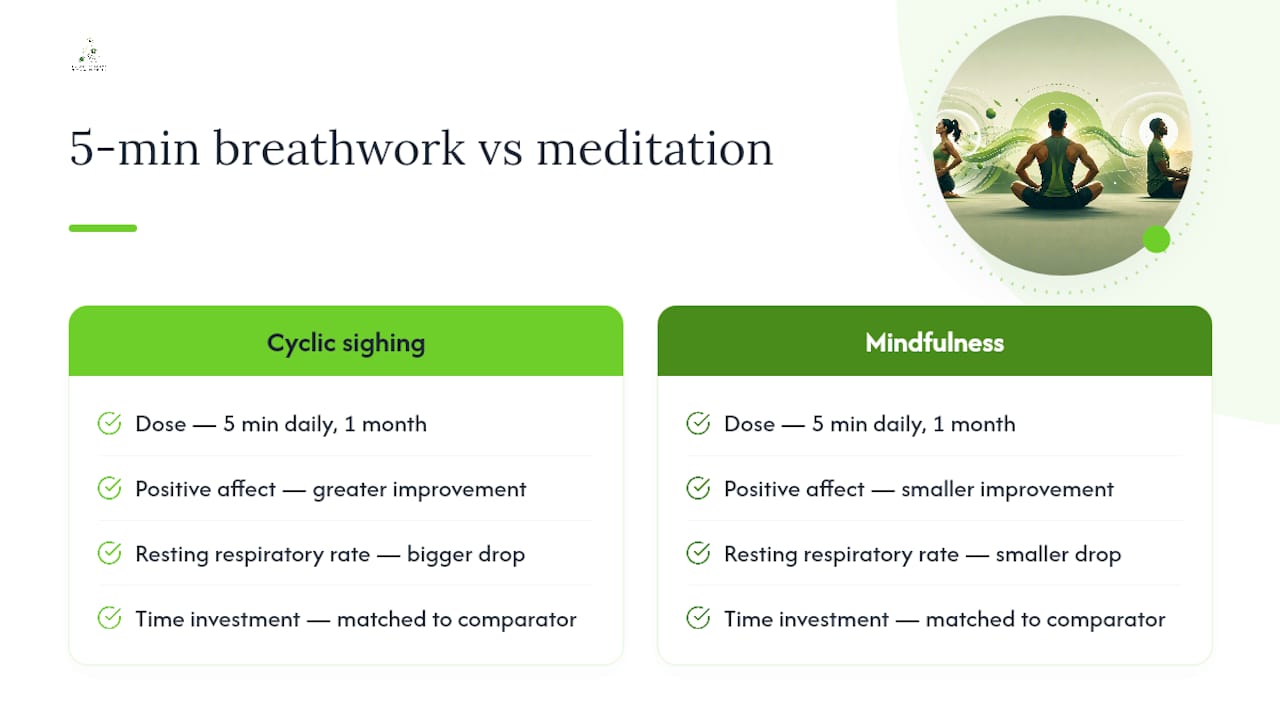
The evidence in one line: breathwork's stress-reduction effect size (g = −0.35) sits in the same range clinicians consider clinically meaningful for short daily interventions, not just a self-reported feel-good bump.
None of this is settled science, though. The meta-analysis itself flags moderate risk of bias across many included trials, along with real heterogeneity in techniques, dosages, and populations studied. A 2025 mechanistic review adds an important caveat: while structured breathing reliably shifts heart rate variability and autonomic markers, the evidence does not yet establish that any one breathing technique beats another for most clinical outcomes. Translation: breathwork works, but the field hasn't nailed down exactly which version works best for whom.
Who Should Choose Breathwork or Meditation, and When Is It Risky?
Breathwork tends to suit people dealing with acute anxiety spikes, panic responses, pre-performance jitters, or trouble winding down for sleep. Meditation tends to suit people whose problem is more chronic, ongoing rumination, a generally reactive baseline, difficulty sustaining focus. Athletes often benefit from both: breathwork to reset between reps or before competition, meditation as a season-long practice that lowers overall reactivity.
Not every breathwork technique is safe for every person, and that's the part general wellness content tends to skip.
- Intense or hyperventilation-style techniques can trigger dizziness, tingling in the extremities, or a full panic response, particularly in people with existing anxiety disorders.
- People with cardiovascular disease, uncontrolled hypertension, or respiratory conditions like severe asthma or COPD should get medical clearance before trying breath-holding or rapid-breathing protocols.
- Pregnant individuals should avoid forceful breath-holding techniques and stick to gentle, slow-paced patterns.
- Trauma history matters. Rapid or forced breathing can sometimes surface intense emotional or somatic responses, which is why trauma-informed facilitation exists as its own specialty.
Pro Tip: Before trying any activating breathwork technique for the first time, do it seated, in a quiet space, with nothing scheduled immediately after. If you feel lightheaded or panicky, stop and return to normal breathing. That's not failure, that's your nervous system telling you the dose was too high.
When choosing an instructor for anything beyond basic slow breathing, ask directly whether they're trained in trauma-informed facilitation and how they handle a client who has a strong emotional reaction mid-session.
How Do You Choose Between Breathwork and Meditation?
The decision usually comes down to one question: are you trying to calm something down right now, or build a different baseline over time? If you're in active distress, breathe first, always. Meditation asks you to sit with discomfort, which is nearly impossible to do productively while your nervous system is flooded. Regulate, then deepen.
- Name your goal. Acute calm points to breathwork. Long-term resilience or focus points to meditation.
- Check your physical tolerance. If you have a cardiovascular or respiratory condition, stick to gentle paced breathing and skip intense protocols until you've talked to a doctor.
- Be honest about time. Three minutes available means breathwork. Fifteen consistent minutes daily makes meditation worthwhile.
- Consider your history. A trauma background means any breathwork beyond basic slow breathing should happen with a trauma-informed guide, not a random app.
- When in doubt, sequence them. Two to five minutes of breathwork to bring your system down, followed by meditation once you're actually settled enough to sit still with your thoughts.
If symptoms are severe or persistent, panic attacks, chronic insomnia, unresolved trauma responses, a conversation with a therapist or physician belongs ahead of any self-directed technique, breath or meditation alike.
Simple Breathwork and Meditation Practices to Try Today
Start small enough that you'll actually repeat it tomorrow.
- Cyclic sighing (3 to 5 minutes): double inhale through the nose, then one long, slow exhale through the mouth. Repeat.
- Box breathing (2 to 5 minutes): inhale for four counts, hold four, exhale four, hold four.
- Coherent breathing (3 to 6 minutes): inhale for a count of four, exhale for a count of eight, aiming for roughly five to six breaths per minute.
- Breath awareness meditation (5 to 10 minutes): sit quietly, notice the breath without controlling it, return attention each time it drifts.
- Guided body scan (10 to 12 minutes): move attention slowly from feet to head, noticing sensation without trying to change anything.
- Loving-kindness primer (5 minutes): silently repeat a phrase of goodwill, starting with yourself, then extending outward.
Pro Tip: Stack them. Two to five minutes of breathwork followed by eight to twelve minutes of meditation gets you both the fast down-regulation and the attentional training in one sitting, and it's the sequence clinicians increasingly recommend for exactly that reason.
What Athletes and High Performers Get Wrong About Nervous System Training
Regulate first, deepen second isn't just a nice sequencing tip, it's how the nervous system actually works. You cannot meditate your way out of a flooded state any more than you can think your way out of a full sprint. Breathwork buys the physiological window that makes deeper capacity work possible. For athletes carrying old injury trauma or performance anxiety that self-directed practice hasn't resolved, structured, supervised nervous-system retraining can close a gap that breathing exercises alone won't touch.
— Paige
When Self-Directed Practice Isn't Enough
Cyclic sighing and a solid meditation habit handle a lot of everyday stress. They don't always touch the deeper stuff, old injury trauma, performance anxiety that resurfaces at the worst moment, a nervous system stuck in a fight-or-flight loop that no amount of box breathing seems to fully unwind. That's a different problem than daily stress management, and it usually needs a different level of intervention.
Specialist services exist that work with athletes and high performers at that deeper layer through protocols designed to retrain the nervous system's response to pressure rather than just manage its symptoms in the moment. Sessions often involve brain mapping to see what's actually happening under the hood, followed by targeted retraining so the mental block that shows up under competition pressure gets addressed at its source instead of coped with every single time it appears. If you're a competitive athlete whose performance anxiety keeps resurfacing despite consistent breathwork and meditation, or you're returning from injury and the block feels more mental than physical, explore Alpha Imprinting and book a consultation to see if supervised nervous-system retraining fits where you're at, whether you compete in tennis, baseball, or another sport entirely.
Sources
- PubMed entry for breathwork meta-analysis (2023)
- Cyclic sighing trial (2023) — PMC
- Frontiers review on neurophysiological mechanisms of breathing-based practices (2025)
Talk to a clinician before starting any intense breathwork protocol if you have a cardiovascular, respiratory, or trauma-related concern.
This article is general information, not a substitute for advice from a qualified doctor. Consult a qualified healthcare professional about your own circumstances before acting on anything here.
FAQ
Why Do People Scream During Breathwork?
Intense breathwork styles, particularly holotropic and other hyperventilation-based methods, can trigger strong emotional or somatic release, and vocalizing, including screaming, sometimes happens as tension discharges. It's not universal and isn't something gentle, calming techniques like cyclic sighing typically produce.
What Are the Potential Downsides of Breathwork?
Intense techniques can cause dizziness, tingling, lightheadedness, or panic, especially in people with anxiety disorders, cardiovascular conditions, or trauma histories. Milder techniques like box breathing or coherent breathing carry minimal risk for most healthy adults.
What Happens When You Do Breathwork Every Day?
Daily practice, even just five minutes, has been shown in a randomized trial to improve positive affect and lower resting respiratory rate over one month. Consistency at low doses appears to matter more than occasional longer sessions.
Who Should Not Do Breathwork?
People with uncontrolled cardiovascular disease, severe respiratory conditions, or pregnancy should avoid intense breath-holding or hyperventilation techniques without medical clearance. Those with significant trauma histories should work with a trauma-informed instructor rather than trying activating protocols alone, and anyone with performance anxiety that persists despite regular practice may benefit from supervised approaches like nervous system reset training.