

Choking under pressure is a sudden drop in performance below your normal baseline when the stakes rise, and it's not a talent problem. It's a brain-and-body response, and it responds well to the right kind of training. Most people can train their way out of it with targeted practice and attentional techniques. A smaller group of cases, usually marked by frozen or "locked" movements that won't release even with effort, need clinical-level support like graded exposure therapy.
TL;DR:
- Choking under pressure occurs when performance drops significantly due to over-attention, distraction, or over-arousal, not a lack of skill.
- Pressure causes the prefrontal cortex to compete with motor circuits, leading to freeze or locked movements that persist across attempts.
- Recognizable signs include blanking on known information, muscle tightness, freezing mid-movement, and rushing techniques, especially under high-stakes conditions.
- Effective training involves simulated pressure practice, external focus cues, consistent routines, breathing control, and graded exposure.
- Severe cases with persistent, locked movement patterns may require clinical support like EMDR, alongside sport psychology interventions.
Table of Contents
- What Choking Under Pressure Actually Means
- The Three Ways Pressure Breaks Down Performance
- Recognizing Choking When It's Happening to You
- How to Train Yourself Out of Choking
- When Choking Becomes a Performance Block
- A Practical Weekly System for Training Under Pressure
- A Coaching Note on What Actually Fixes This
- How Robertsneurotraining Can Help You Train for Pressure
- Sources
What Choking Under Pressure Actually Means
Choking is performing significantly worse than your established baseline in a high-stakes moment, driven by pressure or anxiety rather than a lack of skill. That's the core definition researchers use, and it matters because it draws a hard line between choking and simply being undertrained. A golfer who has never broken 90 isn't choking when he shoots 95 in a tournament. He's playing at his level. The golfer who normally shoots 78 and suddenly can't putt from three feet during the club championship is choking.
This shows up anywhere performance has to happen live, under evaluation, with something real on the line:
- Competitive sports, from a missed free throw to the putting yips that end amateur careers
- Academic testing, where a well-prepared student blanks on material they knew cold the night before
- Public speaking and presentations, where the mind goes empty mid-sentence
- Job interviews and high-stakes negotiations
- Surgical and procedural work, where a practiced hand suddenly hesitates
The common thread is a well-learned skill breaking down specifically because the moment matters more than usual, as research on choking's theoretical models lays out.
The Three Ways Pressure Breaks Down Performance
Researchers point to three overlapping explanations, and knowing which one applies to you changes what fix actually works.
The first is explicit monitoring, sometimes called reinvestment or "paralysis by analysis." Skills that were automatic suddenly get dragged back into conscious control. A pitcher who has thrown the same motion ten thousand times starts thinking about elbow angle mid-windup, and the fluid motion falls apart. Cognitive scientist Sian Beilock's lab work found that over-attention to mechanics is exactly what causes skilled performers to fumble tasks they could otherwise do in their sleep, a pattern she documented in golf and soccer studies covered by NPR's reporting on the science of choking.
The second is the distraction account: worry about outcomes eats up the limited attention your brain has for the task itself. The third is over-arousal, tied to the old Yerkes-Dodson law showing performance rises with arousal only up to a point, then collapses as anxiety floods the system.
The prefrontal cortex, built for deliberate problem-solving, starts competing with the motor circuits that should be running the show on autopilot. That tug-of-war between the dorsolateral prefrontal cortex, the anterior cingulate cortex, and the brain's reward circuitry is where choking actually lives.
Frontiers research on incentive-induced performance decrements ties these mechanisms directly to executive and motivation circuits in the brain. More recently, neural recordings out of Carnegie Mellon captured how pressure physically alters motor-control activity at the cell level, giving choking a biological signature rather than just a psychological label.
Recognizing Choking When It's Happening to You
Choking has a recognizable signature, and telling it apart from ordinary nerves matters because the fix is different. Ordinary nerves fade once you start moving. Choking gets worse the moment execution begins.
Watch for these signs:
- Blanking on information or steps you know cold
- Freezing mid-motion, especially in fine motor tasks like putting, free throws, or surgical precision
- Sudden muscle tightness or tremor in hands you normally control easily
- Rushing technique, skipping steps you'd never skip in practice
Common triggers include a live audience, a big financial or career incentive, protecting a lead you've already built, or simply facing a pressure context you've never trained for. This is the mechanism behind the sports yips, the mid-interview blank, and the test-taking freeze that hits a student who studied for weeks.
How to Train Yourself Out of Choking
The good news backed by the research: choking responds to specific training, not generic "relax and trust yourself" advice.
- Practice under simulated pressure. Beilock's applied work shows that rehearsing with real, incremental stakes, cameras, small bets, an audience, is what actually inoculates you. Practicing calm and performing under stress are two different skills.
- Use a single external focus cue instead of a mantra about mechanics. Thinking "smooth follow-through" during a golf swing invites monitoring. Thinking about the target instead keeps attention outward, where automatic skills run best.
- Build a pre-performance routine that's identical every time. A fixed sequence, same warmup, same breath pattern, same physical trigger, gives your nervous system a cue that this is familiar territory, even when the setting isn't.
- Control arousal directly with breathing. Slow, extended exhales lower physiological arousal enough to pull you back from the far end of the Yerkes-Dodson curve without dulling the readiness you need to perform.
- Use graded exposure as a bridge to automaticity. Start at a stress level you can handle without breaking down, then increase it week over week. This is the same principle behind clinical graded exposure, just applied preventively before things reach a clinical level.
MDPI's functional contextual research on skill breakdown backs a mixed approach: attentional cues, exposure, and arousal control together outperform any single fix alone.
Pro Tip: Pick your focus cue before you need it, not during the moment. Deciding "I'll focus on the target" while you're already mid-collapse is too late. Rehearse the cue in low-stakes practice until it's automatic itself.
When Choking Becomes a Performance Block
Some cases go past ordinary choking into what practitioners call a performance block: a locked or frozen movement pattern that persists across attempts, sometimes for months, and doesn't respond to willpower or standard practice. Baseball's version is the well-known yips, a total breakdown of a formerly automatic throw.
Case literature on athletes with these frozen patterns points to underlying anxiety or trauma components in many severe cases, and reports meaningful improvement from EMDR combined with graded exposure under clinical supervision. This is not a self-help fix. It calls for collaboration between a clinical provider and a sport psychology specialist.
Signs it's time to bring in that kind of specialist support:
- The block persists across weeks or months despite deliberate practice
- You've started avoiding the situation entirely rather than facing it
- The disruption is affecting your career, income, or standing on a team
- The movement itself looks physically locked, not just anxious or rushed
| Signal | Ordinary choking | Performance block |
|---|---|---|
| Duration | Single event or short streak | Weeks to months, persistent |
| Movement quality | Rushed, shaky, but present | Frozen, locked, or absent |
| Response to practice | Improves with training | Resists standard drills |
| Recommended path | Self-directed drills, routines | Clinical + sport psych collaboration |
For a deeper walkthrough of nervous-system-based approaches to these frozen patterns, see how athletes overcome performance blocks.
A Practical Weekly System for Training Under Pressure
None of this works as a one-time pep talk. It works as a repeatable system, and it's simpler than most people expect.
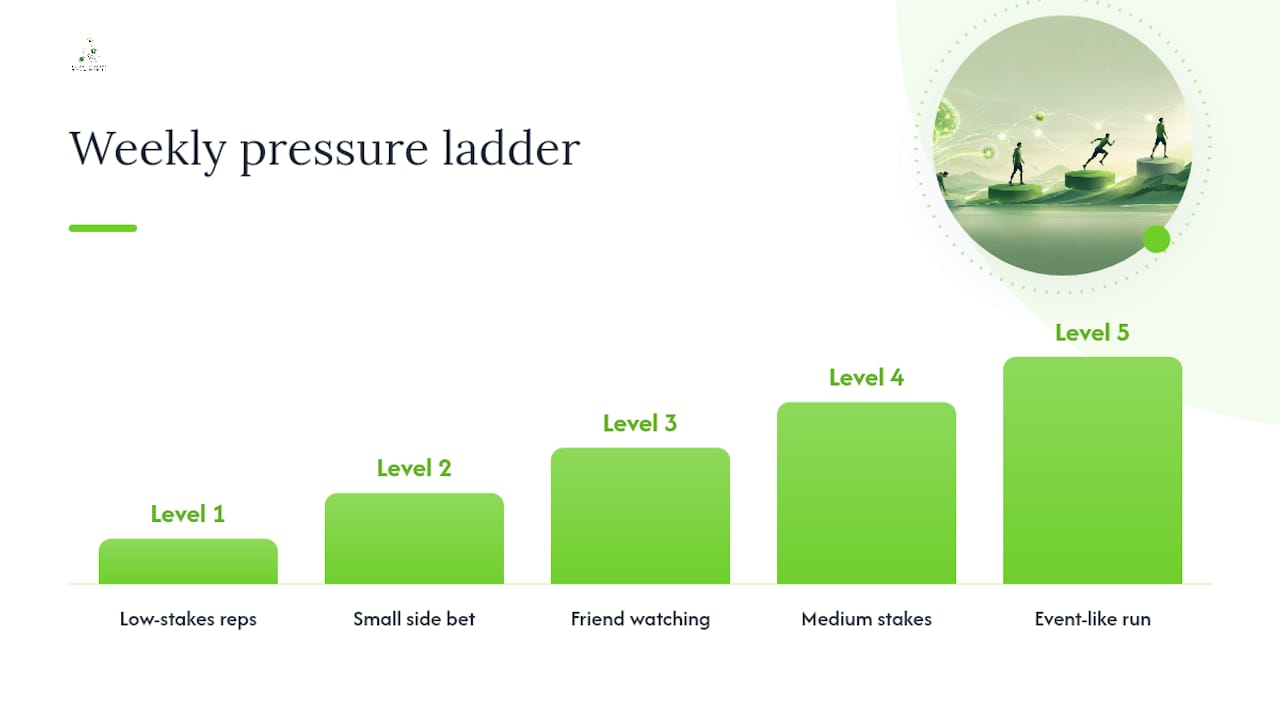
- Weekly graded pressure drills. Start with low-stakes reps, a small side bet, a friend watching, then build toward medium stakes, then a fully simulated high-pressure run that mimics the real event as closely as possible.
- A day-of checklist. The same warmup sequence, a quick arousal check (are you flat, or spiking?), and one anchor cue you've already rehearsed a hundred times.
- A sixty-second pre-performance routine. Box breathing (four counts in, four hold, four out, four hold), a two-step physical cue like a hand tap or a specific stance, then your execution trigger word.
- A way to track it. Log baseline performance numbers, note physical stress markers like heart rate if you track it, and rate your subjective confidence before and after each pressure drill.
Research from Carnegie Mellon's neural work suggests objective markers like these help confirm whether an intervention is actually shifting you back toward automatic, baseline-level execution rather than just feeling better in the moment.
Pro Tip: Don't skip the low-stakes week to rush to the hard stuff. The graded ladder only works if the bottom rung is genuinely easy. If you're anxious on rung one, you built the ladder wrong.
For more on structuring the day-of piece specifically, see this breakdown of pre-performance routines for peak performance.
A Coaching Note on What Actually Fixes This
Most athletes I work with have already tried the cognitive fixes, positive self-talk, visualization scripts, breathing apps, before they ever reach out. Those tools help at the margins. They rarely touch the deeper issue, which is a nervous system still running an old threat response that no amount of conscious reframing can override.
Alpha Imprinting works at that level instead of arguing with it. One competitive golfer came to us mid-season with a putting yip that had resisted a full year of sports psychology work. The block wasn't mental in the way she'd been told. It was a nervous system stuck in a protective pattern from an old injury, replaying itself every time she stood over a short putt. Clearing that pattern, not managing around it, is what got her stroke back.
— Paige
How Robertsneurotraining Can Help You Train for Pressure
Robertsneurotraining gives you a structured path when generic mental-game advice stops working. Instead of another script to memorize, you get nervous-system training built to clear the specific block behind your choking pattern, whether that's competition freezes, the yips, or a post-injury hesitation that won't quit.
The Energy Optimization Workbook is the starting point for most people: a self-guided introduction to the regulation techniques Roberts Neurotraining uses in full coaching engagements. If you want the complete picture, including how sessions are structured and what to expect from an assessment, Roberts Neurotraining's process walks through it step by step, and pairs well with grounding techniques like the ones covered in this primer on nervous system regulation. Athletes managing a performance block tied to a past injury or trauma response tend to benefit most from 1:1 Performance Neuro Training. Start with the workbook, or book an assessment directly if you already know you need the full program.
Sources
- Choking under pressure: theoretical models and interventions (ScienceDirect)
- Choking under pressure: the neuropsychological mechanisms of incentive‑induced performance decrements (Frontiers)
- Why we choke under pressure, according to a cognitive scientist (NPR)
- Identification and treatment of performance blocks (Bennett et al., SHU)
- A novel neural explanation for choking under pressure (CMU/engineering news)