

If you're mid-season and running on fumes, do three things right now: take a 90-second mental reset before your next session, cut one non-essential task from today's schedule, and text a coaching peer to set up a 20-minute debrief this week. That's the triage. Everything else in this guide builds from those three moves.
Quick self-check (30–60 seconds):
- Are you dreading practice more than two days in a row?
- Have you snapped at an athlete or staff member this week and felt nothing afterward?
- Is your sleep broken most nights, even when you have time to rest?
- Do you feel like nothing you do is making a difference?
If you answered yes to two or more, you're likely in yellow or red territory. Keep reading.
Warning: If you're experiencing persistent thoughts of self-harm, inability to function at work or home, or severe depression, stop and contact a mental health professional or call the 988 Suicide and Crisis Lifeline today. This guide is not a substitute for clinical care.
Key Takeaways
Coach burnout in season accumulates through compounding seasonal stress, and the fastest path to recovery combines immediate load reduction, structured peer processing, and relational investment with athletes and staff.
| Point | Details |
|---|---|
| Burnout builds across the season | Exhaustion and cynicism accumulate over months, not days; early-season habits have the highest return on investment. |
| Relational quality is a protective factor | Research shows coach–athlete relationship quality directly reduces burnout; investing in those relationships protects your mental health. |
| Short structured programs work mid-season | An 8-week stress-management program produced significant reductions in perceived stress in a small pilot; don't wait for the off-season to start. |
| Recovery takes 3–6 months | Expecting full restoration in weeks sets up a second burnout cycle; staged reduction and active support are required. |
| Robertsneurotraining Alpha Imprinting | The 10-week Energy Optimization Program targets nervous-system patterns driving persistent in-season exhaustion, available via telehealth. |
Table of Contents
- What is coach burnout in season, and why does it hit hardest mid-competition?
- How burnout typically builds across a competitive season
- What are the warning signs of burnout, and how do you assess your own risk?
- Why coaches burn out during the season: the root causes worth targeting
- Practical in-season strategies: daily, weekly, and monthly routines that actually hold
- How relational and organizational conditions protect you from burnout
- A step-by-step recovery plan if burnout is already present
- What the research says about seasonal burnout and what actually works
- Practical tools, short programs, and professional options
- Your printable season roadmap: a daily, weekly, and monthly checklist
- A coach-to-coach note on what this guide is really asking you to do
- How Performance Neuro Training can help you recover in-season
- Sources
What is coach burnout in season, and why does it hit hardest mid-competition?
Burnout isn't just being tired after a long week. In the coaching context, it's a recognized occupational syndrome with three distinct dimensions: emotional and physical exhaustion, cynicism or depersonalization (pulling back emotionally from athletes and staff), and reduced sense of personal effectiveness (feeling like your coaching no longer matters). The combination of all three separates burnout from ordinary fatigue.
Mid-season is the highest-risk window because the stressors don't let up. You're managing game prep, athlete welfare, parent expectations, and administrative demands simultaneously, with almost no recovery time between. Emotional labor, the invisible work of regulating your own emotions while managing everyone else's, compounds daily. Unlike a single stressful event, this accumulation is what drives burnout.
Research backs this up. Longitudinal data on coaches' burnout, stress, and recovery show that burnout development unfolds over months, shaped by ongoing seasonal stress exposure rather than any single incident. High-performance coaches tend to show a negative trend in well-being across a competitive season, with burnout measures rising and recovery capacity falling as the season progresses.
The three dimensions, briefly:
- Exhaustion: Physical and emotional depletion that sleep alone doesn't fix
- Cynicism/depersonalization: Emotional distance from athletes, detachment, or going through the motions
- Reduced effectiveness: Persistent feeling that your effort isn't translating into results
Knowing which dimension is hitting you hardest tells you which intervention to prioritize first.
How burnout typically builds across a competitive season
Burnout rarely arrives all at once. It follows a recognizable arc, and most coaches can trace it back to a specific stretch of the season where the cracks first appeared.
Preseason signals: Anxiety about roster decisions, pressure to set expectations, and the adrenaline of a fresh start often mask early warning signs. Sleep disruption and irritability show up here but get dismissed as "normal pre-season nerves."
Early-season accumulation: The schedule kicks in. Admin piles up. Athletes bring personal problems into the gym. You're absorbing stress from multiple directions, and the recovery window between sessions shrinks. This is where emotional labor starts compounding.
Midseason tipping points: A losing streak, a key injury, a conflict with an administrator, or a personal life stressor lands on top of an already-depleted system. SDT-based longitudinal research found that decreases in perceived autonomy, competence, and relatedness across a competitive season predict increases in exhaustion and cynicism. When you stop feeling like you have control, skill, or connection, the burnout trajectory steepens.
Late-season exhaustion: By playoffs or the final stretch, many coaches are running on obligation alone. The cynicism dimension tends to peak here. You're showing up, but the emotional investment has gone quiet.
The critical insight from high-performance sport research is that burnout accumulates rather than appearing suddenly. Isolated incidents don't cause it. Cumulative exposure, without adequate recovery, does. That means early-season habits matter as much as late-season interventions.
Common tipping points to watch for:
- Roster expansion or unexpected player departures
- Consecutive losses with no tactical explanation
- Increased administrative load (compliance, reporting, parent communications)
- A personal life stressor arriving during peak competition weeks
- Loss of a trusted assistant coach or support staff member
What are the warning signs of burnout, and how do you assess your own risk?
Physical, emotional, and behavioral signs often appear in clusters. Catching them early gives you options. Catching them late means recovery takes longer.
Physical signs
- Persistent fatigue that doesn't improve after a rest day
- Frequent illness or slow recovery from minor sickness
- Disrupted sleep (trouble falling asleep, waking at 3 AM, or sleeping too much)
- Tension headaches, jaw clenching, or chronic muscle tightness
Emotional signs
- Dread before practice or games (not nerves, actual dread)
- Emotional numbness toward athletes you used to care deeply about
- Disproportionate anger or irritability at small problems
- Feeling trapped, like you can't leave but can't stay
Behavioral signs
- Avoiding conversations with athletes, parents, or staff
- Skipping your own preparation rituals
- Increased reliance on caffeine, alcohol, or other substances
- Withdrawing from friends and family outside of coaching
Quick self-assessment (score 1–4 per question: 1 = rarely, 4 = almost always)
- I feel emotionally drained after coaching sessions.
- I feel detached from the athletes I coach.
- I doubt whether my coaching is making any real difference.
- I feel physically exhausted even after adequate sleep.
- I find myself dreading going to practice or games.
- I feel resentful toward athletes, parents, or administrators.
- I have little energy left for anything outside of coaching.
- I feel like I'm just going through the motions.
Scoring:
- 8–16 (Green): Manageable stress. Maintain your routines and monitor weekly.
- 17–24 (Yellow): Elevated risk. Start the prevention strategies in this guide now.
- 25–32 (Red): Active burnout. Reduce your load immediately and seek supervision or professional support.
Safety note: A score in the red zone combined with any thoughts of self-harm, inability to function, or severe depression warrants immediate contact with a licensed mental health professional, not just a coaching adjustment.
Why coaches burn out during the season: the root causes worth targeting
Generic wellness advice misses the point if it doesn't address what's actually driving the burnout. For coaches, the in-season drivers are specific.
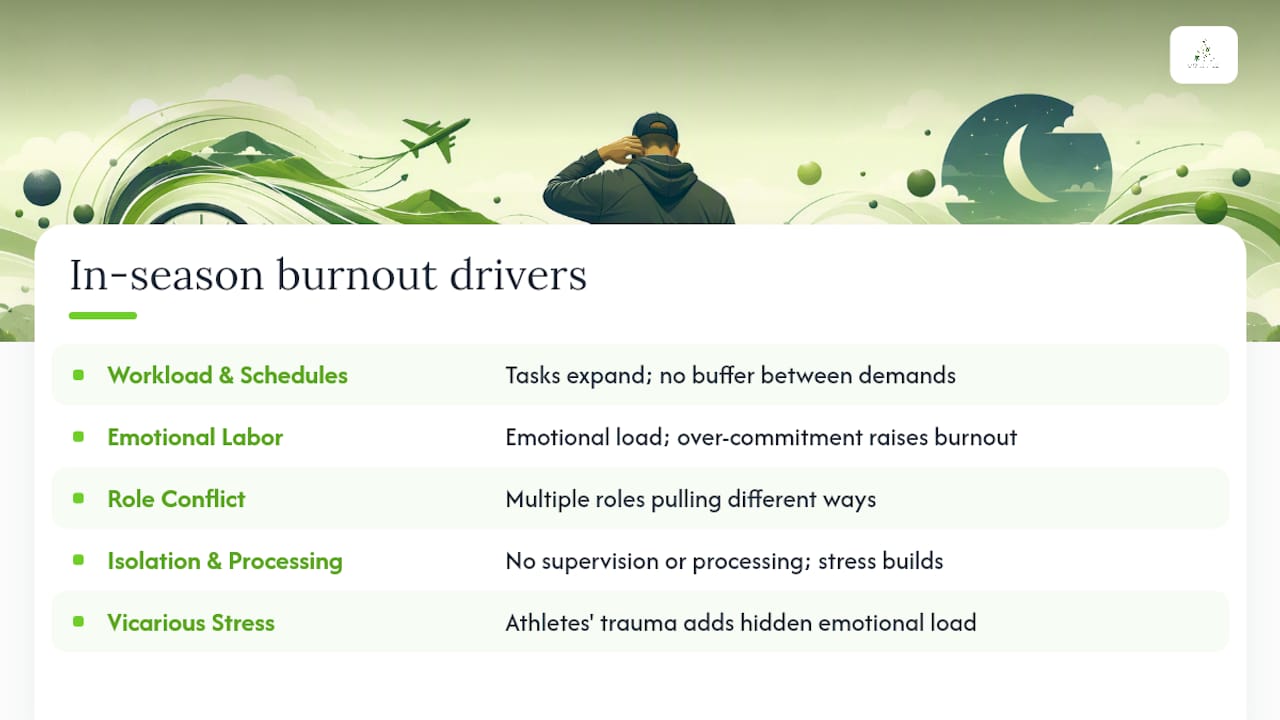
Workload and compressed schedules sit at the top of the list. Game prep, practice planning, film review, athlete check-ins, and administrative reporting don't shrink during the season. They expand. The problem isn't just volume; it's the absence of any buffer between demands.
Emotional labor is the most underestimated driver. You're managing athlete anxiety, parent frustration, staff conflict, and your own competitive pressure simultaneously, while projecting calm and confidence. Research on effort–reward imbalance in sport coaching found that over-commitment, the tendency to keep giving without adequate return, meaningfully increases burnout risk. Coaching efficacy buffers that effect, but only up to a point.
Role conflict compounds the load. You're simultaneously a teacher, a therapist, a manager, a recruiter, and a public face for your program. When those roles pull in different directions on the same day, the cognitive and emotional cost is significant.
Isolation and lack of processing time are structural problems. Many coaches, especially at the youth and high school level, have no supervisor, no peer cohort, and no structured space to process what they're carrying. Supervision research consistently shows that the restorative function of regular processing time prevents emotional load from calcifying into burnout. Without it, stress accumulates.
Vicarious stress from athletes' personal struggles, particularly when athletes are dealing with trauma or mental health challenges, adds another invisible layer. Understanding how trauma affects coachability can help you recognize when an athlete's behavior is a trauma response rather than a character problem, which reduces the emotional toll of managing it.
Hand those off.
Practical in-season strategies: daily, weekly, and monthly routines that actually hold
The challenge with in-season prevention isn't knowing what to do. It's fitting it into a schedule that leaves no margin. These routines are designed for that reality.
Daily micro-resets (60–120 seconds each)
- Pre-session reset: Before athletes arrive, take 90 seconds. Slow your breathing to a 4-count inhale and 6-count exhale. Name one thing you're genuinely looking forward to in today's session. This isn't affirmation theater; it's a brief nervous-system shift before you absorb everyone else's energy.
- Post-session transition: Before you check your phone or start admin, take two minutes to physically move (walk to the parking lot, stretch, splash water on your face). The transition ritual signals to your nervous system that the performance window has closed.
- End-of-day reflection: Ten minutes, not more. Write three sentences: what went well, what you'd change, and one thing you're leaving at the gym tonight.
Performance state management techniques developed for athletes translate directly to these coach rituals, particularly the pre-performance activation and post-performance deactivation sequences.
Weekly structure
- Admin batching: Block two 45-minute windows per week for email, compliance, and reporting. Outside those windows, close the inbox. Reactive admin is one of the biggest time drains coaches underestimate.
- Protected no-session time: One morning or afternoon per week with no coaching obligation. Non-negotiable. If you can't protect a full half-day, protect 90 minutes.
- Peer debrief: A 20-minute call with another coach, not to solve problems but to say what's hard. Supervision and peer processing reduce emotional load accumulation over time.
Monthly checkpoints
- Workload audit: list every responsibility you're currently carrying and mark which ones could be delegated, dropped, or batched.
- Delegation decision: identify one task to hand off this month.
- Mental skills refresh: revisit one technique from your own training or a resource like mental performance optimization and apply it to your own preparation, not just your athletes'.
Sample weekly time budget (adjust for your sport and level)
| Activity | Target weekly hours |
|---|---|
| Direct coaching (practice, games) | 20–25 |
| Admin and communication | 4–6 |
| Planning and film review | 3–5 |
| Recovery (personal, non-coaching) | 7–10 |
| Supervision or peer debrief | 1 |
Boundary scripts worth keeping
- To a parent requesting an immediate call: "I'm with athletes right now. I have a window Thursday at 4 PM. Does that work?"
- To an administrator adding a new task: "I want to do this well. Can we talk about what comes off my plate to make room for it?"
- To yourself, when you're about to skip your reset: "Two minutes now saves two hours of reactivity later."
Pro Tip: When you're traveling for away games, your reset window is the bus or van ride back. Put in earbuds, close your eyes for 10 minutes, and do nothing. That's the recovery window. Use it.
How relational and organizational conditions protect you from burnout
Burnout isn't only an individual problem. The relational and systemic environment you work in either accelerates or buffers it.
Research on coach knowledge, psychological safety, and coach–athlete relationships found a clear sequential pathway: coach knowledge builds psychological safety, which improves coach–athlete relationship quality, which in turn reduces burnout (β = −0.34, p = 0.002). That's a structural finding with a practical implication: investing in your relationships with athletes isn't just good coaching. It protects your own mental health.
Steps you can take this week to build psychological safety with your staff and athletes:
- Open your next staff meeting with one question: "What's one thing that would make your job easier this week?" Then act on at least one answer.
- Tell your athletes explicitly that mistakes in practice are information, not failures. Say it out loud, not just in your coaching philosophy document.
- Acknowledge your own uncertainty when you don't have an answer. Coaches who model psychological safety don't pretend to have everything figured out.
For a deeper framework on building this environment, team psychological safety best practices covers both the evidence and the practical steps in a sport context.
How to request supervision or peer processing:
If your program doesn't have a formal structure for coach support, you can create an informal one. Email your athletic director or program head with this framing:
"I'd like to set up a monthly 30-minute check-in to review workload and flag anything that needs attention before it becomes a problem. This is standard practice in high-performance programs and helps me stay effective across the full season. Can we schedule the first one this month?"
That framing positions supervision as a performance tool, not a distress signal, which makes it easier to request and easier to approve.
A step-by-step recovery plan if burnout is already present
If you're already in the red zone, the goal isn't to push through. It's to stabilize, reduce load, and return to full function in a way that actually holds.
Phase 1: Stabilize (weeks 1–3)
- Tell one trusted person (a colleague, supervisor, or partner) what you're experiencing. Isolation accelerates burnout.
- Identify the two or three highest-drain responsibilities and either delegate them or temporarily suspend them.
- Sleep becomes non-negotiable. Protect 7–8 hours even if it means cutting film review or admin.
- Book a session with a licensed therapist, sports psychologist, or coaching supervisor this week, not next month.
Phase 2: Reduce load and rest (weeks 4–12)
- Formalize the delegation decisions from Phase 1. Put them in writing with your athletic director.
- Reduce your direct coaching hours where possible. An assistant taking one practice per week is a meaningful reduction.
- Begin a structured stress-management program. An 8-week stress-management and health-coaching intervention produced statistically significant short-term reductions in perceived stress and improvements in daily routine in a small randomized pilot, suggesting structured programs are worth the time investment even mid-season.
- Track your energy level daily on a simple 1–10 scale. You're looking for an upward trend, not a straight line.
Phase 3: Phased return (months 3–6, depending on severity)
- Gradually reintroduce responsibilities as your baseline energy stabilizes. Add one task back at a time, not all at once.
- Continue supervision or therapy at least twice monthly through this phase.
- Establish the daily and weekly routines from the prevention section as permanent structure, not temporary fixes.
When to consider medical leave or formally stepped-back duties:
If you're unable to function in basic daily tasks, experiencing severe depression or anxiety, or your performance is affecting athlete welfare, a formal leave or reduced-duties arrangement is the right call. Talk to your employer's HR department or a physician. Trauma-informed practices for sports professionals can also provide context on how prolonged stress affects the nervous system and what recovery realistically looks like.
Recovery from significant burnout typically takes three to six months of consistent reduced load and active support. Expecting to feel fully restored in two weeks sets up a second burnout cycle.
What the research says about seasonal burnout and what actually works
The evidence on coach burnout has sharpened considerably over the past decade. A few findings stand out for their practical implications.
Burnout accumulates seasonally. Longitudinal research confirms that burnout develops over months, not days, and that recovery capacity decreases as the season progresses. This means early-season prevention has a disproportionate return on investment.
Psychological-need satisfaction is a mechanism, not just a metaphor. The SDT-based longitudinal study found that when coaches lose perceived autonomy, competence, and relatedness across a season, exhaustion and cynicism follow. Interventions that restore any one of those three needs, even partially, can slow the burnout trajectory.
Relational pathways matter as much as workload management. The sequential model from high-performance sport research shows that coach knowledge reduces burnout primarily through psychological safety and coach–athlete relationship quality, not through time management alone. This is the finding most coaches miss: the quality of your relationships is a protective factor for your own mental health.
Short structured programs produce measurable results. Pilot RCT evidence supports 8-week programs combining stress-management education, routine-building, and social support. The sample was small, so these findings are preliminary, but the direction of effect is consistent with broader evidence on care modalities for chronic stress.
Effort–reward imbalance is a specific, targetable driver. The integrated demand–control and effort–reward imbalance study found that over-commitment exacerbates burnout while coaching efficacy buffers it. Building your sense of competence through deliberate skill development, not just working harder, is a direct intervention on this pathway.
Practical implications for in-season practice:
- Prioritize relational investments (psychological safety, athlete check-ins) as burnout prevention, not just performance tools
- Use short structured programs during the season rather than waiting for the off-season
- Track your own sense of autonomy, competence, and connection weekly; a drop in any one of them is an early warning signal
- Address effort–reward imbalance directly by identifying where you're over-committing relative to the return you're getting
Practical tools, short programs, and professional options
The right tool depends on where you are in the burnout spectrum and what's driving it.
Self-directed tools for early-stage stress:
- Workload trackers: A simple spreadsheet logging daily hours by category (coaching, admin, personal) reveals patterns most coaches don't see until they're already depleted.
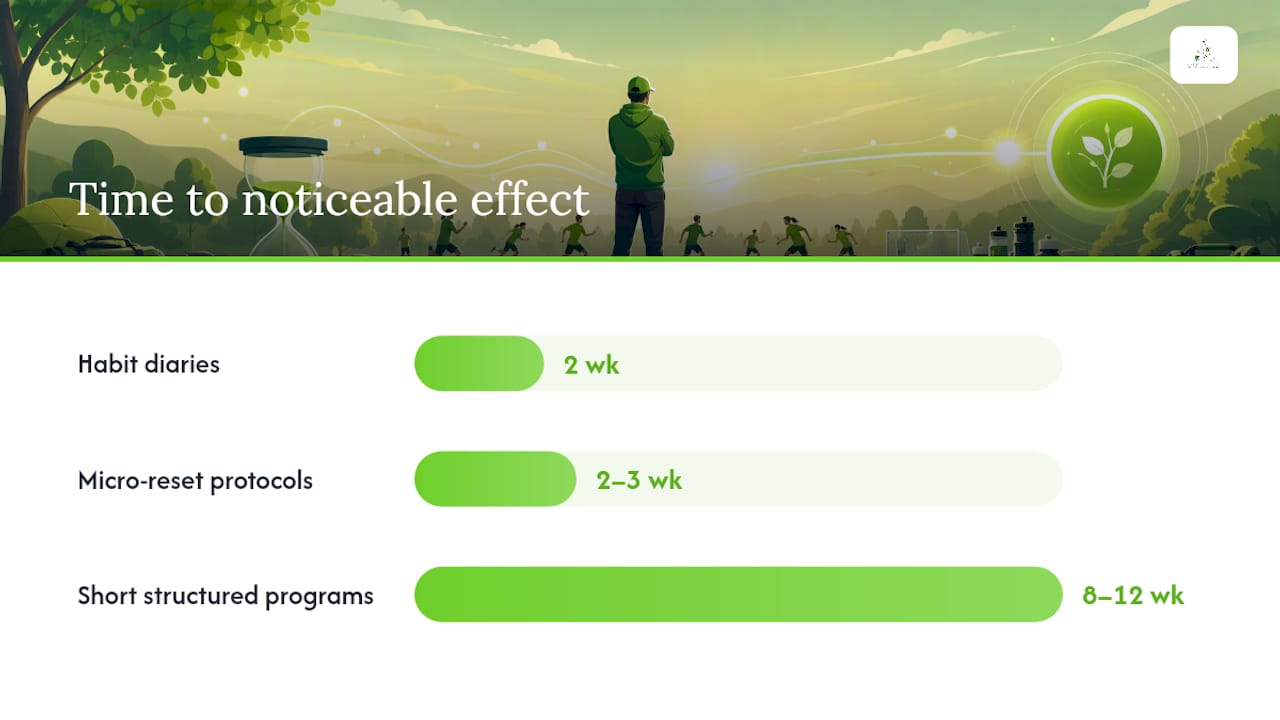
- Habit diaries: A 5-minute end-of-day log tracking sleep, energy, and one stressor. Over two weeks, patterns become visible.
- Micro-reset protocols: The 90-second breathing and transition rituals described earlier. Consistent application over two to three weeks produces a noticeable shift in baseline reactivity.
- Somatic coping strategies adapted from athlete recovery work, including body-scan check-ins and grounding techniques, translate well to coach self-regulation.
Short structured programs (8–12 weeks):
An integrative health coaching model typically combines habit change, stress education, and accountability check-ins over 8–12 weeks. This format fits an in-season schedule because sessions are short (30–45 minutes) and spaced weekly.
The Robertsneurotraining 10-week Energy Optimization Program is built for exactly this kind of in-season demand. It targets nervous-system regulation, energy management, and performance state recovery, areas where standard stress-management programs often fall short because they address behavior without addressing the underlying nervous-system patterns driving it.
Performance Neuro Training and Alpha Imprinting:
For coaches experiencing persistent exhaustion, emotional dysregulation, or a sense that their nervous system is stuck in overdrive or shutdown, nervous-system-focused approaches address the root mechanism rather than the symptoms. Nervous-system based interventions target the overdrive and shutdown patterns that standard wellness advice doesn't reach.
Who each option helps:
- Workload trackers and habit diaries: Coaches in the green-to-yellow zone who need visibility before they can act
- Short structured programs: Coaches in the yellow zone with some schedule flexibility and motivation to build new routines
- Performance Neuro Training / Alpha Imprinting: Coaches in the yellow-to-red zone, particularly those with persistent nervous-system dysregulation, anxiety, or a history of stress accumulation across multiple seasons
- Therapy or clinical support: Coaches in the red zone, especially those with severe depression, trauma history, or functional impairment
When to choose therapy over coaching:
If your burnout is accompanied by clinical depression, anxiety disorder, trauma responses, or suicidal ideation, a licensed therapist or psychiatrist is the right first call. Coaching and performance programs work best when clinical needs are already being addressed.
Pro Tip: Don't wait until the off-season to start a program. The coaches who recover fastest are the ones who begin a structured intervention mid-season, even a light one, rather than white-knuckling through to summer and starting from a deeper deficit.
Your printable season roadmap: a daily, weekly, and monthly checklist
Print this, pin it to your office wall, or save it to your phone. Adapt the timing to your sport's schedule.
Daily checklist
- 90-second pre-session breathing reset (4-count in, 6-count out)
- Physical transition ritual after the last session of the day
- 10-minute end-of-day reflection (what went well, what to change, what stays at the gym)
- Hydration: water before coffee, water before the drive home
- One non-coaching activity, however brief (a walk, a meal without screens, a conversation unrelated to sport)
Weekly checklist
- Two 45-minute admin batching windows (email, compliance, reporting)
- One protected no-session block (90 minutes minimum)
- 20-minute peer debrief or supervision call
- Weekly workload review: is anything on your plate that shouldn't be?
- Sleep audit: did you hit 7–8 hours at least four nights this week?
Monthly checklist
- Full workload audit: list every responsibility, mark what can be delegated or dropped
- One delegation decision: hand off one task this month
- Mental skills refresh: apply one technique from your own development to your coaching preparation
- Energy trend review: is your daily 1–10 energy score trending up, flat, or down?
- Relationship check: how is your connection with your athletes and staff? Any relationships that need attention?
For travel weeks and playoffs: Compress the daily checklist to three items (reset, transition ritual, reflection) and protect the weekly peer debrief above everything else. The debrief is the highest-leverage single habit during high-pressure stretches.
A coach-to-coach note on what this guide is really asking you to do
The conventional framing of coach burnout puts the solution entirely on the individual: sleep more, delegate better, set boundaries. That framing isn't wrong, but it's incomplete. The coaches I see who recover fully and stay recovered are the ones who change something structural, not just personal. They build a supervision relationship. They invest in their athlete relationships as a deliberate act of self-protection. They stop treating their nervous system like a machine that should run indefinitely without maintenance.
The research on relational pathways to burnout is worth sitting with. The finding that coach–athlete relationship quality directly reduces burnout isn't a soft, feel-good result. It's a structural one, with a measured effect size. The quality of your relationships at work is part of your recovery plan, not separate from it.
The staged recovery roadmap in this guide asks you to do something most coaches find genuinely difficult: reduce your load before you feel ready to. The instinct is to push through to the off-season. But the longitudinal data is clear that recovery capacity decreases as the season progresses. Waiting makes the hole deeper. Starting now, even with small reductions, changes the trajectory.
How Performance Neuro Training can help you recover in-season
Most stress-management programs address what you do. Robertsneurotraining's Alpha Imprinting protocol addresses how your nervous system is wired to respond, which is a different problem entirely.

Coaches dealing with persistent in-season exhaustion, emotional dysregulation, or a nervous system that won't downshift after games are often dealing with a nervous-system pattern, not just a scheduling problem. Alpha Imprinting works by reprogramming the nervous system's stress-response patterns, targeting the overdrive and shutdown states that keep coaches stuck even when the external load temporarily decreases. The 10-week Energy Optimization Program delivers this in a structured, telehealth-accessible format that fits a coaching schedule.
This is the right fit if you:
- Feel wired but exhausted, or emotionally flat even when things go well
- Have tried standard wellness strategies without lasting results
- Are coaching a team and want a system-level intervention (group workshops and cohort programs are available)
- Need a structured program that works around your season, not after it
To get started, book an intake consultation through Robertsneurotraining. The intake covers your current stress patterns, nervous-system baseline, and which program format fits your season timeline.
Sources
The following research and resources support the strategies in this guide.
- Understanding coach burnout in high-performance sport: the sequential effects of knowledge, psychological safety, and coach–athlete relationships
- Coaches' burnout, stress, and recovery over a season (longitudinal study, PMC7730165)