

Restoring visual processing after a concussion takes a targeted, neuroscience-based program, not rest alone. The highest-impact approach combines dorsal-stream visual timing training (PATH), sub-threshold aerobic conditioning guided by the Buffalo Concussion Treadmill Test, HRV and breathing work, and oculomotor drills, sometimes paired with imaging-guided neurofeedback. The first move for any athlete: get objective baseline testing and ask for a performance-focused neurotraining plan, not a generic rest protocol.
TL;DR:
- Objective baseline testing such as tracking, VEP, reaction time, and HRV monitoring is essential to tailor an effective concussion recovery plan.
- Combining dorsal-stream visual timing training, sub-threshold aerobic conditioning, HRV biofeedback, and oculomotor drills yields better results than treating each issue in isolation.
- Recovery typically takes at least 8 weeks, with intensive protocols like image-guided neurofeedback considered for persistent deficits beyond that period.
- Most programs emphasize restoring visual timing and neurovascular health before advancing to high-speed athletic drills to prevent setbacks.
- Most concussion programs focus on symptom relief rather than regaining peak decision speed, which is critical for returning to elite performance.
Table of Contents
- Why Concussion and Vision Problems Persist in Athletes
- What Tests Reveal Visual Processing Deficits After Concussion
- Which Training Methods Rebuild Visual Timing and Athletic Performance
- A Practical Recovery Plan for Athletes and Coaches
- What the Research Says About Recovery Outcomes
- Why Most Concussion Programs Miss the Performance Piece
- Get Started With Alpha Imprinting for Concussion Recovery
- Sources
- FAQ
Why Concussion and Vision Problems Persist in Athletes
A concussion doesn't just bruise tissue. It disrupts the timing circuits your brain uses to track a ball, read a defender's shoulders, or judge closing speed on a breakaway. The dorsal visual stream, the pathway responsible for motion perception and spatial tracking, is especially vulnerable to shear forces during impact. When that pathway loses precision, athletes describe it as a half-step delay between seeing and reacting. It's rarely blurred vision. It's mistimed vision.
A second mechanism compounds the first: neurovascular uncoupling, where blood flow no longer matches neural demand in real time. This uncoupling limits how much cerebral blood flow can ramp up during exertion, which is why symptoms often spike during sprints or scrimmages rather than at rest. Add autonomic dysfunction, a nervous system stuck oscillating between sympathetic overdrive and blunted recovery, and you get an athlete who fatigues faster, tolerates less visual load, and feels "off" in ways that standard imaging can't explain.
This is why unimodal treatment routinely underperforms. An athlete with dorsal-stream timing loss, autonomic dysfunction, and lingering visual fatigue needs three different systems addressed at once, not sequentially treated as separate problems. Nervous system dysregulation after concussion explains how these systems interact in more technical detail for coaches and clinicians.
What Tests Reveal Visual Processing Deficits After Concussion
You can't manage what you don't measure. A handful of objective markers turn "still feels off" into a trackable recovery curve.
- Predictive visual tracking and gaze-target synchronization. These measures correlate closely with symptom burden and serve as one of the most sensitive early biomarkers for concussion screening, catching subtle deficits standard neurological exams miss.
- Visual evoked potentials (VEP). Amplitude and latency shifts on VEP testing reveal binocular magnocellular processing deficits common in mild traumatic brain injury, and these values improve as visual therapy progresses.
- Dynamic versus static visual acuity. Comparing acuity while stationary against acuity while the head or target moves isolates timing delays that static eye charts never surface.
- Reaction time and trail-making tests. Standard concussion batteries quantify processing speed, giving a second, independent lens on recovery.
- Buffalo Concussion Treadmill Test (BCTT) with HRV monitoring. This graded exercise protocol pinpoints the exact heart rate where symptoms provoke, which then sets the ceiling for sub-threshold aerobic work.
Build a simple dashboard: record tracking variability, VEP latency, reaction time, HRV, and a symptom checklist every one to two weeks. That cadence is tight enough to catch plateaus and loose enough not to burn out the athlete with constant testing.
Which Training Methods Rebuild Visual Timing and Athletic Performance
Each modality targets a different broken system, and combining them beats treating anyone in isolation.
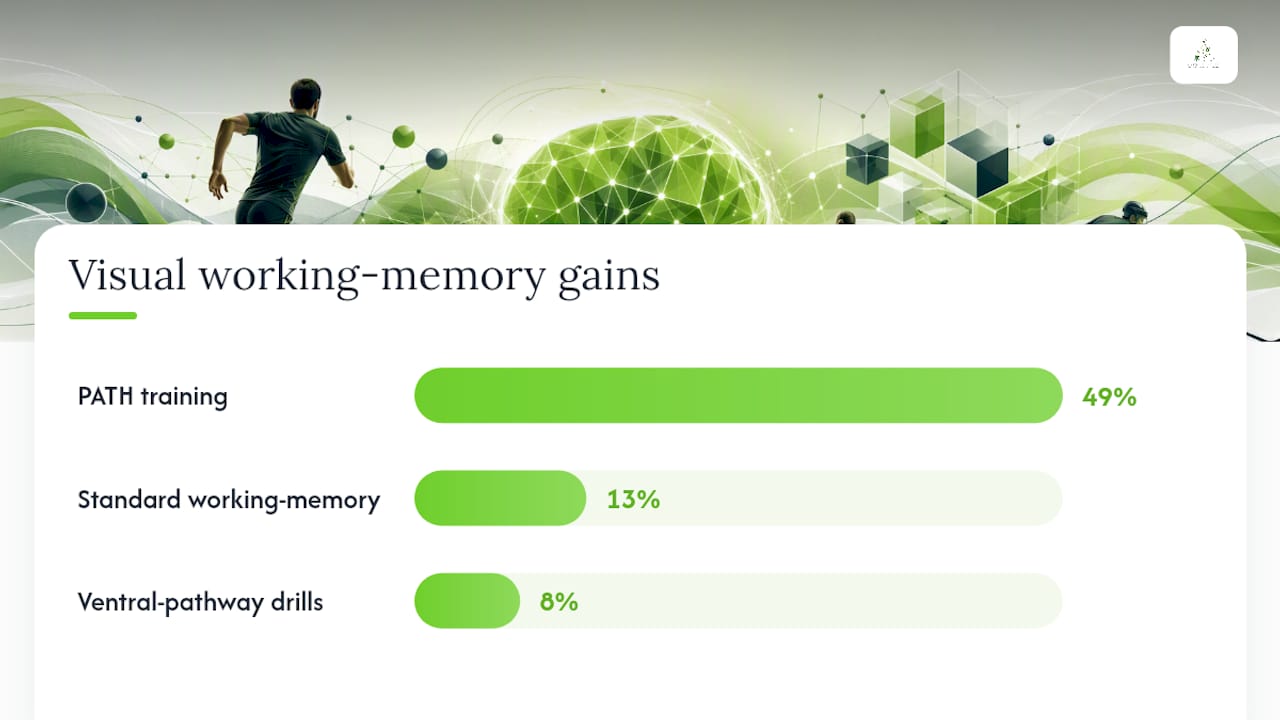
PATH (dorsal visual pathway) training directly retrains the brain's motion-timing circuits. A randomized trial found PATH training produced a 49% improvement in visual working memory compared with 13% for standard working-memory training and 8% for ventral-pathway drills. A related study using PATH combined with digit-memory protocols confirmed large gains in processing speed and reading speed, with MEG imaging showing activation spreading well beyond the visual cortex into the prefrontal and parietal networks that govern decision-making.
Sub-threshold aerobic training, dosed against the BCTT symptom-provocation threshold, restores the cerebrovascular system's ability to regulate CO2 sensitivity and blood flow under load. This is what widens the "activation window" an athlete can tolerate before visual and cognitive drills spike symptoms.
HRV biofeedback and resonance breathing rebalance autonomic tone directly. A recent trial on athletes with lingering post-concussive symptoms found resonance and pelvic floor resonance breathing reduced symptom scores and improved HRV and EEG readings within a short intervention window.
Oculomotor drills (Brock string, gaze stabilization) build the fine motor control that PATH's timing gains need to translate into game-speed tracking.
For persistent cases, image-guided intensive programs using fNCI-style imaging cycle athletes through preparatory aerobic work, cognitive/visual activation, and structured rest, a rhythm that speeds recovery on objective neurovascular measures.
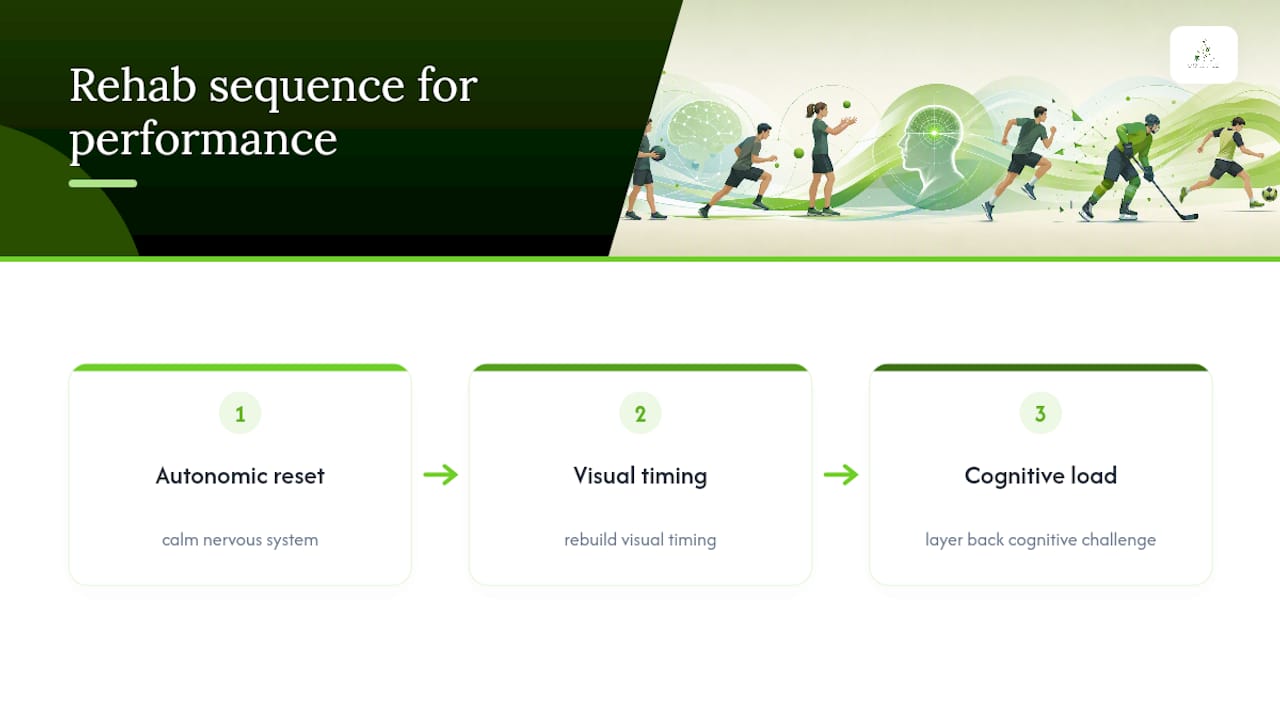
Pro Tip: Sequence matters more than intensity. Prepare the autonomic system with sub-threshold cardio first, then activate visual timing, then rest. Skipping the "prepare" phase is the most common reason visual training plateaus.
A Practical Recovery Plan for Athletes and Coaches
- Weeks 1 to 3: Establish baseline testing (tracking, VEP if available, reaction time, HRV, symptom checklist), then begin daily sub-threshold aerobic sessions dosed under the BCTT-derived heart rate ceiling, paired with HRV biofeedback and breathing work.
- Weeks 3 to 8: Layer in PATH sessions and targeted oculomotor drills two to three times weekly, adjusting load based on tracking variability and symptom response rather than the calendar.
- When deficits persist past 8 weeks: Consider a 4 to 5 day intensive image-guided block, an option worth discussing when neurological training after concussion hasn't moved the objective markers on its own.
- Return-to-skill and return-to-contact: Advance only when tracking variability tightens, VEP latency trends down, reaction time normalizes, and HRV shows a directional gain alongside a declining symptom checklist, not simply when the athlete "feels fine."
- Coordination: Share the testing dashboard across athletic trainers, coaches, and clinicians so progressive exposure to contact and game speed is a shared, data-backed decision rather than a guess.
What the Research Says About Recovery Outcomes
The strongest single figure in this field: PATH training produced a 49% improvement in visual working memory, versus 13% and 8% for comparator protocols (p = 0.011), a gap wide enough that it's now driving how intensive programs sequence visual retraining.
A separate chart review of a 5-day intensive multi-modal program found significant pre-post gains in processing speed, reaction time, and visual acuity among patients averaging over two years post-injury, evidence that even long-standing deficits respond to combined training. The caveat: these are mostly retrospective or moderate-sample studies. Populations vary widely in injury severity and time since injury, and individual response differs enough that a rigid one-size protocol underperforms a tailored one.
Why Most Concussion Programs Miss the Performance Piece
Most concussion protocols were built around "get the athlete symptom-free," not "get the athlete back to elite decision speed." Those are different goals. Symptom-free and game-ready are not the same threshold, and treating them as one is why so many athletes return to play and still feel a step slow.
At Robertsneurotraining, we sequence autonomic, visual, and cognitive training deliberately, calming the nervous system first, then rebuilding visual timing, then layering back cognitive load, because trying to force high-speed visual work onto a dysregulated autonomic system just produces frustration and setbacks. Early progress usually shows up first in HRV trends and tracking variability, often before the athlete consciously feels different. A focused intensive block makes sense for plateaued, persistent cases; a phased outpatient plan fits most in-season athletes better.
— Paige
Get Started With Alpha Imprinting for Concussion Recovery
An effective approach to concussion recovery focuses on helping competitive athletes return to full speed, not just symptom-free. Our proprietary Alpha Imprinting protocol pairs nervous-system retraining with the visual and autonomic work covered above, addressing the mental blocks, panic, and performance anxiety that often linger even after physical symptoms clear.
Such programs may be offered as 1:1 telehealth sessions, intensive multi-day blocks, and team workshops, to accommodate different needs. Sport-specific pages for equestrian, baseball, and tennis athletes show how the protocol adapts to different visual and reaction-speed demands. Athletes or coaches dealing with plateaued recovery might consider starting with an objective baseline assessment and customized training plan.
Sources
- PATH dorsal-stream training trial (PubMed entry)
- Frontiers in Human Neuroscience — PATH training (2025)
- Active recovery from concussion (systematic review / narrative) — PMC
FAQ
Can a Concussion Really Cause Lasting Vision Problems?
Yes. Concussion can disrupt the dorsal visual stream's timing circuits and cause neurovascular uncoupling, both of which impair motion tracking and split-second visual decisions well after initial symptoms fade.
What Is PATH Training and How Does It Help?
PATH is dorsal visual pathway training that targets motion-timing circuits directly. A randomized trial found it produced a 49% improvement in visual working memory, outperforming standard working-memory and ventral-pathway protocols.
How Does HRV Biofeedback Help With Post-Concussion Vision Issues?
HRV biofeedback and resonance breathing rebalance autonomic nervous system tone, which reduces symptom scores and widens the exertion window an athlete can tolerate before visual training triggers symptoms.
How Long Does Vision-Focused Concussion Recovery Take?
Most phased programs run 8 weeks or longer, starting with sub-threshold aerobic and HRV work before introducing PATH and oculomotor training, though persistent cases may need an intensive 4 to 5 day image-guided block.
Does Roberts Neurotraining Treat Concussion-Related Vision and Performance Issues?
Yes. Roberts Neurotraining's Alpha Imprinting protocol combines nervous-system retraining with visual and autonomic rehabilitation to help competitive athletes recover visual timing, mental resilience, and return-to-play readiness.