

If your heart races, your chest tightens, and your breath gets short mid workout, exercise really can trigger panic, especially if you're sensitive to internal body signals. Slow down or stop, sit if you need to, breathe in a slow, steady rhythm, and sip water. Seek emergency care for chest pain, fainting, or breathlessness that won't ease. Structured exercise exposure and short-term therapy can bring this under control over a matter of weeks.
TL;DR:
- Structured, gradual exposure through high-intensity exercise is more effective at reducing panic symptoms than avoidance or casual activity.
- Visible triggers such as dehydration, heat, caffeine, and social pressure can intensify exercise-induced panic responses.
- Signs of normal exertion resolve within 10-20 minutes, whereas panic attacks tend to persist longer and involve catastrophic thoughts.
- Treatment protocols like brief intense exercise (BIE) show that deliberate exposure decreases panic attacks over several months when supervised clinically.
- For those with persistent symptoms, professional therapy focusing on interoceptive exposure remains the most reliable treatment.
Table of Contents
- Why Exercise Can Trigger Exercise-Induced Panic
- How to Tell Normal Exercise Sensations From a Panic Attack
- Practical Strategies to Prevent and Manage Exercise Anxiety
- What the Evidence Says About Exercise as Treatment
- When to Get Professional Help for Exercise-Induced Panic
- An Athlete's Nervous System Doesn't Lie: A Trainer's Perspective
- What Actually Moves the Needle on Exercise-Induced Panic
- How Roberts Neurotraining Supports Athletes Through Exercise-Triggered Panic
- Sources
Why Exercise Can Trigger Exercise-Induced Panic
Your body cannot tell the difference between a hard sprint and a genuine threat. Both send your heart rate up, quicken your breathing, and trigger sweating, because the same sympathetic nervous system runs both responses. For most people, those sensations register as normal exertion. For someone with heightened anxiety sensitivity, the same signals get read as danger, and that misreading is the spark for a panic loop.
Anxiety sensitivity, essentially interoceptive hypervigilance, means your brain flags a racing pulse or breathlessness as the start of something catastrophic rather than a sign you're working out. That single misinterpretation can snowball into a full panic attack in under a minute. Interoceptive exposure research treats this exact pattern as the core mechanism behind panic disorder, and it explains why exercise anxiety symptoms often show up during cardio specifically, where heart rate climbs fastest.
Several factors turn up the volume on this response. Caffeine mimics adrenaline. Dehydration and heat stress push your heart rate higher for the same effort. Low baseline fitness means routine exertion produces sensations that feel unfamiliar and alarming. Past trauma, whether from injury or unrelated life stress, can prime your nervous system to treat exertion as unsafe. Working out in a crowded gym adds social pressure on top of all of it.
How to Tell Normal Exercise Sensations From a Panic Attack
Not every racing heart at the gym is panic. The clearest signal is timing: ordinary exertion responses fade within 10 to 20 minutes once you slow down, while panic can drag on for closer to an hour because your sympathetic nervous system stays activated.
A second signal is what's happening in your head. Exertion feels intense but neutral. Panic comes loaded with catastrophic thoughts, "I'm having a heart attack," "I'm going to pass out," "something is seriously wrong." That thought pattern, not the heart rate number itself, is what separates workout panic response from a hard set of squats.
Run through this quick self-check when symptoms show up:
- Did the feeling start suddenly and peak within minutes, or build gradually with your effort level?
- Are you having frightening thoughts about dying, losing control, or fainting?
- Does the feeling ease once you slow down, or does it keep climbing?
- Are you experiencing chest pain, fainting, numbness, or breathlessness that doesn't improve with rest?
Any of those last symptoms warrant a same-day medical evaluation, not a guess.
Practical Strategies to Prevent and Manage Exercise Anxiety
Managing exercise-induced panic works in three windows: before you start, during the session, and after you finish.
Before you train:
- Cut or reduce caffeine on training days, especially if you're prone to jitteriness.
- Hydrate well in the hours leading up to your session, not just right before.
- Choose lower-trigger modalities to start, like brisk walking, resistance training, or yoga, since resistance and mind-body exercise rank among the most effective modalities for lowering anxiety severity.
- Extend your warm-up so your heart rate climbs gradually instead of spiking.
During the session, watch your perceived exertion rather than chasing a number on a screen. If sensations start climbing toward panic, step back to a lower intensity or pause outright. Soothing rhythm breathing, in through the nose for four counts, out for six, works better than instructions to "just calm down." Grounding techniques help too: name five things you see, four you can touch, three you can hear, two you can smell, one you can taste. The 3-3-3 rule is a faster version of the same idea for when you're mid-set and can't stop to run a full checklist.
After training, don't skip the cooldown. An abrupt stop leaves your heart rate elevated longer, which can itself feel alarming. Use paced breathing during the cooldown and consciously reframe what you just felt: a fast heart rate after a hard set is expected physiology, not a warning sign.

Pro Tip: Build a graded exposure ladder before you build fitness. Spend week one at a heart rate that feels only mildly uncomfortable, then add small five to ten percent increases in intensity every week or two, only progressing once the previous level stops triggering fear. Programs like this work best with structure behind them, similar to the performance state management approach used with competitive athletes, and a breath control technique borrowed from precision sports can sharpen the paced breathing piece further. If your resting anxiety is high or you have a diagnosed panic disorder, run this kind of protocol under a clinician's guidance rather than solo.
What the Evidence Says About Exercise as Treatment
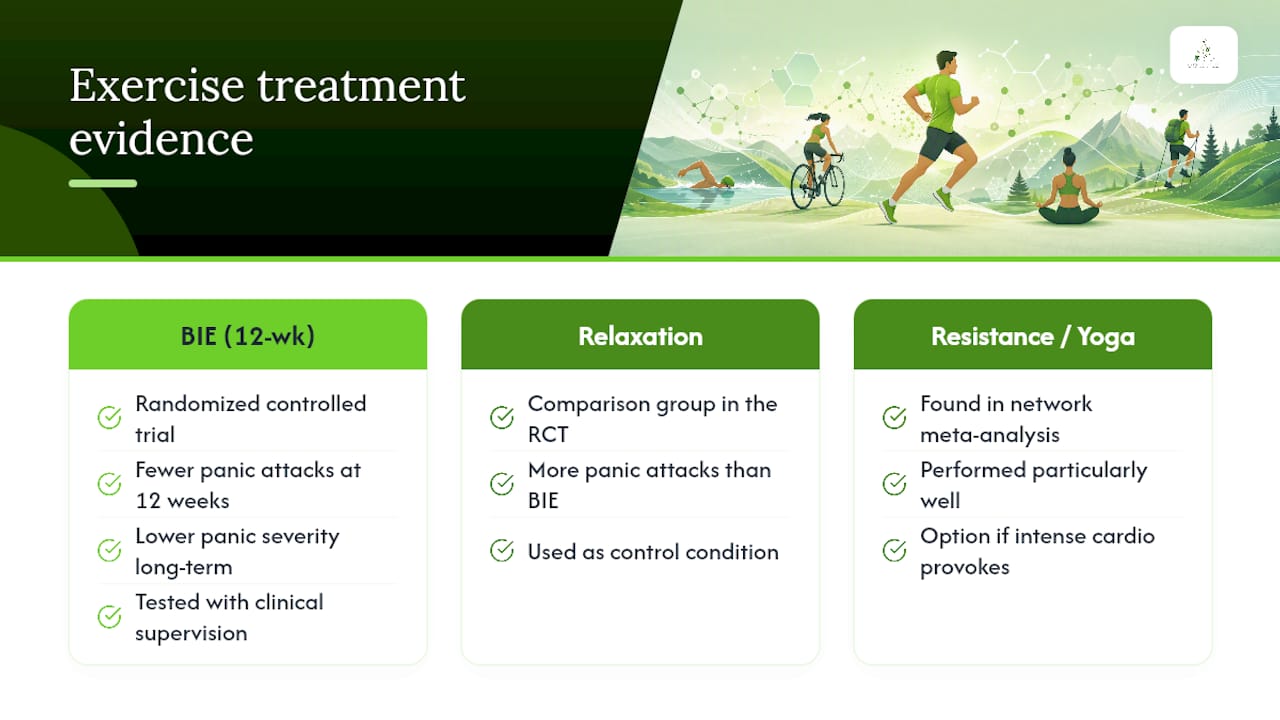
The strongest evidence for using exercise itself to treat panic comes from a randomized controlled trial on brief intermittent intense exercise, or BIE, run as a structured 12-week program. Participants alternated short bursts of intense effort with recovery periods, deliberately provoking the same racing heart and breathlessness that trigger their panic, but in a controlled, predictable setting. At the 12-week mark, the BIE group reported fewer panic attacks compared with the relaxation-training group, and their panic severity scores stayed lower at follow-up over several months.
That's interoceptive exposure at work: repeated, deliberate contact with feared bodily sensations until your brain stops treating them as dangerous. A broader network meta-analysis of exercise treatments for anxiety disorders found resistance training and mind-body exercise, yoga among them, performed particularly well, which matters if intense cardio still feels too provocative to start with.
There's a real paradox buried in this research: acute exercise can raise anxiety temporarily in people with panic disorder, even as regular exercise lowers anxiety over the following weeks. Feeling worse during today's session doesn't mean the approach is failing. It's also worth saying plainly that BIE-style protocols aren't a casual DIY project for someone with a active panic disorder diagnosis. They were tested under clinical supervision, and that supervision is part of why they worked.
When to Get Professional Help for Exercise-Induced Panic
Get evaluated urgently if you have chest pain, fainting, an irregular heartbeat, or breathlessness that doesn't resolve with rest. Those symptoms need medical rule-out before anything else.
Beyond the emergency cases, cognitive behavioral therapy built around interoceptive exposure is the standard, evidence-backed treatment for panic disorder, sometimes paired with supervised exercise prescription or medication depending on severity. When you're vetting a clinician, ask directly whether they have experience treating panic disorder with interoceptive exposure and whether they've integrated exercise into that work. Bring a log of your symptoms, triggers, and what you've already tried to your first appointment.
An Athlete's Nervous System Doesn't Lie: A Trainer's Perspective
A trainer works with competitive athletes whose exercise-induced panic shows up specifically under performance pressure, not in casual workouts. That distinction matters clinically: an athlete's nervous system has often learned to associate a specific competitive context, not exertion itself, with threat. Nervous-system training targets that learned association directly, retraining how the body interprets high-arousal states so competitors can push into hard effort without their own physiology working against them.
What Actually Moves the Needle on Exercise-Induced Panic
Most advice on exercise anxiety symptoms treats avoidance as the safe choice. It isn't. Every skipped workout confirms to your nervous system that exertion is dangerous, which is exactly the belief you're trying to unlearn. The BIE trial data backs this up directly: people who leaned into structured, intense exercise saw panic frequency drop, not rise.
Where conventional advice falls short is in treating "just breathe" as a complete strategy. Breathing techniques matter, but they're a tool for managing a moment, not a substitute for graded exposure that actually retrains how your body reads its own signals over weeks.
If you take one thing from this, prioritize structure over intensity. A slow, deliberate progression through mildly uncomfortable heart rates, tracked and adjusted week to week, beats either pushing through blind or avoiding exercise altogether. Fitness level matters less here than how consistently you can practice tolerating the sensation itself. That's a skill, and skills respond to repetition far more reliably than willpower does.
— Paige
How Roberts Neurotraining Supports Athletes Through Exercise-Triggered Panic
For competitive athletes, exercise-induced panic isn't just uncomfortable, it can cap performance right when the stakes are highest. One approach to address this problem is supervised nervous-system training that targets the learned link between high-arousal states and fear, rather than asking you to white-knuckle through it.
Sessions often start with an assessment of where your nervous system is getting stuck and pacing the program from there. This fits athletes and high performers whose panic shows up under competitive load, whether that's a pre-meet spike in heart rate or a full-blown attack mid-competition. First contact typically means a conversation about your specific triggers and history before any protocol begins. If that sounds like where you're stuck, you can learn more about Alpha Imprinting and get a sense of whether the program fits your situation.
Sources
- Brief intermittent intense exercise as interoceptive exposure for panic disorder: a randomized controlled clinical trial
- Interoceptive exposure and panic disorder (review / clinical guidance)
- The acute antipanic and anxiolytic activity of aerobic exercise (review/clinical literature)