

Individual sessions with a sports psychologist in the United States generally range in price from moderate to higher fees depending on credentials, with licensed psychologists charging more and mental performance consultants often less. Team workshops usually start at a flat fee in the lower hundreds per session, sometimes more depending on group size and travel.
The split that matters most: a licensed psychologist (PhD or PsyD, with an LP license) can diagnose and treat clinical issues, and can sometimes bill insurance. A certified mental performance consultant (CMPC) or master's-level coach usually charges less but works strictly on performance, not clinical treatment, and almost always requires private pay.
- Individual sessions vary widely depending on credentials and location
- Intake/evaluation sessions usually cost more than standard follow-ups
- Team workshops often are charged as a flat fee starting in the lower hundreds, or per-athlete pricing may apply for smaller clubs
- Multi-session packages typically offer some discount compared with single-session rates
If you're comparing quotes right now, check the provider's license type first, then book a short 15 to 20 minute consult before committing to a package.
Key Takeaways
Sports psychology costs in the U.S. depend far more on credentials and service scope than on geography alone, and matching the provider type to the actual problem matters more than chasing the lowest quote.
| Point | Details |
|---|---|
| Individual session baseline | Expect $150 to $300 per session, with licensed psychologists at the higher end. |
| Intake costs more | First sessions usually cost noticeably more than standard follow-ups. |
| Team workshops price as flat fees | Typical starting point is $300 to $325 per session, higher with travel or reports. |
| Insurance requires a license and diagnosis | Performance-only coaching almost never qualifies for reimbursement. |
| Roberts Neurotraining bundles cost upfront | Programs package assessment, Alpha Imprinting protocols, and device work into defined intakes rather than open-ended per-session billing. |
Table of Contents
- How Much Does Sports Psychology Cost for a Typical Session?
- What Drives the Price Difference Between Providers?
- Sports Psychology Services and Their Price Ranges
- Using Insurance, HSA/FSA, and Sliding Scale Options
- How to Find and Compare Sports Psychology Providers
- How Roberts Neurotraining Prices Its Programs
- What This Pricing Data Actually Tells Athletes
- Ready to Get Real Pricing for Your Situation
- Sources
How Much Does Sports Psychology Cost for a Typical Session?
Every quote you get will fall somewhere on a spectrum shaped by two things: who is providing the service and what kind of session it is. Getting a handle on the standard tiers before you call around saves you from either overpaying or underestimating what a real program costs.
Intake and evaluation fees are usually higher than follow-up sessions. Most practices charge more for the first session because it involves history-taking, goal-setting, and sometimes formal assessment. It's common for intake fees to be noticeably above standard session rates, so budget accordingly and ask providers directly.
Follow-up sessions for licensed psychologists commonly land between $150 and $300 for a 50 to 60 minute session, while performance consultants without a doctoral license often price between $75 and $200. One real-world example: a private-practice sport psychologist's published rate card lists a 60-minute individual session at $275, with team sessions priced upward of $325. That's a useful anchor point. If someone quotes you $90 for a 50-minute session with a licensed PhD in a major metro area, that's below market. If a consultant with no clinical license quotes $280, ask what's included.
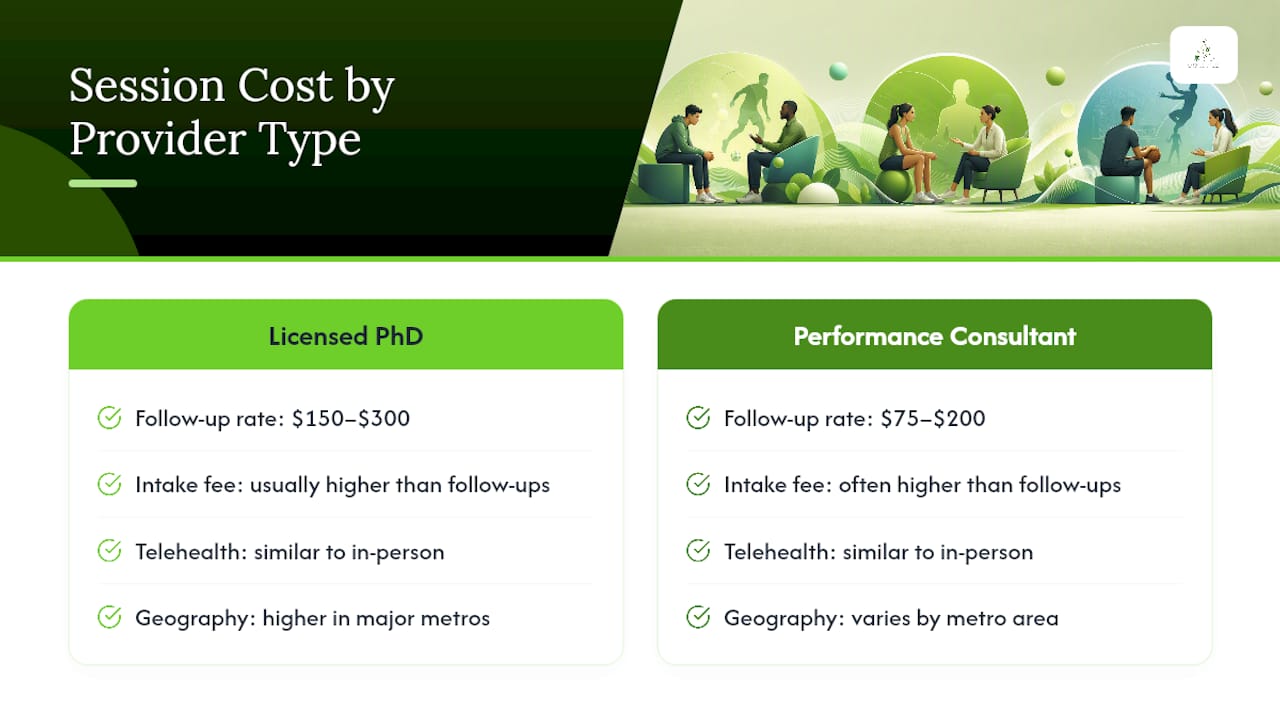
Telehealth pricing generally aligns closely with in-person rates, occasionally slightly lower due to reduced overhead. Geography affects pricing, with providers in major metro areas charging more, reflecting local market dynamics and cost of living.
Team workshops and group sessions are usually priced as a flat fee. Single team sessions of 60 to 90 minutes typically start in the lower hundreds and increase depending on factors like team size, travel requirements, and inclusion of written materials. Smaller youth club teams sometimes negotiate per-athlete pricing to lower individual costs, which can raise total fees if rosters are large.

Package pricing is where real savings show up. Providers who bundle five or ten sessions often knock 10 to 20% off the per-session rate compared to paying one at a time, a pattern visible across several practice fee pages. Good value here means checking two things: whether the package requires payment upfront (some do, as a retainer) and whether unused sessions expire. A package that saves you $40 per session but forces a use-it-or-lose-it clause within 90 days may not actually be the better deal for an athlete training on an irregular schedule.
What Drives the Price Difference Between Providers?
A $150 session and a $300 session for the same 50 minutes aren't automatically different in quality. They're usually different in scope, and knowing why helps you figure out what you're actually paying for.
- Credentials and license type: A PhD or PsyD with state licensure (LP) can treat anxiety disorders, trauma, and depression as clinical conditions. A CMPC or unlicensed coach sticks to performance skills like visualization, routine-building, and focus training. Clinical scope justifies a higher rate.
- Experience with elite or professional athletes: Providers who've worked with Olympic programs, D1 athletic departments, or pro franchises often set fees closer to the top of the range, reflecting both demand and specialized experience noted in AASP's compensation data across settings.
- Local market and cost of living: Providers near major college athletic programs or professional franchises tend to charge more, simply because demand is higher and their overhead reflects a pricier metro area.
- Session length and added assessment: A standard 50 minute talk session costs less than a 90 minute session that includes performance testing, written reports, or device-guided protocols like QEEG brain mapping.
- Insurance billing capability: Providers who accept insurance carry more administrative overhead, which sometimes shows up as a slightly higher self-pay rate even for patients who don't use insurance.
The Bureau of Labor Statistics groups sports psychologists under its broader "Psychologists, All Other" category, and the median pay reported there helps explain why doctoral-level clinicians consistently price higher than master's-level consultants: they're compensated for a wider scope of practice, not just more years in school.
Pro Tip: Ask upfront whether the quoted rate includes a written summary or just verbal feedback. Assessment reports and progress notes often carry a separate fee that isn't mentioned until the invoice arrives.
Sports Psychology Services and Their Price Ranges
Matching your actual need to the right service type keeps you from either underpaying for something you need clinical help with, or overpaying for basic mental skills coaching.
- Mental skills coaching / performance consulting. Sessions run 50 to 60 minutes and focus on routines, self-talk, and pre-competition mindset. Expect $75 to $250 per session, with most consultants offering multi-session packages.
- Clinical therapy for athletes. When anxiety, depression, or trauma is part of the picture, only a licensed psychologist can legally provide psychotherapy. This is also the only category where insurance sometimes applies, since it requires a diagnosable condition. Expect $150 to $300 per session self-pay, less with insurance coverage.
- Multi-week performance intensives. Structured 8 to 10 week programs bundle assessment, weekly sessions, and homework protocols into one price. These programs shift cost toward an upfront package rather than a per-visit fee, and they typically run into the low thousands total depending on scope.
- Team workshops. A single session for a full roster typically starts at $300 to $325 flat, with higher fees for multi-day retreats, pre-season programs, or workshops that include a written report for coaching staff.
- Add-ons: QEEG scans, neurofeedback, and in-home devices. Brain mapping and device-guided protocols add real cost, often several hundred dollars beyond the base session fee, because they require specialized equipment and interpretation time.
The difference between performance coaching and clinical therapy matters more than most athletes realize when they're comparing quotes. Two providers charging wildly different rates might simply be offering two different services entirely.
Using Insurance, HSA/FSA, and Sliding Scale Options
Insurance coverage for sports psychology is narrower than most people expect. Coverage generally requires a licensed clinician and a diagnosable mental health condition, meaning performance-only work like pre-game visualization coaching almost never qualifies. If an athlete is dealing with performance anxiety severe enough to meet clinical criteria, insurance becomes a real option; ask the provider for a "superbill" you can submit for out-of-network reimbursement even if they don't bill directly.
HSA and FSA funds generally cover licensed mental health treatment, so keep every receipt and ask the provider for an itemized invoice showing their license type and CPT code.
For athletes on a tighter budget, three routes bring costs down meaningfully:
- University training clinics, where graduate students work under licensed supervision at reduced rates
- Sliding-scale private practices, common in college towns and larger metros
- Athlete assistance programs run through some university athletic departments or national governing bodies
Packages and retainers change the math too. A team signing a season-long retainer often locks in a lower effective per-session rate than booking one-off workshops, but read the cancellation and no-show policy closely. Many practices charge full price for missed sessions with less than 24 hours' notice.
Pro Tip: Before paying for a package upfront, ask what happens if the athlete gets injured or the season ends early. Some practices prorate refunds; many do not.
How to Find and Compare Sports Psychology Providers
Price alone tells you almost nothing about fit. The better filter is credentials plus method plus what happens if the first few sessions don't click.
- Start with real referral channels. The AASP provider directory, your athletic department, or your team's athletic trainer are more reliable than a general web search.
- Ask about credentials directly. Confirm whether you're speaking with a licensed psychologist (PhD/PsyD, LP) or a CMPC-credentialed consultant, and ask which one fits your actual need.
- Get the full fee structure before booking. Ask about session length, cancellation policy, package terms, and whether written reports or assessments cost extra.
- Watch for red flags. Avoid anyone who guarantees a performance outcome, won't disclose their license status, or adds fees mid-package that weren't in the original quote.
- Weigh evidence-based methods over price alone. A cheaper provider using outdated or unproven techniques costs you more in wasted time than a slightly pricier one using documented mental performance methods.
Pro Tip: Ask any provider what a typical treatment timeline looks like for someone with your specific issue. A vague answer is a bigger red flag than a high price tag.
How Roberts Neurotraining Prices Its Programs
Performance Neuro Training, led by Dr. Paige Roberts, takes a different approach than talk-based coaching or standard clinical sessions. The method, called Alpha Imprinting, works directly with the nervous system to clear the performance anxiety and trauma responses that block flow states, rather than relying purely on cognitive strategies.
Pricing reflects the program structure: single sessions exist, but most clients start with either the 10-week Energy Optimization Program or a team workshop, both of which bundle assessment, QEEG-guided protocols, and in-home device work into a single package rather than an open-ended series of hourly sessions.
Bundling assessment, device-guided homework, and clinician time into one program shifts more of the cost into upfront evaluation and tools, and less into an endless string of per-session fees.
Clients get a clear intake process before committing to a program, so the scope and cost are known upfront rather than discovered invoice by invoice.
What This Pricing Data Actually Tells Athletes
Most pricing guides treat sports psychology fees like a menu. They aren't. The wide range between $75 and $300 per session isn't noise, it's a signal about scope, and too many athletes shop for the lowest number without asking what that number buys.
Here's what the conventional advice gets wrong: it tells you to compare rates. You should compare what actually resolves the problem with the benefits of sports performance coaching for athletes. An athlete dealing with a genuine trauma response from a past injury isn't well served by a $75 mental skills session focused on visualization drills, no matter how affordable it looks. That's a mismatch, not a bargain.
If you're budgeting for this kind of support, prioritize matching the service to the actual block you're trying to clear, then let credentials and format determine the price you should expect to pay. A nervous-system-based approach that resolves a fear response in ten weeks can cost less overall than a year of $150 sessions that manage symptoms without addressing the root cause.
— Paige
Ready to Get Real Pricing for Your Situation
If you've been comparing hourly rates and still can't tell what you'd actually be paying for, that's the exact gap Roberts Neurotraining was built to close. Instead of open-ended per-session billing, you get a defined intake and a program built around your specific block, whether that's post-injury anxiety, a performance plateau, or a trauma response that talk-based sessions haven't resolved.
Athletes recovering from injury or carrying performance anxiety from past setbacks are the best fit for this approach, along with teams looking for a structured group protocol rather than a one-off pep talk. Every engagement starts with a free consult where Dr. Roberts walks through the intake process and lays out program options, including the Alpha Imprinting protocol and the self-guided Energy Optimization Workbook for athletes who want a lower-cost starting point before committing to a full program. Pricing is laid out clearly before you commit to anything. Book a consult to find out which option fits your situation and budget.
Sources
- Bureau of Labor Statistics — Occupational Employment and Wages, May 2023: Psychologists, All Other
- FAQ - Dr. Jon Fledzinskas - Clinical and Sport Psychologist